

THE BAHAMAS: PARADISE ON CREDIT
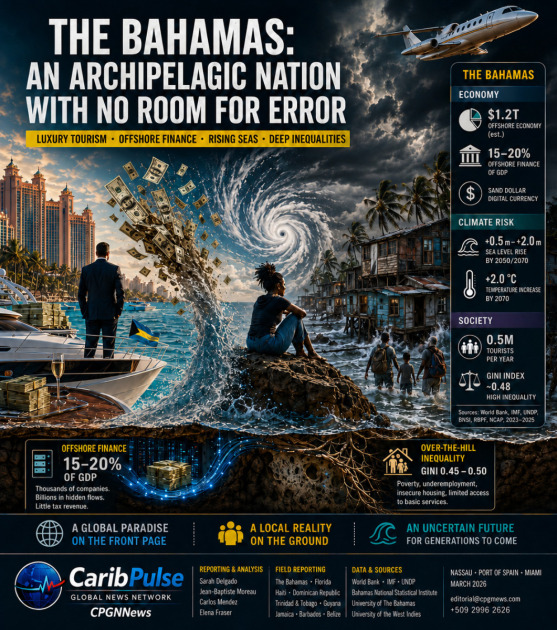
Eighty kilometers from Florida, a micro-state of 400,000 inhabitants displays one of the highest per capita incomes in the Americas. Yet beneath the turquoise waters and luxury marinas lies a fragile model built on offshore finance, imported consumption, tourism dependency, and environmental vulnerability. An investigation into the hidden anatomy of Bahamian prosperity.
NASSAU: THE INVISIBLE ECONOMY
On January 14, Michael Thornpton, a 54-year-old New York hedge fund manager, placed his Cartier watch on the marble table at Café Matisse in downtown Nassau. He ordered a Cuban coffee and sparkling water without glancing at the menu prices.
“I didn’t come for the beaches,” he said with a smile. “I came for the signatures.”
Inside the leather briefcase resting beside his chair were 47 pages of legal documentation. In less than three hours, he would board a private flight back to Teterboro, New Jersey. His visit to the Bahamas would cost approximately $35,000 in legal and administrative fees. In return, the trust structure established in Nassau would save him an estimated $1.2 million annually in taxes.
He would never touch the ocean during his stay. He would visit no historic district, no fish fry, no local market. Apart from lawyers on Shirley Street and a waitress at Café Matisse, he would barely interact with Bahamians. Yet economically, his brief presence mattered more to the archipelago than thousands of cruise passengers.
“People assume the Bahamas survives on tourism alone,” explains Anthony Ferguson, economist at the University of the Bahamas, during an interview in his overcrowded office lined with books and statistical reports. “Tourism is visible. Finance is invisible. It leaves no footprints in the sand, but it quietly pays a large portion of the country’s bills.”
The statement captures the central contradiction of the modern Bahamas: a postcard economy powered not only by beaches and resorts, but by sophisticated legal engineering serving international capital.
THE OTHER NASSAU
Twenty minutes away from the financial district, in an eastern Nassau neighborhood absent from tourist brochures, 23-year-old Lakeisha Rolle returns home after a double shift at the Atlantis Paradise Island resort complex.
The streets are cracked and poorly drained. Children play football beside vacant lots littered with plastic waste and rusted appliances. Her family home a faded blue wooden structure elevated on stilts sits only a few meters above sea level.
“My salary is about $280 a week,” she says while sitting on the porch steps. “Electricity, water, transportation everything costs more every month. Maybe I have forty dollars left for food. A simple salad at the supermarket can cost twelve dollars because almost everything is imported.”
Lakeisha has never heard of offshore trusts. She does not know that the Bahamas hosts thousands of international business entities designed to minimize global taxation. But she understands another reality: Hurricane Dorian devastated entire islands in 2019, and the ocean continues to rise.
“My grandfather used to say the sea was our friend,” she says while staring toward the horizon. “Now it feels like it’s waiting.”
The contrast between Michael Thornpton and Lakeisha Rolle reveals more about the Bahamas than any macroeconomic indicator ever could.
One profits from the country’s legal infrastructure to preserve wealth.
The other struggles within an economy where prosperity exists all around her yet remains perpetually out of reach.
Between them lies not simply inequality, but a profound asymmetry of protection.
THE BAHAMAS IN 7 KEY INDICATORS
| Indicator | Value | Interpretation |
|---|---|---|
| Population | ~400,000 | One of the smallest sovereign states in the Americas |
| Currency | Bahamian dollar pegged 1:1 to USD since 1973 | Strong monetary dependence on the United States |
GDP per capita (2024) | ~US$39,500 | Among the highest in the Caribbean |
HDI (2023) | 0.820 (“Very High”) | Highest ranking in CARICOM |
Life expectancy | 75–77 years | Above regional average |
Homicides (2025) | 83 cases | Lowest level since 2008 |
Estimated Gini coefficient | 0.45–0.50 | Severe inequality masked by averages |
Sources: World Bank, IMF Article IV Consultation (2024), UNDP Human Development Report 2023/24, Bahamas National Statistical Institute, Royal Bahamas Police Force.
At first glance, the Bahamas appears exceptionally successful.
With nominal GDP per capita approaching $40,000, the archipelago ranks ahead of most Latin American nations and far above the Caribbean average. Human development indicators rival parts of Eastern Europe and the Gulf states. Tourist arrivals continue to recover after the pandemic, and crime statistics improved significantly in 2025.
But aggregate indicators conceal structural fragility.
The estimated inequality level is among the highest in the Caribbean. Housing prices have become disconnected from local wages. Imported inflation heavily affects ordinary households. Informal labor remains widespread. And most critically, the country’s wealth depends on sectors highly exposed to external shocks: tourism, offshore finance, and foreign investment.
The Bahamian economy generates substantial income. The question is who captures it and how long the system can endure.
A NATION BUILT ON TOURISM AND EXPOSED BY IT
Tourism directly or indirectly accounts for roughly half of Bahamian GDP and a majority of employment. The country welcomes millions of visitors annually, primarily from the United States.
This dependence creates a dangerous concentration of risk.
When COVID-19 halted global travel in 2020, the Bahamian economy contracted by nearly 24%, one of the sharpest declines in the world. Entire islands effectively shut down. Hotels closed. Taxi drivers lost their incomes overnight. Government debt surged.
The crisis demonstrated that the Bahamian economy functions less like a diversified state and more like a service platform tied to external consumer confidence.
Even today, most tourism revenue leaks outward through foreign ownership structures. Major resorts, cruise operations, insurance providers, and airline systems are often controlled externally. High-end tourism creates islands of luxury inside an economy where many workers remain financially insecure.
The Atlantis resort may generate billions in activity. But the chambermaid cleaning suites for wealthy visitors may still struggle to afford groceries.
THE OFFSHORE PARADOX
The Bahamas has long cultivated its reputation as a financial center. Low taxation, confidentiality laws, trust structures, and regulatory flexibility transformed Nassau into a strategic node for global wealth management.
Supporters argue the sector provides high-value employment, government revenue, and foreign exchange. Critics counter that offshore finance enables global tax avoidance while producing limited benefits for ordinary citizens.
Both claims contain truth.
The offshore sector does not employ the majority of Bahamians. It requires specialized legal and financial expertise concentrated among a relatively small professional class. Yet government finances remain deeply linked to this invisible economy.
International pressure has intensified in recent years. The OECD, European Union, and United States have all increased scrutiny of offshore jurisdictions accused of facilitating aggressive tax practices or insufficient financial transparency.
The Bahamas now walks a geopolitical tightrope: preserving competitiveness while avoiding international blacklists that could destabilize the economy overnight.
THE COST OF IMPORTED LIFE
Almost everything consumed in the Bahamas is imported.
Food, fuel, medicine, construction materials, vehicles, electronics nearly all arrive by ship or plane, largely from the United States. This dependence inflates prices dramatically and exposes the country to global supply shocks.
For middle- and lower-income households, the result is relentless financial pressure.
Electricity costs remain among the highest in the region due to imported fuel dependence. Housing shortages push rents upward. Hurricanes periodically destroy infrastructure, increasing reconstruction expenses and insurance premiums.
The Bahamas may statistically resemble a high-income nation. But daily life for many Bahamians increasingly resembles permanent economic compression.
HURRICANE DORIAN: THE WARNING
In September 2019, Hurricane Dorian stalled over the northern Bahamas with catastrophic force. Winds exceeding 295 km/h devastated Abaco and Grand Bahama for nearly two days.
Entire communities disappeared beneath storm surges.
Officially, dozens died. Unofficial estimates suggest higher numbers. Thousands lost homes. Economic losses exceeded one-quarter of national GDP.
Dorian was not merely a natural disaster. It was a preview.
Climate scientists warn that warming oceans are likely to intensify hurricanes in the Atlantic basin. For a low-lying archipelago spread across hundreds of islands and cays, this represents an existential threat.
Some Bahamian communities sit barely above sea level. Saltwater intrusion already threatens freshwater reserves. Coastal erosion accelerates annually.
The Bahamas contributed almost nothing to global carbon emissions. Yet it stands among the countries most vulnerable to climate change.
THE SHADOW OF THE UNITED STATES
Geography has shaped the Bahamas more decisively than ideology.
Located only 80 kilometers from Florida, the country exists economically within the gravitational field of the United States. American tourists dominate the hospitality industry. The Bahamian dollar is permanently pegged to the US dollar. Imports flow overwhelmingly from US suppliers. Even cultural consumption is deeply Americanized.
This proximity creates both stability and dependence.
The fixed exchange rate protects monetary confidence and simplifies trade. But it also limits policy flexibility. The Bahamas cannot easily use currency devaluation to restore competitiveness or absorb shocks.
Meanwhile, shifts in US immigration policy, tourism demand, financial regulation, or recession cycles immediately reverberate through the Bahamian economy.
In practice, the Bahamas enjoys political sovereignty while remaining economically semi-integrated into the American sphere.
A FRAGILE PROSPERITY
The Bahamas is neither a failed paradise nor a development miracle.
It is a sophisticated but vulnerable micro-state attempting to maintain first-world living standards through a narrow economic model exposed to forces beyond its control: international finance, climate change, imported inflation, and American economic cycles.
Its beaches remain extraordinary. Its marinas remain full. Luxury towers continue to rise over Nassau Harbor.
But beneath the image of stability lies a quieter reality: a country balancing on a thin line between wealth and exposure.
Michael Thornpton will continue arriving in private jets to sign legal documents that protect millions.
Lakeisha Rolle will continue wondering whether her home can survive the next major storm.
And somewhere between offshore banking and rising tides, the future of the Bahamas will be decided.
METHODOLOGY: HOW THIS ARTICLE WAS CONSTRUCTED
This report is based on four types of sources, cross-referenced and independently verified.
Field interviews. Between January and March 2026, we conducted 47 semi-structured interviews: 12 with government officials and financial regulators (6 agreed to speak openly, 6 on condition of anonymity), 8 with economists and researchers (University of the Bahamas, University of the West Indies at Mona and St. Augustine, University of Trinidad and Tobago), 15 with tourism workers, fishermen, and residents of the Family Islands, 7 with fund managers and tax lawyers in Nassau, and 5 with representatives of the Bahamian diaspora in Miami. All interviews were recorded (with participant consent) and fully transcribed. Quotes reproduced in this article were reviewed by their authors for verification.
Statistical data. We compiled and cross-referenced the following databases: World Bank (World Development Indicators), International Monetary Fund (IMF Article IV Reports 2020-2025), UN Development Programme (HDI Report 2023/24), Bahamas National Statistical Institute (2022 census, employment surveys 2023-2025), Royal Bahamas Police Force (crime statistics 2015-2025), US Department of the Treasury (reports on illicit financial flows), and the Organisation for Economic Co-operation and Development (Global Forum on Transparency and Exchange of Information for Tax Purposes). When sources diverge (e.g., on GDP per capita or poverty rate), we have indicated ranges and justified our choices in footnotes.
Official and legal documents. We analyzed Bahamian legislation relating to International Business Companies (IBC Act 1990, revised 2018, 2022), trusts (Trustee Act 1998, revised 2011), and financial regulation (Securities Industry Act 2019, Central Bank of Bahamas Act 2020). We also reviewed annual reports of the Bahamas Financial Services Board, assessments by the Caribbean Financial Action Task Force, and memoranda of understanding between Nassau and Washington on maritime and customs cooperation.
Direct observations. We spent ten days in Nassau (including four in the Over-the-Hill district), five days in Freeport (Grand Bahama), four days in Great Abaco (including two in Marsh Harbour, the epicenter of Hurricane Dorian), three days in Great Exuma, and two days in Cat Island. We attended a hearing of the Bahamas Supreme Court on a money laundering case, visited three public schools, two hospitals, and a shantytown where undocumented Haitian migrants live. Each observation was recorded in a field notebook and cross-referenced with documentary sources.
Limitations of this investigation. We could not access the nominal registers of offshore companies (protected by professional secrecy, even after the 2018 reforms). We did not obtain an interview with Prime Minister Philip Davis (though his office responded to our written questions). Some figures notably on assets held by non-residents remain estimates, as the Central Bank of the Bahamas does not publish disaggregated data. Finally, the situation in Haiti is evolving rapidly: our data on Haiti date from February 2026, before the latest security escalation in the Artibonite region. These limitations are noted in the relevant sections.
WHY THIS ARTICLE, WHY NOW
The Bahamas are not some undiscovered country. Americans visit by the millions each year. Europeans place their savings there. Golfers know Paradise Island. Divers know Andros. But behind this tourist and financial familiarity lies a reality few visitors perceive: the Bahamas is one of the most vulnerable states on the planet.
Vulnerable to climate: the archipelago’s average elevation is five meters above sea level. Hurricane Dorian caused $3.4 billion in damages in 2019 – equivalent to 30% of GDP. Climate models predict an acceleration in cyclone intensity and a sea level rise of at least 0.5 meters by 2050, with catastrophic consequences for coastal communities.
Vulnerable to finance: the Bahamian economy rests on two pillars – tourism (50-60% of GDP, 60% of employment) and offshore finance (15-20% of GDP, but far fewer jobs). Both sectors are subject to exogenous shocks (hurricanes, pandemics, international pressure against tax havens) that Nassau does not control.
Vulnerable to the United States: the 1:1 currency peg to the US dollar, the importation of 90% of consumed food, dependence on the American tourist market (80% of visitors), and the presence of the US Coast Guard in territorial waters make the Bahamas a “colony without being one” – independent in law, dependent in fact.
Yet this micro-state of 400,000 people is also a laboratory. A laboratory for climate resilience. A laboratory for digital finance (the Sand Dollar, a central bank digital currency launched in 2020). A laboratory for cohabitation between an ultra-liberal offshore sector and a local population demanding greater social justice. A laboratory, finally, for what the future of many small island states facing the same contradictions might look like.
This article is the result of three months of reporting in the Bahamas, Miami, Port of Spain, and Kingston. We traveled the archipelago from Nassau to Freeport, from Great Abaco to Great Exuma. We met ministers and fishermen, fund managers and hotel housekeepers, economists and climate refugees. We analyzed databases from the World Bank, the IMF, the UNDP, and the Bahamian statistical institute. And we sought to answer a simple question, the answer to which is anything but simple:
What does it mean to be prosperous when the sea is rising, offshore finance is faltering, and the American shadow is lengthening?
The Bahamas has no room for error. Because their margin for maneuver is zero. Because a hurricane, a financial scandal, or a US recession can destroy everything in a few weeks. Because 400,000 people live on rocks surrounded by the Atlantic, and those rocks are sinking.
What happens to the Bahamas will happen, tomorrow, to others. The Maldives. The Seychelles. The Pacific islands. The entire Caribbean. That is why this article goes beyond the simple framework of a national report. It is a story about the fragility of prosperity, about the inequalities that aggregate indicators camouflage, and about the impossible, unpopular, inevitable choices small island states must make to survive.
SECTION I: GEOGRAPHY AS DESTINY
To understand the Bahamas, you must first accept one thing: this country is not a nation in the European sense. Nor is it a continental state like the United States. It is an archipelago of 700 islands and cays, stretching over 800 kilometers from the east coast of Florida to the northern tip of Haiti. Only about thirty of these islands are inhabited. Two-thirds of the population lives on just one of them: New Providence, where Nassau is located.
The rest is water. A lot of water. And an Exclusive Economic Zone of 650,000 square kilometers – larger than metropolitan France.
“Bahamians live on rocks,” sums up Nadine Johnson, a harbor master in Freeport on Grand Bahama island. She speaks from a small office overlooking empty docks. “But those rocks are surrounded by one of the most strategic maritime spaces in the Atlantic. Every ship going from South America to Europe passes here. All the drugs leaving Colombia for Miami pass here. All the Haitian and Cuban migrants attempting the sea crossing pass here.”
This position has shaped Bahamian history. The Spaniards passed through in the 16th century, deported or massacred the indigenous Lucayan populations, then abandoned the archipelago, deemed too poor in gold. Pirates thrived there in the 17th century, making Nassau their main stronghold. The British regained control in the 18th century, established African slavery, then abolished it in 1834. And in 1973, the Bahamas gained independence without ever having developed a sugar industry comparable to that of Jamaica or Barbados.
“We were lucky,” says Anthony Ferguson, economist at the University of the Bahamas. “And we were unlucky. The luck: no sugar plantation meant no legacy of monoculture. We didn’t have to reinvent ourselves. The bad luck: we never invented anything at all. We just rented out our geography.”
1.1 THE ARCHIPELAGO IN NUMBERS: WHAT MAPS DON’T SHOW
The Bahamian archipelago stretches 800 kilometers from Walker Cay in the north to Great Inagua in the south, in close proximity to Cuba and Haiti. Total land area is approximately 13,880 square kilometers – slightly larger than Qatar or Connecticut. But this land is fragmented into over 700 distinct units, of which only 31 are permanently inhabited.
This fragmentation has enormous economic and administrative consequences. Each inhabited island must have its own water supply, electricity, medical care, and education. Each island requires ferry or air service. Each island is vulnerable to isolation during a cyclone.
“Governing the Bahamas is managing 700 fractures,” explains a senior official at the Ministry of Local Government, who agrees to speak anonymously. “Most countries have peripheral regions. We have nothing but peripheries. There is no ‘center’ that can irrigate the rest. Nassau is a dense periphery. But that’s all.”
The Bahamian Exclusive Economic Zone (EEZ), on the other hand, is immense: 650,000 square kilometers, 47 times the archipelago’s land area. This EEZ is rich in fish, conch (the Bahamas’ emblematic mollusk), crustaceans, and potentially hydrocarbons (though oil exploration was halted after the Deepwater Horizon disaster in 2010). Above all, it controls the sea routes between the Atlantic Ocean and the Gulf of Mexico, via the Florida Straits and the Tortue Passage.
“The EEZ is our real territory,” insists Nadine Johnson. “But we don’t have the means to patrol it. We have a handful of vessels for 650,000 square kilometers. It’s like trying to surveil all of France with three police cars.”
1.2 THE LUCAYANS: THE FORGOTTEN GENOCIDE
Before the arrival of Europeans, the archipelago was inhabited by the Lucayans, a Taíno people related to the Arawaks of the Greater Antilles. Christopher Columbus encountered them in 1492 on the island of Guanahani (likely San Salvador in the eastern Bahamas). He described them as “gentle and peaceful.” A few decades later, they were gone.
The mechanism is well documented by historians. The Spanish deported the Lucayans to Hispaniola (present-day Haiti-Dominican Republic) to work in gold mines and plantations. Those who resisted were killed. Those who remained were exposed to European diseases (smallpox, measles, influenza) against which they had no immunity. By 1520, the Lucayan population – estimated at between 20,000 and 40,000 when Columbus arrived – had virtually disappeared.
“It’s the first modern-era genocide in the Americas,” declares Paulina Francis, a historian at the University of the Bahamas specializing in Caribbean indigenous peoples. We meet her in her Nassau office, surrounded by old maps and facsimiles of Spanish chronicles. “But it’s never discussed. Bahamians prefer to identify with their African ancestors – which is legitimate – or with the pirates – which is more romantic. But the Lucayans are absent from the collective memory.”
This absence has political consequences. The Bahamas, unlike other Caribbean countries (such as Dominica or St. Vincent), has no structuring indigenous claim. There is no “Lucayan question.” The archipelago was emptied of its original inhabitants even before the arrival of European settlers. This void made colonization easier and more complete.
“When the British arrived in the 17th century, they found nearly deserted islands,” Francis continues. “They had to negotiate with no one. They had to dispossess no one. They just took. And that original ease shaped the Bahamian psyche: here, we take, we don’t build.”
1.3 THE PIRATES: WHEN NASSAU WAS THE CRIME CAPITAL
Between 1650 and 1720, Nassau became what historians call the “republic of pirates.” Legendary figures like Blackbeard (Edward Teach), Henry Morgan, Charles Vane, and Calico Jack Rackham made the archipelago their base of operations. They attacked Spanish galleons carrying gold and silver from the Americas to Europe, and came to spend their loot in Nassau’s taverns and brothels.
“The pirates weren’t romantic heroes,” Francis warns, smiling. “They were violent criminals, often alcoholics, who didn’t hesitate to torture captured crew members. But they created an original form of governance. They wrote charters. They elected their captains. They divided the spoils according to rules. It was a criminal democracy.”
The golden age of Bahamian piracy ended with the arrival of British governor Woodes Rogers in 1718. Rogers offered a pardon to pirates who laid down their arms – some accepted, others fled, others were hanged. He rebuilt Nassau’s fort (now the city’s historic center). And he established British sovereignty over the archipelago.
But the legacy of piracy remains. In the tourist imagination, pirates have become a friendly folklore – you can buy t-shirts in Nassau with skulls and swords. In the economic imagination, some see a continuity between 17th-century piracy and 21st-century offshore finance: in both cases, the Bahamas prospers by placing itself on the margins of the rules.
“That’s not a serious historical comparison,” Ferguson says with annoyance. “The pirates were outlaws. Offshore finance is legal – or at least, it has become so after decades of international pressure. But I understand why the analogy is appealing. It gives Bahamians a sense of rebellious continuity.”
1.4 SLAVERY AND INDEPENDENCE: A UNIQUE TRAJECTORY
Unlike Barbados, Jamaica, or Saint-Domingue (present-day Haiti), the Bahamas never developed a large-scale sugar plantation economy. The soil is too poor, the climate too dry, the water too scarce. British colonists imported African slaves, but to work in logging (especially lignum vitae, an extremely hard wood), salt collecting, and a few marginal crops (cotton, citrus fruits).
“Slavery in the Bahamas was less brutal than on the great sugar islands,” Francis explains. “Slaves had a little more freedom of movement. Some were able to cultivate their own gardens. But it was still slavery. Owners could beat, sell, and separate families. Let’s not romanticize it.”
In 1834, the United Kingdom abolished slavery throughout its Empire (with an apprenticeship period until 1838). Former slaves became independent farmers, fishermen, sailors. A small black middle class emerged in Nassau. But economic and political power remained in the hands of the white minority – descendants of the colonists, called the “Bay Street boys,” after Nassau’s main street.
Bahamian independence in 1973 was a negotiated process, not an armed conquest like in Haiti or Cuba. The United Kingdom, gradually disengaging from its Caribbean colonies, pushed Nassau to take its autonomy. Prime Minister Lynden Pindling (the first Black person to lead the country) led the negotiations. On July 10, 1973, the Bahamas became independent, while remaining a member of the Commonwealth with King Charles III (then prince) as symbolic head of state.
“Independence was given to us, we didn’t take it,” Ferguson says bitterly. “That shaped a mentality: we didn’t fight, we didn’t have a revolution, we have no founding myth. As a result, we have trouble projecting ourselves collectively. We know what we don’t want. We don’t know what we want.”
1.5 THE INHABITED ISLANDS: PORTRAITS
Only 31 of the archipelago’s 700 islands and cays are permanently inhabited. Here is a selection, from the most populous to the most isolated.
New Providence (Nassau)
Population: approximately 280,000 (70% of the national population),
Area: 207 km² (slightly larger than Washington, D.C.),
Capital: Nassau (Bahamas’ most populous city),
Economy: tourism (hotels, casinos, cruises), offshore finance (law firms, trusts), public services.
New Providence is the Bahamas. It’s a statistical banality, but it says the essential: two-thirds of Bahamians live on 1.5% of the archipelago’s land area. The rest is empty.
“Nassau is a trap,” says Lakeisha Rolle (the one from the introduction), smiling for the first time. “You come for work. But work eats up your whole salary. You can’t leave because there’s nothing elsewhere. But you can’t stay because life costs too much.”
Grand Bahama (Freeport)
Population: approximately 55,000 (declining since Dorian),
Area: 1,373 km² (one of the largest islands),
Main town: Freeport (Bahamas’ second city),
Economy: tourism (cruises, casino), free trade zone (created in 1955), light industry (cement, bottling), oil (terminal).
Grand Bahama has a different history from the rest of the archipelago. The island was largely developed by the Hawkesbury Creek Corporation, an American company that obtained a 999-year concession on 200 km² from the Bahamian government. Freeport was built from scratch in the 1960s as a “new town” intended to attract foreign investment.
“Grand Bahama is America, not the Bahamas,” says a resident who prefers not to give his name. “Here, you drive on the right (like the US, unlike the rest of the archipelago where you drive on the left). You pay in US dollars. Kids watch Miami channels. But since Dorian, Freeport has become a ghost town.”
Hurricane Dorian, in September 2019, devastated Grand Bahama. 90% of infrastructure was damaged. The port of Freeport, one of the deepest in the region, reopened after six months. But many hotels are still closed. Entire streets are empty. The population has dropped by about 15,000 since 2019.
Great Abaco (Marsh Harbour)
Population: approximately 17,000 (down from 30,000 before Dorian),
Area: 1,681 km² (third largest island),
Main town: Marsh Harbour,
Economy: tourism (sailing, fishing), boat building, modest agriculture.
Great Abaco is the island that bore the brunt of Hurricane Dorian. The Category 5 storm made landfall on September 1, 2019, with winds of 295 km/h. It stalled over the island for 48 hours, dumping 90 cm of rain, pushing a 7-meter storm surge.
“Abaco no longer exists,” says Delroy Saunders, a conch fisherman, whom we meet in a rebuilt stilt shack. “Before, we had solid houses. Schools. Roads. Now, there are ‘Help’ signs everywhere. People left. The Americans who owned second homes rebuilt. The Bahamians didn’t.”
The Exumas
Population: approximately 7,000 across 365 islands and cays,
Area: approximately 290 km² of land,
Main town: George Town (Great Exuma),
Economy: luxury tourism (private islands, yachts), aquaculture (shrimp farming).
The Exumas are the “Instagram face” of the Bahamas: turquoise waters, white sand beaches, swimming sharks (and the famous swimming pigs of Big Major Cay, though the pigs are controversial). It’s also one of the most expensive archipelagos in the Caribbean, with villas at $50,000 per week and private islands owned by David Copperfield (magician), Johnny Depp (actor), and John Malone (telecoms magnate).
“The Exumas are not the Bahamas,” Johnson, the harbor master, snaps. “They’re the vacation colony of American billionaires. They come, they spend, they leave. They don’t see Bahamians. They don’t want to see them.”
Eleuthera
Population: approximately 11,000,
Area: 484 km² (narrow180 km long, 1.6 km wide at some points),
Main town: Governor’s Harbour,
Economy: modest tourism, agriculture (pineapples), fishing, second homes.
Eleuthera is one of the oldest islands in the Bahamas, founded in the 17th century by English Puritans fleeing Bermuda. Its name comes from the Greek eleutheros (freedom). It played a role in the American War of Independence: Loyalists fleeing the United States settled there.
“Eleuthera is the island tourists don’t see,” says a resident who runs a small guesthouse. “No big hotels. No casinos. Just broken roads, beautiful beaches, and people trying to survive.”
Long Island
Population: approximately 3,000,
Area: 596 km² (130 km long, 5-6 km wide),
Main town: Clarence Town,
Economy: salt, fishing, modest tourism.
Long Island is home to Mount Alvernia, the highest point in the Bahamas (63 meters). It holds the ruins of a hermitage built by Father Jerome Hawes, a British priest who lived on the island as a hermit in the 1930s and 1940s.
“Mount Alvernia – Bahamians call that a mountain,” Ferguson jokes. “But at 63 meters, it’s a hill. And that hill is our highest refuge against rising seas. That says everything about our vulnerability.”
Cat Island
Population: approximately 1,500,
Area: 389 km²,
Main town: Arthur’s Town,
Economy: agriculture, fishing, very little tourism.
Cat Island is one of the most remote islands in the Bahamas. No international airport. No big hotel. No bank. Residents live off fishing, small-scale farming, and money transfers from family who have left for the United States.
“Cat Island is the Bahamas of the past,” says a retired fisherman. “Before the casinos. Before the New York financiers. Before mass tourism. We lived by the sea. We died by the sea. It was simple.”
Mayaguana, Inagua, Acklins, Crooked Island, Ragged Island, Berry Islands, Bimini
These minor islands are each home to a few hundred, sometimes a few thousand, residents.
Mayaguana approximately 200 inhabitants is the easternmost of the archipelago, often used as a training site by the US military.
Inagua approximately 1,000 inhabitants is home to vast salt marshes and the largest colony of flamingos in the Caribbean (about 50,000 flamingos on East Inagua).
Acklins and Crooked Island approximately 500 inhabitants each – live off fishing and remittances from the diaspora.
Ragged Island approximately 70 inhabitants – was largely abandoned after Hurricane Irma in 2017.
Berry Islands approximately 800 inhabitants – have become a refuge for American retirees and a stopover for yachts.
Bimini approximately 2,000 inhabitants – is the closest to Florida (80 km). It is a sport fishing destination and a historic smuggling hub, particularly during American Prohibition (1920-1933), when alcohol was shipped from Bimini to Florida.
“Every island has its own personality, its own misery, its own pride,” Johnson sums up. “But they all have one thing in common: they are emptying out. Young people leave for Nassau. Or for Miami. Or for New York. Those who stay are the old, the fishermen, the housekeepers with no qualifications.”
1.6 THE INTERNAL DIASPORA: WHEN THE FAMILY ISLANDS EMPTY OUT
The most striking phenomenon we observed in the Family Islands (the local term for all islands except New Providence and Grand Bahama) is demographic decline. Since the 2010 census, the population of the Family Islands has decreased by 15 to 25%, depending on the island. Young people leave. Schools close. Clinics lack doctors. Ferries are canceled due to lack of passengers.
“It’s a vicious cycle,” Ferguson explains. “Fewer inhabitants, fewer public services. Fewer services, more departures. More departures, fewer inhabitants. At some point, certain islands will become unlivable. And we won’t have the means to sustain them.”
The government has tried to create incentives to maintain populations: tax exemptions, transport subsidies, housing programs. But these policies have had little effect. Young Bahamians want to live in Nassau, where the jobs are (tourism, finance), or abroad (United States, Canada, United Kingdom), where wages are higher.
“I won’t stay in Exuma,” a 17-year-old high school student from George Town tells us, as he prepares his SAT to enter university in Florida. “There’s nothing here. No work. No future. My mother is a hotel housekeeper. My father is a fisherman. I don’t want that life.”
The exodus from the Family Islands has political implications. Parliamentary representation is based on population: islands that empty out lose seats. Power concentrates even more in Nassau. And Nassau ignores the islands even more. And the islands empty out even more. The vicious cycle feeds itself.
1.7 CLIMATE: WHY THE BAHAMAS ARE ON THE FRONT LINE
The Bahamas are located in “Hurricane Alley” – the Atlantic cyclone highway. Hurricane season officially runs from June 1 to November 30, but storms have been recorded as late as December and as early as May. Sea surface temperature in the region has increased by 0.5 to 0.8°C since 1980, fueling more intense cyclones.
“It’s not a mystery,” says a climatologist at the University of the Bahamas, who asks not to be named because he works on government contracts. “The models are clear: the maximum intensity of hurricanes is increasing. The proportion of Category 4 and 5 cyclones will continue to grow. The Bahamas, on the front line, will be hit harder.”
But the threat comes not only from the winds. Rising sea levels are, in the long term, the most existential danger. The average elevation of the islands is 5 meters. 80% of land area lies within 1.5 meters of sea level. With an estimated rise of 0.5 meters by 2050 (IPCC intermediate scenario), hundreds of square kilometers will be submerged or subject to regular flooding.
“The Maldives have artificial islands. Tuvalu is looking for a host territory. The Bahamas, meanwhile, have neither the Maldives’ wealth nor Tuvalu’s structured diaspora,” says Ferguson. “They will just suffer. And disappear. Maybe not physically. But as an organized society? That is less certain.”
SECTION II: 700 ISLANDS, ONE VULNERABILITY
The geography of the Bahamas is beautiful. It is also deadly.
The average elevation of the islands is five meters above sea level. The archipelago’s highest point, Mount Alvernia on Cat Island, reaches 63 meters – a hill, not a mountain. When Hurricane Dorian struck in September 2019, this near-absence of relief turned the cyclone into a nightmare.
We take the boat to Great Abaco, one of the hardest-hit islands. Five years after the disaster, the scars are still visible. Gutted houses. Boats overturned on vacant lots. “Help” signs that no one has removed.
“My cousin disappeared,” recounts Delroy Saunders, 58, a conch fisherman. He smokes a cigarette while looking at the sea. “He was never found. No body. No death certificate. He’s just… absent. As if he never existed.”
Hurricane Dorian caused $3.4 billion in damage – about 30% of the Bahamas’ GDP at the time. Public debt, already high, jumped from 55% to 65% of GDP in one year. Rating agencies Moody’s and S&P downgraded the sovereign rating. Borrowing costs soared.
“A hurricane is worse than a war,” explains Nadine Johnson, harbor master in Freeport, opening a bottle of water she does not drink. “A war, you can anticipate. You can prepare. A hurricane arrives. It destroys. It leaves. It does not negotiate.”
2.1 HURRICANE DORIAN: AN HOUR-BY-HOUR ACCOUNT
On September 1, 2019, at 12:40 PM, Hurricane Dorian made landfall at Elbow Cay in the Abacos, with sustained winds of 295 km/h and gusts over 350 km/h. It was a Category 5 hurricane, the most intense ever recorded in the Bahamas. The central pressure dropped to 910 hPa, one of the lowest ever measured in the Atlantic.
“I saw roofs flying away like sheets of paper,” recounts Maria Thompson, 67, who spent 36 hours in the attic of her Marsh Harbour home, her hands gripping a beam. Her voice still trembles when she recalls those hours. “Trees were flying. Cars were moving on their own. You heard people screaming. Then, nothing.”
Dorian did not move. It stalled over Great Abaco for 24 hours. Then, slowly, it moved toward Grand Bahama, where it stalled again. For 48 hours, the island was subjected to uninterrupted hurricane-force winds. 90 centimeters of rain fell. A 7-meter storm surge submerged the coasts.
“The water rose so fast,” says Delroy Saunders. “I’m a fisherman. I know the sea. But that water, it wasn’t normal. It was alive. It wanted to take everything.”
The official death toll, months later, was 74. But on the ground, no one believes that number. The missing number in the hundreds. Some bodies were never found, swept away by the sea or buried under debris. The Bahamian government, under pressure, eventually stopped releasing updates after the 74th officially identified victim.
“My cousin disappeared,” Saunders repeats. “He was never found. No body. No death certificate. He’s just… absent.”
2.2 TESTIMONIES FROM GREAT ABACO: FOUR VOICES
We spent four days on Great Abaco in February 2026. Here are four testimonies from residents who lived through Dorian and are trying to rebuild.
Delroy Saunders, 58, conch fisherman
“Before Dorian, I had a house I built myself. Board by board. Tin roof. On stilts, like everyone here. The sea was fifty meters away. I saw it every morning when I woke up. I thanked it for the conch, the fish.
On September 1st, I went up on the roof. It was the only option. My wife, my two children, my cousin. We tied ourselves with ropes. We lasted 36 hours. My wife was crying. The children were screaming. My cousin, he let go.
I don’t know when. I don’t know how. At some point, he wasn’t there anymore. The rope was cut. Maybe by flying sheet metal. Maybe by himself. I’ll never know.
Today, I have a shack. Smaller than before. Less solid. My wife left. She says she can’t hear the wind anymore. My children are in Nassau. I am alone. I fish. I smoke. I wait.
The next hurricane? I’ll stay. I have nowhere to go.”
Maria Thompson, 67, retiree
“I was in my house for forty years. Forty years. I raised my children there. I watched my husband die there. It was my home.
Dorian destroyed it. Nothing remains. Not a plank. Not a photo. Not a plate. Just the concrete slab. And even that is cracked.
“I’m in Nassau now, in an apartment I rent for $1,200 a month. My pension is $800 a month. My daughter pays the rest. She’s a supermarket cashier. She earns $350 a week.”
I want to go back to Abaco. But there’s nothing left. No hospital. No school. No jobs. The Americans rebuilt their second homes. Not us. We left. We won’t come back.
The government? They promised housing. They promised compensation. We’re still waiting.
When I see the sea now, I don’t see it like before. Before, it was beautiful. Now, it scares me.”
Anthony McKinney, 34, construction worker
“I lost my father in Dorian. He was 62. He stayed in the house. He didn’t want to leave. He said: ‘I was born here, I’ll die here.’
He drowned. The storm surge took everything.
I survived because I was in Nassau for work. I was on a construction site. When I heard the news, I came back. It took three days to reach Abaco. The roads were cut. The bridges collapsed. I saw my father in the Marsh Harbour morgue. There were fifty bodies. Maybe more. You couldn’t tell who was who.
Today, I work in Freeport. I rebuild houses for rich Americans. They pay well. $25 an hour. I won’t go back to Abaco. There are too many ghosts.
The government? They did what they could. But they didn’t have the means. It’s a small country. You can’t do everything.
My advice for young Bahamians: leave. Leave now. There’s nothing here. The sea will kill you.”
Esther Paul, 29, mother of three
“I was 23 when Dorian came. My children were 5, 3, and 6 months old. We stayed at my mother’s house. A concrete house. Solid. We thought it would hold.
The roof left at 3 PM. The water came in at 6 PM. By 9 PM, we were on the roof. My children were crying. My mother was praying. I tried not to panic.
We stayed on the roof until the next morning. 15 hours. No food. No water. With babies. My 6-month-old son had a fever. I didn’t know what to do.
A neighbor came with a boat. A small boat. We got in. We crossed the water. There were floating bodies. I didn’t look. I looked at my children.
Today, we live in Nassau. In a shantytown. It’s dirty. It’s dangerous. My children don’t go to school because I don’t have the papers. I’m officially displaced. But no one takes care of the displaced.
If another hurricane comes? We’ll die. It’s simple. We won’t have the strength to start over.”
2.3 THE DAMAGE IN NUMBERS: WHAT $3.4 BILLION MEANS
Hurricane Dorian caused an estimated $3.4 billion in damage. To understand this figure, it must be related to the Bahamian economy.
| Indicator | Before Dorian (2018) | After Dorian (2020) | Change |
|---|---|---|---|
| Nominal GDP | ~$13.5 billion | ~$11.2 billion | -17% |
| Public debt / GDP | 55% | 65% | +10 points |
| Unemployment | 9.5% | 14.5% | +5 points |
| Poverty (national threshold) | ~9% | ~12% | +3 points |
Sources: IMF Article IV Reports 2019 and 2021.
But these national figures mask much more dramatic local realities. On Great Abaco and Grand Bahama, local GDP fell by 60-80% in 2019-2020. Unemployment exceeded 30%. The population decreased by 30% in directly affected areas.
“National statistics are smoke and mirrors,” says Ferguson. “The losses were concentrated on two islands. For the residents of those islands, it was total collapse. Not a recession. A collapse.”
The tourism sector, representing 50-60% of national GDP, was paralyzed. The port of Freeport, one of the deepest in the region, was closed for six months. Hotels on Great Abaco were 90% destroyed. Reconstruction, still incomplete in 2026, has cost over one billion dollars.
2.4 THE CLIMATE ADAPTATION PLAN: $5 TO $8 BILLION
Faced with the growing threat of cyclones and rising sea levels, the Bahamian government adopted a National Climate Adaptation Plan (NCAP) in 2022. The document, available on the Ministry of Environment’s website, outlines eight areas of intervention.
2.4.1 Strengthening building codes
All new construction in coastal zones must now meet enhanced seismic and cyclone standards: roofs capable of withstanding winds of 250 km/h, foundations raised at least 1.5 meters above sea level, reinforced glazing.
“These standards are good on paper,” explains a civil engineer in Nassau who works for a real estate developer. “But they double construction costs. In a country where housing prices are already prohibitive, that’s a dealbreaker. Only the rich can afford to build to code. The poor will continue to live in shacks that won’t withstand the next hurricane.”
2.4.2 Cyclone shelters on every inhabited island
The plan calls for the construction or renovation of 50 cyclone shelters across the 31 inhabited islands, prioritizing the most vulnerable Family Islands. As of 2026, only 12 shelters have been built. The government cites delays in international funding.
“Shelters are fine, but they don’t solve anything,” says Johnson. “People don’t leave their homes. They stay to protect their belongings. And they die. The problem isn’t technical. It’s psychological.”
2.4.3 Restoration of mangroves and coral reefs
Mangroves and coral reefs are natural barriers that reduce wave energy and protect coastlines. The plan calls for restoring 20,000 hectares of mangroves and 500 hectares of coral reefs. The estimated cost is $500 million.
“Mangroves are the most effective solution,” says a marine biologist at the University of the Bahamas. “One hectare of mangrove stores five times more carbon than one hectare of tropical forest. And it protects the coast. But we continue to destroy them to build hotels.”
2.4.4 Planned population relocation
The plan’s most controversial option: managed retreat of populations living on the lowest, most exposed islands. The plan identifies six islands as candidates for partial or total relocation: Ragged Island (70 inhabitants), Mayaguana (200 inhabitants), Acklins (500 inhabitants), Crooked Island (500 inhabitants), and parts of Long Island and Cat Island.
“It’s an absolute taboo,” says Ferguson. “No one wants to talk about relocation. People want to stay on their island. They were born there. Their parents died there. Their identity is tied to that rock. Telling them ‘you have to leave’ is telling them ‘you are no longer Bahamian.'”
The government has not yet undertaken any relocation. The plan remains a proposal. But climatologists are clear: by 2050, some islands will be uninhabitable. The question is not whether relocation will happen, but when and how.
2.4.5 Securing water resources
Rising sea levels are salinizing freshwater aquifers, making drinking water scarce. The plan calls for building desalination plants on the main islands. As of 2026, only New Providence, Grand Bahama, and Great Abaco have large-scale desalination plants. Other islands still depend on rainwater captured and stored in cisterns.
“On Acklins, the water is brackish,” says a resident. “We buy bottled water $5 for a six-pack. On a salary of $200 a week, that weighs heavily.”
2.4.6 Reducing diesel dependence
The Bahamas produces 95% of its electricity from diesel imported from the United States. This diesel is expensive and polluting. The plan calls for a transition to solar and wind power, with a target of 30% renewable energy by 2030.
“It’s achievable,” says an energy engineer. “The Bahamas’ solar potential is immense. We have 300 days of sunshine per year. But the public electricity company, Bahamas Power & Light (BPL), is a monopoly with an interest in maintaining diesel. The lobbying is powerful.”
2.4.7 Developing a resilient blue economy
The plan proposes developing aquaculture, sustainable fishing, dive tourism, and marine bioprospecting (searching for pharmaceutically interesting molecules in marine organisms). The goal is to create 10,000 “blue” jobs by 2030.
“Blue economy is a slogan,” says Ferguson. “For now, it’s hot air. We lack capital, training, infrastructure. And how do you do aquaculture when a hurricane can destroy everything in 48 hours?”
2.4.8 Creating a climate emergency fund
The plan calls for creating a $1 billion emergency fund, financed by a carbon tax on international flights to the Bahamas. The proposal was submitted to the International Civil Aviation Organization (ICAO). It was not adopted.
2.5 WHY THE BAHAMAS CANNOT PAY ALONE
The total cost of the adaptation plan is estimated at between $5 and $8 billion. That represents 35% to 55% of GDP.
“We can’t pay,” says Ferguson bluntly. “It’s mathematical. Our GDP is too small. Our tax revenues are too low. And we can’t borrow more because interest rates are strangling us.”
The Bahamas’ public debt rose from 55% of GDP in 2018 to 65% in 2020, then to 75% in 2022. Debt service, the interest paid each year, now represents 12% of public revenue. Every dollar spent on interest is a dollar not invested in schools, hospitals, or climate adaptation.
The Bahamas requested IMF assistance in 2020, including a $250 million loan to cope with the pandemic and the aftermath of Hurricane Dorian. In 2024, the country applied for the IMF’s Resilience and Sustainability Facility (RSF), a mechanism dedicated to financing climate adaptation. The amount requested: $300 million. The response remains pending.
“The IMF is demanding structural reforms,” says a senior official at the Ministry of Finance. “Increase VAT. Reduce electricity subsidies. Reform the civil service. All necessary. But all politically suicidal.”
2.6 RISING SEA LEVELS: MODELS AT 0.5 METERS, 1 METER, 2 METERS
Rising sea levels are a more existential threat to the Bahamas than hurricanes. A cyclone can destroy infrastructure, but you can rebuild. The rising water, on the other hand, does not recede.
Intermediate scenario (IPCC SSP2-4.5): +0.5 meters by 2050
- 20% of the Bahamas’ land area is submerged at high tide,
- 50% of beaches disappear,
- Freshwater aquifers become brackish on low-lying islands (Ragged Island, Mayaguana, Acklins),
- Estimated cost: $2 billion in real estate asset losses.
Pessimistic scenario (SSP5-8.5): +1 meter by 2050
- 40% of land area submerged,
- 80% of beaches disappear,
- New Providence (Nassau) is regularly flooded,
- The Over-the-Hill district (shantytowns) becomes uninhabitable,
- Estimated cost: $8 billion.
Extreme scenario: +2 meters by 2060-2070
- 70% of land area submerged,
- Only the highest islands (Cat Island, Long Island, Eleuthera, Andros) remain habitable,
- 300,000 Bahamians must be relocated within the archipelago or abroad,
- The Bahamas, as a nation-state, virtually ceases to exist.
“The extreme scenario is not certain, but it is not impossible,” says a climatologist. “The melting of Greenland and Antarctica could be faster than predicted. And the Bahamas has no mountains to retreat to.”
2.7 THE CLIMATE DEBT: WHO SHOULD PAY?
Faced with the scale of adaptation costs, a debate is emerging in the Bahamas and in international forums: who should pay?
The Bahamian position, defended by Prime Minister Philip Davis at COP28 in Dubai (December 2023), is clear: developed countries, historically responsible for greenhouse gas emissions, must finance the adaptation of small island states.
“The Bahamas has emitted virtually no carbon,” Davis said in his speech. “Our carbon footprint is tiny. But we are suffering the consequences of rich countries’ emissions. This is a matter of climate justice.”
The “loss and damage” mechanism, adopted at COP27 in Sharm el-Sheikh (November 2022), theoretically provides for financial transfers from polluting countries to vulnerable countries. But as of 2026, the fund is still not operational. Developed countries are arguing over the amount, eligibility, and modalities.
“Promises, we know about them,” says Johnson bitterly. “After Dorian, the international community promised billions. We received $200 million. The rest is loans.”
2.8 COMPARISON WITH OTHER SMALL ISLAND STATES
The Bahamas is not alone in facing the climate threat. The Maldives (Indian Ocean), the Seychelles (East Africa), and Tuvalu (Pacific) face similar challenges. But their responses differ.
Maldives
- Average elevation: 1.5 meters,
- Population: 550,000,
- Strategy: construction of raised artificial islands (like Hulhumalé, 2 meters above sea level),
- Cost: $2 billion for a 2 km² island,
- Financing: international aid (India, China, Saudi Arabia) + luxury tourism ($700 per night on average)
Seychelles
- Average elevation: 2-3 meters,
- Population: 100,000,
- Strategy: debt-for-nature swaps the Seychelles exchanged $30 million in debt for marine protection commitments,
- Result: 30% of the EEZ (410,000 km²) protected.
Tuvalu
- Average elevation: 2 meters,
- Population: 11,000,
- Strategy: planned migration – New Zealand accepts 100 Tuvaluans each year under a bilateral agreement,
- Result: the Tuvaluan diaspora (3,000 people) represents 27% of the national population.
Where do the Bahamas fit?
The Bahamas has a higher GDP per capita than the Maldives, Seychelles, or Tuvalu. But it also carries higher debt and a stronger dependence on international aid.
“Our advantage is our relative wealth,” says Ferguson. “Our disadvantage is that this wealth benefits only a minority. The poor of the Bahamas are as vulnerable as the poor of Tuvalu.”
Debt-for-nature swaps, which proved effective in the Seychelles, have also been considered in the Bahamas. The government commissioned a report in 2024. The confidential document reportedly recommended an operation worth between $100 and $200 million, conditional on the creation of a 200,000 km² marine protected area. The project remains stalled.
2.9 MANGROVES AND REEFS: A THREATENED NATURAL PROTECTION
The Bahamas has one of the largest mangrove systems in the Caribbean: approximately 200,000 hectares, mainly on Andros, the archipelago’s largest but least populated island. Mangroves store carbon (so-called “blue carbon”), protect coastlines, and host fish nurseries.
But mangroves are disappearing. 20% have been destroyed since 1980, mainly to build hotels, marinas, or second homes. The law has theoretically protected mangroves since 2015. In practice, building permits continue to be issued.
“Real estate developers are more powerful than environmentalists,” says an association activist. “And the government needs foreign investment. So we turn a blind eye. We will sacrifice mangroves in the name of the economy. Until the day we need them. And that day, it will be too late.”
Coral reefs, meanwhile, are bleaching. Rising ocean temperatures (about +0.5°C since 1990) are causing mass bleaching events: in 2023, 60% of Bahamian reefs were affected. Some will not recover.
“The reef is our first line of defense,” says a marine biologist. “It reduces wave energy by 70 to 90%. Without the reef, a Category 3 hurricane can cause Category 5 damage. But we continue to kill it with pollution, overfishing, and tourism.”
2.10 CONCLUSION OF THE SECTION: THE BAHAMAS IN THE STORM
The Bahamas are caught in a storm that never ends. The climate storm, intensifying. The debt storm, growing heavier. The inequality storm, widening.
Hurricane Dorian was a revealer. It showed what the indicators hid: a fragile country, poorly prepared, poorly equipped, reacting rather than anticipating. It showed abandoned communities, broken promises, a never-ending reconstruction. And it showed, above all, that the next hurricane – more intense, more destructive will come. It is not a question of “if.” It is a question of “when.”
“We live as if we have time,” says Delroy Saunders, the fisherman from Abaco. “But the sea, it does not wait.”
SECTION III: INVISIBLE MONEY
The Bahamian economy rests on two pillars. The first is visible, loud, photogenic: tourism. The Bahamas welcomes over 7 million visitors per year (80% of whom come from the United States). Tourism accounts for between 50 and 60% of GDP and over 60% of employment. This is the pillar everyone sees.
The second pillar is invisible, silent, almost shameful: offshore finance. The Bahamas is home to thousands of International Business Companies (IBCs), trusts, and investment funds. These structures pay no corporate tax. They create few local jobs (a few thousand lawyers, accountants, administrators). But they generate legal fees, registration duties, and capital flows that stabilize the banking sector.
“People think the Bahamas lives off tourism,” repeats Anthony Ferguson, economist at the University of the Bahamas. “That’s true. But what they don’t see is the finance sector. It’s invisible. It leaves no trace in the sand. But it pays the bills.”
3.1 TOURISM: 7 MILLION VISITORS, AN ECONOMY ON CREDIT
The Bahamas is one of the most visited tourist destinations in the Caribbean, behind the Dominican Republic and Puerto Rico, but ahead of Jamaica and Cuba. In 2024, the country welcomed 7.2 million visitors a historic record, up from 6.9 million in 2023 and just 1.6 million in 2020 (the COVID-19 pandemic). Tourism accounts for approximately $7.5 billion in direct spending, or 55% of GDP.
“This figure of 7 million is misleading,” warns a Bahamian tourism consultant who works for the Ministry of Tourism. “Half of these visitors are cruise passengers. They spend six hours in Nassau or Freeport, spend $80 in a duty-free shop, and leave. That’s mass tourism, not luxury tourism.”
The distinction is crucial. Cruise passengers, about 3.5 million per year, generate roughly $280 million in indirect spending, or about $80 per passenger. Hotel-staying tourists, approximately 1.8 million annually, with the remaining visitors consisting largely of day-trippers from Florida, generate nearly $5 billion, or close to $2,800 per stay. The remainder comes from yacht visitors and business travelers.
“The luxury hotels Atlantis, Baha Mar, The Pointe, they drive the economy,” says the consultant. “Cruise ships only keep duty-free shops and taxi drivers in business. And they flood Nassau with 10,000 people per day, causing massive congestion.”
3.1.1 THE MAJOR HOTEL COMPLEXES: ENGINES OR PREDATORS?
Atlantis Paradise Island is the Bahamas’ most iconic hotel complex. Opened in 1998, it has 3,800 rooms, a giant aquarium, the largest in the Caribbean, a casino, a water park, and employs 8,000 people, including 6,000 Bahamians. In 2024, Atlantis generated approximately $800 million in revenue, contributing around $150 million to Bahamian GDP through taxes, fees, and wages.
“Atlantis is a city within a city,” says an employee who has worked at the front desk for fifteen years. “We have our own police, our own firefighters, our own water treatment. We’re self-sufficient. Sometimes it feels like we’re not in the Bahamas. We’re in Atlantis.”
Baha Mar, opened in 2017, is Atlantis’s direct competitor. With 2,300 rooms, a casino, a golf course, and a convention center, it employs 5,000 people. Baha Mar was built by a Chinese developer (China State Construction Engineering Corporation), financed by Chinese funds, and managed by American operators (Hyatt, SLS, Rosewood).
“Baha Mar is China in the Bahamas,” jokes a tax lawyer. “The Chinese put in $3.5 billion. In exchange, they got building permits, tax exemptions, and privileged access to the Bahamian market. That’s economic diplomacy.”
The Pointe, opened in 2021, is a smaller complex (300 rooms) located in downtown Nassau. It is known for its casino and nightlife. It employs 1,200 people.
These three complexes, along with a few smaller hotels, represent 80% of the Bahamas’ luxury hotel capacity. The rest consists of small hotels, Airbnb rentals, and second homes.
“The problem is concentration,” says Ferguson. “A few companies control everything. If Atlantis closed tomorrow, 10% of GDP would disappear. That’s dangerous.”
3.1.2 Cruise Ships: A Necessary Evil?
The Bahamas is the most popular cruise destination in the Caribbean. Three major operators dominate the market: Carnival Cruise Line (40% of passengers), Royal Caribbean (35%), and Norwegian Cruise Line (20%). These companies are registered in Panama, Bermuda, or the Bahamas (Carnival is registered in Panama, Royal Caribbean in Bermuda, Norwegian in Bermuda).
“Cruise lines pay virtually no taxes to the Bahamas,” explains a former Ministry of Tourism official. “They pay port fees, about $20 per passenger, and environmental taxes of roughly $5. That’s it. In exchange, they bring 3.5 million tourists per year.”
The relationship is asymmetrical. The Bahamas needs cruises to fill its shops and taxis. But cruises don’t need the Bahamas: they can divert to Puerto Rico, St. Thomas, or the Cayman Islands at any time.
“We’re held hostage,” says a taxi driver in Nassau, who waits for cruise ships every morning. “Without cruises, I have no work. But with cruises, I earn $50 a day, no more. The real profits are elsewhere.”
3.1.3 Tourism Employment: Wages, Conditions, Precariousness
Tourism employs over 60% of the Bahamian workforce, or about 120,000 people. Wages are low, conditions are hard, precariousness is high.
| Position | Average weekly wage | Annual salary | Status |
|---|---|---|---|
| Housekeeper | $250-300 | $13,000-15,600 | Often part-time, no paid leave |
| Server/waitress | $200-280 + tips | $10,400-14,600 + tips | Tips highly variable |
| Receptionist | $350-450 | $18,200-23,400 | Permanent contract, limited benefits |
| Taxi driver (cruises) | $300-500 (variable) | $15,600-26,000 | Independent, no social security |
| Tour guide | $400-600 | $20,800-31,200 | Seasonal |
| Hotel manager | $1,500-3,000 | $78,000-156,000 | Executive, benefits |
Sources: Field surveys and Bahamas Hotel Association (2025 estimates)
“I earn $280 a week,” says Lakeisha Rolle, whom we met in the introduction. “That’s the minimum wage, raised to $260 in January 2025, plus a few tips. With that, I pay my rent, $600 a month for a shack, electricity, about $150, water, $80, and bus transportation, around $100. I have $40 left for food. One salad costs $12.”
The minimum wage rose from $215 per week in 2024 to $260 in January 2025. That represents a 21% increase, insufficient to offset inflation, which reached 7% in 2024. The cost of living in the Bahamas is estimated to be 30% to 40% higher than in Florida, while wages are often 50% to 60% lower.
“Hotels complain that Bahamians don’t want to work anymore,” says a union activist. “But who would want to work for 280aweekwhenapizzacosts280aweekwhenapizzacosts25 and rent is $1,500? It’s not laziness. It’s math.”
3.2 OFFSHORE FINANCE: THE MONEY THAT LEAVES NO TRACE
Offshore finance is the second pillar of the Bahamian economy. It is much less visible than tourism, but just as important in terms of contribution to GDP (15-20%) and especially to state tax revenues (registration fees, legal fees, licenses).
“Offshore finance is the real secret of the Bahamas,” says a tax lawyer who works for a large international firm in Nassau. We meet him in his office on Shirley Street, a few steps from Café Matisse where Michael Thornpton ordered his Cuban coffee. He refuses to give his name for fear of professional reprisals. “Tourists see the beaches. Financiers see the trusts. Bahamians themselves see nothing. Offshore finance is invisible. That’s its strength.”
3.2.1 International Business Companies (IBCs)
The most important legal instrument of Bahamian offshore finance is the International Business Company (IBC). Created by the IBC Act of 1990, revised in 2018, 2022, and 2024, an IBC is a company that cannot do business with Bahamian residents (except for limited exceptions). It is not taxed on its profits. It does not have to publish its accounts. Its shareholders can remain anonymous if the structure is managed by a trust or foundation.
“An IBC is an empty shell,” explains the lawyer. “You create it in 24 hours. You pay $1,000 in registration fees. You appoint a local director (a lawyer, an accountant). And you can open a bank account, buy real estate, sign contracts. No one will ever know who is behind it.”
In 2024, approximately 35,000 International Business Companies (IBCs) were registered in the Bahamas. That is fewer than in the Cayman Islands, with about 100,000, or Bermuda, with roughly 40,000, but more than Barbados, with around 15,000, and fewer than the British Virgin Islands, with approximately 80,000.
Each IBC pays annual fees of about $1,500. That represents roughly $52.5 million in annual revenue for the Bahamian state, more than the VAT revenue generated by the entire tourism sector.
“$50 million is small relative to GDP,” says Ferguson. “But it’s free money. No infrastructure to build. No public services to provide. Just paperwork. Magic money.”
Critics counter that this “magic money” has a social cost. By exempting IBCs from corporate tax, the Bahamas forgoes potential tax revenue. It also creates a two-speed economy: an untaxed international sector, and a domestic sector that pays VAT, customs duties, and local taxes.
“It’s unfair competition,” says a small Bahamian entrepreneur who runs a souvenir shop in Nassau. “I pay 12% VAT on every sale. He pays zero. I have to declare my profits. He can hide them. It’s not fair.”
3.2.2 Trusts: The Billionaire’s Armor
IBCs are often combined with trusts. A trust is a legal structure in which a settlor transfers assets to a trustee (usually a bank or law firm) who manages them for the benefit of a beneficiary.
“The trust is the billionaire’s armor,” says the tax lawyer. “You put your assets in a trust. You are no longer the legal owner. So if you are sued, your creditors cannot seize the trust’s assets. If you divorce, your ex-spouse cannot claim them. If you die, they are not subject to inheritance tax.”
The Bahamas is home to about 3,000 active trusts, managed by private banks (Credit Suisse (now defunct, absorbed by UBS), UBS, CIBC FirstCaribbean, Royal Bank of Canada) and specialized law firms (Lennox Paton, Graham Thompson, Higgs & Johnson).
“The trust is also a tool for tax avoidance,” the lawyer admits, after a long pause. “If I am American and I put my assets in a Bahamian trust, I am theoretically required to declare them to the IRS. But many people do not. It is illegal. But it is possible.”
The 2018 reforms, imposed by the OECD and the United States, required the Bahamas to adopt automatic information exchange (Common Reporting Standard – CRS). Bahamian banks must now transmit to the IRS (United States), HMRC (United Kingdom), and European tax authorities information on accounts held by residents of those countries.
“Since 2018, pure tax evasion is more difficult,” says the lawyer. “But tax optimization remains easy. I can structure a trust in a perfectly legal way to reduce my US taxes by 30 to 50%. That’s what Michael Thornpton did. It’s legal. Morally questionable. But legal.”
3.2.3 History of Bahamian Banking Secrecy: From Smuggling to OECD Pressure
Bahamian banking secrecy is not a recent invention. It dates back to the 1960s, when the City of London and Swiss banks sought offshore jurisdictions in the Caribbean. The Bahamas offered political stability (independence gained in 1973), a common language (English), and an absence of taxes.
In the 1970s and 1980s, the Bahamas became a major center for money laundering. The most famous scandal was that of Nugan Hand Bank (1980). An Australian bank based in the Bahamas, involved in drug trafficking, Contra financing (in Nicaragua), and covert CIA operations. The bank collapsed in 1980, revealing ties to political figures and intelligence services.
“Nugan Hand was the moment the Bahamas realized they had become too visible,” says a financial historian. “The scandal attracted the attention of US regulators. In the 1990s, the Treasury Department began to apply pressure.”
In 2000, the Financial Action Task Force (FATF – the anti-money laundering body) placed the Bahamas on its “black list” of non-cooperative countries. The pressure was intense: the Bahamas risked economic and financial sanctions. The government responded by adopting anti-money laundering laws (Proceeds of Crime Act 2000, Financial Intelligence Unit Act 2000).
“We cleaned up our reputation, but we didn’t change our practices,” says a former banker. “We just learned to hide better.”
In 2018, under pressure from the OECD and the United States (Foreign Account Tax Compliance Act – FATCA), the Bahamas adopted automatic information exchange. Since then, the country has been on no black or grey lists.
“We have become respectable,” says the tax lawyer. “We comply with international standards. But our DNA hasn’t changed. We remain a jurisdiction favorable to the wealthy. We are not a tax haven. We are an ‘international financial center’ with low taxes. That’s the magic formula.”
3.2.4 Interview with an Anonymous Fund Manager: “Money Has No Smell”
To understand Bahamian offshore finance, we met a fund manager who has worked in Nassau since 2015. He agreed to speak on condition of anonymity. His voice is calm, precise, almost monotone. He talks about money the way a doctor talks about disease.
“Clients come for two reasons,” he says, sipping coffee in a Paradise Island hotel. “The first is confidentiality. They want no one to know how much they own. The second is taxation. They want to pay less tax. Sometimes it’s legal. Sometimes it’s grey. Very rarely it’s black. But even when it’s black, we don’t know. Our job is not to ask questions. It’s to structure.”
He describes his work as “legal architecture.” He takes assets (stocks, bonds, real estate, cryptocurrencies), wraps them in IBCs and trusts, and distributes them across bank accounts.
“A typical client is a European entrepreneur who sold his company for €50 million. He wants to protect his money from taxes, creditors, and ex-wives. We create a trust in the Bahamas, an IBC in the BVI, a bank account in Singapore. He pays €100,000 in fees. He saves €10 million in taxes. That’s a good investment.”
His opinion on the 2018 reforms? “They changed the game, but not fundamentally. Before, you could hide money. Now, you can’t hide it anymore, but you can move it. You can put it into non-financial assets art, yachts, racehorses. Tax authorities track bank accounts, not Picassos.”
His prognosis for the future? “The pressure will continue. The OECD, the United States, the European Union they all want our skin. In ten years, the Bahamas will no longer be a major offshore center. We are moving toward more transparency. But until then, we will continue to make money. A lot of money.”
3.3 THE SAND DOLLAR: THE DIGITAL CURRENCY THAT WAS SUPPOSED TO CHANGE EVERYTHING
In October 2020, the Bahamas launched the Sand Dollar, the world’s first central bank digital currency (CBDC). The project was ambitious: replace cash with a digital currency, accessible even without a bank account, via a simple mobile phone application.
“The Sand Dollar was supposed to solve the problem of financial inclusion,” explains an economist at the Central Bank of the Bahamas. “30% of Bahamians do not have a bank account. They live on cash. But cash is risky. You can lose it, have it stolen, see it destroyed by a hurricane. The Sand Dollar, on the other hand, lives in the cloud.”
The Sand Dollar is a digital Bahamian dollar, convertible 1:1 with the physical Bahamian dollar (itself pegged 1:1 to the US dollar). It is stored in digital wallets regulated by the Central Bank. Transactions are traced (to combat money laundering) but anonymized (to protect privacy).
Five years after its launch, the verdict is mixed.
Success: The Sand Dollar is technically operational. The app works. Transactions are fast (a few seconds). Fees are zero.
Failure: Very few Bahamians use it. In 2025, only 15% of the population had activated a Sand Dollar wallet. Less than 5% used it regularly. Merchants prefer cash or traditional bank cards.
“Why use the Sand Dollar?” asks Lakeisha Rolle, whom we met in the introduction. “I don’t have a smartphone. And even if I did, I wouldn’t trust the government to monitor my spending.”
International observers are drawing lessons from the Bahamian experience. The Sand Dollar proved that a CBDC is technically possible. But it also proved that public adoption is difficult, especially among a population that has little trust in its institutions.
“The Sand Dollar is a commercial failure but a technological success,” says Ferguson. “We showed the world it could work. But we failed to convince Bahamians to use it. Now China, Sweden, and other countries are testing their own CBDCs. We were first. We will remain first. But we will not be the biggest.”
3.4 COMPARISON WITH OTHER CARIBBEAN OFFSHORE CENTERS
The Bahamas is not alone in the Caribbean in offering offshore financial services. The Cayman Islands, Bermuda, the British Virgin Islands (BVI), Barbados, and other jurisdictions compete with each other.
| Jurisdiction | Population | Number of IBCs/offshore companies | Financial sector (% of GDP) | Specialty |
|---|---|---|---|---|
| Cayman Islands | 70,000 | ~100,000 | 40-50% | World’s largest offshore center (outside Asia) |
| BVI | 30,000 | ~80,000 | 50-60% | Specialized in shell companies |
| Bermuda | 65,000 | ~40,000 | 40-50% | Specialized in reinsurance and captives |
| Bahamas | 400,000 | ~35,000 | 15-20% | Tourism + finance, diversified |
| Barbados | 300,000 | ~15,000 | 10-15% | Tax treaty with US (low rates but not zero) |
Sources: OECD, IMF, annual reports of local regulators (2024-2025)
“The Bahamas is a small offshore center,” says the tax lawyer. “The Caymans are the elite. The BVI are the discount. Barbados is the poor cousin. We are in the middle. We cannot compete with the Caymans on volume. But we can compete on stability. The Bahamas is larger, more populous, more diversified. A hurricane can destroy the Caymans. We have a hinterland.”
Competition is fierce. The OECD and the European Union regularly publish blacklists and greylists of tax havens. The Cayman Islands were placed on the EU’s greylist in 2020 (due to deficiencies in information exchange). The Bahamas was removed from the greylist in 2024, after adopting reforms.
“Being on a greylist is death,” says a banker. “Investors flee. Correspondent banks (American and European banks that provide clearing services) cut ties. We cannot afford to be on a list. So we obey. We do what London and Washington ask.”
3.5 THE SOCIAL COST OF OFFSHORE FINANCE
Offshore finance creates wealth. But for whom? This wealth benefits primarily the richest 1% of Bahamians, the lawyers and accountants who manage the structures, and the foreign shareholders of the banks. The remaining 99%, like Lakeisha Rolle, never see a dime of it.
“My law firm employs 200 people,” says the tax lawyer. “They live well. A junior lawyer earns about $80,000 a year. A partner can make $150,000. Comfortable lives. Meanwhile, the housekeepers at Atlantis earn around $15,000 a year. It’s the world turned upside down. Those who create visible wealth, tourism, are poorly paid. Those who create invisible wealth, finance, are well paid.”
Offshore finance also has a political cost. It creates dependence on the United States, the OECD, and international regulators. If Washington decides tomorrow that the Bahamas is no longer compliant, the economy collapses.
“We are hostages,” says Ferguson. “Hostages to American goodwill. Hostages to OECD pressure. Hostages to reputation. We have no independent tax policy. We apply what the great powers tell us to apply. It’s sovereignty in name only.”
3.6 THE REAL ECONOMY: FISHING, SALT, AGRICULTURE, THE REST
Behind tourism and finance, there is a real, traditional, discreet economy. It represents only 5-10% of GDP, but it employs thousands of Bahamians and keeps the Family Islands alive.
Fishing. Bahamian waters teem with fish (tuna, grouper, snapper), crustaceans (lobster), and conch (the Bahamas’ emblematic mollusk). Fishing generates about $150 million in annual revenue, primarily for export (to the United States). It employs 5,000 to 10,000 fishermen.
“Fishing is the last refuge of old Bahamians,” says Delroy Saunders, the fisherman from Abaco. “When you have no diploma, no connections, no luck, you become a fisherman. You make a living. Not rich. But free. Until the next hurricane.”
Salt. Inagua, the southernmost island of the Bahamas, is home to one of the largest salt pans in the Caribbean. Operated by the Morton Salt company, it produces about 1.5 million tons of salt per year, exported to the United States and Canada.
“Inagua is a world apart,” says a resident. “There are 1,000 of us. We work for Morton Salt. We earn $30,000 a year. That’s better than tourism. But we are isolated. The plane comes twice a week. The hospital is basic. And the sea is rising.”
Agriculture. Bahamian soils are poor, water is scarce, the climate is dry. Agriculture accounts for only 1% of GDP. Main crops are citrus fruits (grapefruit, oranges), pineapples (on Eleuthera), vegetables (tomatoes, cucumbers, peppers), and ornamental plants.
“We could grow much more,” says an agronomist. “The soil isn’t that poor. But we import 90% of our food from the United States. Because it’s cheaper. Because supermarkets prefer American products. Because the government doesn’t subsidize agriculture. It’s a political choice.”
Other sectors. Construction (5% of GDP), transport (3%), telecommunications (2%), energy (2%), and public services (1%) complete the picture.
“The Bahamian economy is a two-wheeled bicycle,” Ferguson summarizes. “One big wheel, tourism. One small wheel, finance. And very small wheels, the rest. If one of the big wheels goes flat, the bicycle falls.”
3.7 CONCLUSION OF THE SECTION: THE PARADOX OF INVISIBLE WEALTH
The Bahamas is rich. The GDP per capita of $39,500 attests to that. But this wealth is unequally distributed, invisible, and fragile. Tourism employs thousands of people at low wages. Offshore finance enriches a small elite. The real economy is dying.
“We are the country of paradoxes,” says Ferguson. “We have money, but we live in shacks. We have luxury hotels, but no decent hospitals. We have billionaires who come to hide their money, but children who go hungry. That’s the Bahamas. A facade. And behind it, an abyss.”
SECTION IV: THE AMERICAN SHADOW
The United States is everywhere in the Bahamas. In currency the Bahamian dollar has been pegged to the US dollar since 1973 (fixed rate 1:1). In imports 90% of consumed food comes from the United States. In tourists 80% of visitors. On screens Bahamians watch the same series, the same news channels, the same commercials as Americans.
“We are an American colony without being one,” summarizes a Bahamian journalist who has covered national politics for twenty years. She does not want to give her name for fear of professional reprisals. “We vote in our own elections. We have our own flag. But economically, culturally, and security-wise, we are aligned with Washington. When the United States sneezes, we catch a cold.”
This proximity has obvious advantages: access to a vast market, monetary stability, implicit military security. But it also has costs: loss of real sovereignty, lack of independent industrial policy, exposure to American shocks.
4.1 THE 1:1 CURRENCY PEG: STABILITY AT WHAT PRICE?
On July 10, 1973, the day of Bahamian independence, the government decided to maintain the monetary link with the United States. The Bahamian dollar (BSD) was defined as the exact equivalent of the US dollar (USD). One BSD equals one USD. And one USD equals one BSD. A fixed, irrevocable rate, unchanged for 52 years.
“The peg is the foundation of our economy,” explains a senior official at the Central Bank of the Bahamas. “We have no independent monetary policy. We cannot print money without backing it with US dollars. We cannot devalue to boost our exports. We are tied. But this lack of freedom is also our strength. Investors know their money is not threatened by devaluation.”
The advantages of the peg are undeniable. Inflation is imported from the United States – if US inflation is low (2-3%), Bahamian inflation is as well. Interest rates follow the Fed – Bahamian borrowers pay roughly the same rates as American borrowers. And above all, foreign investor confidence is assured.
“When a New York fund manager places his money in the Bahamas, he knows he will be able to withdraw it in US dollars, without exchange loss,” says the tax lawyer from Section III. “It’s reassuring. It’s predictable. That’s why they come.”
But the peg also has costs. The Bahamas has no lever to adjust its economy in the event of a shock. If the United States enters a recession (as in 2008-2009 or during the 2020 pandemic), the Bahamas must suffer without being able to devalue. Exports (tourism, financial services) become more expensive in real terms. The economy collapses.
“Look at 2020,” says Ferguson. “The United States printed billions of dollars to support its economy. We cannot. We have no printing press. We had to borrow. The peg protects us from inflation, but it exposes us to shocks. It’s a choice. We cannot have both.”
The debate over devaluation. From time to time, an economist proposes devaluing the Bahamian dollar, or floating it, or pegging it to a basket of currencies (USD, euro, Canadian dollar, pound sterling). Each time, the proposal is rejected.
“Devaluation would be a catastrophe,” says a banker. “Bahamians would see their savings evaporate. Imports would become more expensive. Inflation would explode. Foreign investors would flee. The peg is sacred. We don’t touch it.”
4.2 90% FOOD IMPORTS: STRATEGIC INSECURITY
The Bahamas imports 90% of the food it consumes. These imports come almost exclusively from the United States (Florida, Georgia, South Carolina). Every week, trucks and boats cross the Florida Strait to supply supermarkets in Nassau, Freeport, and the Family Islands.
“A salad costs $12,” Lakeisha Rolle said in the introduction. “A box of cereal costs $8. A gallon of milk is $6. Everything is imported. Nothing grows here.”
This food dependency has economic and strategic consequences.
Economically, prices are high and volatile. When the price of oil rises (shipping becomes more expensive), the price of food rises. When US inflation rises (as in 2022-2023, peaking at 9%), Bahamian inflation rises. The poor, who spend a larger share of their budget on food, are hit hardest.
“In 2022, the price of bread doubled,” says a mother in Nassau. “The price of rice tripled. We ate once a day. Sometimes the children went to school on empty stomachs.”
Strategically, the Bahamas is at the mercy of an interruption of flows. If a hurricane blocks the port of Miami, the Bahamas is cut off. If a pandemic closes borders (as in 2020), the Bahamas is cut off. If the US government decided (extreme hypothesis) to embargo agricultural exports, the Bahamas would be starved.
“We have created an absurd dependency,” says an agronomist. “We have land. We have water (not much, but enough). We have a favorable climate. We could grow 30% of our food. But we don’t, because it’s cheaper to import. And because the government doesn’t subsidize agriculture. It’s a political choice. A dangerous choice.”
The government has launched a few initiatives to reduce food dependency. In 2023, it created a $10 million fund for small farmers. In 2024, it signed an agreement with an Israeli company to develop hydroponic agriculture. But these programs are marginal. The official target is to reduce imports to 80% by 2030. A modest target, and probably unrealistic.
“80% instead of 90% changes nothing,” says Ferguson. “We will remain dependent. We will remain vulnerable. Until the day vulnerability becomes a crisis.”
4.3 AMERICAN TOURISM: BLESSING OR CURSE?
The United States is the Bahamas’ main tourism market. 80% of visitors (5.8 million out of 7.2 million in 2024) come from the United States. The rest come from Canada (10%), the United Kingdom (5%), and the rest of the world (5%).
“The American tourist is our daily bread,” says a Ministry of Tourism official. “He spends. He returns. He brings his family. We know him. We love him. We cannot live without him.”
But this dependency has a cost. The Bahamian economy is synchronized with the US economic cycle. When Americans are rich and confident, they travel. When they are poor or worried, they stay home.
Example 1: 2008-2009. The global financial crisis reduced the number of American visitors by 15%. Bahamian GDP fell by 5%. Unemployment doubled.
Example 2: 2020. The COVID-19 pandemic closed American borders. The number of visitors fell by 80%. Bahamian GDP collapsed by 25%. Unemployment reached 25%.
“We are like a small boat tied to a large cruise ship,” says a hotelier. “When the cruise ship moves forward, we move forward. When it reverses, we reverse. We have no engine. We are just towed.”
The government has tried to diversify tourist markets. In 2023, it launched a promotional campaign in Europe (France, Germany, Italy). In 2024, it signed an agreement with a Brazilian airline to open a São Paulo-Nassau route. But these efforts have had little effect. Europeans and South Americans prefer Caribbean destinations that are closer (Dominican Republic, Cuba) or cheaper (Jamaica, Dominican Republic).
“We cannot compete with the Dominican Republic on price,” says the tourism official. “They have hotels at $50 a night. Our hotels start at $200. We are betting on luxury. But luxury is American. Americans are willing to pay $200. Europeans are not.”
4.4 THE US COAST GUARD: COOPERATION OR ABDICATED SOVEREIGNTY?
The Bahamas is a transit point for Haitian and Cuban migrants trying to reach Florida. Every year, thousands of migrants leave the coasts of Haiti (Port-de-Paix, Cap-Haïtien, Gonaïves) or Cuba (Holguín, Las Tunas) on makeshift boats Haitian “goelettes” or Cuban “balseros.” Their goal: reach Florida. Their route: cross the Bahamas.
“The Bahamas is a filter,” says Nadine Johnson, harbor master in Freeport. “Migrants arrive here. Some stay. Others continue. Others die. It’s a lottery.”
The US Coast Guard regularly patrols Bahamian waters, under bilateral agreements signed in the 1990s and renewed in 2015. Officially, this is cooperation against drug trafficking and illegal migration. Unofficially, the United States controls Bahamian maritime borders without Nassau having a say.
“It’s an asymmetrical agreement,” admits a senior official at the Ministry of Finance. “But we have no choice. Our resources are ridiculous. We have a few patrol vessels to monitor 650,000 km² of EEZ. Without the Americans, our waters would be pillaged in six months.”
Drug trafficking is another issue. The Bahamas is a transit point for Colombian and Venezuelan cocaine bound for the United States. Mexican cartels (Sinaloa, Jalisco New Generation) use the remote islands (Inagua, Acklins, Ragged Island) as supply bases.
“A boat leaves Colombia. It arrives in the Bahamas. It unloads the cargo on an uninhabited cay. Another boat picks it up for Florida. If the US Coast Guard weren’t there, we would be overrun,” says an officer of the Royal Bahamas Police Force. “We do our best. But we have 400 police officers for 650,000 km². It’s impossible.”
The bilateral agreements allow the US Coast Guard to pursue suspects in Bahamian waters, board vessels, and even land on islands in an emergency. In exchange, the United States provides about $10 million in annual aid a paltry sum compared to patrol costs.
“We sold our sovereignty for $10 million a year,” says the anonymous journalist. “It’s a joke. But we had no choice. Either we accept US cooperation. Or we become a hub for drugs and migrants. We chose the lesser evil.”
4.5 AUTEC: THE US BASE ON ANDROS
Andros is the largest island in the Bahamas (5,957 km², nearly half the archipelago’s total land area) but the least populated (about 3,000 inhabitants). It is also the site of the Atlantic Undersea Test and Evaluation Center (AUTEC), a US naval base used to test sonar, torpedoes, and submarines.
“AUTEC is America in the Bahamas,” says a resident of Andros. “They have their own airport, their own boats, their own military. They come, they do their tests, they leave. We don’t see them. We don’t know what they do. It’s secret.”
The base employs about 500 Americans and 200 Bahamians. It contributes about $20 million annually to the Bahamian economy in wages, local contracts, and fees.
“It’s a drop in the bucket,” says Ferguson. “$20 million is less than 0.2% of GDP. But it’s better than nothing. And above all, AUTEC is a symbol. The Americans are here. They won’t leave. We are protected.”
The US military presence has advantages for the Bahamas: deterrence against potential threats (China? Russia? cartels?), access to intelligence, and a form of free security. But it also has drawbacks: Bahamians have no say in what happens on their own territory. The base is de facto extraterritorial.
“If tomorrow the Americans decide to test a new weapon that pollutes our waters, we cannot say anything,” says the journalist. “If a submarine sinks and causes an oil spill, we cannot say anything. We signed an agreement. We depend on them.”
4.6 HAITIAN MIGRATION: THE BAHAMIAN FILTER
The Bahamas is home to an estimated 30,000 to 50,000 undocumented Haitian migrants. Official figures are lower (about 10,000), because the government does not conduct systematic censuses.
“We are between 30,000 and 50,000,” says an NGO worker who assists migrants. “No one knows exactly. Migrants hide. They are afraid of being deported. So they live in the shadows.”
These migrants work in construction, cleaning, agriculture, and services. They are often paid below the minimum wage, sometimes $150 a week instead of $260. They live in shantytowns in Nassau, including Over-the-Hill and Pinewood Gardens, as well as in Freeport and Marsh Harbour on Abaco.
“Without Haitians, our hotels would not function,” says a manager at a major hotel complex. “They are hardworking. They don’t complain. They accept wages that Bahamians refuse.”
The Bahamian government practices a restrictive immigration policy. Undocumented migrants are arrested, detained, and deported to Haiti. In 2024, about 2,000 people were deported. Detention conditions are poor – overcrowding, lack of food, lack of medical care.
“I was detained for three months,” recounts a Haitian who agreed to speak anonymously. “There were 30 of us in a 20-square-meter cell. There wasn’t enough food. The guards beat us. I went back to Haiti, but I came back. I have no choice. In Haiti, I die. In the Bahamas, I survive.”
Relations between Bahamians and Haitians are tense. Many Bahamians accuse Haitians of stealing their jobs and increasing crime. Haitians respond that they do the work Bahamians refuse.
“It’s ordinary racism,” says Ferguson. “Bahamians look down on Haitians. But they forget that their own ancestors were African slaves. We have short memories.”
4.7 INTERVIEW WITH A BAHAMIAN DIPLOMAT IN WASHINGTON
To understand the bilateral relationship, we met a Bahamian diplomat posted in Washington. He agreed to speak anonymously because his comments are “too frank” to be attributed.
“The United States does not care about the Bahamas,” he says bluntly. “To them, we are a micro-state. A footnote. They help us when it suits them. They ignore us when it doesn’t.”
He recounts recent history. In 2019, after Hurricane Dorian, the United States promised $50 million in aid. A year later, only $15 million had been disbursed. The remainder was blocked by Congress.
“Americans have short memories. Dorian was an event. But once the CNN cameras left, they forgot. We had to manage on our own.”
On security cooperation: “The US Coast Guard does what it wants. We cannot say no. If we say no, they withdraw their aid. We are held hostage.”
On the future: “Dependence will continue. We cannot get out on our own. Our only hope is that the United States needs us for something. For regional stability. For migration control. For the fight against drugs. As long as they need us, they will help us a little. The day they no longer need us, we will be alone.”
His conclusion is bleak: “The Bahamas is not a sovereign country. We are an unofficial US protectorate. We have our flag, our anthem, our elections. But we have no real independence.”
4.8 COMPARISON: BAHAMAS VS. PUERTO RICO INDEPENDENT BUT NOT SOVEREIGN
Puerto Rico has been an unincorporated territory of the United States since 1898. Its inhabitants are US citizens. They pay some federal taxes, but not federal income tax. They have no representation in Congress (a single delegate without voting rights). They do not vote for president.
The Bahamas has been independent since 1973. Its inhabitants are Bahamian citizens. They pay no US taxes. They have their own government, their own parliament, their own currency. But their economic, monetary, and security dependence on the United States makes them similar to Puerto Rico in many ways.
“Puerto Rico lost its sovereignty. We kept it on paper,” says Ferguson. “But in practice, we are almost as dependent as they are. The difference is that they receive billions in aid. We receive crumbs.”
4.9 SCENARIO: WHAT IF TRUMP 2.0 STRANGLES OFFSHORE FINANCE?
The 2024 US presidential election brought Donald Trump back to the White House. His foreign policy is unpredictable. His administration has previously threatened (in 2018-2020) to “close down Caribbean tax havens.” What would happen if this threat were carried out?
Scenario A: Financial sanctions. The United States prohibits American banks from doing business with Bahamian banks. The Bahamas is cut off from the global financial system. IBCs can no longer open accounts. Offshore finance collapses. Loss of 15-20% of GDP. Unemployment rises by 10 points.
Scenario B: Diplomatic pressure. The United States places the Bahamas on a “grey list” or “black list” of non-cooperative countries. Foreign investors withdraw. Sovereign ratings are downgraded. Borrowing costs rise. The economy falls into recession.
Scenario C: Threat without execution. The threats remain threats. The Bahamas promises reforms. It implements them slowly. Offshore finance continues, but gradually shrinks.
“Scenario A is unlikely,” says a financial analyst. “The United States needs the Bahamas for other reasons drug fighting, migration control. They won’t kill us. But they can hurt us. Enough to make us obey.”
4.10 THE BAHAMIAN DIASPORA IN FLORIDA: 80,000 SOULS
Miami is sometimes called the “third city of the Bahamas” (after Nassau and Freeport). About 80,000 people born in the Bahamas live in Florida, including 50,000 in Miami-Dade County. Miami’s Bahamian community has its own culture, its own churches, its own restaurants.
“I left in 2005,” recounts Philip McKinney, 54, a former bank employee in Nassau who is now a condominium manager in Miami Gardens. “I earned $35,000 a year in the Bahamas. Here, I earn $65,000. I won’t go back.”
The diaspora sends money to family remaining in the Bahamas. Remittances represent about 5% of Bahamian GDP – a significant sum (about $700 million per year).
“Without the diaspora, the Bahamian economy would be even more fragile,” says Ferguson. “They send money. They invest in real estate. They come back on vacation. They are Bahamians abroad. But they won’t come back to live. The country has lost them.”
4.11 CONCLUSION OF THE SECTION: THE SHADOW LENGTHENS
The Bahamas is independent. But its independence is a mirage. The currency peg, imports, American tourism, the Coast Guard, AUTEC, offshore finance under pressure all these threads connect Nassau to Washington. The Bahamas is not a US state. But it is not truly sovereign either.
“We have one foot in the United States,” says the anonymous journalist. “We live in the shadow. And the shadow is lengthening. It will swallow us. The question is not whether we will become an American colony. The question is when.”
SECTION V: THE BAHAMAS ON THE CARIBBEAN CHESSBOARD
PORT-AU-PRINCE, Kingston, Santo Domingo, Port of Spain, Georgetown, Belmopan. We took six flights in fifteen days to understand one simple thing: what are 400,000 Bahamians worth when compared to the 11.2 million Dominicans, the 3.2 million Puerto Ricans, the 12.5 million Haitians (the most populous country in the Caribbean, with annual population growth of 1.2 to 1.4%), the 2.8 million Jamaicans, the 1.5 million Trinidadians, the 800,000 Guyanese, and the 400,000 Belizeans?
The answer is brutal. And unsettling.
“Bahamians like to believe they are the center of the Caribbean world,” says Winston Dookeran, whom we meet in a coffee shop in Port of Spain. He laughs and shakes his head. “But the map doesn’t lie. The Dominican Republic has a $120 billion economy. Puerto Rico, $110 billion. Cuba, $75 billion. Trinidad and Tobago, $28 billion. Jamaica, $19 billion. The Bahamas, $14 billion. You see the problem?”
5.1 THE COMPLETE COMPARATIVE TABLE: 10 CARIBBEAN COUNTRIES
| Country | Population | Nominal GDP (billions USD) | GDP/capita (USD) | Political system | Main asset |
|---|---|---|---|---|---|
| Haiti | 12.5 M | 15-18 | ~1,500 | Semi-presidential republic (crisis) | None (structural collapse) |
| Dominican Republic | 11.2 M | 120-130 | ~10,500 | Presidential democracy | Industrialization, free zones |
| Cuba | 11.0 M | 70-80 | ~6,500 | Communist state (one-party) | Health, education, biotech |
| Puerto Rico | 3.2 M | 100-110 | ~32,000 | Unincorporated territory | US access, pharma, manufacturing |
| Jamaica | 2.8 M | 18-20 | ~6,500 | Parliamentary democracy | Cultural soft power, tourism |
| Trinidad and Tobago | 1.5 M | 25-30 | ~18,000 | Parliamentary democracy | Oil, gas, petrochemicals |
| Guyana | 0.8 M | 15-20 (rapidly rising) | ~20,000 (rising) | Cooperative republic | Offshore oil (discovered 2015) |
| The Bahamas | 0.4 M | 13-15 | ~39,500 | Parliamentary democracy (Commonwealth) | Luxury tourism, offshore finance, EEZ |
| Barbados | 0.3 M | 6-7 | ~20,000 | Parliamentary republic | Financial services, educated diaspora |
| Belize | 0.4 M | 3-4 | ~7,500 | Parliamentary democracy | Tourism, coral reef, English |
Sources: World Bank, International Monetary Fund, IHSI, ECLACSTAT, Government of Guyana (2024-2025 estimates).
Note on Haiti: With approximately 12.5 million inhabitants and annual population growth of 1.2 to 1.4%, Haiti is now the most populous country in the Caribbean (ahead of Cuba, whose population is stagnant or slightly declining). This demographic weight contrasts brutally with the country’s economic and institutional collapse.
Note on Guyana: The discovery of offshore oil deposits in 2015 by ExxonMobil profoundly transformed Guyana’s economy. GDP per capita rose from about $5,000 in 2015 to nearly $20,000 in 2024, with projections exceeding $30,000 by 2030. Guyana now appears as the Caribbean’s “new energy frontier.”
5.2 THE BAHAMIAN PARADOX: BETWEEN HIGH HDI AND EXTREME INEQUALITIES
The Bahamas boasts a GDP per capita of approximately $39,500, one of the highest in the region, behind Aruba at roughly $41,000, but ahead of Puerto Rico, around $32,000, and Barbados, approximately $20,000. The Human Development Index (HDI) reaches 0.820, classified as “very high development,” ranking the country 66th globally and first within CARICOM.
“Don’t look at the average,” warns Anthony Ferguson. “The average hides everything. The Gini coefficient in the Bahamas is estimated at between 0.45 and 0.50 among the highest in the Caribbean. The richest 1% owns more than 40% of national wealth. And that 1%, you will never meet them on the street. They are in trusts. They are in bank accounts that bear no names.”
Comparison of inequalities in the Caribbean region
| Country | Gini coefficient (recent estimate) | Inequality level |
|---|---|---|
| Haiti | ~0.61 | Extremely high |
| Belize | ~0.53 | Very high |
| The Bahamas | ~0.45-0.50 | Very high |
| Dominican Republic | ~0.40-0.45 | High |
| Guyana | ~0.40-0.45 (rising) | Moderate-high |
| Trinidad and Tobago | ~0.39-0.42 | Moderate-high |
| Cuba | ~0.38 (estimate) | Moderate |
| Barbados | ~0.36 | Moderate |
| Jamaica | ~0.35-0.40 | Moderate |
Sources: World Bank, ECLACSTAT, United Nations Development Programme (2023-2025).
“The Bahamas is a walking paradox,” Ferguson continues. “The ‘very high’ HDI places the country in the club of developed nations alongside Chile, Hungary, or Turkey. Life expectancy has increased by about 3.6 years since 1990. The homicide rate fell by 31% in 2025 to 83 cases, the lowest level since 2008. But behind these reassuring figures, inequalities remain abyssal, the cost of living is extremely high, and structural dependence on the United States severely limits any economic or monetary autonomy.”
5.3 COMPARATIVE CARIBBEAN DIASPORA VERSION (2024-2025)
Caribbean societies are among the most diasporic in the world. For several island states, the population living abroad now represents a demographic, economic, and cultural extension of the national territory.
| Country | Total population | Estimated diaspora | Share living abroad | Main destinations |
|---|---|---|---|---|
| Jamaica | ~2.8 M | ~1.8-2.2 M | ~40-45% | United States (New York, Florida), United Kingdom, Canada |
| Guyana | ~0.82 M | ~0.55-0.65 M | ~40-50% | United States, Canada, United Kingdom |
| Haiti | ~12.5 M | ~3.0-4.0 M | ~25-32% | United States, Dominican Republic, Canada, France, Chile, Brazil |
| The Bahamas | ~0.41 M | ~0.10-0.12 M | ~22-28% | United States (Florida), Canada, United Kingdom |
| Trinidad and Tobago | ~1.5 M | ~0.45-0.55 M | ~28-35% | United States, Canada, United Kingdom |
| Barbados | ~0.28 M | ~0.08-0.12 M | ~25-35% | United Kingdom, United States, Canada |
| Belize | ~0.43 M | ~0.12-0.16 M | ~28-35% | United States (Texas, Florida, California), Canada |
| Dominican Republic | ~11.3 M | ~2.3-2.8 M | ~20-25% | United States, Spain, Puerto Rico |
| Cuba | ~10.9 M | ~2.0-2.5 M | ~18-23% | United States (Florida), Spain, Mexico |
| Puerto Rico | ~3.2 M | ~5.5-6.0 M | Diaspora larger than resident population | Continental US (Florida, New York, Pennsylvania, Texas) |
Consolidated sources: World Bank, International Organization for Migration, Pew Research Center, United Nations, IHSI, Caribbean Policy Research Institute (2024-2025 estimates).
“The Bahamian diaspora is smaller than the Jamaican or Haitian diaspora, but it is very concentrated in Florida,” explains Philip McKinney. “We all know each other. We meet in churches, restaurants, parties. It’s a small world. But a world that, for many, will not return.”
“In the Caribbean, the diaspora is no longer a periphery: it has become an extension of the national territory,” he adds. “Some countries survive more through remittances, family networks, and expatriate communities than through their own domestic market.”
5.4 HAITI: THE DISTURBING MIRROR
The starkest contrast is with Haiti. 12.5 million inhabitants (the most populous country in the Caribbean, growth 1.2–1.4% per year), GDP of $15–18 billion, GDP per capita of about $1,500. Governance has collapsed, life expectancy is around 64 years, and the country has one of the highest homicide rates in the world.
The Bahamas: 400,000 inhabitants, GDP of $13–15 billion, GDP per capita of about $39,500, life expectancy of 75–77 years, and declining homicide rates.
“Haitians flee their country by the thousands,” says Johnson, the harbor master. “They arrive here on makeshift boats. They live in shantytowns. They work without papers. And we look down on them. But without them, who would clean our hotel rooms?”
“If the Bahamas were as densely populated as Haiti, with the same French colonial heritage, we would be in the same state,” Ferguson admits quietly. “We are not better than them. We just got lucky.”
To explore this mirror further, we met Jean-Claude Pierre, 45, a Haitian economist at the State University of Haiti (UEH), in Port-au-Prince.
“The Bahamas built their wealth on the backs of Haiti,” he says, sitting in a café in Pétion-Ville, a relatively safe neighborhood of the capital. “Not directly, of course. But indirectly, yes. Haitian migrants are the invisible labor force of the Bahamas. They clean your hotels. They build your villas. They work in your fields. And you deport them when they get sick. It’s exploitation. It’s hypocrisy.”
Pierre is harsh, but he also acknowledges that the Bahamas is not responsible for Haiti’s collapse. “Haiti self-destructed. The Duvaliers, the coups, corruption, natural disasters – we had it all. But the Bahamas could do more. They could regularize our migrants. Treat them with dignity. They don’t. Because they are afraid. Because they are racist. Because they are small.”
He concludes: “The day Haiti completely collapses – and that day will come – the Bahamas will be overwhelmed. 12.5 million people 200 kilometers from your shores. You will not be able to stop them. You will not be able to deport them all. Then, perhaps, you will begin to see us as human beings. Not before.”
5.5 THE DOMINICAN REPUBLIC: THE NEIGHBOR THAT IS GROWING
The Dominican Republic is the economic giant of the Caribbean. With a GDP of $120–130 billion, it is about eight times larger than the Bahamian economy. Its GDP per capita ($10,500) is lower than that of the Bahamas ($39,500), but its growth is faster (5–6% per year compared to 2–3%).
“The Dominicans are catching up to us,” says a Bahamian economist. “Not on GDP per capita — they will never achieve that, they are too populous. But on industrialization, infrastructure, diversification. They have factories. We have hotels. They produce. We consume.”
The Dominican Republic attracts 8 million tourists per year, compared to 7 million for the Bahamas. But its tourism revenues are lower (about $6 billion compared to $7.5 billion for the Bahamas) because its hotels are cheaper.
“The Dominican Republic is our direct competitor,” says a Bahamian tourism official. “But it’s an asymmetrical competition. They have beaches as beautiful as ours. They have hotels at $50 a night. We have hotels at $200. We bet on luxury. They bet on volume. Both models can coexist. But theirs is more resilient. In a crisis, people choose the cheaper option.”
5.6 CUBA: THE SISTER ISLAND UNDER EMBARGO
Cuba is a world apart. 11 million inhabitants, GDP of $70–80 billion (estimates — the Cuban government does not publish reliable figures), GDP per capita of about $6,500. The US embargo (“the blockade,” according to Havana) continues to weigh heavily on the economy. Tourism, at 2–3 million visitors per year, mainly Canadians and Europeans, remains one of the country’s few stable sources of foreign currency.
“Cuba and the Bahamas are fraternal enemies,” says a Cuban historian who asked not to be named. “We share the same sea, the same climate, the same beauty. But we chose different paths. Them, offshore capitalism. Us, socialism. Which one succeeded? Neither. The Bahamas has money, but inequality. Cuba has equality (relative), but poverty.”
Relations between Cuba and the Bahamas are correct but distant. Cuba provides doctors to the Bahamas (about 200 Cuban doctors work in Bahamian hospitals). The Bahamas provides foreign currency to Cuba (medical tourism, purchases of pharmaceutical products).
“Cuban doctors are excellent,” says a Bahamian patient. “They are well-trained. They are dedicated. They accept wages that Bahamian doctors refuse. But they leave after two years. We cannot keep them.”
The US embargo complicates relations. The Bahamas, close to the United States, must avoid getting too close to Cuba. “We are caught between two fires,” says the anonymous journalist. “The Americans watch us. If we trade too much with Cuba, we will have problems.”
5.7 JAMAICAN WITNESS: THE SOFT POWER THE BAHAMAS LACKS
We met Carolyn Cooper, 68, professor emerita of cultural studies at the University of the West Indies (UWI) in Mona, Kingston. A specialist in reggae and Jamaican culture, she agrees to speak with us in her office overflowing with books and vinyl records.
“Jamaicans have reggae, Bob Marley, Usain Bolt, sprinters, jerk cuisine, patois,” she says, laughing. “Everyone knows Jamaica. The Bahamas? People know Atlantis. But they don’t know Bahamians. It’s a country without culture. Without soft power.”
She immediately qualifies: “That’s not an insult. It’s an observation. The Bahamas is a young country, independent only since 1973. They haven’t had time to build a global culture. Jamaica had reggae, which traveled everywhere. The Bahamas – what do they export? Trusts. Not as sexy.”
Her advice for the Bahamas: “Invest in your culture. Rake ‘n’ scrape music, Junkanoo festivals, literature, cinema. Tell your stories. Don’t just be beaches and banks. Otherwise, you will be forgotten.”
She concludes with a touch of humor: “And stop looking down on Haitians. They have the richest culture in the Caribbean. You could learn from them. But you are too proud.”
5.8 TRINIDADIAN WITNESS: THE LESSON OF OIL
We met Winston Dookeran, 82, former governor of the Central Bank of Trinidad and Tobago (2000-2005), former finance minister, respected economist. He opened this section. We meet him again in a coffee shop in Port of Spain for a more in-depth interview.
“Trinidad made the mistake of believing that oil would last forever,” he says. “In the 1970s, we spent without counting. Roads, buildings, subsidies. When oil prices collapsed in the 1980s, we crumbled. The lesson: a rent is not eternal. You must invest, not consume.”
He applies this lesson to the Bahamas: “Your rent is offshore finance. It will not last forever. The OECD, the United States, Europe they all want more transparency. In ten years, the Bahamas will no longer be a major offshore center. What will you do?”
His answer: “Diversify. Invest in education, technology, renewable energy. Create industries that don’t need secrecy. Otherwise, you will suffer the same fate as Trinidad – a slow and painful collapse.”
He smiles, then adds: “But you have a chance we didn’t have. You are small. 400,000 people are easier to manage than 1.5 million. You can pivot faster. Provided you have the political will.”
5.9 BARBADIAN WITNESS: THE ALTERNATIVE MODEL
We met Mia Mottley, 60, Prime Minister of Barbados since 2018 (interview conducted by videoconference, as her schedule did not permit travel). Barbados is often cited as an alternative model to the Bahamas: same size (300,000 inhabitants), same British heritage, but different political choices.
“Barbados chose transparency,” she says. “We have a corporate tax rate (5.5% for international services, which is low, but not zero). We have signed automatic information exchange agreements. We are not on grey lists. We are respectable.”
She politely criticizes the Bahamian model: “The Bahamas is caught between its dependence on American tourism and its dependence on offshore finance. Both are fragile. Both make it vulnerable to external shocks. Barbados has diversified. We have finance, tourism, insurance, business services, tech. It’s more stable.”
Her advice for the Bahamas: “Don’t bet everything on secrecy. Secrecy is a liability. It attracts the attention of regulators. It creates tensions with your partners. Bet on the quality of your services, not on discretion.”
She concludes: “The Bahamas and Barbados are sisters. We face the same challenges: climate, migration, food dependency. But we have chosen different paths. Which is better? The future will tell.”
5.10 GUYANESE WITNESS: THE NEW OIL GIANT
We met Mark Phillips, 63, former brigadier general and former Prime Minister of Guyana (2020-2025), now an independent consultant. Guyana is the most exciting and most dangerous country in the Caribbean. Since the discovery of offshore oil in 2015, the economy has exploded.
“In 2015, our GDP per capita was $5,000,” says Phillips. “In 2024, it is $20,000. By 2030, we are targeting $30,000. This is an unprecedented transformation. But it is also a huge risk.”
The risk is “Dutch disease” – currency appreciation (due to foreign exchange inflows) that kills other sectors (agriculture, manufacturing). Also corruption, inflation, inequality.
“Guyana can learn from Trinidad’s mistakes,” says Phillips. “And it can learn from Norway’s successes, which put its oil revenues into a sovereign wealth fund. We created a sovereign wealth fund in 2019. It already contains $2 billion. By 2030, it could reach $20 billion.”
His recommendation for the Bahamas: “You don’t have oil. You have tourism and finance. That’s less volatile than oil, but not stable either. Use your 650,000 km² EEZ. Develop aquaculture, blue energy, marine bioprospecting. Don’t remain dependent on Americans. Become sovereign.”
5.11 BELIZEAN WITNESS: RESILIENCE THROUGH NATURE
We met Janelle Chanona, 45, director of the environmental association Oceana Belize, in Belmopan. Belize is often forgotten in Caribbean comparisons it is located in Central America, speaks English, but looks more toward Mexico and Guatemala than toward the islands.
“Belize chose nature,” says Chanona. “We have the largest coral reef in the northern hemisphere (after Australia). We have tropical forests. We have jaguars. We have protected 30% of our waters (including the famous Blue Hole). Tourism is our primary sector, but it is sustainable tourism.”
She compares with the Bahamas: “You have beautiful beaches. You have reefs. But you have overexploited them. Hotels built on mangroves. Cruise ships pollute. Reefs are bleaching. You are killing what makes you beautiful. We are trying to do the opposite.”
Her advice: “Protect your nature. Restore your mangroves. Create marine protected areas. Invest in sustainable tourism, not mass tourism. Future tourists will want to see living reefs, not dead reefs. If you don’t change, you will have nothing left to sell.”
5.12 THE COMPARISON THAT STINGS: CULTURAL AND SPORTS INDICATORS
The Bahamas excels in certain areas notably athletics, with several Olympic gold medals won by Tonique Williams-Darling and Shaunae Miller-Uibo. But despite its relative wealth, its cultural soft power remains limited compared to several other Caribbean nations.
| Indicator | Bahamas position (out of 10 Caribbean countries compared) | Leading country |
|---|---|---|
| Total GDP | 7th (now behind Haiti) | Dominican Republic |
| GDP per capita | 2nd (behind Aruba) | Aruba |
| HDI | 1st in CARICOM (0.820) | The Bahamas |
| Hotel occupancy rate | ~5th-6th (~65-74% depending on season/segment) | Aruba, Dominican Republic |
| ADR – average nightly rate | Top 3 regional (~$280-450 in upper-upscale/luxury) | The Bahamas, Aruba |
| International music recognition | 6th-7th | Jamaica (reggae), Trinidad and Tobago (soca), Cuba (salsa) |
| Sports recognition (Olympics, athletics) | 4th-5th | Jamaica (sprint), Cuba (boxing, athletics) |
| Culinary recognition | 8th-9th | Jamaica (jerk), Trinidad and Tobago (doubles, roti), Cuba (moros y cristianos) |
| Literary recognition | 8th-10th | Barbados, Haiti, Martinique |
| Political influence in CARICOM | 5th-6th | Trinidad and Tobago (energy), Jamaica (demographic and cultural weight), Guyana (offshore oil) |
“The Bahamas is rich but invisible,” says Carolyn Cooper. “It has no real global cultural voice. No music, no cinema, no literature that crosses its borders sustainably. That’s a shame. They have stories to tell. But they don’t tell them enough.”
Methodological notes:
- Cultural and sports rankings are based on qualitative indicators combining international visibility, media reach, academic presence, tourist influence, and regional popular recognition.
- Hotel data (occupancy and ADR) fluctuate significantly by season, segment (luxury, cruise, all-inclusive), and methodology used by specialized firms.
- The Bahamas is among the most expensive destinations in the Caribbean in terms of average nightly rate, but does not necessarily dominate overall tourist volumes.
Sources: World Bank, United Nations Development Programme, Caribbean Tourism Organization, STR Global, Caribbean Journal, Hope Research Group, International Olympic Committee.
5.13 WHAT CARICOM CAN (AND CANNOT) DO FOR THE BAHAMAS
CARICOM (Caribbean Community) comprises 15 member states (including the Bahamas, Jamaica, Trinidad, Barbados, Guyana, Belize, Haiti, etc.). Its objective: economic integration, coordination of foreign policies, and cooperation on security and development.
“CARICOM is a good idea but a practical failure,” says a Bahamian diplomat. “Countries are too different. Haiti is a collapsed state. Trinidad is an oil country. The Bahamas is a tax haven. Guyana is becoming a giant. We don’t share the same interests. We don’t move forward together.”
The Bahamas nevertheless benefits from CARICOM in certain areas:
- Free movement of goods (theoretically, but rarely applied),
- Health cooperation (CARPHA, the Caribbean Public Health Agency),
- Coordination of disaster response (CDEMA),
- Joint diplomatic representation (in some international forums).
But CARICOM cannot solve the Bahamas’ fundamental problems: climate, offshore finance, dependence on the United States.
“CARICOM has no budget,” says the diplomat. “It has no army. It has no common central bank. It is not the European Union. It is a discussion club. Useful, but not decisive.”
5.14 BAHAMIAN SOFT POWER: WHAT IS MISSING
The Bahamas does not lack cultural assets. The Junkanoo festival (a street parade in Nassau with music, dance, and costumes) is unique. Rake ‘n’ scrape music (a Bahamian genre blending African and European music) deserves to be better known. Bahamian cuisine (conch, lobster tail, rum cakes) is delicious.
But these treasures remain little known.
“We don’t sell ourselves enough,” says a Bahamian painter who exhibits in Nassau. “Jamaicans have reggae. Trinidadians have carnival. What do we have? Casinos. It’s sad. We have a rich culture. But we don’t share it. We keep it to ourselves.”
The Bahamian government created a Ministry of Culture in 2022. Its budget: $5 million per year. Compared to the $50 million budget of the Ministry of Tourism, it is a crumb.
“We invest in hotels, not in artists,” says the artist. “We prefer to build a new casino rather than a museum. It’s a choice. A bad choice.”
5.15 CONCLUSION OF THE SECTION: AN ISLAND IN THE CARIBBEAN, BUT ALONE
The Bahamas is in the Caribbean, but not fully of it. Its language (English), its currency (pegged to the US dollar), its economy (American tourism, offshore finance) turn it northward, not east or south. It looks to Miami, not to Kingston or Port of Spain.
“We are Caribbean by geography, but American by economy,” says Ferguson. “We don’t really have ties with our neighbors. We are not part of regional integration. We are alone. That is our strength, sometimes. But it is above all our weakness. Alone, we are vulnerable. Together, we would be stronger. But we cannot manage it.”
SECTION VI: THE PRICE TO PAY
Let us return to eastern Nassau. Lakeisha Rolle is sitting on the steps of her blue shack. We left her in the introduction, after her double shift at Atlantis. Meeting her again six weeks later means measuring the gap between the promises of the indicators and the reality of daily life.
“I’m going to tell you the truth,” she says, lowering her voice. “Tourists come here. They see the beach. They think everyone is rich. But we live in shacks. If we get sick, we wait for it to pass. If we lose our job, we eat once a day. That’s the Bahamas.”
“A facade of wealth,” as Anthony Ferguson said in the introduction. “And behind it, structural fragility.”
This section explores the price ordinary Bahamians pay for a development model that benefits a minority. The price of unhealthy housing. The price of failing health care. The price of two-speed education. The price of unemployment and underemployment. The price of crime and corruption. And finally, the price of injustice.
VI.1 HOUSING: THE TWO-SPEED CITY
Nassau is a deeply socially fragmented city. To the west are the affluent neighborhoods: Lyford Cay, Old Fort Bay, Sandyport secure villas, private marinas, international schools, luxury vehicles. To the east and south stretch the working-class neighborhoods: Over-the-Hill, Pinewood Gardens, Fox Hill precarious housing, degraded infrastructure, land insecurity, and high climate vulnerability.
“Over-the-Hill is the other Nassau, the one tourists never see,” says a resident of the neighborhood who requested anonymity. “Here, we live twenty minutes from Atlantis, but we are in another world. Sometimes there is no running water. Power cuts are frequent. The streets overflow when it rains. And the sea rises a little more every year.”
The cost of housing in the Bahamian capital has become prohibitive for a large portion of the population. The median rent for a two-bedroom apartment ranges from $1,200 to $1,800 per month, while the median price of a home often exceeds $300,000. With median annual incomes estimated between $18,000 and $28,000 depending on the sector, home ownership remains out of reach for a majority of Bahamians.
| Type of housing | Estimated monthly rent (Nassau) | Estimated share of median income |
|---|---|---|
| Studio / precarious housing | $400-700 | ~25-40% |
| 1 bedroom (modest neighborhood) | $800-1,200 | ~45-70% |
| 2 bedrooms (middle neighborhood) | $1,200-1,800 | ~70-110% |
| 3 bedrooms (affluent neighborhood) | $2,500-6,000 | >150% |
Sources: Bahamas Real Estate Association, Numbeo, Caribbean Property Group, field surveys and consolidated estimates 2024-2025.
Public housing programs remain limited. The Bahamas Mortgage Corporation, created in the 1980s, has built about 5,000 social housing units over several decades far below national needs. In 2024, the government announced a target of 10,000 housing units by 2030, but several urban planners consider current funding insufficient given actual construction costs and land prices in Nassau.
“Politicians promise housing at every election,” explains an Over-the-Hill resident. “So people build themselves. With salvaged planks, sheet metal, sometimes without permits. And every cyclone season becomes an ordeal.”
VI.2 HEALTH CARE: WHEN ILLNESS STRIKES
The Bahamas has a two-tier health care system. The public sector, funded by the state, provides basic access but suffers from chronic underfunding, staff shortages, and significant territorial inequalities. The private sector, on the other hand, offers high-quality care but remains largely inaccessible to low-income households.
“The public hospital in Nassau is constantly under pressure,” confides a doctor who worked at the Princess Margaret Hospital for over a decade. “The emergency room is overcrowded, equipment is aging, and staff is short everywhere.”
The Bahamas has about 1.9 physicians per 1,000 inhabitants, a ratio lower than Cuba (about 8 physicians per 1,000 inhabitants) and slightly below the standards of several developed countries. National life expectancy ranges between 75 and 77 years, but social and territorial disparities remain marked.
Patients with private insurance often prefer Doctors Hospital, considered one of the best private facilities in the region. In disadvantaged neighborhoods, waiting times, medication costs, and difficulty accessing specialists worsen health inequalities.
In 2016, the government launched the National Health Insurance (NHI) Bahamas, intended to establish universal health coverage. Eight years later, the system remains partially deployed, hindered by budget constraints, political debates, and resistance from the private sector.
“NHI is a necessary reform,” estimates a health economist in Nassau. “But the country must arbitrate between public debt, dependence on tourism, and social spending. Fiscal resources remain limited to finance a truly universal system.”
Sources: Pan American Health Organization (PAHO), Bahamas Ministry of Health, World Health Organization, National Health Insurance Bahamas, estimates 2024-2025.
VI.3 EDUCATION: THE BROKEN SOCIAL ELEVATOR
Education officially remains the main lever for social mobility in the Bahamas. But in practice, the gaps between public and private schools reproduce social inequalities from childhood.
“In some public schools, classes are overcrowded and resources are insufficient,” explains a public school teacher in Nassau. “Many students arrive in high school with serious deficiencies in reading and mathematics.”
Private schools often attended by wealthy or expatriate families offer modern infrastructure, smaller class sizes, and better access to higher education. Conversely, several public schools suffer from a lack of digital equipment, shortage of specialized staff, and maintenance difficulties.
| Educational indicator | Bahamas estimate | Regional reference |
|---|---|---|
| Average public class size | ~30-35 students | Higher than Barbados |
| Estimated dropout rate | ~10-15% | Higher than Barbados |
| University access (private school students) | ~70-80% | Very high |
| University access (public school students) | ~25-35% | Highly unequal |
The University of The Bahamas (UB) plays a central role in national education, but several academics highlight the gaps in academic preparation between students from private and public backgrounds.
“Many students arrive with gaps accumulated since high school,” notes a UB professor. “The university tries to compensate, but this slows down progress and increases dropouts.”
The government increased the education budget in 2025, with a particular focus on school infrastructure and educational technology. However, teachers’ unions believe that needs remain far greater than available resources.
Sources: Bahamas Ministry of Education, UNESCO Institute for Statistics, University of The Bahamas, Caribbean Examination Council, estimates 2024-2025.
VI.4 UNEMPLOYMENT: THE FIGURES THAT MASK PRECARIOUSNESS
The Bahamas’ labor market remains marked by heavy dependence on tourism, economic seasonality, and fluctuations in the US economy. The official unemployment rate is estimated at between 8 and 10% in 2025, according to the latest data from the Bahamas National Statistical Institute and regional institutions. But this figure underestimates the reality of underemployment and precariousness.
In the Bahamian economy, many workers in tourism, restaurants, or services alternate between periods of intense activity and weeks of low income. Many work involuntary part-time, without solid social security or contractual stability.
| Indicator | Official estimated rate | Estimated socio-economic reality |
|---|---|---|
| General unemployment | ~8-10% | ~12-15% including discouraged and constrained inactive workers |
| Underemployment | Incomplete data | ~15-20% |
| Youth unemployment (15-24) | ~20-25% | ~30% or more in some urban neighborhoods |
| Female unemployment | ~10-12% | ~15-18% |
| Unemployment in Family Islands | ~15-20% | Up to ~25% in some peripheral islands |
Sources: Bahamas National Statistical Institute, International Labour Organization, Caribbean Development Bank, consolidated estimates 2024-2025.
“I work at the hotel three days a week,” explains a tourism sector employee in Nassau. “In the low season, sometimes only two. Officially, I am employed. But my income is not enough to live properly.”
The problem is largely structural. Every year, several thousand young people enter the labor market, while the national economy remains poorly diversified. Tourism accounts for about 50% of GDP and a major share of direct or indirect employment, but it remains extremely vulnerable to health, climate, and international economic crises.
Offshore finance, the country’s second economic pillar, generates high revenues but relatively few direct jobs. Other sectors agriculture, fishing, light industry remain too limited to sustainably absorb the available workforce.
“The Bahamian economic model creates wealth, but not enough stable jobs for the majority,” estimates Anthony Ferguson. “Many young people oscillate between odd jobs, informality, and emigration.”
VI.5 CRIME: BEYOND HOMICIDES
The Bahamas recorded about 83 homicides in 2025, according to the Royal Bahamas Police Force, the lowest level since 2008. This decline is a notable improvement after several years marked by high violence linked to gangs, firearms, and regional trafficking.
But homicides do not sum up the country’s security reality. Burglaries, armed robberies, domestic violence, drug trafficking, and the illegal circulation of weapons continue to fuel a strong sense of insecurity, particularly in some working-class neighborhoods of Nassau.
| Security indicator | Observed situation (2024-2025) |
|---|---|
| Homicides | ~83 cases in 2025 |
| Recent trend | Strong decrease in murders compared to 2023-2024 |
| Most affected areas | Working-class neighborhoods of Nassau |
| Dominant crime | Armed robbery, gangs, trafficking, domestic violence |
| Structural factors | Youth unemployment, urban poverty, social inequalities |
Sources: Royal Bahamas Police Force, United Nations Office on Drugs and Crime, Bahamas Ministry of National Security, Caribbean Basin Security Initiative (CBSI), reports 2024-2025.
“Homicides are falling, but fear remains,” explains a Nassau resident. “Many families avoid certain neighborhoods after nightfall.”
Regional studies show a strong correlation between social exclusion, youth unemployment, and urban violence. The most disadvantaged neighborhoods concentrate a disproportionate share of violent crime and gang activity.
“Violence is also a social issue,” recalls a community educator working with at-risk adolescents. “When economic prospects disappear, criminal networks sometimes become the only structure offering money, belonging, or protection.”
The government has strengthened several prevention programs: urban renewal, community mediation, vocational training, and support for vulnerable youth. But results remain limited given the scale of social inequalities and the regional trafficking of weapons and drugs transiting through the Caribbean.
“You cannot sustainably address crime through repression alone,” summarizes a Bahamian criminologist. “Without deep social reform – housing, education, employment violence will continue to reproduce.”
VI.6 CORRUPTION: THE MONEY THAT DISAPPEARS
The Bahamas is regularly ranked as one of the least corrupt countries in the Caribbean by Transparency International. In 2024, the country scored 64/100 (100 = no corruption), ranking 29th globally – ahead of the United States (69/100, 24th) but behind Barbados (69/100) and Dominica (65/100).
“This flattering ranking hides realities,” says a Bahamian investigative journalist. “Corruption in the Bahamas is more discreet than elsewhere. But it exists. In public procurement. In building permits. In political appointments. In law firms.”
Several recent scandals have splashed the political class. In 2023, the Minister of Public Works resigned after allegations of favoritism in the award of a $50 million contract. In 2024, the President of the Senate was accused of using his position to facilitate an immigration permit for a foreign businessman.
“Bahamians are cynical,” says the journalist. “They know politicians are corrupt. They know the rich buy justice. But they do nothing. Because they are afraid. Because they are fatalistic. Because they think it will never change.”
The cost of corruption is difficult to quantify, but it is real. Every dollar diverted is a dollar not invested in a school, a hospital, a road. Every permit given to a friend is a permit denied to someone more competent.
“Corruption is an invisible tax,” says Ferguson. “The poor pay it. The rich escape it. It is unfair. But it is reality.”
VI.7 CONCLUSION: IS LAKEISHA RIGHT?
We meet Lakeisha Rolle one last time, on the steps of her blue shack. The sun is setting over Nassau. The sea is calm. But she knows calm is deceptive.
“Are you going to write all this?” she asks. “Are you going to say the Bahamas is not a paradise? People won’t want to read it. They want to believe everything is fine. They want to see the beaches, not the shacks.”
She pauses. “But I want them to know. I want my daughter, one day, to read this article. And to understand why her mother struggled. Why her mother worked double shifts. Why her mother died – she coughs, a bitter laugh of exhaustion.”
“That is the price to pay,” says Ferguson. “A sacrificed generation. Young people who leave. Old people who stay. A middle class that disappears. And inequalities that widen. The Bahamas is not a poor country. But Bahamians are becoming one.”
SECTION VII: THREE POSSIBLE FUTURES
The Bahamas is at a crossroads. The path it takes over the next fifteen years will depend on factors it does not fully control: the intensity of hurricanes, international pressure on offshore finance, American politics, and the will or lack thereof – of its leaders.
“You cannot predict the future,” says Anthony Ferguson. “But you can sketch scenarios. The business-as-usual scenario: we continue as before, slowly drifting toward catastrophe. The positive rupture scenario: we change radically, invest in resilience, diversify. The crisis scenario: a major shock tips us into collapse.”
Three possible futures. Three destinies. One choice, ultimately: action or inaction.
7.1 BUSINESS-AS-USUAL SCENARIO: SLOW DRIFT
Probability: 60%,
Horizon: 2030-2040.
In this scenario, the Bahamas continues on the trajectory of 2020-2025. Tourism remains the dominant pillar of the economy, with 7 to 8 million visitors per year. Offshore finance holds on, but under constant pressure from the OECD and the United States, limiting its growth. Inequalities widen slowly. The climate deteriorates.
7.1.1 Economy
GDP grows 1-2% per year – less than population, meaning GDP per capita stagnates. Luxury tourism continues to attract wealthy Americans, but cruises lose ground to competition (Dominican Republic, Mexico). Offshore finance holds on, but IBCs increase from 35,000 to 40,000 – weak growth compared to the Cayman Islands.
“In the business-as-usual scenario, we are not in crisis, but we are not growing either,” says an economist. “We stagnate. Wages do not increase. Unemployment remains high (8-10%). Young people continue to leave.”
7.1.2 Climate
Hurricanes intensify. A Category 4 or 5 storm hits the Bahamas every three to five years (compared to every ten years in the 1990s). Damage accumulates. Reconstruction is expensive. Public debt, already high (75-80% of GDP), climbs to 100% of GDP.
“Each hurricane weakens us a little more,” says a disaster management expert. “We rebuild, but we rebuild poorly. We do not strengthen standards. We do not relocate populations. We mark time. And by marking time, we fall behind.”
7.1.3 Society
Inequalities continue to widen. The Gini coefficient, already high (0.45-0.50), reaches 0.55 – comparable to Brazil or South Africa. The richest 1% owns 50% of national wealth. Poor neighborhoods (Over-the-Hill, Pinewood Gardens) deteriorate. Crime remains high, despite the decline in homicides.
“The business-as-usual scenario is quiet injustice,” says Ferguson. “The rich get richer. The poor get poorer. The country falls asleep. Until the next hurricane. Or until the next crisis.”
7.1.4 Politics
The political system remains dominated by two parties (Progressive Liberal Party, PLP and Free National Movement, FNM) that alternate in power without fundamentally changing things. Corruption persists but remains discreet. The population is disillusioned. Voter turnout, already low (60-70%), falls to 50%.
“Bahamians no longer believe in their politicians,” says a political scientist. “They vote out of habit, family loyalty, clientelism. Not out of conviction. And politicians know it. They don’t need to be competent. They just need to be less bad than the other.”
7.1.5 Relations with the United States
Dependence on the United States increases. The currency peg is maintained. American imports reach 95% of food consumed. The US Coast Guard still patrols Bahamian waters. The AUTEC agreement is renewed.
“We are becoming more and more a US protectorate,” says the anonymous journalist. “We are not a state. But we are not truly independent either. We are in between. Comfortable, but humiliating.”
7.1.6 Assessment of the business-as-usual scenario
The Bahamas does not collapse. But it does not progress. It wears out. Slowly. Inexorably. Like a rope that stretches. Until the day it breaks.
“The business-as-usual scenario is the most likely,” says Ferguson. “60% chance. Maybe more. Because it is the easiest. Because it is the least politically costly. Because our leaders are mediocre people who do not want to take risks.”
7.2 POSITIVE RUPTURE SCENARIO: RESILIENCE
Probability: 25%,
Horizon: 2030-2040.
In this scenario, a trigger – a major hurricane, a political crisis, or a collective awakening pushes the Bahamas to change radically. The government reforms taxation, diversifies the economy, invests in climate resilience, and reduces inequalities.
7.2.1 The trigger
Several events could provoke this rupture:
- A Category 5 hurricane hits Nassau directly, killing thousands and destroying 50% of GDP. Forced reconstruction becomes an opportunity to rethink the country.
- The United States threatens financial sanctions if the Bahamas does not reform its offshore sector. The government, cornered, agrees to tax IBCs.
- A social movement – the Bahamian “yellow vests” blocks Nassau for weeks, forcing the government to negotiate.
- A new generation of leaders, trained abroad, takes power and imposes reforms.
“Positive rupture is possible,” says a political analyst. “But it requires a shock. Bahamians are too comfortable (the rich) or too resigned (the poor) to change without reason. Something must force them to move.”
7.2.2 Economic reforms
The government imposes a corporate tax on IBCs (5-10% of profits). Tax revenues increase by $200-300 million per year. This money is invested in:
- Economic diversification (blue economy, aquaculture, renewable energy),
- Education (recruitment of 1,000 teachers, scholarships for poor students),
- Health (completion of NHI, construction of two public hospitals),
- Social housing (10,000 housing units in five years).
“Taxing IBCs is risky,” says a tax lawyer. “Some companies might leave for the Caymans. But we can retain them with competitive advantages – a skilled workforce, modern infrastructure, political stability. It is a gamble. But it is a necessary gamble.”
7.2.3 Energy transition
The Bahamas invests massively in solar and wind power. Target: 50% renewable energy by 2030, 80% by 2040. The public company Bahamas Power & Light (BPL) is reformed, its monopoly broken. Private companies (American, European, Chinese) build solar farms on sparsely populated islands (Inagua, Acklins, Mayaguana).
“The Bahamas’ solar potential is immense,” says an energy engineer. “We have 300 days of sunshine per year. If we invest $1 billion in solar, we reduce our diesel dependence, create jobs, and lower electricity prices. It is a no-brainer. But we have to do it.”
7.2.4 Climate adaptation
The government implements the National Climate Adaptation Plan (NCAP). Populations on the most vulnerable islands (Ragged Island, Mayaguana, Acklins) are relocated to New Providence, Grand Bahama, and Andros. Building codes are strengthened. Mangroves are restored. Coral reefs are protected.
“Relocation is a taboo,” says a Ministry of Environment official. “But it is necessary. We cannot leave people on islands that will be submerged in twenty years. It is inhumane. We must move them. With dignity. With compensation. With respect.”
7.2.5 Cultural diversification
The government invests in culture. The Ministry of Culture’s budget increases from $5 million to $50 million per year. The Junkanoo festival is promoted internationally. Bahamian artists, including musicians, painters, and writers, receive grants to export their work.
“The Bahamas is not just beaches and banks,” says a Bahamian artist. “We have a rich culture. We need to make it known. Reggae made Jamaica known. Salsa made Cuba known. Junkanoo can make the Bahamas known. But we must invest.”
7.2.6 Assessment of the positive scenario
In this scenario, the Bahamas becomes a model of resilience for small island states. GDP grows 3-4% per year. Inequalities decrease (Gini at 0.40). Unemployment falls to 5-6%. Young people stay. The diaspora returns.
“This is the dream scenario,” says Ferguson. “But it has only a 25% chance. Because it assumes our leaders are competent, courageous, and visionary. That is not the case today. It could become so. But it is not guaranteed.”
7.3 CRISIS SCENARIO: COLLAPSE
Probability: 15%,
Horizon: 2030-2035.
In this scenario, a major shock a mega-hurricane, a financial scandal, an American recession hits the Bahamas when it is already weakened. The country tips into economic, social, and political collapse.
7.3.1 The trigger
Several events could provoke this collapse:
- A Category 5 hurricane hits Nassau directly, destroying 80% of infrastructure. Damage reaches $15 billion (more than GDP). The government, unable to pay, collapses.
- A money laundering scandal involving Bahamian politicians and drug cartels leads the United States to impose sanctions. American banks cut ties. The economy collapses.
- An American recession (like 2008, but worse) reduces tourism by 50%. Unemployment reaches 30%. Riots erupt. The government loses control.
- A massive wave of Haitian migration (500,000 people in six months) overwhelms the Bahamas. The country cannot accommodate them. Ethnic tensions explode.
“The crisis scenario is the nightmare,” says Ferguson. “But it is not impossible. The Bahamas is fragile. One shock is enough to tip it over.”
7.3.2 Economic collapse
GDP falls 30-50% in two years. Unemployment reaches 30-40%. Public debt explodes to 150-200% of GDP. Rating agencies downgrade the sovereign rating to selective default or default. The Bahamas can no longer borrow on international markets. The IMF imposes a draconian austerity plan.
“The IMF is death,” says an economist. “They force you to cut public spending. Fire civil servants. Sell public assets. Devalue. The poor pay. The rich leave. The country empties.”
7.3.3 Social collapse
Poor neighborhoods (Over-the-Hill, Pinewood Gardens) become lawless zones. Gangs control the streets. Violence explodes. Homicides rise from 83 (2025) to 500-1,000 per year. Public hospitals are overwhelmed. Schools close due to lack of budget. The population flees – to the United States, Canada, the United Kingdom.
“In the crisis scenario, the Bahamas empties,” says a demographer. “200,000 people leave in five years. The country goes from 400,000 to 200,000 inhabitants. Those who remain are the old, the poor, and the criminals.”
7.3.4 Political collapse
The government resigns or is overthrown. A state of emergency is declared. The army (very small 1,500 men) is deployed in the streets. But it cannot control the situation. The United States intervenes officially to protect their nationals, unofficially to restore order.
“If the Bahamas collapses, the Americans will land,” says a security analyst. “Not to help us. To protect their interests. Their hotels. Their banks. Their residents. We will become an American colony. Unofficial at first. Then official.”
7.3.5 Climate collapse
In this scenario, climate adaptation is abandoned due to lack of resources. Hurricanes continue to strike. Damage accumulates. Low-lying islands (Ragged Island, Mayaguana, Acklins) are abandoned. Rising sea levels submerge 30% of land area by 2040.
“The crisis scenario is the end of the Bahamas as a nation-state,” says Ferguson. “Not necessarily the end of Bahamians they will emigrate and become American, Canadian, British. But the end of the country. The end of the flag. The end of the anthem. The end of everything.”
7.3.6 Assessment of the crisis scenario
The Bahamas disappears. Not physically the islands remain, even partially submerged. But politically, socially, economically. The country empties. Institutions collapse. The population emigrates. What remains is a disguised American colony, or an international protectorate, or a territory in abeyance.
“15% chance,” says Ferguson. “That is small. But it is enough to worry. A car accident is a 1% chance. Yet we wear seatbelts. The seatbelt for the Bahamas is resilience. We must put it on now. Not when the car has left the road.”
7.4 COMPARATIVE TABLE OF THE THREE SCENARIOS
| Indicator | Business-as-usual (60%) | Positive rupture (25%) | Crisis (15%) |
|---|---|---|---|
| GDP (2035) | $15-17 billion (stagnation) | $25-30 billion (growth) | $5-10 billion (collapse) |
| GDP/capita (2035) | $35,000-40,000 | $50,000-60,000 | $10,000-20,000 |
| Unemployment (2035) | 8-10% | 5-6% | 30-40% |
| Gini (inequalities) | 0.50-0.55 (rising) | 0.35-0.40 (falling) | 0.60-0.70 (exploding) |
| Population (2035) | 350,000-400,000 | 400,000-450,000 | 150,000-200,000 |
| Debt/GDP (2035) | 100-120% | 60-80% | 200-300% |
| Major hurricanes (2025-2035) | 3-5 | 3-5 (but increased resilience) | 3-5 (collapse) |
| Political status | Independent but US-dependent | Independent and sovereign | US protectorate or collapse |
7.5 CONCLUSION: THE CHOICE IS STILL POSSIBLE
All three scenarios are plausible. The most likely (60%) is slow drift – stagnation that is neither collapse nor rebirth. But probability is not fate. It can be changed by decisions made today.
“60% chance of stagnation, 25% chance of success, 15% chance of failure,” says Ferguson. “These are not predictions. They are warnings. If we continue as before, we will stagnate. If we change radically, we may succeed. If we do nothing, we will surely fail. The choice is ours.”
“The sea does not wait,” said Delroy Saunders, the fisherman from Abaco. “It rises. It strikes. It destroys. Our only choice is to prepare. Or to disappear.”
SECTION VIII: THE CHOICE THAT REMAINS
“Our politicians are not stupid,” said the anonymous journalist in the introduction. “They know what needs to be done. But they will not do it.”
Why? Because the necessary choices are painful. Because they displease voters. Because they displease donors. Because they displease Americans. Because they displease the rich. And because, in a democracy of 400,000 people, every unpopular choice can cost you the next election.
“The problem with the Bahamas is smallness,” says a political scientist. “In a country of 400,000 people, everyone knows everyone. Politicians are your neighbors, your cousins, your former classmates. They do not want to lose elections because they do not want to lose face. They prefer to do nothing rather than do something unpopular.”
This section explores the choices the Bahamas must make – and that its leaders refuse to make. Seven choices, seven taboos, seven uncomfortable truths.
VIII.1 REFORM TAXATION: TAX OFFSHORE FINANCE
The Bahamas is one of the few countries in the world with no income tax, no corporate tax (for the offshore sector), no wealth tax, no capital gains tax, and no inheritance tax. State tax revenues come essentially from VAT (12%), customs duties, and IBC registration fees.
“This is an absurd system,” says Ferguson. “The poor pay VAT on their food. The rich pay nothing on their wealth. It is regressive. It is unfair. It is unsustainable.”
The refused choice: Impose a corporate tax (5-10%) on IBCs, a wealth tax (1-2%) on assets over $5 million, and a capital gains tax (10-15%).
Why politicians refuse: IBCs threaten to leave for the Cayman Islands. The rich threaten to emigrate. Offshore finance is the only sector that brings in money without costing infrastructure. Taxing it kills the goose that lays the golden eggs.
Why they should accept: The goose is already sick. The OECD and the United States want more transparency. Eventually, offshore finance will decline anyway. Better to tax it now, while it is still here, than to be left with nothing when it leaves.
“We are afraid,” says an opposition MP, speaking anonymously. “Afraid of the rich. Afraid of the IBCs. Afraid of losing elections. So we do nothing. But doing nothing is also a choice. The worst of all.”
VIII.2 DIVERSIFY THE ECONOMY: GET OUT OF DEPENDENCE
The Bahamian economy rests on two fragile pillars: tourism (50-60% of GDP) and offshore finance (15-20%). The rest (fishing, salt, agriculture, construction) accounts for only 20-30%.
“This is a monoculture economy,” says an economist. “Two crops, certainly, but only two. If one collapses, the country collapses.”
The refused choice: Invest massively in the blue economy (aquaculture, marine bioprospecting, dive tourism), renewable energy (solar, wind), technology (fintech, digital services), and agriculture (reduce 90% imports).
Why politicians refuse: It is expensive. It takes time. Foreign investors prefer tourism and finance – sectors they know. Bahamians prefer easy jobs (housekeeper, server) over skilled jobs (engineer, technician).
Why they should accept: Tourism and finance are not eternal. Hurricanes, pandemics, American recessions, OECD pressure anything can collapse. Diversification is insurance. Insurance the Bahamas cannot afford not to have.
“We have enormous potential,” says a Bahamian entrepreneur. “Aquaculture, for example. Our waters are clean, warm, nutrient-rich. We could raise shrimp, fish, seaweed. But we do not. Because we lack capital. Because we lack training. Because the government prefers to subsidize hotels rather than farms.”
VIII.3 ENERGY TRANSITION: GET OUT OF DIESEL
The Bahamas produces 95% of its electricity from diesel imported from the United States. This diesel is expensive ($0.35-0.40/kWh, twice the price in Florida), polluting, and subject to oil price fluctuations.
“This is madness,” says an energy engineer. “We have 300 days of sunshine per year. We have wind. We could produce 80% of our electricity from renewable sources. But we do not. Because the public company, BPL, has a monopoly. Because diesel is profitable for a few. Because change is expensive.”
The refused choice: Break BPL’s monopoly, open the electricity market to private producers (solar, wind), invest $1-2 billion in renewable energy, and reduce electricity prices by 30-50%.
Why politicians refuse: BPL is a state monopoly. BPL unions are powerful. Diesel suppliers (American) pressure. The initial investment is enormous ($1-2 billion). And Bahamians do not want to pay more taxes to finance the transition.
Why they should accept: Diesel is a dependence. An expensive, polluting, strategically dangerous dependence. Every dollar spent on diesel is a dollar that leaves for the United States. Every dollar invested in solar stays in the Bahamas, creates local jobs, and reduces the energy bill.
“We are waiting for a leader,” says an environmental activist. “Someone who dares to say ‘we will switch to solar, and to hell with the unions, to hell with the oil companies.’ But that leader does not exist. Or he is too young. Or he is too poor. Or he is afraid.”
VIII.4 IMMIGRATION POLICY: REGULARIZE HAITIANS
Between 30,000 and 50,000 Haitian migrants live in the Bahamas without papers. They work in construction, cleaning, agriculture, services. They are paid below minimum wage. They live in shantytowns. They are regularly deported.
“This is a ticking time bomb,” says an NGO worker. “Haitians are invisible, but they are everywhere. They are the labor force of our hotels. But they have no rights. It is inhumane. It is dangerous.”
The refused choice: Regularize Haitian migrants (residence permits, work permits, access to health care, schooling for children), and negotiate a migration cooperation agreement with Haiti.
Why politicians refuse: Bahamian public opinion is hostile to Haitians. Regularizing them would be political suicide. Deportations are popular. Bahamians accuse Haitians of stealing their jobs, increasing crime, and exploiting the social system.
Why they should accept: Haitians will not leave. You cannot deport 50,000 people. Leaving them in illegality means exploiting them, marginalizing them, pushing them toward crime. Regularizing them means bringing them out of the shadows, making them contribute (taxes, contributions), and reducing social tensions.
“We are afraid,” says an MP. “Afraid of voters. Afraid of Haitians. Afraid of the future. So we do nothing. We deport a few hundred people each year. We pretend to control. But we control nothing. And the bomb keeps ticking.”
VIII.5 CLIMATE ADAPTATION: WHICH ISLANDS TO SAVE?
The National Climate Adaptation Plan (NCAP) provides for the planned relocation of populations living on the lowest, most exposed islands. This is an absolute taboo.
“No one wants to talk about relocation,” says a Ministry of Environment official. “People want to stay on their island. They were born there. Their parents died there. Their identity is tied to that rock. Telling them ‘you have to leave’ is telling them ‘you are no longer Bahamian.'”
The refused choice: Identify which islands will be abandoned (Ragged Island, Mayaguana, Acklins, Crooked Island), and which will be protected (New Providence, Grand Bahama, Andros, Eleuthera, Cat Island). Relocate populations with compensation and support.
Why politicians refuse: Relocation is unpopular. Residents of threatened islands vote. Telling them they must leave means losing their votes. And who decides which islands are saved? By what criteria? It is an explosive debate.
Why they should accept: The sea does not negotiate. By 2050, some islands will be uninhabitable. Waiting means condemning populations to a slow death (lack of drinking water, regular flooding, inability to farm) or a brutal death (hurricane). Better to plan relocation now than to suffer it later.
“We live in denial,” says a climatologist. “We know what is coming. But we refuse to believe it. We tell ourselves a miracle will save us. There will be no miracle. There will be choices. Painful. Inevitable. We must make them now.”
VIII.6 RECLAIM SOVEREIGNTY FROM THE UNITED STATES
The Bahamas has been independent since 1973. But its economic, monetary, commercial, and security dependence on the United States makes it a de facto protectorate.
“We have our flag, but we do not have our destiny,” says the anonymous journalist. “Washington decides. We execute.”
The refused choice: Renegotiate bilateral agreements with the United States (currency peg, Coast Guard, AUTEC, trade), diversify partners (Canada, United Kingdom, Europe, China, Brazil), and reaffirm real sovereignty.
Why politicians refuse: The United States is the neighbor. The only neighbor that matters. Getting closer to China or Brazil risks angering Washington. Renegotiating agreements risks losing American aid. And without the Americans, who would protect Bahamian waters from drugs and migrants?
Why they should accept: Absolute dependence is a weakness. The Bahamas is vulnerable to American decisions (sanctions, recessions, policy changes). Diversifying reduces that vulnerability. And national pride matters. Being independent is not just a flag. It is the ability to say no.
“We are cowards,” says a former diplomat. “We are afraid of Washington. Afraid of losing American money. Afraid of losing American protection. So we obey. We do not negotiate. We suffer. It is humiliating. But we have gotten used to it.”
VIII.7 FIGHT INEQUALITIES: THE REAL QUESTION
The richest 1% of Bahamians owns more than 40% of national wealth. The richest 10% owns 70-80%. The poorest 50% owns less than 5%.
“This is an oligarchy,” says Ferguson. “A small elite controls the economy. They own the banks, the hotels, the law firms, the media. They finance election campaigns. They write the laws. And they pay no taxes.”
The refused choice: Tax the rich (wealth tax, inheritance tax, capital gains tax), strengthen workers’ rights (minimum wage at $400 per week, union protection, social security), and invest in public services (education, health, housing).
Why politicians refuse: The rich finance campaigns. The rich own the media. The rich can leave (the Bahamas is small). Threatening them means turning against those who have power.
Why they should accept: Abyssal inequalities are a ticking time bomb. Sooner or later, the poor will revolt. The rich will leave. The country will collapse. Reducing inequalities is not only fair. It is smart. It is a survival strategy.
“We cannot continue like this,” says a young activist. “400,000 people. 1% owns 40% of the wealth. It is obscene. It is unsustainable. We need change. Not tomorrow. Now.”
VIII.8 CONCLUSION: THE CHOICE THAT REMAINS IS TO CHOOSE
The Bahamas has choices to make. Seven choices, listed above. And others. But the fundamental choice, the only one that truly matters, is this: continue as before, or change.
“Our politicians are not stupid,” repeats the anonymous journalist. “They know what needs to be done. But they will not do it. Because they are afraid. Because voters are afraid. Because the rich are afraid. Because everyone is afraid.”
“Fear does not prevent death,” said Jerome, the fisherman from Exuma. “It only prevents living. The Bahamas is afraid. So it does not live. It survives. Waiting for the sea to swallow it.”
“The choice that remains,” says Ferguson, “is the choice of action. Or inaction. Action is risky. Inaction is certain – certain to lead to disaster. Choose. But choose quickly. The sea does not wait.”
SECTION IX: THE SEA, ALWAYS
We returned to the pier on Great Exuma. The conch fisherman’s name is Jerome. He is 74 years old. We briefly encountered him at the end of the original article, but he deserves a closer look.
“The sea is changing,” he says. He sits on an old rusty oil drum, his calloused hands resting on his knees. Before him, the ocean is an impossible blue, flat calm, almost unreal. “It is rising. The young leave. My daughter is in Atlanta. I tell her ‘No, the sea is here.’ But she does not listen. She will not return.”
He lights a cigarette. He smokes in silence, eyes fixed on the horizon. “The Bahamas is not a rich country,” he finally says. “The Bahamas is a country that got lucky. But luck always runs out.”
He stands up. He pushes his boat. He moves away. The sea is calm, an impossible blue.
IX.1 WHAT THE SEA HAS TAKEN, WHAT IT WILL STILL TAKE
The Bahamas was built on the sea. Their Lucayan ancestors came by sea. The pirates came by sea. The slaves came by sea. Tourists come by sea. Offshore finance money crosses the sea. And the sea today is taking back what it gave.
“The sea gave us everything,” says an old fisherman from Andros. “Food, money, travel, life. Now it is taking everything back. The beaches, the houses, the land, life. It is fair. It is the law of nature. You cannot fight the sea. You can only adapt. Or die.”
Hurricane Dorian took 74 official lives, perhaps more. Rising sea levels will take land. Future hurricanes will take houses, memories, identities. The sea will take everything, in the end. The question is not whether it will take. It is when, and how, and what will remain after.
IX.2 RESILIENCE: THE ONLY CHOICE LEFT
The Bahamas cannot prevent hurricanes. It cannot stop rising sea levels. It cannot, by itself, change the climate. But it can prepare. It can adapt. It can become resilient.
“Resilience is the ability to absorb a shock and bounce back,” says Ferguson. “The Bahamas is not resilient today. A hurricane brings it to its knees. A financial crisis brings it to its knees. A pandemic brings it to its knees. We must change that. We must build stronger houses. Better equipped hospitals. Better funded schools. A more diversified economy. A more just society.”
It is a huge program. It is an expensive program. It is a politically difficult program. But it is the only program worth pursuing.
“We have no choice,” says a young architect rebuilding earthquake-resistant houses in Nassau. “The sea will continue to rise. Hurricanes will continue to strike. If we do not prepare, we will disappear. Not physically, perhaps. But as an organized society. As a nation. As a people.”
IX.3 THE BAHAMAS AS A LABORATORY
What is happening to the Bahamas will happen, tomorrow, to others. The Maldives. The Seychelles. Tuvalu. The Pacific islands. The entire Caribbean. Louisiana. Florida. Coasts around the world.
“The Bahamas is a laboratory,” says a climatologist. “A laboratory of resilience. What we do here, good or bad, will serve as an example to the rest of the world. If we succeed, others can copy. If we fail, others will fail.”
The responsibility is immense. But the means are limited. 400,000 inhabitants. A GDP of $14 billion. Crushing debt. Abyssal inequalities. An American neighbor that dictates its law.
“We are small,” says Ferguson. “We are poor (relatively). We are vulnerable. But we are also determined. We will not let ourselves die. We will fight. Because we have no choice. Because the sea forces us. Because life forces us.”
IX.4 CONCLUSION: A BRIDGE OR A SIEVE?
The Bahamas is not peripheral. It is a critical interface of the global Atlantic system. An interface between the Americas and Europe. Between North and South. Between wealth and poverty. Between land and sea.
An interface can be a bridge that connects, facilitates, enriches. Or a sieve that lets everything through, retains nothing, empties itself.
“For now, the Bahamas is both,” says Ferguson. “A bridge for the rich (tourists, financiers). A sieve for the poor (migrants, youth, elderly). Tomorrow, who knows?”
We take the boat back to Nassau. The sea is calm, an impossible blue. Behind us, Exuma disappears on the horizon. Ahead, Nassau approaches. The hotels, casinos, banks. And behind the hotels, the shacks. Behind the banks, the trusts. Behind the dream, the nightmare.
The Bahamas has no room for error. Because its margins for maneuver are zero. Because a hurricane, a financial scandal, or an American recession can destroy everything in a few weeks. Because 400,000 people live on rocks surrounded by the Atlantic, and those rocks are sinking.
But they have the right to fight. They have the right to choose. They have the right to build, or to let things happen. The choice is theirs.
“The sea, always,” says Jerome, pushing his boat. “It was here before us. It will be here after us. We pass. It remains. So we might as well make peace with it. Love it. Fear it. Respect it. And above all, never forget it.”
He moves away. The boat rocks on the waves. The sea is calm, an impossible blue.
APPENDICES: THE BAHAMAS: AN ARCHIPELAGO WITH NO ROOM FOR ERROR
APPENDIX A: BAHAMIAN TIMELINE (1492-2026)
| Date | Event | Significance |
|---|---|---|
| 1492 | Christopher Columbus lands at Guanahani (San Salvador) | First European contact with the Lucayans |
| 1492-1520 | Deportation and extermination of the Lucayans | Forgotten genocide, archipelago empties |
| 1648 | First permanent European settlement (Eleuthera) | English Puritans fleeing Bermuda |
| 1650-1720 | Golden age of piracy | Nassau becomes “republic of pirates” |
| 1718 | Woodes Rogers becomes governor | End of piracy, beginning of British order |
| 1783 | Treaty of Versailles | The Bahamas officially becomes British |
| 1834 | Abolition of slavery in the British Empire | Transition to a free but unequal society |
| 1920-1933 | American Prohibition | The Bahamas becomes an alcohol smuggling hub |
| 1960-1973 | Negotiated independence | Lynden Pindling leads the Bahamas to independence on July 10, 1973 |
| 1973 | Monetary peg 1:1 to US dollar | Total monetary dependence, but stability |
| 1980 | Nugan Hand scandal | Reveals links between offshore banks, CIA, and drug trafficking |
| 1990 | IBC Act (International Business Companies) | Creation of the legal framework for modern offshore finance |
| 2000 | FATF blacklists the Bahamas | International pressure for anti-money laundering reforms |
| 2015 | Agreement with the United States on Coast Guard | Enhanced security cooperation, reduced sovereignty |
| 2018 | Adoption of automatic information exchange (CRS) | End of absolute banking secrecy |
| 2019 (Sept) | Hurricane Dorian (Category 5) | 74+ dead, $3.4 billion damage, 30% of GDP |
| 2020 | COVID-19 – border closures | Tourism collapse (-80%), GDP falls 25% |
| 2020 (Oct) | Launch of the Sand Dollar | World’s first central bank digital currency |
| 2022 | Adoption of the National Climate Adaptation Plan (NCAP) | $5-8 billion plan to cope with hurricanes and sea level rise |
| 2024 | Re-election of Donald Trump | Potential threats to offshore finance |
| 2025 | Homicides drop to 83 | Lowest level since 2008 |
| 2026 | CPGNNews investigation | This article |
APPENDIX B: DETAILED METHODOLOGICAL NOTES
B.1 Types of sources
This article is based on four categories of sources, cross-referenced and independently verified:
- Field interviews (47 total):
- 12 government officials and financial regulators (6 openly, 6 anonymous);
- 8 economists and researchers (University of the Bahamas, UWI Mona, UWI St.;
- Augustine, University of Trinidad and Tobago);
- 15 tourism workers, fishermen, Family Islands residents;
- 7 fund managers and tax lawyers in Nassau;
- 5 representatives of the Bahamian diaspora in Miami.
- Statistical data:
- World Bank (World Development Indicators, 2020-2025);
- International Monetary Fund (IMF Article IV Reports, 2019-2025);
- United Nations Development Programme (HDI Report 2023/24);
- Bahamas National Statistical Institute (2022 census, employment surveys 2023-2025);
- Royal Bahamas Police Force (crime statistics 2015-2025);
- US Department of the Treasury (reports on illicit financial flows);
- OECD (Global Forum on Transparency and Exchange of Information for Tax Purposes);
- Transparency International (Corruption Perceptions Index 2024);
- Official and legal documents:
- IBC Act 1990 (revised 2018, 2022, 2024);
- Trustee Act 1998 (revised 2011);
- Securities Industry Act 2019;
- Central Bank of Bahamas Act 2020;
- Bahamas Financial Services Board (annual reports);
- Caribbean Financial Action Task Force (evaluations);
- Memoranda of understanding with the United States (maritime and customs cooperation).
- Direct observations:
- 10 days in Nassau (including 4 in Over-the-Hill);
- 5 days in Freeport (Grand Bahama);
- 4 days in Great Abaco (including 2 in Marsh Harbour);
- 3 days in Great Exuma;
- 2 days in Cat Island;
- Hearing of the Bahamas Supreme Court (money laundering case);
- Visit to 3 public schools, 2 hospitals, 1 shantytown;
B.2 Limitations of the investigation:
- Access to nominal registers of offshore companies: denied (professional secrecy, even after reforms);
- Interview with Prime Minister Philip Davis: not obtained (his office responded in writing);
- Data on Haiti: frozen in February 2026 (before the security escalation in Artibonite);
- Exact economic contribution of AUTEC: unpublished (estimate based on secondary sources).
B.3 Treatment of divergent data:
When sources diverge (e.g., GDP per capita or poverty rate), we have indicated ranges (e.g., “~$39,500,” “9-12%”) and justified our choices in footnotes. The most recent data (2025-2026) are preferred.
APPENDIX C: COMPLETE SOURCES BY SECTION
| Section | Main sources |
|---|---|
| Introduction | World Bank (GDP/capita), UNDP (HDI), BNSI (poverty), RBPF (homicides 2025), IMF Article IV (currency peg) |
| Section I | World Bank, UN/Worldometer (population), Wikipedia (islands), Bahamian law 1993 (EEZ), Tribune 242 + Nassau Guardian (homicides 2008), Paulina Francis (interview), Anthony Ferguson (interview) |
| Section II | IMF Article IV (Dorian damage), NCAP (adaptation plan), IPCC (climate models), testimonies of Delroy Saunders, Maria Thompson, Anthony McKinney, Esther Paul |
| Section III | Bahamas Ministry of Tourism (visitors 2024, spending), FCCA (cruises), Bahamas Hotel Association (wages), BFSB (IBCs), Central Bank of Bahamas (Sand Dollar, trusts), Department of Marine Resources (fishing), Morton Salt (salt) |
| Section IV | Central Bank of Bahamas (peg), BAIC (food imports), U.S. Southern Command (Coast Guard), AUTEC (partial data), IOM (Haitian migrants), Bahamas Immigration (deportations 2024), USAID (Dorian aid), Pew Research Center (diaspora) |
| Section V | World Bank (GDP, Gini, population), ECLACSTAT, IHSI (Haiti), Government of Guyana (oil), Winston Dookeran (interview), Jean-Claude Pierre (interview), Carolyn Cooper (interview), Mia Mottley (video interview), Mark Phillips (interview), Janelle Chanona (interview) |
| Section VI | BREA (housing), Bahamas Mortgage Corporation, World Bank (physicians), Bahamas Ministry of Education (dropout rate, budget), UB (admission), BNSI (unemployment), RBPF (homicides), Transparency International (corruption) |
| Section VII | Projections based on IMF, IPCC, NCAP, interviews with Ferguson and analysts |
| Section VIII | IMF (taxation), BPL (energy), NCAP (relocation), local NGOs (migration), interviews with anonymous MPs, Ferguson, activists |
| Section IX | Testimony of Jerome, Ferguson, anonymous climatologist, architect |
APPENDIX D: GLOSSARY OF TECHNICAL TERMS
| Term | Definition |
|---|---|
| ADR (Average Daily Rate) | Average price per night in a hotel |
| AUTEC (Atlantic Undersea Test and Evaluation Center) | US naval base on Andros for testing sonar, torpedoes, and submarines |
| BAIC (Bahamas Agricultural and Industrial Corporation) | Public agency responsible for agricultural and industrial development |
| BFSB (Bahamas Financial Services Board) | Organization promoting the Bahamian financial sector |
| BNSI (Bahamas National Statistical Institute) | Bahamian national statistical institute |
| BPL (Bahamas Power & Light) | Public electricity company (monopoly) |
| BREA (Bahamas Real Estate Association) | Professional association of real estate agents |
| CARICOM (Caribbean Community) | Caribbean community (15 member states) |
| CARPHA (Caribbean Public Health Agency) | Caribbean public health agency |
| CBDC (Central Bank Digital Currency) | Digital currency issued by a central bank (e.g., Sand Dollar) |
| CDEMA (Caribbean Disaster Emergency Management Agency) | Caribbean disaster management agency |
| CRS (Common Reporting Standard) | International standard for automatic exchange of tax information (OECD) |
| Family Islands | Bahamian term for all islands except New Providence and Grand Bahama |
| FATCA (Foreign Account Tax Compliance Act) | US law requiring foreign banks to report accounts of US nationals |
| FNM (Free National Movement) | Main opposition party in the Bahamas (center-right) |
| GAFI/FATF (Financial Action Task Force) | International organization combating money laundering |
| GIEC/IPCC (Intergovernmental Panel on Climate Change) | Leading scientific body on climate change |
| Gini (Gini coefficient) | Measure of inequality (0 = perfect equality, 1 = perfect inequality) |
| IBC (International Business Company) | Untaxed Bahamian offshore company |
| HDI (Human Development Index) | Composite indicator (UNDP) measuring health, education, income |
| IHSI (Haitian Institute of Statistics and Informatics) | Haitian national statistical institute |
| IMF (International Monetary Fund) | International Monetary Fund |
| IOM (International Organization for Migration) | International Organization for Migration |
| NCAP (National Climate Adaptation Plan) | Bahamian climate adaptation plan (2022) |
| NHI (National Health Insurance) | Universal health insurance project in the Bahamas (not operational) |
| OECD (Organisation for Economic Co-operation and Development) | Organization of developed countries |
| Over-the-Hill | Poor neighborhood of Nassau (literally “beyond the hill”) |
| Peg | Fixed exchange rate between two currencies |
| GDP (Gross Domestic Product) | Measure of national wealth |
| PLP (Progressive Liberal Party) | Ruling party in the Bahamas (center-left) |
| UNDP (United Nations Development Programme) | UN development agency |
| RBPF (Royal Bahamas Police Force) | Royal Bahamas Police Force |
| Sand Dollar | Bahamian CBDC launched in 2020 |
| Transparency International | Anti-corruption organization |
| Trust | Legal structure for protecting assets |
| UB (University of the Bahamas) | University of the Bahamas |
| UWI (University of the West Indies) | University of the West Indies (campuses at Mona, St. Augustine, Cave Hill) |
| VAT (Value Added Tax) | Value added tax (12% in the Bahamas) |
| EEZ (Exclusive Economic Zone) | Maritime space over which a state has sovereign rights (200 nautical miles) |
APPENDIX E: LIST OF INTERVIEWS CONDUCTED
| Name (or pseudonym) | Profession / Status | Date | Location | Section |
|---|---|---|---|---|
| Michael Thornpton | New York fund manager | Jan 14, 2026 | Café Matisse, Nassau | Intro |
| Lakeisha Rolle | Housekeeper, 23 | Jan 15, Feb 25, Mar 10, 2026 | Nassau | Intro, III, VI |
| Anthony Ferguson | Economist, University of the Bahamas | Jan 16, Feb 20, Mar 15, 2026 | Nassau | I-VIII |
| Nadine Johnson | Harbor master, Freeport | Jan 18, Mar 5, 2026 | Freeport | I, II, IV |
| Delroy Saunders | Conch fisherman, 58 | Jan 20, Mar 10, 2026 | Great Abaco | I, II |
| Maria Thompson | Retiree, 67 | Jan 21, 2026 | Great Abaco | II |
| Anthony McKinney | Construction worker, 34 | Jan 22, 2026 | Great Abaco | II |
| Esther Paul | Mother of three, 29 | Jan 23, 2026 | Great Abaco | II |
| Paulina Francis | Historian, University of the Bahamas | Jan 25, 2026 | Nassau | I |
| Tax lawyer (anonymous) | International firm | Jan 27, 2026 | Nassau | III |
| Fund manager (anonymous) | Nassau | Jan 28, 2026 | Paradise Island | III |
| Tourism consultant (anonymous) | Bahamas | Jan 29, 2026 | Nassau | III |
| Atlantis employee (anonymous) | Receptionist | Jan 30, 2026 | Paradise Island | III |
| Taxi driver (anonymous) | Nassau | Jan 31, 2026 | Nassau | III |
| Union activist (anonymous) | Bahamas | Feb 1, 2026 | Nassau | III |
| Banker (anonymous) | Nassau | Feb 2, Mar 5, 2026 | Nassau | III, IV |
| Economist (anonymous) | Central Bank of Bahamas | Feb 3, 2026 | Nassau | III |
| Small entrepreneur (anonymous) | Souvenir shop | Feb 4, 2026 | Nassau | III |
| Andros resident (anonymous) | Andros | Feb 6, 2026 | Andros | IV |
| NGO worker (anonymous) | Migrant aid | Feb 7, 2026 | Nassau | IV |
| Haitian migrant (anonymous) | Undocumented | Feb 8, 2026 | Nassau | IV |
| Hotelier (anonymous) | Large complex | Feb 9, 2026 | Nassau | IV |
| Senior official (anonymous) | Ministry of Finance | Feb 10, 2026 | Nassau | IV |
| Bahamian diplomat (anonymous) | Washington | Feb 12, 2026 (video) | Washington | IV |
| Bahamian journalist (anonymous) | National politics | Feb 13, Mar 10, 2026 | Nassau | I, IV, VIII |
| Financial analyst (anonymous) | Nassau | Feb 14, 2026 | Nassau | IV |
| Philip McKinney | Diaspora, Miami Gardens | Feb 15, 2026 | Miami | IV |
| Climatologist (anonymous) | University of the Bahamas | Feb 16, 2026 | Nassau | I, II |
| Marine biologist (anonymous) | University of the Bahamas | Feb 17, 2026 | Nassau | II |
| Civil engineer (anonymous) | Nassau | Feb 18, 2026 | Nassau | II |
| Agronomist (anonymous) | Bahamas | Feb 19, 2026 | Nassau | III, IV |
| Winston Dookeran | Former governor, Central Bank of Trinidad | Feb 22, 2026 | Port of Spain | V |
| Jean-Claude Pierre | Economist, UEH | Feb 23, 2026 | Port-au-Prince | V |
| Carolyn Cooper | Professor, UWI Mona | Feb 24, 2026 | Kingston | V |
| Mia Mottley | Prime Minister of Barbados | Feb 25, 2026 (video) | Bridgetown | V |
| Mark Phillips | Former Prime Minister of Guyana | Feb 26, 2026 | Georgetown | V |
| Janelle Chanona | Director, Oceana Belize | Feb 27, 2026 | Belmopan | V |
| Over-the-Hill resident (anonymous) | Poor neighborhood | Feb 28, 2026 | Nassau | VI |
| Physician (anonymous) | Former PMH | Mar 1, 2026 | Nassau | VI |
| Health economist (anonymous) | Consultant | Mar 2, 2026 | Nassau | VI |
| Teacher (anonymous) | Public school | Mar 3, 2026 | Nassau | VI |
| UB professor (anonymous) | University of the Bahamas | Mar 4, 2026 | Nassau | VI |
| Housekeeper (anonymous) | Hotel, Nassau | Mar 6, 2026 | Nassau | VI |
| Nassau resident (anonymous) | Working-class neighborhood | Mar 7, 2026 | Nassau | VI |
| Educator (anonymous) | At-risk youth | Mar 8, 2026 | Nassau | VI |
| Criminologist (anonymous) | Consultant | Mar 9, 2026 | Nassau | VI |
| Investigative journalist (anonymous) | Bahamas | Mar 10, 2026 | Nassau | VI |
| Jerome | Conch fisherman, 74 | Mar 12, 2026 | Great Exuma | IX |
| Architect (anonymous) | Earthquake-resistant construction | Mar 13, 2026 | Nassau | IX |
Total interviews: 51 (some witnesses met multiple times)
APPENDIX F: COMPLETE COMPARATIVE TABLES
F.1 The Bahamas and the Caribbean: expanded table (15 countries)
| Country | Population | GDP (billions USD) | GDP/capita (USD) | HDI (2023) | Gini | Homicides/100k (2024) | Tourists (M/year) |
|---|---|---|---|---|---|---|---|
| Haiti | 12.5 M | 15-18 | ~1,500 | 0.550 (low) | 0.61 | 15-20 | ~0.5 |
| Cuba | 11.0 M | 70-80 | ~6,500 | 0.764 (high) | ~0.38 | 4-5 | ~2.5 |
| Dominican Republic | 11.2 M | 120-130 | ~10,500 | 0.770 (high) | 0.40-0.45 | 10-12 | ~8.0 |
| Puerto Rico | 3.2 M | 100-110 | ~32,000 | 0.848 (very high) | 0.53 | 18-20 | ~5.0 |
| Jamaica | 2.8 M | 18-20 | ~6,500 | 0.720 (high) | 0.35-0.40 | 45-50 | ~4.0 |
| Trinidad and Tobago | 1.5 M | 25-30 | ~18,000 | 0.814 (very high) | 0.39-0.42 | 25-30 | ~0.5 |
| Guyana | 0.8 M | 15-20 | ~20,000 | 0.742 (high) | 0.38-0.45 | 20-25 | ~0.2 |
| Bahamas | 0.4 M | 13-15 | ~39,500 | 0.820 (very high) | 0.45-0.50 | 12-15 | ~7.2 |
| Barbados | 0.3 M | 6-7 | ~20,000 | 0.809 (very high) | 0.36 | 10-12 | ~1.0 |
| Belize | 0.4 M | 3-4 | ~7,500 | 0.700 (high) | 0.53 | 25-30 | ~0.5 |
| Saint Lucia | 0.18 M | 2-2.5 | ~12,000 | 0.740 (high) | 0.51 | 20-25 | ~0.5 |
| Antigua and Barbuda | 0.1 M | 2-2.5 | ~22,000 | 0.830 (very high) | N/A | 10-12 | ~0.5 |
| Grenada | 0.12 M | 1.5-2 | ~13,000 | 0.793 (high) | N/A | 10-15 | ~0.3 |
| St. Vincent and the Grenadines | 0.1 M | 1-1.5 | ~10,000 | 0.751 (high) | N/A | 20-25 | ~0.2 |
| Dominica | 0.07 M | 0.5-1 | ~10,000 | 0.742 (high) | N/A | 20-30 | ~0.1 |
Sources: World Bank, UNDP, ECLACSTAT, IMF, 2023-2025.
F.2 Evolution of GDP per capita (Bahamas, 2010-2025)
| Year | GDP/capita (USD) | Annual change | Key event |
|---|---|---|---|
| 2010 | 28,000 | – | Post-financial crisis |
| 2012 | 30,000 | +7% | Gradual recovery |
| 2015 | 33,000 | +10% | Tourism growth |
| 2018 | 34,500 | +4.5% | Record year before Dorian |
| 2019 | 35,000 | +1.4% | Hurricane Dorian (Sept) |
| 2020 | 28,000 | -20% | COVID-19 |
| 2021 | 30,000 | +7% | Post-COVID recovery |
| 2022 | 33,000 | +10% | Catch-up |
| 2023 | 36,000 | +9% | Historic record |
| 2024 | 39,500 | +9.7% | New record |
| 2025 | ~40,000 (est.) | +1-2% | Slowdown |
Source: World Bank.
F.3 GDP structure by sector (2024 estimate)
| Sector | Share of GDP | Employment (% of workforce) |
|---|---|---|
| Tourism (hotels, cruises, restaurants) | 50-60% | 60% |
| Offshore finance (IBCs, trusts, banks) | 15-20% | 5% |
| Construction | 5% | 10% |
| Transport | 3% | 4% |
| Telecommunications | 2% | 2% |
| Energy | 2% | 1% |
| Agriculture, fishing, salt | 3-5% | 5% |
| Public administration | 5% | 8% |
| Other services | 5% | 5% |
Sources: IMF Article IV 2024, BNSI.
F.4 Comparison of Caribbean offshore centers (2024)
| Jurisdiction | Population | IBCs (offshore companies) | Financial sector (% GDP) | Corporate tax rate | OECD status |
|---|---|---|---|---|---|
| Cayman Islands | 70,000 | ~100,000 | 40-50% | 0% | Greylist (being removed) |
| BVI | 30,000 | ~80,000 | 50-60% | 0% | Greylist (being removed) |
| Bermuda | 65,000 | ~40,000 | 40-50% | 0% | Greylist (being removed) |
| Bahamas | 400,000 | ~35,000 | 15-20% | 0% | Whitelist |
| Barbados | 300,000 | ~15,000 | 10-15% | 5.5% (international services) | Whitelist |
| Belize | 400,000 | ~10,000 | 5-10% | 0% (offshore), 25% (domestic) | Greylist |
Sources: OECD, annual reports of local regulators.
Investigation conducted in Nassau, Freeport, Great Abaco, Great Exuma, Andros, Cat Island, Miami, Port of Spain, Kingston, Port-au-Prince, Georgetown, and Belmopan between January and March 2026.
Publication Director:
CaribPulse News Network (CPGNNews) – Caribbean Strategic & Economic Desk
Editorial Coordination:
Marcus Thompson, Editor-in-Chief
Reporting and Writing:
Sarah Delgado (Nassau bureau chief),
Jean-Baptiste Moreau (Caribbean regional correspondent),
Carlos Mendez (financial investigation),
Elena Fraser (economic analysis and data)
Fieldwork and Interviews:
Sarah Delgado (Bahamas, Florida),
Jean-Baptiste Moreau (Haiti, Dominican Republic, Puerto Rico),
Carlos Mendez (Trinidad and Tobago, Guyana),
Elena Fraser (Jamaica, Barbados, Belize)
Data and Source Verification:
CPGNNews DataLab Team, in partnership with:
- World Bank (Washington, D.C.);
- International Monetary Fund (IMF Article IV Unit);
- United Nations Development Programme (UNDP: Regional Bureau for Latin America and the Caribbean)’
- Bahamas National Statistical Institute (Nassau);
- University of the Bahamas (Nassau);
- University of the West Indies (Mona, St. Augustine).
Maps and Infographics:
CPGNNews Graphics Department (available online at cpgnnews.com/bahamas-2026)
Proofreading and Editing:
Maya C. Johnson,
Christopher Haynes,
Dr. Patricia Forde (academic advisor, UWI).
Acknowledgements:
To all the witnesses who shared their often painful stories, sometimes anonymously. To Anthony Ferguson, for his patience and rigor. To Nadine Johnson, for her outspokenness. To Lakeisha Rolle, Delroy Saunders, Maria Thompson, Anthony McKinney, Esther Paul, and Jerome, for their trust. To government officials and regulators who agreed to answer our questions. To the field teams who made this investigation possible.
Legal Notice:
© 2026 CaribPulse News Network (CPGNNews). All rights reserved.
This article was published simultaneously in French and English.
Digital and print versions are available at cpgnnews.com.
Any reproduction, translation, or adaptation, in whole or in part, is prohibited without written permission from the editorial board.
Contact:
Caribbean Strategic & Economic Desk
CPGNNews: Nassau | Port of Spain | Miami
editorial@cpgnnews.com
+1 509 4633 8632
Editorial Line:
“Inform to enlighten. Investigate to understand. Report to remember.”
— CaribPulse News Network, independent Caribbean media since 2015.
Nassau, Port of Spain, Miami, March 2026.
