


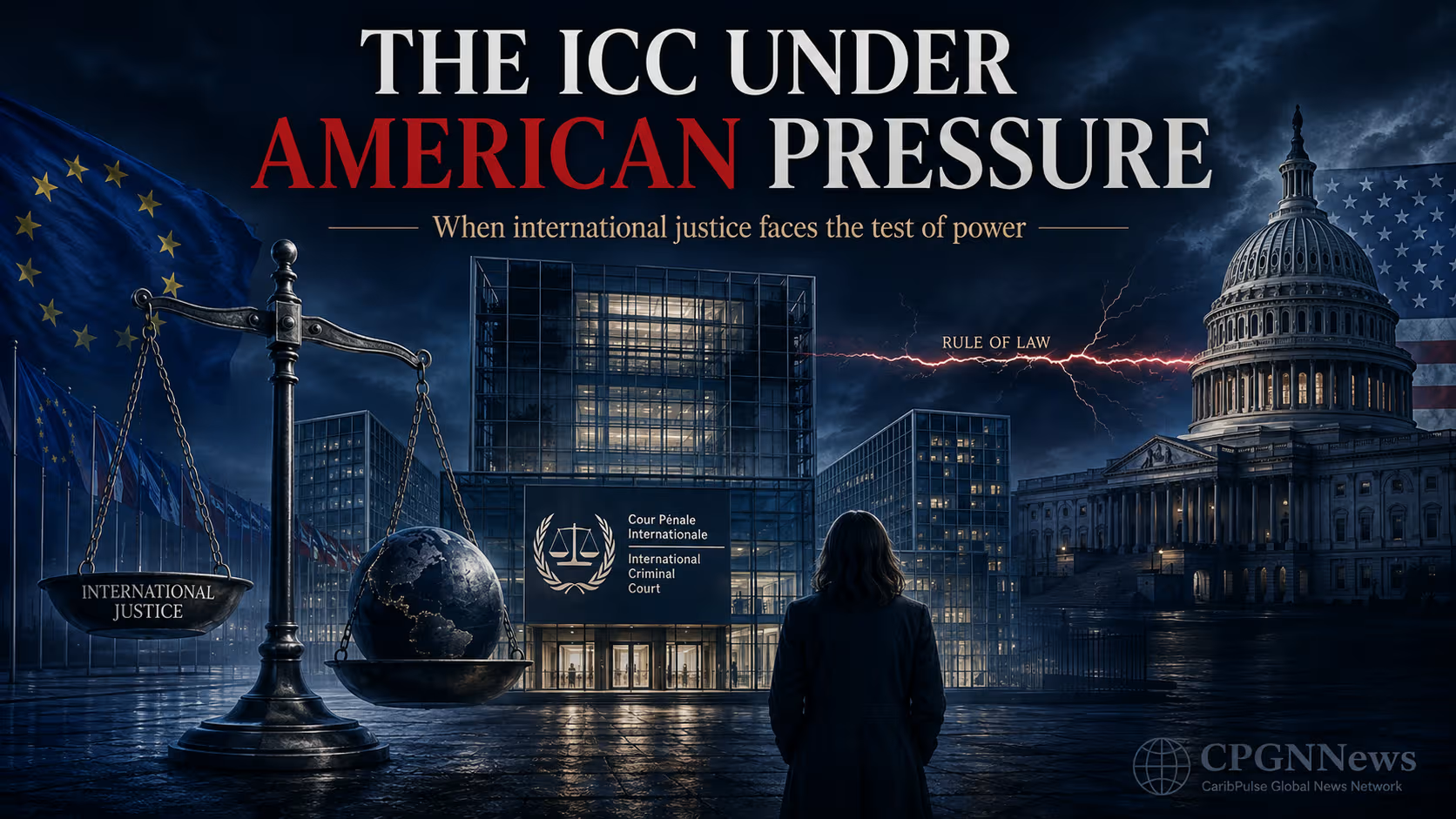
From The Hague to Washington, the sanctions targeting officials of the International Criminal Court (ICC), the permanent international judicial institution responsible for prosecuting individuals accused of crimes falling within its jurisdiction under the Rome Statute, can no longer be reduced to a confrontation between a judicial institution and a power that challenges its jurisdiction. They raise a broader question about the future of multilateralism: how far can an international court exercise its mandate when its decisions affect the interests of a major power, and how far are states prepared to defend the independence of law when doing so becomes politically costly?
CPGNNews Special Report
2026 Edition
CaribPulse Global News Network (CPGNNews)
Multilingual international editorial platform born in the Caribbean.
Think the Caribbean. Understand the World.
WHEN LAW ENTERS THE FRICTION ZONE OF GREAT POWERS
The confrontation unfolding around the International Criminal Court can no longer be understood as simply another episode in the strained relationship between Washington and an international judicial institution. It has become a revealing indicator of deeper transformations within the international order, at a time when the principles of multilateralism are being confronted with a renewed assertion of national sovereignty, intensifying competition among powers, and a growing determination by major states to define for themselves the limits within which international institutions may exercise their mandates. The question therefore extends beyond the individuals directly targeted by U.S. sanctions and even beyond the specific legal dispute between Washington and the Court. It concerns something more fundamental: whether an institution created by states can continue to exercise a judicial function when one of the most powerful poles of the international system considers that function detrimental to its interests or incompatible with its conception of sovereignty.
The ICC occupies a particular place within this architecture. Established by the Rome Statute, it is a permanent institution with jurisdiction over individuals for the most serious crimes of concern to the international community as a whole. The Statute limits its jurisdiction to the crimes defined therein and establishes the conditions under which that jurisdiction may be exercised. It is therefore not a court possessing automatic universal jurisdiction over every person, everywhere and under all circumstances. Its jurisdiction depends on specific legal mechanisms, including the territorial and personal jurisdictional conditions established by the Statute, the acceptance of jurisdiction under the conditions provided therein, the referral of a situation by a State Party or by the United Nations Security Council, as well as mechanisms enabling the Prosecutor to open an investigation in accordance with the Statute. This distinction is essential because a significant part of the current political confrontation rests precisely on differing interpretations of the scope of that jurisdiction.
Washington has long challenged the legitimacy of certain ICC proceedings involving U.S. nationals and maintains that the Court should not be able to exercise such jurisdiction under the circumstances it disputes. This American position should be presented for what it is: a legal and political position defended by Washington, not a legal truth that has definitively settled the matter. The U.S. sanctions framework against the ICC was notably established by Executive Order 14203 of February 6, 2025, which created a regime allowing the blocking of property and property interests belonging to designated persons, as well as restrictions on entry into the United States. The Office of Foreign Assets Control (OFAC), within the U.S. Department of the Treasury, is responsible for implementing the measures.
On August 18, 2026, Washington took another step by designating, among others, the President of the ICC, Japanese Judge Tomoko Akane, as well as legal official Abdoulaye Seye. OFAC simultaneously issued General License 12, authorizing, until September 17, 2026, certain transactions intended to facilitate the orderly wind-down of transactions involving designated persons. These measures confirm that the U.S. framework has not remained at the level of a political declaration: it operates through a concrete legal and administrative architecture.
This distinction between fact and position is far from secondary. It is one of the fundamental conditions of serious international journalism. Saying that Washington believes the ICC lacks jurisdiction under certain circumstances is not equivalent to asserting that such jurisdiction does not legally exist. Likewise, saying that the ICC is defending its mandate does not mean that all of its decisions are beyond criticism. Between these two positions lies precisely the space in which analysis must be situated. It is within that space, rather than in the search for a side to defend, that CPGNNews intends to place its perspective.
SANCTIONS AS AN INSTRUMENT OF PRESSURE
The American measures have implications that extend beyond their individual dimension. When an official of an international judicial institution is placed under the sanctions regime of a major power, the potential effect is not limited to the individual directly designated. Financial restrictions, administrative consequences and risks associated with relations with the U.S. economic system can create an environment in which pressure exerted on an individual indirectly becomes pressure on an institution. This does not mean that the ICC has automatically been paralyzed, nor that sanctions have already produced such an outcome. Any assertion of that nature would go beyond the established facts. The relevant question is rather one of systemic risk: how far can an international institution preserve its independence when the individuals leading it may be exposed to coercive measures imposed by an external power?
The U.S. Department of the Treasury officially presents the sanctions program as an instrument intended to respond to what Washington considers illegitimate actions by the ICC targeting the United States and certain of its allies. The February 6, 2025 Executive Order notably states that Washington considers the Court’s actions to constitute a threat to U.S. sovereignty and national security. This is the official justification of the U.S. government and must be distinguished from the legal assessment advanced by the ICC and by the States Parties to the Rome Statute.
The new step taken on August 18, 2026, nevertheless demonstrates that this policy has not remained at the level of an isolated declaration. The designation of Tomoko Akane and Abdoulaye Seye by OFAC gives the framework an additional dimension, directly involving officials exercising judicial or legal functions within the Court. The ICC condemned the new measures and stated that they constituted an attack on its independence.
Yet the existence of sanctions, by itself, does not justify concluding that the Court is collapsing. Such a conclusion would be premature. The real question concerns institutional resilience. An international institution can experience financial, diplomatic or political pressure without immediately losing its legal capacity to act. It can also continue to operate while the political, financial and human costs of its activities gradually increase. Between institutional survival and full freedom of action, therefore, lies an intermediate zone that must be observed with considerable precision.
It is precisely within this zone that the most serious problem lies. International law rests on texts, procedures and institutions, but it also depends on state cooperation. When that cooperation becomes selective, the authority of an institution can gradually be weakened without any formal decision bringing its existence to an end. The risk is not necessarily dramatic. It may take the form of a slow weakening, reduced resources, growing administrative obstacles, or increased caution among actors who hesitate to cooperate for fear of political or economic consequences.
This is why the question of sanctions must be examined calmly. It would be excessive to portray every U.S. measure as proof of a certain intention to destroy international law. It would be equally naïve to ignore the fact that the repeated use of economic instruments against international judicial officials can create a precedent whose consequences extend beyond the ICC itself. Power can exert real pressure; it cannot, by itself, establish that the legal position it advocates is necessarily correct.
INTERNATIONAL LAW BETWEEN SOVEREIGNTY AND RESPONSIBILITY
The conflict surrounding the ICC reveals a contradiction that is older than it may appear. The international system rests on the sovereignty of states, but it also depends on the ability of those same states to voluntarily accept common obligations. The Rome Statute embodies this second dimension. States that join it agree to participate in a permanent judicial institution and to recognize its mechanisms under the conditions established by the treaty. International justice therefore does not simply replace states; it is also the product of their collective decision to create a mechanism designed to address certain crimes when the conditions established by law are met.
This reality requires moving beyond the simplistic opposition between sovereignty and international law. Sovereignty does n’2ot disappear because a state accepts a treaty. It is also exercised through a state’s ability to enter into legally binding commitments. Likewise, defending international justice should not be confused with the idea that a judicial institution must be above criticism. The ICC must be open to scrutiny regarding its procedures, delays, decisions, priorities, methods and operational effectiveness. It must accept the intellectual and legal scrutiny that accompanies any institution exercising public authority.
But the requirement of accountability cannot be confused with an obligation of submission. An independent judicial institution must be subject to rigorous criticism without its officials being personally exposed to coercive measures because of the performance of their duties. This is where the essential boundary lies. Challenging a judicial decision, requesting a review, presenting a legal argument or using mechanisms provided by law belongs to normal institutional debate. Seeking to alter the environment in which judges perform their functions through economic pressure belongs to a different logic. The judgment on that distinction belongs to the reader; the journalist’s role is to make the distinction visible.
THE HAGUE CONFRONTS WASHINGTON
The current confrontation therefore involves two conceptions that cannot be reduced to a simple moral opposition between good and evil. Washington defends a conception of sovereignty and international judicial jurisdiction according to which states that are not parties to the Rome Statute should not be subjected to certain Court proceedings. The ICC, for its part, operates within the framework of its interpretation of the Rome Statute and the jurisdictional mechanisms it considers applicable to the situations before it. Between these positions lies a complex legal question that cannot be resolved solely through the political weight of either protagonist.
The difficulty lies precisely in the fact that the international system has no single global authority capable of instantly resolving every jurisdictional controversy. International institutions function through treaties, procedures, States Parties, judicial and political bodies, and mechanisms of cooperation. Their authority is therefore both legal and institutional. It depends on the strength of the norms they apply, but also on the willingness of states to allow them to perform the functions entrusted to them.
The ICC thus faces a test that extends beyond its own operations. It must demonstrate that it can continue to exercise its mandate with sufficient rigor to withstand political challenges, while accepting that its decisions are subject to the most demanding scrutiny. This dual requirement is difficult, but it is precisely what can give the institution lasting credibility. A Court that rejected all criticism would weaken its own legitimacy. A Court that ceased acting whenever its decisions became politically difficult would lose the very rationale for its existence.
JAPAN BETWEEN ALLIANCE AND THE RULE OF LAW
Within this confrontation, Japan occupies an especially sensitive position. Tokyo is both a major U.S. ally and an important supporter of international justice. Japan became a party to the Rome Statute in 2007 and officially affirms its commitment to the rule of law and to the ICC. Following the new U.S. sanctions targeting the Court’s President, Japan’s Ministry of Foreign Affairs stated that Japan continued to support the ICC and that the measures were “very unfortunate.”
Japan’s position is particularly significant because Tomoko Akane is Japanese. This national dimension could easily be transformed into an emotional narrative, but doing so would miss the essential point. The real issue for Tokyo is not simply to defend a Japanese national. It is to determine how to reconcile a major strategic alliance with the United States and a long-standing commitment to international law. This tension is not necessarily irresolvable. It nevertheless requires Japan to demonstrate that support for multilateralism can continue to exist even when it becomes politically uncomfortable.
Japan’s role also deserves to be examined from a financial and institutional perspective. Tokyo is among the Court’s major supporters and remains a particularly important contributor to its financing. Its accession to the Rome Statute dates back to July 17, 2007, with Japan formally becoming an ICC State Party on October 1 of that year. This position gives Tokyo a particular responsibility, but it does not mean that Japan must choose between Washington and The Hague as though they were two incompatible blocs.
A mature diplomacy can seek simultaneously to preserve a strategic alliance and defend legal principles. The real test will be to determine whether such room for maneuver still exists when the interests of the two partners diverge sharply. The question acquired an additional dimension after Tomoko Akane called on Tokyo to play a more active role in the face of American pressure, making Japan one of the actors potentially capable of influencing the evolution of the crisis.
VICTIMS AT THE CENTER OF A DEBATE THAT RISKS FORGETTING THEM
Amid this institutional confrontation, a human reality risks disappearing behind the language of sanctions, jurisdiction and power relations. International criminal justice was not created to provide additional prestige to the institutions that administer it. It responds to a fundamental human question: what happens when people become victims of crimes so grave that national mechanisms are insufficient to establish responsibility or deliver justice?
Behind judicial cases are victims, families and communities that may carry the consequences of mass violence for decades. Their suffering should nevertheless not be turned into an emotional argument designed to close debate. A genuinely human approach instead requires recognizing that the dignity of victims demands two things at once: independent justice and rigorous justice. Emotion cannot replace evidence, any more than power can replace law.
It is within this tension that perhaps the deepest dimension of the crisis lies. Victims need institutions capable of acting without intimidation, but they also need institutions strong enough to resist the temptation to turn justice into a political instrument. The credibility of international justice therefore depends as much on its independence as on its legal discipline. One without the other would be insufficient.
A CRISIS OF AN INSTITUTION OR A TEST OF THE INTERNATIONAL ORDER?
It would be tempting to regard this affair as a specific conflict destined to disappear once relations between Washington and The Hague return to a lower level of tension. That interpretation would probably be too narrow. The current confrontation forms part of a broader transformation of the international system, in which multilateral institutions are increasingly confronted with the determination of major powers to preserve their strategic autonomy.
The phenomenon does not concern the ICC alone. International institutions must now operate in an environment in which cooperation is becoming more selective, national interests are returning to the center of political calculations, and economic mechanisms can be used as instruments of foreign policy. In this context, the question posed to the ICC is also being posed to other institutions: can they continue to apply common rules when the most powerful states believe those rules conflict with their interests?
It would nevertheless be wrong to conclude that multilateralism is already doomed. International institutions have survived numerous crises and continue to function despite profound disagreements among states. The real challenge is their capacity to adapt. They will have to demonstrate that they can remain effective without losing their independence, accountable without becoming dependent, and open to reform without abandoning their raison d’être.
This requirement is particularly important for the ICC. The Court must be able to demonstrate that its independence is not an excuse for avoiding criticism. It must be able to accept questions regarding its decisions and methods without allowing those questions to become instruments of neutralization. The institution’s credibility will therefore depend on its ability to combine firmness with self-criticism.
POWER ALONE DOES NOT DETERMINE WHO IS RIGHT
The current crisis reveals an old truth of international relations: power can alter the conditions under which law is applied, but it is not sufficient to establish legal truth. A powerful state can impose costs, restrict access to certain markets, influence partners or exert considerable diplomatic pressure. That does not automatically mean that the legal argument it advances is either false or true. Power and legal validity belong to two different registers.
This distinction is essential in a world where the temptation is strong to measure legitimacy according to the ability to coerce. An international institution can be legally grounded while remaining politically vulnerable. A state can be politically powerful while facing legal challenges. Confusing these two realities produces a superficial reading of international crises.
This is also where the Stoic dimension of CPGNNews’ perspective on this confrontation emerges. It is not a matter of denying power, but of refusing to attribute to it a value that it does not possess. Power is a reality; it is not a universal measure of reason. The material weakness of an institution does not necessarily mean normative weakness. Conversely, the geopolitical importance of a state does not automatically transform each of its positions into truth.
Looking at this crisis with composure also means accepting uncertainty. Some consequences are already visible; others remain risks. Some decisions will have lasting effects; others may be corrected through new negotiations. The journalist must not transform every possibility into certainty simply because a more dramatic formulation is easier to remember. Rigor sometimes consists precisely in saying that we do not yet know.
THE CPGNNews PERSPECTIVE
At this stage of the confrontation, CPGNNews considers that the stakes extend far beyond the personality of Tomoko Akane, the American sanctions and the legal disputes between Washington and the International Criminal Court. What is unfolding in The Hague concerns a much deeper question about the nature of the international order being constructed before our eyes. For several years, the multilateral system has been subjected to growing tension between, on the one hand, the affirmation of common norms and institutions responsible for enforcing them and, on the other, the openly asserted return of a logic of power in which major states seek to preserve as broad a margin of sovereignty as possible. The ICC crisis is one of the points at which this contradiction becomes particularly visible because it directly concerns whether an international judicial institution can exercise its mandate when its proceedings affect the interests of a power that contests its jurisdiction.
The CPGNNews perspective is therefore necessarily twofold. It would be intellectually inadequate to portray the ICC as an irreproachable institution for which any criticism would necessarily constitute an attack on international justice. The Court must be open to questions concerning its choices, procedures, delays, results, possible inconsistencies and the manner in which it exercises a jurisdiction that remains dependent on the mechanisms established by the Rome Statute and on state cooperation. An international judicial institution cannot claim lasting authority without accepting the requirement of accountability that accompanies such authority. But it would be equally problematic to conclude that possible shortcomings within the Court justify subjecting its judges or officials to external political pressure when they are performing the functions entrusted to them by their mandate. Criticizing a judicial decision, challenging its legal basis or requesting its review within the frameworks established by law belongs to legitimate debate; seeking to impose a personal cost on those participating in such a decision belongs to a different logic. CPGNNews considers it essential to preserve this distinction.
Contemporary debate should therefore not artificially oppose defenders of sovereignty and defenders of international law, as though one of these concepts must necessarily disappear for the other to exist. Sovereignty remains a fundamental principle of international relations, but it has never prevented states from voluntarily creating common mechanisms designed to address crimes whose consequences extend beyond national borders. The Rome Statute belongs precisely to this history. The fundamental question is not whether sovereignty should be eliminated in favor of an unlimited international justice system, but whether freely undertaken international commitments can retain their value when their application becomes politically difficult. An international rule truly demonstrates its significance when the actors concerned continue to respect it even when its application ceases to be comfortable.
This requirement applies to all protagonists in the crisis. The United States has the right to challenge the ICC’s jurisdiction, defend its nationals and maintain that certain Court decisions rest on an interpretation of law it does not recognize. The ICC, for its part, has the right to defend its interpretation of the Rome Statute and pursue its mandate within the limits of the jurisdiction granted to it by that instrument. States Parties also have the right, and indeed the responsibility, to examine the Court’s decisions, discuss its methods and demand the highest standards of rigor from it. For CPGNNews, the decisive principle lies elsewhere: disagreements about law must be addressed through the mechanisms of law, rather than determined solely by the political or economic capacity of the most powerful actor. This principle does not shield Washington from criticism and does not shield The Hague from scrutiny; it protects the very principle that a rule can be debated without the person applying it necessarily being intimidated.
Japan’s role appears particularly significant from this perspective. Tokyo stands at the intersection of two imperatives that may appear contradictory but are not necessarily so. On the one hand, Japan must preserve an essential strategic relationship with the United States; on the other, it has built a significant part of its diplomatic action around support for multilateralism, the rule of law and international institutions. The fact that the ICC President is herself Japanese gives this tension an additional symbolic dimension, but the issue extends far beyond her individual case. Tokyo’s official response following the August 18 sanctions demonstrates that the Japanese government intends to maintain its support for the Court while continuing dialogue with the countries concerned.
This situation also calls for a deeply human reading, but one that rejects pathos. Behind institutions, sanctions, warrants, governments and power relations are the people for whom international justice is not an academic abstraction. They are the victims of grave crimes, their families and the communities that carry the consequences of violence whose traces can cross generations. The ultimate rationale of international criminal justice is neither the defense of an institution for its own sake nor the symbolic victory of one diplomatic camp over another. It lies in the possibility of establishing responsibility when national mechanisms are insufficient or unable to act. This purpose requires both the protection of judicial independence and an absolute demand for rigor. Humanizing the debate therefore does not mean turning victims into rhetorical instruments; it means never forgetting that behind legal concepts stand human lives.
The CPGNNews perspective is also guided by a more Stoic conviction: power must never be confused with reason, any more than weakness should be confused with powerlessness. In an international environment dominated by power relations, there is a strong temptation to measure the legitimacy of an actor by its ability to impose its will. Such a logic may produce immediate results, but it does not necessarily create a durable rule. Power can impose a cost; it cannot, by itself, demonstrate that a position is legally just. Conversely, an institution that lacks the material resources of a powerful state may nevertheless possess considerable normative strength if it acts with consistency, transparency and perseverance. For CPGNNews, this distinction is one of the major lessons of the current crisis.
The responsibility of States Parties therefore becomes central. An international institution cannot be stronger than the collective will of those who created it. If states regard the ICC as useful only when its decisions do not affect their interests or those of their allies, the promise of universality will necessarily remain fragile. If, by contrast, they accept the responsibility of defending its independence while demanding the highest level of legal rigor from it, they can transform this crisis into an opportunity for institutional consolidation. Support for the Court should therefore not take the form of blind loyalty, but of demanding commitment: protect its independence, strengthen its transparency, improve its effectiveness and maintain sufficiently robust legal scrutiny so that its authority rests on the quality of its procedures rather than solely on the political will of its supporters.
The most troubling prospect, in CPGNNews’ view, would be for the logic of sanctions against judicial officials to become a normalized precedent in international relations. This is not to assert that such an evolution has already occurred, but to identify a risk that would be imprudent to ignore. If every major power comes to believe that it can use its economic weight to sanction officials of international judicial institutions whenever they make decisions contrary to its interests, vulnerability will no longer concern the ICC alone. It could gradually affect the entire multilateral architecture. Such an evolution would not immediately abolish international law; it could produce something more insidious: a system in which rules continue to formally exist but become increasingly dependent on the balance of power surrounding their implementation.
CPGNNews therefore believes that the response to this crisis must avoid two symmetrical excesses: the absolute politicization of law and the naïve depoliticization of power. International justice does not operate in a political vacuum, and no judicial institution can ignore the geopolitical realities within which it functions. But recognizing this reality does not mean accepting that power should become the ultimate criterion of the validity of a rule. The real challenge is to preserve a space in which law can continue to generate obligations, including when their application inconveniences the most powerful actors. This requires a particular intellectual discipline: examining facts without excessive passion, recognizing opposing arguments without caricaturing them, distinguishing what is established from what remains hypothetical, and resisting the ease of definitive judgments when long-term consequences remain uncertain.
It is in this posture that CPGNNews intends to examine the ICC crisis. Neither Washington nor The Hague should be placed above critical scrutiny. Neither American sovereignty nor international judicial independence should be transformed into dogmas that prevent discussion. The role of an international media organization is not to provide readers with a camp with which to identify, but to give them sufficient facts, context and analytical tools to understand why the protagonists defend different positions and what consequences their choices may produce. Editorial independence does not mean pretending that all positions are equally valid; it means subjecting all positions to the same level of intellectual scrutiny.
For CPGNNews, the ICC crisis should therefore be viewed less as a confrontation between two camps than as a revealing indicator of the new global balance. It shows that the international system is entering a period in which institutions will have to demonstrate their capacity for resilience, states will have to clarify the real nature of their commitments, and major powers will have to determine how far they are prepared to use instruments of pressure against multilateral mechanisms. The outcome of this confrontation will not be measured solely by whether U.S. sanctions remain in place. It will be measured by the ability of the international system to preserve an essential distinction between power that challenges a rule and power that seeks to determine by itself whether that rule may be applied.
The real issue, ultimately, is not to protect an institution from all criticism. It is to preserve the possibility of a justice system that can be criticized without being intimidated, challenged without being neutralized, and reformed without being destroyed. Such justice can be credible only if it accepts accountability, respects the limits of its mandate and continually demonstrates the legal soundness of its decisions. But it can be independent only if those exercising its functions can do so without their judicial work itself becoming the target of pressure intended to alter their behavior. It is within this difficult balance between independence, accountability, sovereignty and power that one of the most important questions facing the international order today can be found.
The world has entered a period in which principles will increasingly be confronted with their real cost. It will be relatively easy to defend multilateralism when it threatens no major interest; it will be much more difficult to defend it when its application conflicts with a power, an ally or a strategic partner. It is precisely in such moments that the sincerity of international commitments is tested. CPGNNews therefore does not believe that the answer to the crisis is to ask governments to choose between their alliances and their principles. It is to remind them that a lasting alliance should not require the abandonment of independent judgment and that a credible international order cannot function if common rules become optional whenever they encounter resistance from a powerful actor.
The central question is therefore not who will win a confrontation between Washington and The Hague. It is whether international institutions can retain sufficient independence to perform the functions entrusted to them by states, while remaining sufficiently accountable to accept criticism and sufficiently rigorous to deserve trust. CPGNNews considers that it is along this narrow line, rather than in slogans or power struggles, that the true measure of the maturity of the international system can be found. International justice does not need to be perfect to be necessary; it must, however, be sufficiently demanding of itself that its defense never rests on emotion alone.
This conviction should guide the reading of the current crisis. Sanctions can be challenged, judicial decisions can be debated, institutions can be reformed and states can defend their interests. But when power becomes the means of determining in advance which rules may be applied and against whom they may be applied, the very idea of an order based on common norms begins to weaken. The response can be sustainable only if it rests on more law, more rigor and more accountability, rather than on another escalation of power. For CPGNNews, this is the essential point: preserving the world’s ability to pursue justice without turning justice into an instrument of power, and preserving the rule of law without forgetting that its ultimate purpose remains human.
CONCLUSION: THE DECISIVE TEST OF MULTILATERALISM
The confrontation between Washington and the International Criminal Court may not, by itself, determine the future of the international system. But it already constitutes a particularly powerful indicator of the forces shaping it. It demonstrates the growing difficulty of maintaining common institutions in an environment where national sovereignty, strategic alliances and power relations are once again assuming a central role. It also reminds us that international law is never merely an architecture of texts. It depends on the willingness of states to give those texts practical force, on the ability of institutions to preserve their independence, and on the confidence of societies in the possibility of a justice system that is not reserved for the weakest.
The ICC will therefore have to respond to this crisis through law, rigor and the ability to demonstrate that its independence is accompanied by institutional accountability commensurate with its mandate. States Parties, for their part, will have to decide whether their support for multilateralism remains an abstract principle or retains its value when defending that principle becomes politically costly. Japan will occupy a particularly revealing position in this equation precisely because it must reconcile its alliance with the United States with its declared commitment to the rule of law. Washington, for its part, will have to consider the broader consequences of using its instruments of pressure against an international judicial institution, including the impact on perceptions of American power among states seeking to preserve their own strategic autonomy.
International history is not always decided at the moments when major powers announce their intentions. It is often decided when they encounter a limit they cannot cross without altering the balance of the system to which they themselves belong. The ICC crisis is one of those moments. It forces states to confront a question that is simple in formulation but enormous in consequence: do international rules retain their value when their application becomes difficult for the most powerful?
The answer will probably be neither immediate nor definitive. It will be constructed through judicial decisions, diplomatic reactions, financial choices, the behavior of States Parties and the ability of institutions to withstand pressure without losing their capacity for self-criticism. It would therefore be premature to announce the victory of power over law or, conversely, to present the ICC’s current resistance as definitive proof of the strength of multilateralism. History is still being written.
What can already be affirmed, however, is that the manner in which this crisis is managed will have implications far beyond the walls of The Hague. If disputes concerning the jurisdiction of an international court continue to be addressed through law, institutional debate and diplomatic mechanisms, the international system may still demonstrate its capacity for resilience and adaptation. If, by contrast, economic power gradually becomes the means of determining which institutions may act and under what circumstances, the transformation will be deeper. International law may continue to exist in formal texts, but its practical authority could become increasingly dependent on the balance of power.
This is precisely why the affair deserves to be examined with less passion and greater lucidity. The issue is not to choose between America and international justice, nor between sovereignty and multilateralism. It is to determine whether an international system can still reconcile power and rules, sovereignty and commitment, criticism and independence. A significant part of international stability in the coming decades will depend on this capacity for coexistence.
The ultimate question is therefore not whether the ICC is perfect, nor whether the United States is beyond criticism. No institutional or state actor should enjoy such intellectual immunity. The real question is whether the world will accept that a judicial institution can be judged on the quality of its law and decisions without its survival or independence depending on the favor of a powerful state. If the answer remains positive, the current crisis may still become a moment of clarification and perhaps consolidation. If the answer becomes negative, the consequences will extend far beyond the Court.
The world does not need institutions that no one can criticize. It needs institutions strong enough to accept criticism without abandoning their mission, responsible enough to recognize their own limits, and independent enough to exercise their mandates when the interests at stake are powerful. Only under such conditions can international justice continue to claim a function that transcends states without claiming to abolish them.
For CPGNNews, the current test therefore consists not merely in determining who will exert the greatest pressure on whom. It consists in determining whether the international community is still capable of defending a simple but demanding idea: power may challenge law, law may be reformed, institutions may be criticized, but none of these realities should by itself be sufficient to determine what is legally possible. Within this distinction lies perhaps one of the last lines of defense of an international order founded not on the illusion of perfect equality among powers, but on the conviction that even the most powerful actors must be capable of confronting rules that do not belong to them.
CPGNNews: Think the Caribbean. Understand the World.
Sources and Reference Documents
International Criminal Court; Rome Statute; Assembly of States Parties to the Rome Statute; White House of the United States; U.S. Department of the Treasury / Office of Foreign Assets Control; Ministry of Foreign Affairs of Japan; Reuters; Associated Press and other international news organizations used for verification and contextual analysis.
The elements relating to the U.S. sanctions of August 18, 2026, were cross-checked against official OFAC documents and ICC communications. Japan’s official response of August 19, 2026, was verified through the Ministry of Foreign Affairs of Japan. The initial legal framework for the U.S. sanctions derives from Executive Order 14203 of February 6, 2025.
Geopolitical intelligence in the service of decision-making.
CaribPulse Global News Network, CPGNNews.
Multilingual international editorial platform born in the Caribbean.
Think the Caribbean. Understand the World.
To contact the editorial desk:
info@cpgnnews.com
Paris – Ottawa – Washington – Port-au-Prince | August 2026
