


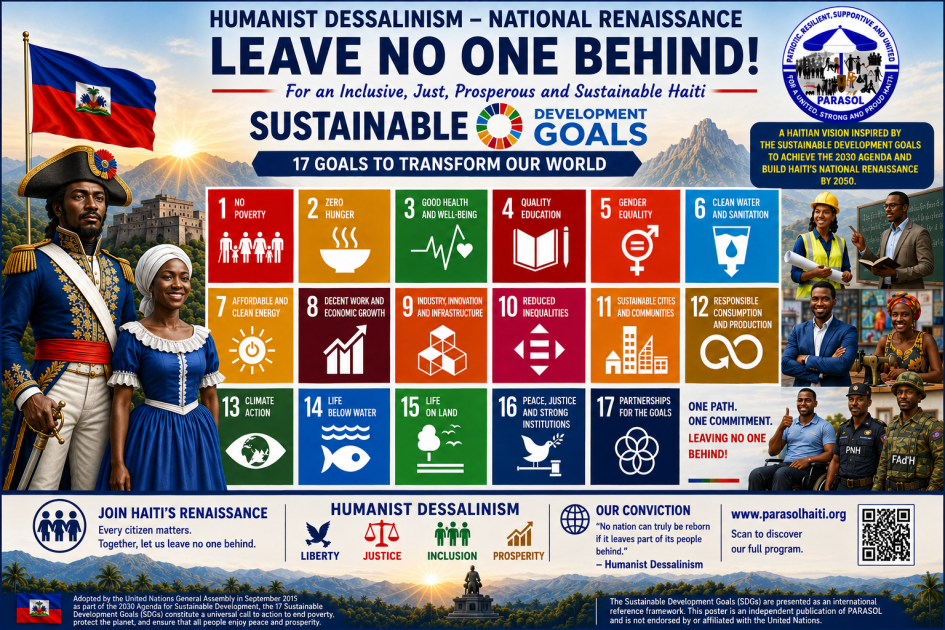
Transforming Global Commitments into National Action through Humanist Dessalinism: A Haitian Vision of Justice, Inclusion, Prosperity, Sovereignty, and Sustainable Development—Leaving No One Behind.
By Emma Jasmin
CPGNNews – CaribbeanPulse Global News Network
PORT-AU-PRINCE — Rarely since the fall of the Duvalier dictatorship has Haiti experienced an accumulation of crises of such intensity. To the violence of armed groups are added the gradual collapse of public services, the weakening of institutions, the deterioration of infrastructure, poverty that continues to affect a considerable portion of the population, and a crisis of trust that now affects nearly all relations between the State and citizens. This reality is no longer reducible to a succession of conjunctural events. For many observers, it reflects the exhaustion of a governance model incapable of responding sustainably to the needs of a society undergoing profound change.
In this particularly fragile context, the Sustainable Development Goals adopted by the United Nations in 2015 continue to offer a widely recognized reference framework for combating poverty, strengthening institutions, fostering inclusive growth, and reducing inequalities. Yet, as several international institutions regularly remind us, these goals produce results only when they are genuinely appropriated by States and adapted to national realities. No international roadmap, however ambitious, can replace a political vision driven from within, capable of responding to the historical, social, economic, and cultural specificities of a country.
It is precisely on this question of national appropriation that the party Patriòt Rasanble pou Sove Lakay, better known by its acronym PARASOL, intends to build its political project. Through its program entitled Renaissance Leave No One Behind, the party does not present the Sustainable Development Goals as a series of technical commitments to be mechanically reproduced. According to its leaders, the aim is rather to inscribe them within a broader reflection on the reconstruction of Haiti by articulating them with a national political doctrine, Humanist Dessalinism, developed by the founding president of the movement, Yvon Bonhomme.
The approach merits examination, as it stands apart from the discourses traditionally heard in the Haitian political landscape. For several decades, the programs of various parties have generally emphasized economic emergencies, security, infrastructure, or institutional reforms. PARASOL, for its part, proposes to begin with a doctrinal reflection, believing that no sustainable transformation can be undertaken without a coherent vision of the State, citizenship, and Haiti’s place in the contemporary world. This desire to associate a national political thought with an international reference framework constitutes one of the most singular aspects of its project.
Humanist Dessalinism draws its inspiration from the legacy of Jean-Jacques Dessalines, considered the founding father of the Haitian nation. However, according to PARASOL, this is not an exercise in memory or a symbolic celebration of independence. The party claims to want to reinterpret the principles that led to the birth of the first independent Black Republic in order to respond to the challenges of the 21st century. National sovereignty, human dignity, and social justice thus become the three foundations of a doctrine that seeks to combine national identity with the modernization of the State.
This contemporary reading of the Dessalinian heritage is part of an intellectual debate that extends far beyond Haiti’s borders. For several years, researchers specializing in postcolonial studies have emphasized that imported development models rarely produce the expected effects when applied without adaptation to local realities. Experiments conducted in Africa, Asia, and Latin America show that public policies achieve better results when they draw on cultural, historical, and institutional references recognized by the populations themselves. It is in this logic that PARASOL claims to situate its program, making Humanist Dessalinism the foundation of a Haitian appropriation of the Sustainable Development Goals.
The exercise is ambitious. It consists of bringing together two universes that seem, at first glance, far removed from one another. On one side, a political doctrine deeply rooted in national history, shaped by the struggles for freedom, independence, and sovereignty. On the other, a universal agenda developed within the framework of the United Nations to address the major contemporary challenges of human development. According to PARASOL, these two approaches are not contradictory. On the contrary, they can complement each other provided that international objectives cease to be perceived as external prescriptions and become instruments in the service of a national project.
This articulation appears clearly in the slogan accompanying the party’s program, Leave No One Behind. The expression is directly borrowed from the vocabulary of the United Nations, but it receives here a distinctly Haitian interpretation. For PARASOL, leaving no one behind means above all rebuilding a State capable of recognizing every citizen as an actor in development, whether they live in a large city, in an isolated communal section, or within the diaspora. This conception goes beyond the merely social dimension. It reflects a desire to restore the bond between the nation and all of its components in a country where large segments of the population have long felt excluded from public policies.
Beyond the discourse, this approach raises a broader question that also interests observers of the Caribbean. The small island states of the region face often comparable challenges, whether economic vulnerability, the effects of climate change, dependence on external markets, or the need to modernize their institutions without renouncing their identity. In this regional environment, the experiment proposed by PARASOL appears as an attempt to reconcile a global agenda with a political vision rooted in national history. Whether it convinces or sparks debate, it participates in an increasingly present reflection in the Caribbean, that of the capacity of island societies to produce their own development models rather than limiting themselves to importing solutions designed elsewhere.
It is precisely from this articulation between national identity, modern governance, and sustainable development that the entire Renaissance program is organized. Behind the institutional, economic, and social proposals advanced by PARASOL, a broader ambition emerges: that of rebuilding the State by restoring political meaning to the very notion of development. It remains now to examine how this vision intends to translate into concrete public policies and what responses it offers to the daily challenges faced by millions of Haitians.
The doctrine developed by PARASOL truly takes on meaning only when it confronts the daily realities of Haitian society. Behind the concepts of sovereignty, human dignity, and social justice, the party claims to want to address long-standing fractures that continue to structure the country. Its Renaissance program does not merely present a series of administrative or economic reforms. It rests on a central idea: that no development strategy can succeed if a significant portion of the population remains permanently excluded from public services, economic opportunities, and social protection.
This conviction aligns with the very spirit of the Sustainable Development Goals, whose guiding principle, Leave No One Behind, invites States to design their public policies by first considering the most vulnerable populations. PARASOL adopts this expression but gives it a broader scope. According to the party, it is not merely a matter of combating poverty or inequalities. It is also about rebuilding the social contract between the State and citizens, in a country where several generations have grown up with the feeling that public institutions had become absent or inaccessible.
Available indicators illustrate the extent of this fracture. More than 36% of Haitians still live in extreme poverty according to several international estimates. Life expectancy remains close to 64 years, one of the lowest in the region, while less than 35% of households have regular access to electricity. To these difficulties are added high unemployment, particularly among young people, as well as significant precariousness in rural areas where public services remain very limited. For PARASOL, these figures do not merely reflect an economic crisis. They above all reveal the State’s inability to ensure a balanced presence across the entire territory.
This is why the program places decentralization at the heart of its reconstruction strategy. Since the adoption of the 1987 Constitution, this has regularly been presented as a national objective without ever having been fully realized. The 570 communal sections that constitute the basis of Haiti’s territorial organization continue, for the most part, to function with an extremely reduced administrative presence. In many localities, citizens must still travel several hours to access a civil registry office, a peace court, a police station, or a health center. This historical concentration of public services in the Port-au-Prince metropolitan area has gradually accentuated regional imbalances and nurtured a deep sense of abandonment.
According to PARASOL, the reconstruction of the country therefore requires a new territorial organization capable of sustainably bringing the administration closer to citizens. The program provides for the creation of a genuine territorial public service, intended to professionalize local administrations and ensure a permanent State presence in municipalities and communal sections. The party also advocates an administrative redistricting aimed at better accounting for the demographic and economic realities of the territories, while strengthening the capacities of local authorities to conduct their own development projects.
This reflection goes beyond the merely administrative question. It rests on a deeper conviction that sustainable development cannot be decreed from the capital. It must be built from the territories, by giving local authorities the means to respond themselves to some of the needs of their populations. Several experiments conducted in other countries show, moreover, that States that have invested in effective decentralization often have more resilient institutions and a better capacity to absorb economic or security crises.
The same logic inspires the social proposals of the program. For PARASOL, the fight against poverty cannot be reduced to occasional assistance policies. It requires the progressive construction of a genuine national social protection system. The project thus provides for the establishment of Universal Health Coverage intended to improve access to care across the entire territory. In a country where health expenditures are still largely borne by families themselves, this measure is presented as an investment in human capital as much as a tool for reducing inequalities.
The program also provides for dignity pensions intended for the elderly, for farmers who have devoted their lives to national production, as well as for other particularly vulnerable categories. To these mechanisms are added the creation of National Retirement Homes, identified by the acronym MRN, the development of Food Banks to better respond to situations of food insecurity, as well as several community structures intended to strengthen local solidarity.
This social vision also extends to education and professional integration. PARASOL notably proposes the creation of Integrated Community Preschools, the EMCI, which would combine preschool education, health monitoring, and family support within a single structure. The program also provides for the establishment of Integrated Employment Resource Centers, the CREI, intended to support job seekers, strengthen professional training, and facilitate the meeting between labor market needs and available skills.
To these initiatives is added the network of Magasin Goodwill Ayiti, the MAGA, presented as a mechanism intended to improve the access of the most modest populations to essential products within an organized and transparent framework. According to PARASOL, all of these mechanisms respond to the same philosophy: that of a State that does not limit its action to traditional sovereign functions but also assumes an active role in reducing social and territorial inequalities.
This conception of public action aligns with several Sustainable Development Goals, notably those devoted to the elimination of poverty, the fight against hunger, health, education, and the reduction of inequalities. However, the party insists that these policies must not be perceived as a simple transposition of international recommendations. They are part, according to it, of a broader vision of social justice inspired by the principles of Humanist Dessalinism.
This desire to modernize the State is also found in one of the program’s most innovative axes, Governance 3.0. For PARASOL, digital transformation is no longer a luxury reserved for advanced economies but a necessity to improve the efficiency of public institutions, strengthen administrative transparency, and bring services closer to the population.
The project thus provides for the creation of the Ministry of Communication, Innovation, and Digital Technology, the MCITN, which would be responsible for coordinating the digital transition of the administration, developing technological infrastructure, and fostering the interconnection of public services. According to the program, this evolution could help reduce certain corrupt practices through better traceability of administrative procedures and more data-driven management.
This reform would be complemented by the creation of the National Order of Scientific Research and Technologists of Haiti, the ONRSTHA. The stated objective is to mobilize national scientific skills as well as those of the diaspora in order to further integrate research, innovation, and technical expertise into public policies. The party believes that Haiti possesses an intellectual potential that is largely underutilized, while thousands of Haitian professionals now occupy leading positions in universities, businesses, and international institutions.
Finally, the National Program for Innovation and Digital Literacy, the PNAIN, would complete this strategy by developing the digital skills of the population. According to PARASOL, preparing the younger generations for the jobs of tomorrow is an indispensable condition for enabling the country to participate fully in the economic transformations currently reshaping the Caribbean and the rest of the world.
Through this set of reforms, PARASOL ultimately attempts to defend a particular conception of development. For the party, Haiti’s reconstruction does not depend solely on material investments or the restoration of security. It also presupposes a State capable of ensuring a balanced presence across the entire territory, of protecting the most vulnerable populations, of mobilizing national skills, and of accompanying society in its transition toward a more modern, more inclusive economy more oriented toward innovation. It is this articulation between social justice, territorial governance, and digital transformation that now constitutes the heart of its project for national reconstruction.
If the social dimension constitutes one of the pillars of the Renaissance project, PARASOL believes that it cannot produce sustainable results without a profound transformation of the national economy. The party considers that the weakness of local production, dependence on imports, insufficient infrastructure, and the State’s low investment capacity largely explain the difficulties Haiti currently faces. According to this reading, social development cannot be dissociated from an economic strategy based on wealth creation, the valorization of national resources, and the gradual recovery of economic sovereignty.
This approach is based first on a relaunch of national production. For several decades, Haitian agriculture, which once supported a large part of the population, has suffered the combined effects of land degradation, natural disasters, lack of public investment, and competition from imported products. This situation has gradually accentuated the country’s food dependence while accelerating rural exodus toward major urban centers. For PARASOL, this evolution is not merely an economic problem. It directly affects social stability, food security, and territorial planning.
The program thus provides for a vast agricultural modernization plan based on the improvement of irrigation systems, the development of rural infrastructure, the progressive mechanization of farms, facilitated access to agricultural credit, as well as the creation of new processing chains intended to increase the added value of local production. According to the party, this strategy would not only reduce food imports but also create thousands of jobs in departments where agriculture remains the main economic activity.
This desire to stimulate production also extends to industry, small and medium-sized enterprises, and the digital economy. PARASOL notably proposes the creation of a National Startup Fund with an envelope that could reach 1 billion USD to support young entrepreneurs, finance innovative companies, and accompany the development of new technologies. The program considers that entrepreneurship must become one of the main engines of job creation in a context where the traditional labor market struggles each year to absorb the thousands of young people entering the job market.
According to the projections presented by the party, the entirety of the economic reforms could contribute to the creation of more than 6 million direct and indirect jobs by 2035. This particularly ambitious objective is based on a combination of public investments, private partnerships, industrial development, agricultural modernization, and major infrastructure projects. These estimates remain naturally conditioned by political stability, the mobilization of necessary financing, as well as the State’s capacity to carry out reforms of a magnitude rarely observed in the country’s contemporary history.
Infrastructure occupies precisely a central place in this transformation strategy. For PARASOL, the accumulated delay in transport, energy, telecommunications, and public equipment constitutes one of the main obstacles to economic development. The program asserts that no industrial policy can succeed sustainably as long as businesses continue to operate in an environment marked by high logistics costs, insufficient road networks, and still very limited energy production.
Among the most emblematic projects is the Renaissance Tunnel, presented as a strategic infrastructure intended to transform exchanges between several regions of the country. According to party documents, this structure could reach approximately 54 kilometers, which would make it, if it were built, one of the longest tunnels on the American continent. PARASOL estimates that such a project would significantly reduce travel times, open up several economic zones, and strengthen trade between different development hubs. The program also cites economic spin-offs that could reach 350 million USD per year, while acknowledging that such an infrastructure would require in-depth technical studies, international financial partnerships, and long-term planning.
The Friendship Tunnel, with an estimated length of 14 kilometers, fits into this same logic of opening up and territorial integration. Here again, the project is presented as a strategic investment aimed at improving mobility, fostering economic exchanges, and strengthening the cohesion of the national territory. These proposals reflect PARASOL’s desire to place infrastructure policy within a global vision of development rather than in a succession of isolated projects.
Beyond transport, the party attaches particular importance to energy. With less than 35% of households benefiting from regular access to electricity, according to several estimates, Haiti remains confronted with one of the lowest electrification rates in the region. PARASOL considers that this situation limits both business competitiveness, access to public services, and investment prospects. The program provides for a progressive development of renewable energies, the strengthening of national production capacities, as well as the extension of electrical networks to support economic growth while improving the living conditions of populations.
The diaspora appears as another major lever of this strategy. Financial transfers from Haitians living abroad represent nearly 30% of the national gross domestic product and exceed, in some years, 6 billion USD. These resources already constitute one of the main economic shock absorbers for hundreds of thousands of families. However, according to PARASOL, their potential extends far beyond mere income transfers. The party considers that the diaspora also represents an exceptional reservoir of skills, expertise, international networks, and investment capacities that remain insufficiently mobilized.
It is in this perspective that the creation of the Haitian Diaspora Economic Conference, the CEDHA, is proposed. According to the program, this structure would have the mission of bringing together Haitian investors from abroad with national economic opportunities, fostering technological partnerships, supporting skills transfer, and facilitating the participation of the diaspora in the major orientations of economic development. This approach directly aligns with the Sustainable Development Goal devoted to partnerships, while responding to a reality specific to Haiti, where the diaspora has for several decades been an essential economic actor.
This reflection also leads PARASOL to address the question of financial governance. The program provides for several reforms intended to improve the transparency of public finances, strengthen the fight against corruption, and restore the confidence of both national and international investors. The party notably claims to want to progressively clean up public accounts and announces as an objective an accelerated repayment of domestic debt within a period that could reach 24 months, subject to the State’s budgetary capacities and macroeconomic conditions. Here again, this is a political commitment whose feasibility would depend largely on available resources and the evolution of the economic situation.
This desire for economic transformation is finally accompanied by a broader institutional reflection. For PARASOL, economic, social, and territorial reforms can produce their effects only if they are part of a constitutional framework adapted to the realities of the 21st century. The party considers that the 1987 Constitution, while having played a major historical role in the democratic transition, no longer fully responds to the current requirements of institutional stability, modern governance, and sustainable development.
It thus proposes the organization of a constitutional reform process intended to clarify the functioning of institutions, strengthen the State’s capacity to conduct public policies, consolidate decentralization, and more broadly recognize the role of the diaspora in national life. This proposal is part of an old debate that has traversed Haitian society for several years and continues to oppose supporters of a constitutional revision to those who consider that the country’s difficulties stem more from its implementation than from its content.
Through this combination of economic reforms, structuring investments, infrastructure modernization, and institutional evolution, PARASOL sketches an ambitious vision of national reconstruction. Beyond the figures cited and the projects proposed, this strategy reflects a desire to reposition Haiti as a State capable of producing its own wealth, mobilizing all of its human resources, and gradually strengthening its place within the Caribbean. It remains now to understand how this vision fits into the Haitian political debate, what challenges it will have to overcome, and to what extent it can contribute to renewing reflection on development models in the region.
Beyond the institutional, economic, and social proposals it develops, the Renaissance program ultimately raises a more fundamental question: that of a State’s capacity to appropriate an international agenda without renouncing its own political identity. For several decades, major international organizations have encouraged States to inscribe their public policies within the framework of the Sustainable Development Goals. Yet experiences conducted in different regions of the world show that these goals produce very variable results depending on national contexts. The countries that record the most significant progress are generally those that manage to adapt these international orientations to their own historical, cultural, and institutional realities rather than applying them as a uniform model.
It is precisely on this ground that PARASOL seeks to distinguish itself. The party does not call the Sustainable Development Goals into question. On the contrary, it claims to want to integrate them into a political doctrine that it presents as deeply rooted in Haitian history. According to this approach, Humanist Dessalinism does not constitute an alternative to the SDGs but a national reading grid allowing them to be given a political content adapted to the country’s specific challenges. This attempt to bring together a doctrine stemming from national history and a universal agenda undoubtedly represents one of the program’s most original characteristics.
This reflection, moreover, extends well beyond the Haitian framework. Throughout the Caribbean, States are confronted with the same question: how to build sustainable development without mechanically reproducing models developed in economic, geographic, or institutional contexts very different from their own. Small island economies must simultaneously face the effects of climate change, their commercial dependence, debt constraints, energy vulnerability, migratory movements, the rapid transformations of the digital economy, as well as increasingly fierce international competition to attract investment. In this context, the question is no longer merely to have a development program. It also consists of defining a vision capable of articulating the demands of globalization with the realities specific to each society.
Haiti occupies a singular place in this regional reflection. First independent Black Republic, first State to emerge from a victorious slave revolution, the country retains a symbolic significance that extends far beyond its borders. But this historical singularity is today accompanied by considerable challenges. Political instability, the security crisis, repeated natural disasters, economic difficulties, and institutional fragilities continue to weigh heavily on development prospects. For many observers, Haiti’s reconstruction will require not only significant financial resources but also a political vision capable of gradually restoring trust between citizens and their institutions.
It is precisely on this dimension that PARASOL’s program intends to concentrate its efforts. By proposing to bring together national sovereignty, social justice, technological innovation, decentralization, institutional modernization, and sustainable development, the party seeks to build a coherent political narrative rather than a simple addition of sectoral measures. This coherence constitutes one of the elements that distinguish its project in Haiti’s current political landscape, even if its implementation would naturally depend on numerous political, economic, financial, and security conditions that extend far beyond the framework of an electoral program.
Like any project of national transformation, this vision also raises legitimate questions. Several proposals presented in the program would require considerable financial investments, lasting institutional stability, a significant strengthening of administrative capacities, as well as close cooperation with international partners. Major infrastructure projects, the digital transformation of the State, the generalization of social protection, or constitutional reform would presuppose long-term reforms whose results could only be measured in the medium and long term. The success of such a strategy would therefore depend as much on the quality of its design as on the institutions’ capacity to ensure its continuity beyond political alternations.
This observation aligns with a finding often formulated by development specialists. The most ambitious public policies produce lasting effects only when they draw on solid institutions, a competent administration, transparent mechanisms of public management, and sufficiently broad support from political, economic, and social actors. In Haiti’s case, these conditions themselves represent an essential part of the challenge to be met.
Nevertheless, the main interest of the Renaissance program perhaps lies elsewhere. It bears witness to a perceptible evolution of the Haitian political debate. Long dominated solely by responses to security or economic emergencies, discussions now tend to integrate broader questions concerning governance, digital transformation, strategic planning, food sovereignty, diaspora mobilization, and the adaptation of national policies to major global issues. In this regard, the project presented by PARASOL participates in a reflection that goes beyond partisan divisions and more broadly questions the way Haiti intends to project itself in the coming decades.
This evolution also presents an interest for the entire Caribbean. The island states of the region, despite their differences in size or level of development, share several common concerns. They seek to strengthen their resilience in the face of climate crises, diversify their economies, accelerate their digital transition, modernize their institutions, and better leverage their diasporas. In this perspective, the debates currently traversing Haiti can also nourish a regional reflection on governance and development models adapted to Caribbean realities.
It is perhaps here that the main contribution of this approach lies. By seeking to articulate a national political doctrine with the Sustainable Development Goals, PARASOL poses a question that goes beyond its own program. Can international agendas produce lasting results if they are not reinterpreted through the history, culture, aspirations, and priorities of the peoples to whom they are addressed. Conversely, can a national doctrine respond to contemporary challenges without dialoguing with the major international reference frameworks that now structure public policies in a globalized economy. These questions remain open, but they reflect an evolution of political debate toward a more global reflection on the place of States in a world undergoing profound transformation.
Ultimately, the Renaissance program does not limit itself to proposing a series of reforms. It seeks to inscribe Haiti’s reconstruction within a long-term vision where economic development, social justice, innovation, national sovereignty, and international cooperation are no longer conceived as competing objectives but as components of a single societal project. Whether this ambition can or cannot be fully realized will depend on future political choices, the capacity of institutions to carry out sustainable reforms, and the population’s adherence to this vision.
One certainty nevertheless imposes itself. In a Caribbean confronted with unprecedented economic, climatic, and geopolitical changes, the question is no longer only how to achieve the Sustainable Development Goals. It now consists of determining how each nation can adapt them to its history, its resources, and its aspirations in order to make them a truly collective project. It is on this ground that, for Haiti as for the entire region, the capacity to transform international ambitions into sustainable results serving present and future generations will be played out.
Emma Jasmin
Senior Correspondent for Caribbean Strategic Affairs
CPGNNews | CaribbeanPulse Global News Network
Political Analysis • Geostrategy • Governance • Sustainable Development • Caribbean Integration.
