


By the International Desk of CPGNNews, CaribPulse Global News Network
Geopolitical analysis produced from the Caribbean, with contributions from researchers, economic analysts, and correspondents across Africa and the Americas.
May 2026.
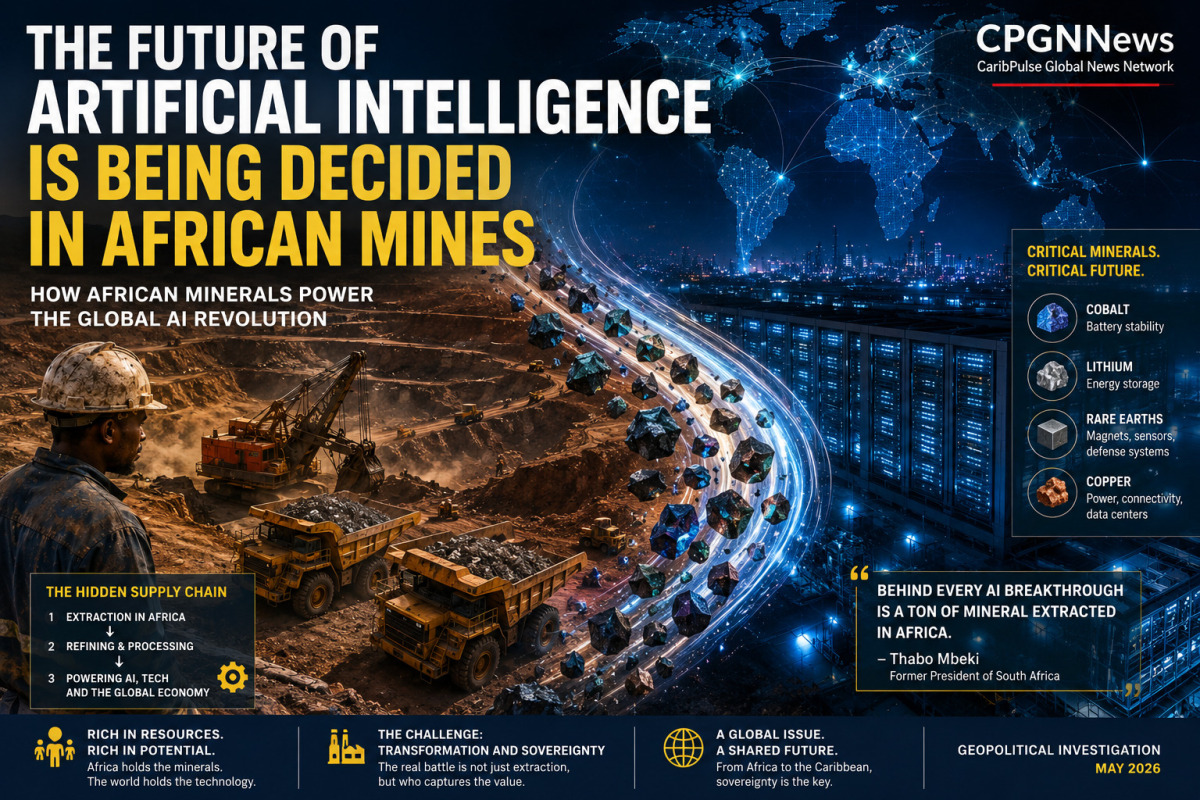
Behind every query sent to ChatGPT, every electric vehicle battery, and every precision-guided weapons system lies a supply chain rooted in African extraction. The technological competition of the 21st century is no longer confined to Californian laboratories or Chinese factories. It is increasingly shaped in the red dust of Katanga, the plateaus of Zimbabwe, and the deserts of Namibia. Never before has control of the subsoil been so directly tied to global digital sovereignty.
1. The New Map of Global Power
The generative artificial intelligence revolution has reshaped, in less than a decade, the strategic hierarchy of raw materials. Long considered secondary industrial inputs, cobalt, lithium, graphite, nickel, copper, and rare earth elements have become as strategically critical as oil was in the 20th century.
According to the International Energy Agency, global lithium demand could increase thirteenfold by 2040, cobalt demand sevenfold, and rare earth demand fivefold. This growth is driven by electric batteries, AI data centers, and next-generation defense systems.
Within this new economic geography, Africa holds a decisive position.
Mineral: Cobalt
Estimated share of global reserves in Africa: ~50%,
Key country: Democratic Republic of the Congo (DRC).
Mineral: Lithium
Estimated share of global reserves in Africa: 10–15%,
Key countries: Zimbabwe, Namibia, Mali, Ghana.
Mineral: Graphite
Estimated share of global reserves in Africa: 15–20%,
Key countries: Madagascar, Mozambique, Tanzania.
Mineral: Rare Earth Elements
Estimated share of global reserves in Africa: 5–10%,
Key countries: Namibia, South Africa, Malawi.
Mineral: Copper
Estimated share of global reserves in Africa: ~10%
Key countries: DRC, Zambia
These resources are now central to global security calculations. For Washington, Beijing, Brussels, and New Delhi, control of supply chains has become a matter of national security as much as economic strategy.
2. The New Oil of the Digital Economy
Contrary to widespread perception, artificial intelligence is not immaterial.
Cobalt stabilizes lithium-ion batteries used in energy storage systems and data centers. Lithium is the core element of high-density battery chemistry. Rare earth elements are essential for permanent magnets used in drones, military systems, electric motors, and industrial cooling systems. Copper remains indispensable for power distribution and hyperscale data centers.
A single large data center can contain dozens of tons of copper per megawatt of installed capacity.
At a mining conference in Lusaka in March 2026, former South African President Thabo Mbeki summarized the new reality:
“Artificial intelligence begins in an African mine long before it appears in a data center.”
3. How China Secured a Strategic Advantage
China’s advantage does not lie primarily in extraction, but in refining and industrial processing.
According to several specialized institutes, China controls approximately 80% of global cobalt refining, over 60% of lithium refining, and nearly 90% of rare earth processing.
This stage of the value chain is where the greatest economic gains are concentrated.
One kilogram of raw cobalt may be worth around 25 US dollars. Once refined into battery-grade materials, its value can more than double depending on processing levels and market conditions.
Since the early 2000s, Beijing has invested heavily in African infrastructure through the Belt and Road Initiative, financing roads, dams, railways, ports, and industrial zones. In the DRC, the Chinese company CMOC is now among the world’s leading cobalt producers.
For several African governments, these investments have filled long-standing infrastructure gaps left by Western partners. However, critics continue to raise concerns about contract transparency, debt exposure, and limited local value transformation.
4. Washington’s Strategic Countermove
The United States is now accelerating its response.
The most symbolic initiative is the Lobito Corridor, a railway project designed to connect mining regions in the DRC and Zambia to the Angolan port of Lobito on the Atlantic coast.
Backed by the United States, European partners, and international financial institutions, the project aims to provide an alternative export route to networks heavily influenced by China.
In parallel, the 2025 US Critical Minerals Resilience Act introduces policy tools to support mining and refining projects outside China, including in Africa.
Yet despite this diplomatic acceleration, many analysts argue that the United States still lags significantly in refining capacity.
According to the Center for Strategic and International Studies, it could take more than a decade for the US to meaningfully reduce dependence on Chinese processing infrastructure.
5. Europe’s Attempt to Avoid Dependency
The European Union is pursuing a parallel strategy.
The Critical Raw Materials Act, adopted in 2024, sets ambitious targets aimed at reducing dependence on single external suppliers.
Europe has expanded partnerships with several African countries, including Namibia, the DRC, and Zambia.
However, analysts note that European investment levels still remain far below China’s large-scale infrastructure commitments across the continent.
6. The Human and Environmental Cost of the Mining Boom
Behind this geopolitical competition lies a set of social and environmental realities often absent from technological debates.
In parts of the DRC’s mining regions, international organizations continue to report the presence of child labor in artisanal cobalt extraction. Local communities have also raised concerns about river contamination, forced relocations, and insufficient compensation linked to mining expansion.
In Zimbabwe, rapid expansion of artisanal lithium mining has raised concerns over land instability and groundwater contamination.
In Madagascar, graphite projects threaten fragile biodiversity zones.
As Senegalese economist Fatou Diop notes:
“The world demands clean batteries and powerful artificial intelligence, yet the environmental and human costs of this transition remain concentrated in extraction regions.”
In Kolwezi, southern DRC, former farmer turned truck driver Jean Baptiste Mukendi describes the daily reality:
“We see the minerals leave every day. But many villages around the mines are still waiting for electricity and clean water.”
7. Africa’s Central Debate
Across the continent, a growing debate is taking shape between governments, economists, industry actors, and civil society.
Should Africa continue exporting raw materials, or should it enforce deeper local transformation?
Several countries have already begun shifting policy. Zimbabwe has banned the export of raw lithium in order to promote domestic processing. Others are developing plans for local refineries, battery manufacturing, and more balanced industrial partnerships.
However, major structural constraints remain.
Energy infrastructure is often insufficient for industrial processing. Governance challenges and corruption weaken institutional capacity in some regions. Investors sometimes threaten to relocate operations when regulatory conditions tighten.
Botswana-based researcher Mmusi Kgafela summarizes the dilemma:
“If we move too fast on local transformation, investors go elsewhere. If we do nothing, we remain raw material suppliers. Sovereignty is built through infrastructure, engineers, and time.”
8. Twenty-Five Years That Reshaped Africa’s Mining Geopolitics
2002: Beginning of large-scale Chinese mining investments in the DRC.
2008: Global financial crisis accelerates Chinese expansion in Africa.
2015: Belt and Road Initiative officially launched.
2021: Cobalt prices reach record highs.
2022: Launch of the US-backed Lobito Corridor initiative.
2024: EU Critical Raw Materials Act adopted.
2025: Zimbabwe restricts raw lithium exports.
May 2026: First evaluations of African local value-chain strategies emerge.
9. From Africa to the Caribbean: A Shared Question of Sovereignty
Why does this global minerals competition matter to the Caribbean?
Because it highlights a broader structural question: why do some resource-rich regions remain economically vulnerable within the global system?
Across the Caribbean, debates on economic sovereignty, governance, and local value creation remain deeply tied to historical and structural conditions.
This reflection is particularly relevant in Haiti.
Despite significant agricultural, maritime, geographic, and human potential, the country has experienced a prolonged decline in several development indicators over recent decades. For many Caribbean economists, this trajectory reflects the broader challenges faced by parts of the Global South in converting potential resources and strategic advantages into sustained development.
The parallel with Africa is not purely extractive. It is institutional.
No natural resource alone guarantees prosperity. Political stability, governance quality, education investment, infrastructure, and industrial capacity remain decisive factors.
From Kinshasa to Port-au-Prince, a shared question now emerges across parts of the Global South: how can countries prevent their national wealth from fueling global prosperity without generating sustained local development?
10. The Subsoil Is Not Enough
Africa already holds many of the strategic resources that will power the global economy of the 21st century.
The central question is no longer whether these resources exist, but who will control their transformation and value creation.
Will African minerals continue to leave the continent in raw form before being processed elsewhere, or will they become the foundation of a new industrial sovereignty?
Behind every breakthrough in artificial intelligence, every electric battery, and every technological leap lies a material reality deeply connected to Africa.
The future of the digital world will depend not only on algorithms and data networks, but also on dirt roads in Lualaba, underfunded refineries, rapidly changing mining communities, and political decisions made in Kinshasa, Lusaka, and Windhoek.
Africa is no longer simply seeking investment or infrastructure. A growing part of the continent is seeking to ensure that its role in the global digital economy does not remain limited to that of a raw materials supplier.
And it is in this struggle over transformation that a crucial part of 21st-century global sovereignty will be decided.
CPGNNews — CaribPulse Global News Network
Analysis produced from the Caribbean, with correspondents in the Democratic Republic of the Congo, Zambia, Namibia, and the United States.
International Desk | May 2026
