


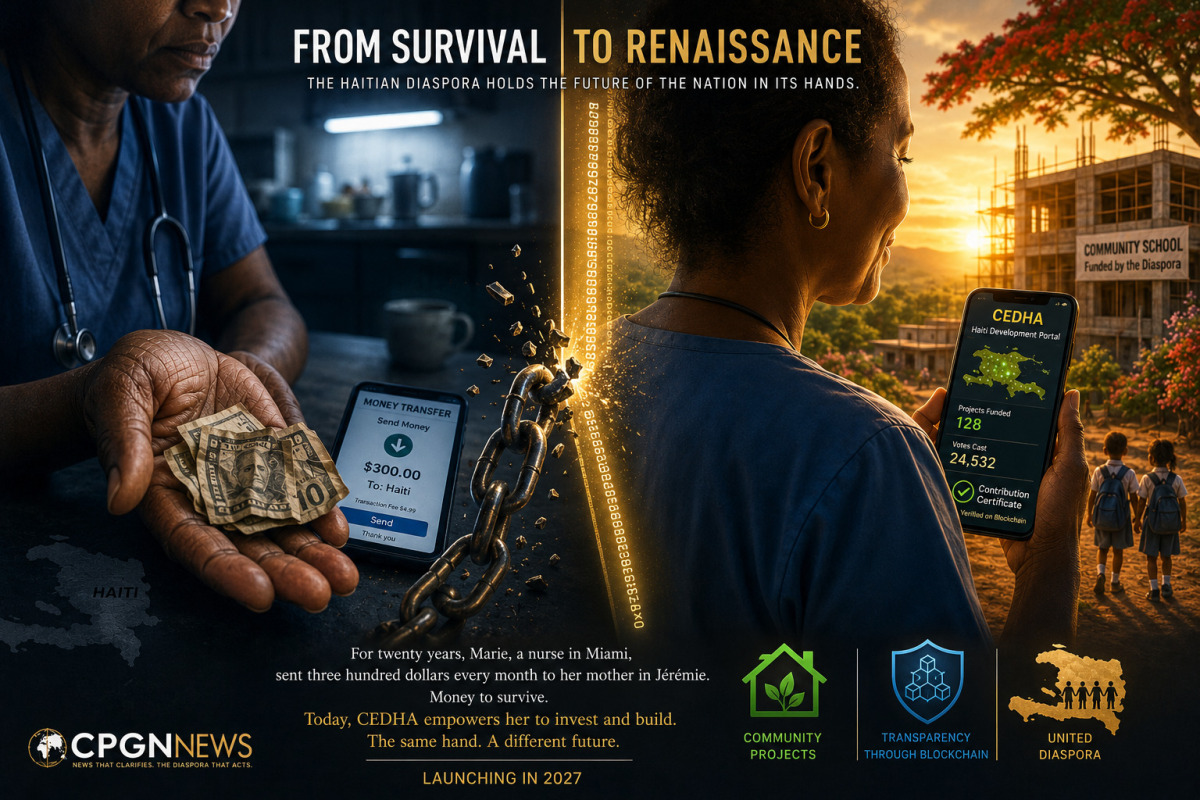
After decades of neglect, institutional failure, and political chaos, a new economic conference backed by blockchain technology and independent oversight promises to After decades of broken promises, institutional failures, and recurring political turmoil, a bold new proposal seeks to reshape the relationship between Haiti and its global diaspora. Called the Haitian Diaspora Economic Conference (CEDHA), the initiative expected to launch in 2027 would channel part of the estimated $3.8 billion sent annually by Haitians abroad into transparent, accountable, and productive investments. Supported by blockchain technology and an independent governance structure, the CEDHA presents itself as an alternative to the Ministry of Haitians Living Abroad (MHAVE) and as a potential catalyst for a new era of Haitian economic development.
Port-au-Prince, Haiti – Miami, Montreal, Paris, Santiago.
Marie is forty-five years old. She is a nurse in Miami’s Little Haiti neighborhood. On Tuesday evening, after a double shift, she opens the Western Union app on her phone. Three hundred dollars. Again. Her mother in Jérémie is waiting for that money to pay the rent, to buy rice, beans, a little cooking oil. Marie has been sending this money for twenty years. She left Haiti two decades ago, but Haiti never left her.
The same scene plays out in Montreal-Nord, in the 18th arrondissement of Paris, in Quilicura on the outskirts of Santiago, a neighborhood Chileans have nicknamed Haitilicura. The same fingers tapping on screens. The same sums crossing oceans. The same question, never answered.
Does any of this actually change Haiti?
The honest answer, the one nobody dares speak at charity galas or diplomatic receptions, is no. Sending money without decision-making power does not structurally transform a country. The 3.3to3.3to3.8 billion sent home each year by the Haitian diaspora, roughly 20 percent of Haiti’s GDP, is a life raft that keeps the nation from sinking. But it is consumed to survive, not invested to build. Less than one percent of that money goes into productive, long-term projects.
After decades of failed promises, Haiti is now attempting a radical reversal. The government, together with the political movement PARASOL and its founder Yvon Bonhomme, has unveiled a proposal that aims to turn the diaspora from a passive remittance sender into an active national architect. The instrument is the Conférence Économique de la Diaspora Haïtienne, or CEDHA, the Haitian Diaspora Economic Conference. The launch date is 2027. The question is whether Haitians abroad will believe it this time.
The Ministry of Haitians Living Abroad, known by its French acronym MHAVE, was created in the mid-2000s with a clear mission. It was supposed to coordinate relations between the state and the diaspora, protect the rights of Haitians overseas, and channel their investments into national development. Fifteen years later, the verdict is devastating.
The annual budget of the MHAVE hovers around $10 million. Only five to seven percent of that amount is actually spent on programs that benefit the diaspora. The ministry employs twenty-five permanent staff, of whom just seven have any specialization in international relations. Over a decade and a half, fewer than five major investment projects have been completed. A 2020 report by Haiti’s Inspector General of the State revealed serious financial irregularities, misallocation of resources, and outright embezzlement through suspicious contracts. The ministry never managed to build a functional digital platform, nor credible transparency mechanisms, nor solid partnerships with diaspora organizations.
Internationally, the comparison is stark. India spends approximately $50 million annually on its Ministry of Overseas Indian Affairs, which employs more than 400 people and helps channel roughly 15 percent of remittances into productive investment. Mexico’s Institute for Mexicans Abroad operates with an annual budget of approximately $35 million and a specialized staff of 250 professionals. The Philippines achieves an estimated remittance-to-investment conversion rate of 18 percent. Haiti, through its Ministry of Haitians Living Abroad (MHAVE), remains below 2 percent. The CEDHA’s objective is to increase that figure to between 15 and 20 percent by 2037.A member of a diaspora association in Boston summarized the prevailing sentiment in a phrase that has become famous in community circles. They call us when it is time to pay. Never when it is time to decide.
To understand the scale of what is at stake, one must look at how the Haitian diaspora was built. Four major waves of emigration have shaped its global geography.
The first wave, from 1957 to 1986, was the Duvalier exodus. Under the regimes of François Papa Doc and his son Jean-Claude Baby Doc, hundreds of thousands of Haitians fled terror and political repression. These were mostly professionals, intellectuals, merchants, and the middle class. They settled in New York, Miami, Montreal, and Paris.
The second wave followed the 1991 coup against President Jean-Bertrand Aristide. Thousands took to the sea in rickety boats, strengthening the communities of Florida and New York.
The third wave was triggered by the January 12, 2010 earthquake, which devastated Port-au-Prince and its surroundings, killing more than two hundred thousand people and displacing one and a half million. In the months that followed, tens of thousands of Haitians migrated to Brazil and Chile, creating new communities in South America.
The fourth wave is ongoing. Since the assassination of President Jovenel Moïse in July 2021 and the collapse of state control in the face of armed gangs, a new exodus has begun. In 2023 alone, at least 470 migrants disappeared or died in the Caribbean, according to the International Organization for Migration.
Four waves of flight. Zero waves of organized return.
The figures are staggering, yet they reveal only part of Haiti’s economic reality. The Bank of the Republic of Haiti (BRH) recorded approximately $3.28 billion in diaspora remittances in 2023. Estimates based on the broader methodologies of the World Bank and the Haitian Institute of Statistics and Informatics (IHSI) place the total closer to $3.7–$3.8 billion. Whatever the exact figure, one fact is undeniable: Haitians living abroad send home sums that are two to three times greater than the humanitarian aid Haiti receives each year.
The internal distribution is deeply unequal. The West department, which includes Port-au-Prince, captures 68.39 percent of all transfers, about $2.25 billion. Artibonite receives 9.63 percent. The North receives 4.93 percent. The South receives 4.54 percent. The remaining departments share just 12.51 percent.
This territorial imbalance is one of the CEDHA’s explicit targets. By 2031, the conference aims to have forty percent of its funded projects located outside the Port-au-Prince metropolitan area. By 2037, that share should reach forty-five percent.
The diaspora, in other words, is indispensable to daily survival. But it remains institutionally invisible. It sits on no boards. It votes on no budgets. It decides no national priorities. The CEDHA proposes to break that paradox not by reforming the old ministry, but by replacing it entirely with an entirely new architecture.
The CEDHA is built on eight foundational ruptures.
The first rupture is institutional. The CEDHA is not a ministry. It is an autonomous economic conference with an independent board that receives no political interference. The board has seven members proposed by the diaspora, vetted through administrative and technical investigations, approved by the Senate by a two-thirds majority, and appointed by presidential decree. Their mandate is three years, renewable once. They select projects, validate budgets, supervise execution, and cosign all disbursements.
The second rupture is financial. Diaspora funds are not deposited into the general state budget. They are held in sovereign accounts at the Bank of the Republic of Haiti, completely separate from ordinary public finances. Every dollar is traceable.
The third rupture is technological. Each transaction, each disbursement, each project deliverable is recorded on a public blockchain. The chosen architecture is a private or permissioned blockchain using Hyperledger Fabric or Stellar, with validating nodes operated by the central bank, the telecommunications ministry, the CEDHA board, and two elected representatives of the diaspora. Consensus requires a multi-signature of three out of five keys. Public access is read-only, but everyone can see everything. No one can erase or alter a transaction. A citizen who wants to check whether a school was actually built can do so from a mobile phone.
The fourth rupture is democratic. Every investor receives a digital contribution certificate, one certificate per dollar invested. That certificate grants a weighted vote on the annual strategic orientations of the CEDHA, with a degressivity mechanism to prevent large investors from dominating smaller ones.
The fifth rupture is territorial. The CEDHA establishes regional offices inside Haiti, in Cap-Haïtien for the Grand North, in Les Cayes for the Grand South, and in Port-au-Prince for the metropolitan area. It also opens a liaison office in Washington, D.C., to maintain operational continuity in the event of a major political crisis in Haiti.
The sixth rupture is transparency. A digital portal tracks every project in real time: budget, deadlines, beneficiaries, photographs, videos. A citizen reporting mechanism triggers an investigation within forty-eight hours.
The seventh rupture is rigor. Eight key performance indicators are defined, tracked annually, and made public. A risk matrix identifies eight major dangers and proposes mitigation strategies for each.
The eighth rupture is philosophical. The CEDHA is grounded in what its creator Yvon Bonhomme calls Humanist Dessalinism, a political philosophy that draws three principles from the legacy of Jean-Jacques Dessalines, the founding father of Haitian independence. Sovereignty reclaimed. Dignity imposed. Social justice for all. For the diaspora, this translates into a board that decides, a vote for every investor no matter how modest, and a blockchain that makes everything visible, ending the dark holes of administration.
The CEDHA is not a leap of faith. It rests on a formalized theory of change that can be stated clearly and verified over time.
If the diaspora invests through transparent mechanisms, and if the independent board selects projects according to strict criteria, then the capture rate of remittances into productive investment will rise from below one percent to between fifteen and twenty percent, which will generate hundreds of thousands of jobs and billions of dollars in additional GDP.
The ten-year projections follow a clear and measurable trajectory under the median scenario. During the first operational year, 2027, CEDHA-financed investments are projected to reach between $280 million and $350 million. By 2029, the range rises to between $296 million and $370 million. In 2031, investments are expected to reach between $320 million and $400 million. By 2033, they increase further to between $352 million and $440 million. In 2035, projected investments reach between $400 million and $500 million. By 2037, annual investment volumes are expected to range between $416 million and $520 million.
The economic multiplier varies by sector. Irrigated agriculture offers the highest estimated multiplier, at 1.8, meaning that each dollar invested generates approximately $1.80 in additional economic value. Education follows with a multiplier of 1.7. Infrastructure and digital technologies generate multipliers of 1.6, while renewable energy and tourism average 1.5. Health sector investments produce an estimated multiplier of 1.4.
The comparison with the status quo in 2037 is particularly striking. Without the CEDHA, productive investments financed by the diaspora would likely remain below $50 million annually. With the CEDHA, those investments are projected to reach between $416 million and $520 million per year—an increase of eight to ten times. Employment creation would rise from fewer than 10,000 jobs under the current model to between 80,000 and 120,000 jobs, representing an eight- to twelve-fold increase. Additional GDP generated by diaspora-financed productive investment would expand from less than $80 million annually to between $1.2 billion and $1.6 billion, equivalent to a fifteen- to twenty-fold increase.
The CEDHA is not content with grand declarations. Five pilot projects have already been modeled and could be launched as early as 2027.
The first project is a digital community school in Jérémie, with a total cost of $250,000, of which $150,000 would be financed through the CEDHA. The school would serve approximately 400 students per year and create 15 direct jobs, with an estimated social return on investment of 1.8.
The second project is an off-grid solar power plant in the South Department. With a total cost of $2 million, including $1.2 million financed by the CEDHA, the facility would provide electricity to approximately 5,000 households, reduce carbon emissions by an estimated 2,500 tons annually, and create 40 direct jobs.
The third project is a telemedicine platform in the Artibonite region, with a total cost of $350,000, financed entirely by diaspora investors. The platform would connect 12 rural health clinics and facilitate approximately 15,000 remote medical consultations each year.
The fourth project is an irrigated agricultural cooperative in Artibonite, with a total investment of $600,000, including $400,000 financed through the CEDHA. The cooperative would support 250 farmers cultivating 120 hectares of irrigated land and is expected to increase agricultural yields by approximately 200 percent.
The fifth project is a technology startup incubator in Port-au-Prince, with a total budget of $500,000, half of which would be financed by the diaspora. The incubator would support 10 startups annually while providing training and mentorship opportunities to approximately 200 young people each year.
These five projects are intentionally modest. They are not utopian visions but practical proofs of concept. Their purpose is to demonstrate the viability of the model, build public confidence, and establish the institutional credibility necessary for larger-scale investments in the years ahead.
The attentive reader will have noticed that all projections begin in 2027, not in 2024 or 2025. This delay is deliberate and assumes a form of strategic patience.
Haiti is in the midst of a deep political crisis, marked by the absence of regular elections, the vacancy of legitimate institutions, and a prolonged transition. Launching the CEDHA today would risk political capture or delegitimization. Yvon Bonhomme, the founder of PARASOL and the intellectual author of the project, puts it bluntly. A project of this magnitude, touching the very heart of the relationship between Haiti and its diaspora, cannot be rushed or launched under contested institutional legitimacy.
The CEDHA will therefore become one of the first major undertakings of the Second Republic, once minimal democratic conditions are in place. Until then, this document remains a reference, a matrix for reflection, and a philosophical and technical contract that PARASOL submits to national debate and to the diaspora.
The years 2024 to 2026 will be a prefiguration phase structured around six axes. Consultations with diaspora communities. Finalization of legal frameworks. Technical blockchain experiments. Recruitment and training of future managers. Mobilization of preparatory financing. Public awareness and citizen engagement campaigns.
As Bonhomme puts it in a phrase intended to become the project’s mantra, we are rushing nothing, but we are renouncing nothing. The renaissance will come on Haitian time, not on the time of imported clocks.
No project of this scale is without risk. The CEDHA identifies eight major risks and proposes mitigation strategies for each.
The most obvious risk is political instability, both highly probable and highly impactful. The mitigation relies on three pillars. The board is independent of the sitting government. The central bank accounts are protected and separate from the general budget. In the event of a major crisis, the Washington office can be activated and operational continuity maintained.
The risk of board member corruption is judged low in probability but very high in impact. The blockchain allows real-time auditing. A recall procedure is provided. Criminal prosecution is possible.
The risk of cyberattack against the platform is considered medium in probability and high in impact. The response combines advanced cryptography, external security audits, and data redundancy.
The risk of administrative blockage by reluctant civil servants is considered medium in probability but high in impact. Double signature for disbursements and an automatic release clause in case of excessive delay are provided.
The risk of gourde depreciation against the dollar, highly probable but of moderate impact, is addressed by keeping accounts in dollars and converting only at the time of disbursement.
An independent international supervision mechanism is also foreseen. It brings together the World Bank, the Inter-American Development Bank, two diaspora representatives, Haitian civil society organizations, and an expert designated by the United Nations or the Organization of American States. This body conducts an annual audit, can issue suspensive recommendations, has unlimited access to data, and can trigger a red alert in case of serious dysfunction.
Behind the numbers and the institutions, there are lives. The CEDHA has collected five testimonies that summarize better than any speech the longing and weariness of a generation.
Marie, forty-five, a nurse in Miami, says she no longer wants to just send money. She wants to send a future. She has been sending three hundred dollars a month to her mother in Jérémie for twenty years, never knowing where the money goes once it has paid for rent, rice, and medicine.
Jean-Baptiste, thirty-two, an engineer in Montreal, says he could train young people in Port-au-Prince, but no one has ever asked him. He has skills, networks, valuable experience, but no channel to put them at the service of his country.
Fabienne, fifty, a teacher in Paris, speaks of the memory of her father, who died without ever seeing Haiti again. She wants her daughter to see something other than ruins. For her, the CEDHA is a promise of reconciliation between generations and between the two shores of the Atlantic.
Emmanuel, twenty-eight, a worker in Santiago, earns a good living in Chile but wants to invest at home. He is not asking for charity. He is asking for a reliable mechanism to put his savings to work for the benefit of his home community.
Rachel, thirty-nine, a lawyer in New York, summarizes the general feeling with a biting formula. They call us for charity galas. Never for board meetings. She wants to sit where decisions are made, not where checks are signed.
The CEDHA is not only a Haitian project. It should also interest international donors and partners for three reasons.
The first is geopolitical. The United States is seeking to relocate its supply chains through nearshoring. Haiti, with its one-and-a-half-hour flight from Florida, its young and bilingual workforce, and its strategic maritime position at the heart of the Caribbean, could become a major logistics and manufacturing platform. But to seize this opportunity, Haiti needs infrastructure, energy, roads, ports, and training. The diaspora can finance all of this, provided transparency and trust are guaranteed.
The second is methodological. The CEDHA is experimenting with a blockchain-based governance mechanism applied to diaspora mobilization. If the model works, it could be replicated in other Global South countries facing the same challenges of remittance capture and corruption control. International institutions such as the World Bank and the United Nations Development Program are already following such innovations with interest.
The third is diplomatic. The CEDHA creates an institutional bridge between Haiti and its diasporas in the United States, Canada, France, Chile, and Brazil. These diasporas are influential economic, political, and cultural actors in their host countries. Better involving them in Haiti’s development also helps stabilize the country and reduce uncontrolled migration flows.
Seven criticisms recur regularly in debates. The CEDHA addresses them head on.
First criticism. The diaspora is not organized enough to carry such a project. The response is that more than 1,200 associations already exist worldwide. The CEDHA provides a framework to federate these forces. It does not wait for perfect organization to begin.
Second criticism. The Haitian state will steal the money, as in the past. The response is that the accounts are separate from the general budget, held at the central bank, secured by a multi-signature blockchain, and audited by international bodies. Stealing becomes impossible without leaving traces immediately visible to all citizens.
Third criticism. Projects will never be completed, like so many others. The response is that payments are staggered based on validated deliverables, penalties are provided for delays, and a blacklist of defaulting companies will be maintained.
Fourth criticism. Blockchain is too complicated for Haiti. The response is that the general public interacts only with a web portal, as simple as any online banking site. The complexity is technical, not human. Haitians already use Western Union, mobile banking, and social networks without mastering their underlying architectures.
Fifth criticism. PARASOL will never govern, so this document is a pipe dream. The response is that the CEDHA is designed as a framework law. Any rational government, regardless of political affiliation, can adopt it. The document is placed on the table of national debate, not as a partisan property, but as a public policy offer.
Sixth criticism. The diaspora will continue to prioritize direct family aid over collective investment. The response is the 2023 IOM survey, which indicates that 68 percent of diaspora members are willing to invest collectively if transparency is guaranteed. The demand exists. The supply has been missing. The CEDHA aims to fill that void.
Seventh criticism. The diaspora will dictate its law from abroad without knowing local realities. The response is that the board is composed of both diaspora and local representatives, that priorities emerge from the municipalities through the regional offices, and that the diaspora is a partner, not a parallel government. Haitians inside and outside the country co-construct. They do not confront each other.
The CEDHA follows a five-phase roadmap.
Phase zero, prefiguration, covers the years 2024 to 2026. Its objectives are diaspora consultations, finalization of the framework law, technical blockchain tests, recruitment and training of future managers, mobilization of preparatory financing, and public awareness campaigns.
Phase one, foundation, is the year 2027. The board is installed. The sovereign accounts at the central bank are opened. Fifteen to twenty pilot projects are launched.
Phase Two, the Scale-Up Phase, covers the years 2028 and 2029. By this stage, the digital portal is fully operational, governance mechanisms have been tested, and public confidence has begun to grow. Annual investments are projected to reach between $296 million and $370 million, marking a significant increase in diaspora participation and productive capital mobilization.
Phase three, acceleration, covers 2030 and 2031. One hundred twenty to one hundred sixty projects are completed, creating twenty-five thousand to thirty-five thousand jobs.
Phase four, maturity, covers 2032 to 2037. Five hundred to six hundred projects are completed, generating eighty thousand to one hundred twenty thousand jobs.
Eight key performance indicators will be tracked annually and made public. The amounts invested. The capture rate. The number of projects completed. The number of jobs created. The number of diaspora members registered on the portal. The investor satisfaction rate. The average time for fund release. And the share of projects completed outside the Port-au-Prince metropolitan area.
On January 1, 1804, the ancestors of the Haitian nation signed the birth certificate of the first black republic in the world. On the day of the adoption of the CEDHA, we will sign the coming of age of the Haitian diaspora, the moment when we stop sending money to survive and finally start investing in life.
The renaissance is not given. It is built with you. 2027 is tomorrow.
This document is published by the PARASOL political movement as part of its program Renaissance: Leave No One Behind. It is submitted to national debate, to diaspora associations, to international institutions, and to all citizens of good will who refuse to believe that Haiti is condemned to eternal relief.
The Haitian Diaspora Economic Conference aims to be the greatest socioeconomic vision of the Republic of Haiti since its independence in 1804. Time will tell whether this ambition was justified or excessive. But one thing is certain. Never again will the diaspora be able to say that no contract was offered to them. The contract is here. Its name is CEDHA. It begins in 2027. It awaits its signatories.
CPGNNews – Special Report
Sources: Bank of the Republic of Haiti, World Bank, International Organization for Migration, Inspector General of the State of Haiti, Haitian Observatory of Public Policies, Brookings Institution, Migration Policy Institute, Statistics Canada, France Stratégie, US Department of Homeland Security, IOM 2023 survey.
