


By the CPGNNews Editorial Team
Section: Global Perspective – A View from the Caribbean
April 2026.-
A war of attrition. Diplomatic deadlock. Global fragmentation. For the Caribbean, vulnerability shows up every month in the import bill.
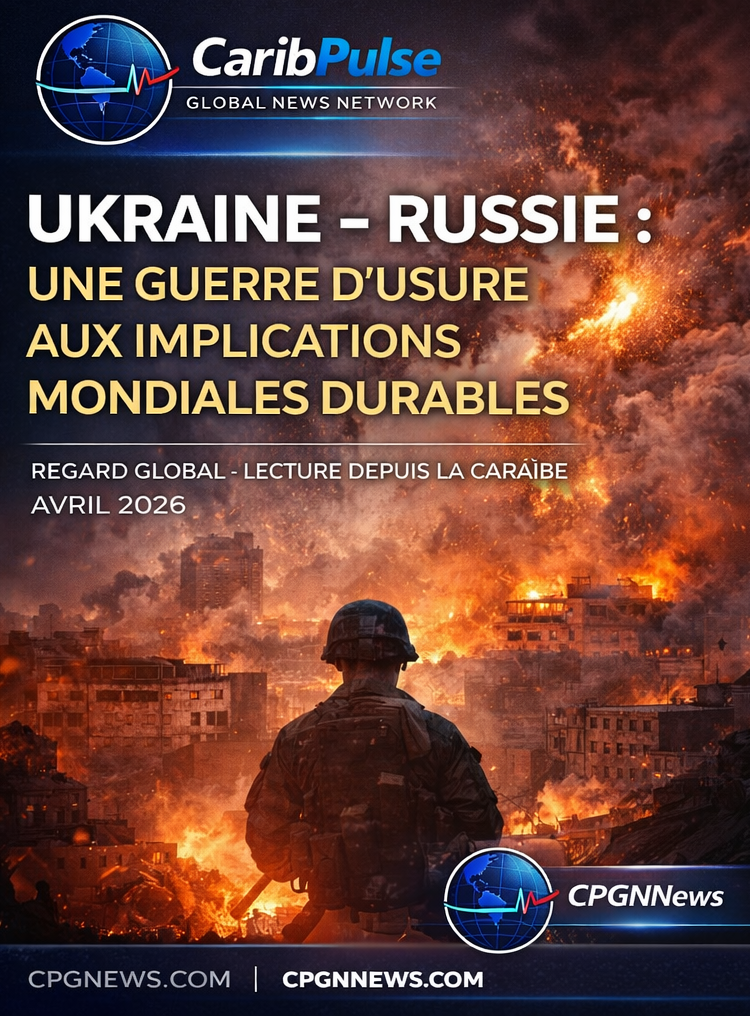
The strategic face-off between Vladimir Putin and Volodymyr Zelenskyy has become one of the central markers of contemporary geopolitical tensions. Month after month, this conflict has evolved into a prolonged confrontation where attrition is no longer a consequence — it has become a strategy.
A Stalemate on the Battlefield.
On the ground, the front lines have barely moved, despite continuous military operations. This situation reflects an unstable balance where neither side can impose a decisive victory. Ukraine benefits from steady Western support, while Russia relies on its internal capabilities and a long-term strategy.
According to analyses relayed by Reuters, the increasing lethality of drones and the consolidation of Russian positions make any major breakthrough unlikely in the short term. Several converging estimates suggest no significant front-line movement should be expected before 2027. Meanwhile, France 24 and the Institute for the Study of War point out that net territorial gains on both sides have not exceeded 0.5% of the front line over the past six months.
This phase of the conflict could therefore continue, reinforcing the likelihood of a long war.
A Confrontation with Global Dimensions.-
Beyond the Ukrainian theater, this war reflects a gradual reshaping of international balances.
It highlights:
- The rivalry between major powers,
- The weakening of multilateral mechanisms,
- The rise of bloc politics.
In this context, the war is accelerating the transition toward a more fragmented world order. China, in particular, is walking a tightrope, adjusting its position between strategic support for Moscow, diplomatic caution toward Europe, and growing influence in the Global South.
A Persistent Diplomatic Impasse.-
Mediation efforts have so far produced no significant progress. The summits in Malta (2025) and Jeddah (2026) failed to establish a common framework for negotiation.
The positions remain deeply opposed:
- Ukraine demands the full restoration of its territorial integrity,
- Russia seeks to consolidate its strategic gains.
This structural deadlock reinforces the prospect of a lasting conflict.
Deep Economic Repercussions.-
The war in Ukraine has direct and lasting effects on the global economy. Disruptions in energy and agricultural markets — wheat, corn, sunflower oil, fertilizers — have led to:
- A structural rise in food prices,
- Recurring tensions in supply chains,
- Persistent imported inflation.
According to the World Bank (April 2026), global cereal prices remain about 18% above their pre-war level, despite the establishment of alternative corridors through Romania and Poland.
For economies dependent on imports — especially in Africa, the Middle East, and the Caribbean — these shocks are no longer temporary. They are here to stay.
A View from the Caribbean: Growing Exposure to External Shocks
For the Caribbean, the effects of this conflict are both tangible and varied. The region, heavily dependent on food and energy imports, directly feels the fluctuations of global markets. Rising living costs amplify vulnerabilities that were already present.
Contrasting Situations:
- Trinidad and Tobago, an exporter of liquefied natural gas, temporarily benefited from higher energy prices while still suffering from imported inflation on food products.
- Barbados, Jamaica, and Haiti, net importers of cereals, have seen their food bills increase by 25 to 35% since 2022, according to CARICOM.
- In Haiti, the social tensions observed in 2025 were worsened by rising prices for basic goods, in a context already marked by internal instability.
A Revealed Structural Fragility.-
In economies characterized by:
- High debt,
- Limited foreign exchange reserves,
- High exposure to climate hazards.
External shocks can quickly become destabilizing factors.
A concrete example: in the Dominican Republic, the price of bread has risen by about 40% between 2022 and 2026, contributing to growing social tensions.
A Strategic Lesson for Caribbean States.-
Beyond its immediate impacts, the war in Ukraine offers several key lessons:
- Strengthen economic resilience: Develop regional agro-processing (cassava, sweet potato, local substitutes).
- Diversify international partnerships: Expand toward India, Brazil, or Turkey.
- Consolidate economic institutions: Strengthen CARICOM coordination mechanisms
In an unstable international environment, the ability to adapt becomes a strategic imperative.
Conclusion.-
The war between Russia and Ukraine extends far beyond its geographical framework. It embodies the deep transformations of the international system: the limits of diplomacy, the return of power politics, and the fragility of interconnected economies.
For the Caribbean, it acts as a revealer. Understanding global dynamics is no longer optional — it is essential.
Sidebar — Key Figures: Ukraine & the Caribbean
Indicator
Value
Source
Global cereal price increase (2022–2026)
+18%
World Bank
Bread price increase (Dominican Republic)
+40%
Social Observatory
Food bill increase (Barbados, Jamaica, Haiti)
25–35%
CARICOM
Front line movement (6 months)
< 0.5%
ISW / Reuters
CARICOM trade agreements (Ukraine/Russia)
0
CARICOM
