


By Yvon Bonhomme
President and Founder of PARASOL
Founder and Editor-in-Chief of CPGNNews – CaribPulse Global News Network
Independent Researcher | Essayist | Stoic | Geopolitical Analyst
From the Caribbean, interpreting the world with rigor, independence, and strategic vision.
Editorial Introduction
The Middle East: A Key to Understanding the Contemporary World from the Caribbean
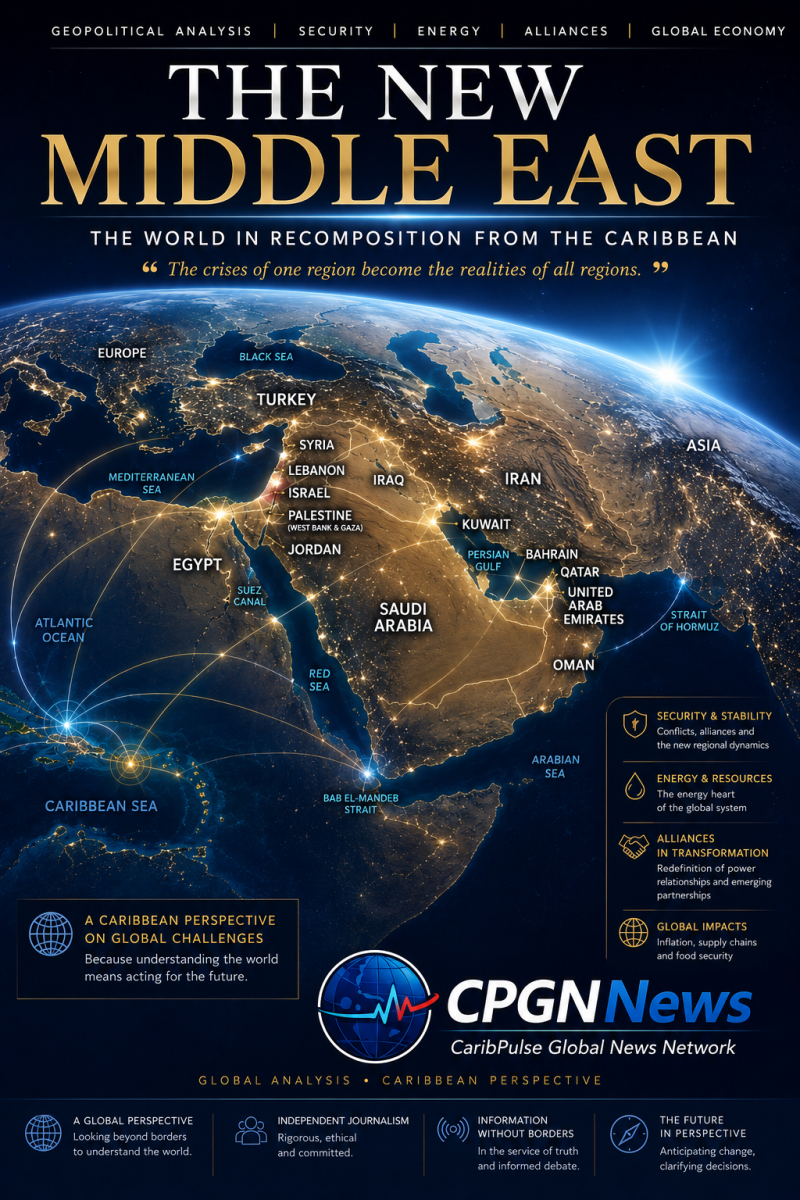
The Middle East can no longer be regarded as a distant region reserved for geopolitical specialists or the exclusive concern of the world’s major powers. What is unfolding there today extends far beyond its own borders. The region has become one of the principal arenas in which the profound transformations of the contemporary international system are revealed: rivalry among great powers, the reshaping of alliances, energy security, sovereignty disputes, political transitions, and the gradual emergence of a new global equilibrium.
For more than a century, the Middle East has occupied a singular place in the history of international relations. As a crossroads of civilizations, the cradle of the world’s great religious traditions, a strategic region situated at the intersection of Europe, Asia, and Africa, and a vital hub of global energy resources, it has remained one of the foremost theaters where national ambitions, economic interests, and the strategies of major powers converge.
Yet reducing its contemporary history to a succession of wars, crises, or military interventions would overlook the profound transformations that have progressively reshaped its political and strategic architecture. Today’s Middle East is the product of a long historical process marked by the collapse of empires, the creation of modern states, ideological rivalries, struggles for sovereignty, foreign intervention, and the aspirations of peoples determined to shape their own future.
From the Iran-Iraq War (1980–1988) to Operation Desert Storm in 1991; from the fall of Saddam Hussein’s regime in Iraq in 2003 to the political upheavals triggered by the Arab uprisings of 2011; from Egypt’s transformation in the post-Hosni Mubarak era to the expanding regional ambitions of Iran, Türkiye, and the Gulf monarchies, each successive crisis has added a new dimension to the ongoing reconfiguration of the Middle East.
The major developments shaping the region today—including tensions between Israel and Iran, the conflicts in Gaza, Syria, and Yemen, the evolving balance of power in the Gulf, the rise of new forms of regional diplomacy, and strategic competition among the United States, China, and Russia—are therefore not isolated phenomena. They are the visible manifestations of a far deeper transformation: the gradual evolution of the international order from an era dominated by a single overwhelmingly preeminent power toward a more fragmented, more competitive, and increasingly multipolar global architecture.
Analyzing the Middle East today is therefore not merely a matter of examining regional crises. It means understanding a strategic laboratory in which several of the defining trends of the twenty-first century are taking shape: the return of great-power competition, the growing influence of autonomous regional actors, the increasing strategic importance of energy, the transformation of warfare through advanced military technologies, cyber operations, and artificial intelligence, as well as the gradual redefinition of international alliances.
The decisions made in Tehran, Jerusalem, Riyadh, Ankara, Doha, Washington, Moscow, or Beijing no longer remain confined to the territories in which they originate. They influence energy markets, global trade routes, supply chains, financial stability, and the strategic choices of numerous states, including those of the Caribbean. Tensions in the Strait of Hormuz, disruptions around the Suez Canal, or fluctuations in global oil markets can have direct consequences for energy costs, economic security, and the development prospects of island societies.
From the Caribbean perspective, therefore, the Middle East is neither a distant nor an external reality. It is an integral part of our strategic environment. Energy dependence, vulnerability to international economic shocks, and exposure to the transformations of global trade all underscore a fundamental reality: in an interdependent world, no region can be understood in isolation.
It is within this perspective that the mission of CPGNNews – CaribPulse Global News Network takes shape. Founded in the Caribbean, CPGNNews has chosen to examine the world in its entirety, guided by the conviction that our region should not merely observe global transformations, but should also become a source of original, rigorous, and independent analysis.
The Caribbean has often been portrayed as a peripheral region within the international system. Its history, however, tells a far more complex story. It has stood at the crossroads of major maritime routes, global commerce, migration, imperial rivalries, and the political upheavals that shaped the modern world. Its historical experience of colonization, resistance, dependency, and reconstruction has endowed it with a unique capacity to understand international power dynamics and their human consequences.
Haiti occupies a singular place within that history. As the world’s first independent Black republic, born in 1804 from a revolution that profoundly transformed the universal history of freedom, it stands as a reminder that a people can reshape the established order when they refuse to surrender their dignity and sovereignty. Its historical journey—with its triumphs, its wounds, and its contemporary challenges—offers an essential perspective on questions of power, independence, justice, and development.
At CPGNNews, our ambition is not to replicate analyses already produced by the world’s major centers of strategic thought and decision-making. Rather, it is to make a distinctive contribution: to explain the world from the Caribbean through the standards of professional journalism, the depth of historical analysis, and an unwavering commitment to factual accuracy.
We believe that the mission of a news organization extends beyond reporting events. It must also enable readers to understand why events occur, how they fit into a broader historical continuum, and what consequences they may have for societies. In an age dominated by immediacy and the relentless flow of information, our responsibility is to privilege understanding, historical perspective, and the search for meaning.
Yet no geopolitical analysis can be complete if it overlooks the women and men who bear the consequences of decisions made in the highest circles of state power. Behind strategic maps, power rivalries, economic sanctions, and military doctrines lie enduring human realities: displaced families, children whose futures have been disrupted, communities living under uncertainty, but also societies capable of resilience, creativity, and hope.
It is this balance between analytical rigor and human depth that defines the editorial philosophy of CPGNNews. Understanding international power relations is indispensable, but understanding their impact on people is equally essential.
Through this special report on the New Middle East, CPGNNews offers a historical, geopolitical, and human-centered reading of a region whose ongoing transformation is helping to shape the future of the international system. This analysis does not claim to impose a single interpretation. Rather, it seeks to provide a space for reflection where experiences, historical memory, and diverse perspectives may engage in meaningful dialogue.
Our ambition is to contribute to a new intellectual mapping of the world—one in which Caribbean voices are no longer merely witnesses to global transformation, but active participants in its interpretation.
For understanding the world is not simply about observing the powers that make decisions. It is also about listening to the peoples who live with their consequences.
The Roots of the Contemporary Middle East (1916–1979)
From an Imperial Order to a Regional Order: The Foundations of Enduring Instability
The crises that continue to shake the Middle East are often portrayed as the immediate consequences of contemporary wars, sectarian rivalries, or confrontations among regional powers. Such a perspective, however, centered primarily on current events, fails to capture the historical depth of the forces at work. Today’s tensions are rooted in a long process of political transformation that began in the early twentieth century, when the gradual collapse of the Ottoman Empire ushered in an era of territorial redefinition whose consequences continue to shape the region.
For nearly four centuries, much of the Middle East formed an integral part of the Ottoman Empire. Despite its limitations and profound internal disparities, the imperial system provided a relatively coherent political framework within which diverse peoples, languages, religious traditions, and local identities coexisted. The Arab provinces enjoyed varying degrees of administrative autonomy, while tribal, religious, and communal affiliations were organized under a common imperial authority.
The First World War fundamentally disrupted this equilibrium. Allied with the Central Powers, the Ottoman Empire emerged defeated from the conflict and ultimately collapsed in 1918. Its dissolution triggered intense competition among the European powers—principally the United Kingdom and France—each determined to consolidate its strategic influence over a region already recognized for both its exceptional geographic position and its vast energy potential.
As early as 1916, while the war was still raging, British diplomat Sir Mark Sykes and French diplomat François Georges-Picot secretly negotiated an agreement designed to divide the Arab provinces of the Ottoman Empire following an Allied victory. Known as the Sykes-Picot Agreement, it remains one of the most consequential episodes in the modern history of the Middle East.
By drawing spheres of influence based largely on the strategic interests of the colonial powers rather than on the historical, cultural, or social realities of local populations, the agreement laid the foundations of a new regional order whose inherent fragilities would gradually become apparent over the course of the following century. Numerous borders were established with little regard for tribal affiliations, religious communities, linguistic identities, or economic realities, creating states that would later be required to manage remarkable internal diversity within often incomplete nation-building processes.
It would nevertheless be overly simplistic to attribute all of today’s challenges solely to the borders inherited from this period. Contemporary scholarship demonstrates that the conflicts affecting the Middle East result from a far more complex interaction of factors, including imperial legacies, the strategies of foreign powers, regional rivalries, economic dynamics, ideological transformations, social change, and the political choices made by successive national leaders. The post-war borders undoubtedly constitute an important part of this history, but they do not, by themselves, explain the region’s entire historical trajectory.
Following the war, the League of Nations established a system of mandates entrusted primarily to the United Kingdom and France. Presented as a temporary administrative arrangement intended to guide newly formed territories toward independence, the mandate system in practice enabled the European powers to extend their political, economic, and military influence over a region that had become strategically indispensable.
The United Kingdom assumed administration over Iraq, Palestine, and Transjordan, while France exercised authority over Syria and Lebanon. These administrations facilitated the development of modern governmental institutions, transportation infrastructure, and administrative systems. At the same time, however, they often reinforced existing internal divisions by favoring particular communities in the organization of political power. The legacy of these policies remains a subject of considerable historical debate.
Parallel to this political reorganization, another development profoundly transformed the regional balance of power: the discovery and progressive exploitation of the Middle East’s immense petroleum reserves. Beginning in the 1920s—and particularly following the major discoveries in Iraq, Arabia, Kuwait, and the Gulf—the region acquired an unprecedented level of strategic significance. Control over energy resources gradually became a central objective of the foreign policies pursued by the world’s leading industrial powers, permanently linking the security of the Middle East to the stability of the global economy.
The rise of the petroleum industry also transformed relations among the states of the region. Oil-producing countries progressively accumulated extraordinary financial resources that accelerated modernization and economic development, while control over maritime routes, strategic straits, and energy infrastructure became a central component of international military planning. From that period onward, the Middle East ceased to be merely a regional geopolitical space; it became one of the principal pillars of the world economy.
The decades that followed witnessed the emergence of powerful nationalist movements. Aspirations for independence, fueled by opposition to colonial rule, encouraged the rise of leaders advocating ambitious political projects. Arab nationalism, traditional monarchies, reformist movements, religious currents, and revolutionary ideologies increasingly coexisted—and often competed with one another—foreshadowing the major ideological confrontations that would define the second half of the twentieth century.
By the end of the Second World War, the Middle East had become far more than a geographical crossroads linking three continents. It had evolved into a strategic intersection where global energy interests, great-power rivalries, the national aspirations of newly independent peoples, and identity-based tensions inherited from a century of political transformation converged. The decades that followed would accelerate these dynamics with the creation of the State of Israel, the rise of Arab nationalism, the Cold War, the oil shocks, and ultimately the watershed events of 1979, which would open the defining chapter of what has become known as the New Middle East.
Long before the contemporary conflicts that dominate today’s headlines, therefore, the foundations of the region’s current crises had already been established through successive diplomatic decisions, territorial reconfigurations, and economic transformations that fundamentally reshaped the regional balance of power. Understanding this historical legacy is far more than a retrospective academic exercise; it is an essential prerequisite for rigorously analyzing the geopolitical transformations that continue to shape the Middle East in the twenty-first century.
1948: The Creation of Israel and the Birth of a Conflict That Would Shape the Contemporary Middle East
If one event fundamentally transformed the political history of the Middle East during the twentieth century, it was undoubtedly the establishment of the State of Israel on May 14, 1948. Beyond its national significance for the Jewish people, the creation of Israel marked a decisive turning point in the geopolitical organization of the region. It inaugurated a new historical era characterized by armed conflict, mass population displacement, diplomatic realignments, and strategic rivalries that, more than seven decades later, continue to influence international relations.
Any rigorous analysis, however, requires placing this event within a broader historical perspective. The origins of the issue lie neither in 1948 nor even in the period of the British Mandate for Palestine. Rather, they are rooted in a succession of political, religious, and national developments that began in the late nineteenth century.
During that period, the Zionist movement, led notably by Theodor Herzl, advocated the establishment of a Jewish national homeland in response to the growing tide of antisemitism across Europe. At the same time, the Arab population of Palestine gradually developed its own national consciousness, inspired by broader aspirations for self-determination that were emerging across many parts of the world.
The First World War accelerated these developments. In 1917, the Balfour Declaration expressed the British government’s support for the establishment in Palestine of “a national home for the Jewish people,” while affirming that the civil and religious rights of the existing non-Jewish communities should be preserved. This deliberately ambiguous wording opened the door to competing interpretations that would fuel tensions for decades to come.
Under the British Mandate, successive waves of Jewish immigration—particularly following the rise of Nazism and the persecution of Jews in Europe—gradually altered the demographic balance. At the same time, concerns among the Arab population intensified, giving rise to increasingly frequent clashes between communities as well as revolts against British rule.
The Second World War and the Holocaust profoundly transformed international debate. The extermination of six million European Jews strengthened the conviction, across much of the international community, that the establishment of a sovereign Jewish state had become both a historical necessity and a moral imperative. In 1947, the United Nations adopted a Partition Plan providing for the creation of two states—one Jewish and one Arab—while granting Jerusalem a special international status.
The plan was accepted by the Zionist leadership but rejected by Palestinian Arab representatives and by several Arab states, which argued that it neither respected the principle of self-determination nor provided an equitable territorial settlement. Under these circumstances, confrontation became virtually inevitable.
On May 14, 1948, David Ben-Gurion formally proclaimed the establishment of the State of Israel. The following day, several Arab armies intervened militarily, marking the beginning of the First Arab-Israeli War. At the end of the conflict, Israel had consolidated its existence and controlled a larger territory than originally allocated under the United Nations Partition Plan. The West Bank came under Jordanian administration, while the Gaza Strip was administered by Egypt. No independent Palestinian state emerged.
The war also produced one of the largest population displacements in the modern history of the region. Several hundred thousand Palestinians fled or were forced to leave their homes under circumstances that remain the subject of historical and political debate. For Palestinians, this episode is known as the Nakba, or “Catastrophe,” and constitutes a foundational element of their national memory. At the same time, in the years that followed, large numbers of Jews living in several Arab countries emigrated to Israel or to other states, further transforming the demographic landscape of the region.
These population movements, together with unresolved questions concerning refugees, abandoned property, the right of return, and compensation mechanisms, remain among the most sensitive issues in every peace process.
Beyond the conflict itself, the creation of Israel profoundly altered the geopolitical balance of the Middle East. National security gradually became the central pillar of Israeli strategic doctrine. Surrounded by hostile states during its early decades, Israel developed a security strategy based on technological superiority, rapid military mobilization, intelligence capabilities, and credible deterrence.
Across the Arab world, the Palestinian issue quickly became a powerful force of political mobilization. It fueled the rise of Arab nationalism, influenced relations between governments and public opinion, and served to legitimize numerous domestic and foreign policy initiatives. Nevertheless, the national interests of Arab states were never entirely identical, leading over time to increasingly divergent approaches toward the conflict.
The decades that followed were marked by major wars in 1956, 1967, and 1973, interspersed with periods of negotiation, ceasefires, and repeated attempts at political settlement. While these conflicts reinforced the centrality of the Israeli-Palestinian issue on the international agenda, they also encouraged growing involvement by the major powers—first within the broader context of the Cold War and later within the post-1991 international order.
Strategic Analysis: A Conflict That Extends Far Beyond the Middle East
One of the most common misconceptions is to regard the Israeli-Palestinian conflict as merely a territorial dispute between two peoples. In reality, its evolution has been inseparably linked to the transformation of the international order.
Since 1948, the conflict has influenced the strategic calculations of the great powers, global energy policies, military alliances, debates over international law, transnational solidarity movements, and the functioning of numerous international organizations. It has also served as a political, ideological, and symbolic reference point for a remarkably diverse range of actors, often extending well beyond the Middle East itself.
At the same time, the regional dynamics of the twenty-first century demonstrate that the Middle East can no longer be understood solely through the prism of the Israeli-Palestinian conflict. Concerns related to national security, economic development, technological innovation, energy diversification, and strategic competition have led several states in the region to redefine their priorities, without diminishing the political and human significance of the Palestinian question.
The creation of Israel, therefore, represents far more than the birth of a new state. It marks the beginning of a profound transformation in regional and international power relations whose consequences continue to shape the geopolitical landscape of the contemporary Middle East. Understanding this event in all its complexity is indispensable not only for analyzing today’s crises but also for assessing the emerging opportunities for cooperation that are gradually taking shape across the region.
The Rise of Arab Nationalism and the Middle East’s Entry into the Cold War (1952–1979)
In the aftermath of the Second World War, the Middle East entered a period of profound transformation marked by the gradual decline of direct European colonial influence and the emergence of a new international order dominated by the strategic rivalry between the United States and the Soviet Union. Yet reducing this period to a mere extension of the Cold War would fail to capture its full complexity. In reality, the region became the stage for a dual dynamic: on one hand, the global confrontation between the two superpowers; on the other, the rise of indigenous political movements through which Arab societies sought to redefine both their sovereignty and their place within the evolving international system.
The symbolic turning point of this transformation came in 1952 with the overthrow of the Egyptian monarchy by the Free Officers Movement. This military revolution, which deposed King Farouk, extended far beyond Egypt’s national borders. It inaugurated a new political era in which regimes rooted in monarchical or colonial structures increasingly appeared vulnerable to challenge. The rapid rise of Gamal Abdel Nasser as the dominant figure of Egypt’s new leadership gave this movement an unprecedented ideological and regional dimension.
Nasserism was part of a broader intellectual and political current: Pan-Arabism. This ideology rested on the belief that the Arab peoples, despite their political borders, shared a common history, a common language, and a collective political destiny that could ultimately be expressed through some form of unity or enhanced cooperation. Throughout the 1950s and 1960s, this vision resonated deeply across much of Arab public opinion, particularly within the broader context of decolonization and the growing quest for national sovereignty.
The growing influence of Pan-Arabism, however, collided with the strategic interests of the Western powers, particularly because of its implications for energy security, international trade routes, and the military alliances established throughout the region. The Suez Crisis of 1956 stands as a defining moment in this regard. Nasser’s decision to nationalize the Suez Canal prompted a coordinated military intervention by the United Kingdom, France, and Israel. Although the operation sought to regain control of one of the world’s most strategic waterways and weaken the Egyptian regime, it ultimately ended with the forced withdrawal of European forces under joint diplomatic pressure from both the United States and the Soviet Union.
The Suez Crisis marked a historic turning point. It confirmed the irreversible decline of the European colonial powers in the Middle East while demonstrating that the region’s strategic balance would henceforth be shaped primarily by the global bipolar rivalry between Washington and Moscow. It also greatly enhanced Nasser’s political prestige, transforming him from Egypt’s leader into one of the most influential figures of the Arab world’s struggle for emancipation.
Against this backdrop, several experiments in political unity emerged, the most notable being the United Arab Republic, established in 1958 through the union of Egypt and Syria. Although the union survived only a few years, it reflected both the strength of the Pan-Arab ideal and the determination of certain governments to transcend the national boundaries inherited from the colonial era. At the same time, other ideological movements gained prominence, particularly Ba’athism, which combined Arab nationalism, state-oriented socialism, and an ambitious vision of political modernization. Established primarily in Syria and Iraq, Ba’athism would eventually produce regimes that, despite their shared ideological references, quickly evolved into fierce national rivals.
These developments unfolded within the broader framework of the Cold War. The United States sought to contain Soviet influence through military, economic, and security alliances, while the Soviet Union expanded its presence across several Arab states through arms transfers, technical cooperation, and strategic diplomatic support. Yet the states of the Middle East were far from passive participants in this global confrontation. Rather than aligning unconditionally with either bloc, many pursued strategies of calculated balance, alternating cooperation and competition in order to preserve their strategic autonomy.
This pursuit of relative independence became a defining characteristic of regional diplomacy and foreshadowed the foreign policy approaches that several Middle Eastern powers would adopt well into the twenty-first century.
Within this evolving geopolitical environment, the Arab-Israeli wars of 1956, 1967, and 1973 profoundly reshaped the region’s military and strategic landscape. The Six-Day War of 1967, in particular, dramatically altered the political map of the Middle East by placing the West Bank, Gaza Strip, Golan Heights, and Sinai Peninsula under Israeli control. These territorial changes fundamentally transformed the security doctrines and strategic priorities of every major regional actor.
The 1973 Arab-Israeli War, known in Israel as the Yom Kippur War and in much of the Arab world as the October War, constituted another decisive turning point. Although its military outcome remained contested, its geopolitical consequences proved far-reaching. The decision by several Arab oil-exporting states to use petroleum as an instrument of political leverage permanently transformed the strategic significance of energy within international relations.
The resulting 1973 oil crisis triggered a global economic shock, exposing the capacity of energy-producing states to exert direct influence over the world’s industrialized economies. The unprecedented revenues generated by soaring oil prices also accelerated the economic transformation of the Gulf monarchies, which progressively emerged as leading financial powers and increasingly influential geopolitical actors.
By the close of the 1970s, the Middle East had undergone a profound transformation. The colonial order had disappeared, the bipolar logic of the Cold War structured regional diplomacy, Pan-Arab ideologies were beginning to reveal their limitations, and new political and economic actors were steadily emerging. This transitional period directly paved the way for the extraordinary sequence of events that would unfold in 1979—a year in which several simultaneous developments fundamentally reshaped the regional balance of power and inaugurated what can rightly be described as the New Middle East.
1979: The Foundational Year of the New Middle East
The year 1979 occupies a singular place in the contemporary history of the Middle East. It cannot be reduced to a single event; rather, it represents the convergence of a series of political, strategic, and ideological ruptures that, taken together, fundamentally redefined the regional balance of power and ushered in a new historical era. It is difficult to understand today’s Middle East without recognizing 1979 as a decisive turning point—indeed, as the true founding moment of its contemporary geopolitical order.
The first major rupture came with the Iranian Revolution. In January 1979, the regime of Shah Mohammad Reza Pahlavi—a strategic ally of the United States and a cornerstone of the regional security architecture—collapsed under the pressure of an unprecedented popular uprising. The return of Ayatollah Ruhollah Khomeini after years of exile marked the birth of the Islamic Republic of Iran. This political transformation extended far beyond a domestic change of government. It introduced a new model of statehood founded upon revolutionary religious legitimacy, breaking decisively with both the conservative monarchies of the region and the geopolitical alignments that had defined the Cold War.
The new direction adopted by Iran immediately altered the strategic balance of the Persian Gulf. The country shifted from being one of the West’s principal regional allies to becoming a revolutionary power claiming a transnational ideological mission. This transformation introduced an entirely new variable into regional international relations: strategic competition would no longer be driven solely by territorial disputes or state interests but increasingly by ideological and religious narratives capable of transcending national borders.
That same year witnessed another landmark development with the signing of the Egypt-Israel Peace Treaty, following the Camp David Accords. Under the leadership of President Anwar El-Sadat, Egypt became the first major Arab state to officially recognize Israel. This historic decision triggered a profound reconfiguration of the Arab world. Egypt faced diplomatic isolation within the Arab League, while the political center of gravity of the Arab world gradually shifted toward other regional capitals. Equally important, the treaty introduced a new diplomatic paradigm: that of bilateral peace agreements, replacing the collective approaches that had previously dominated Arab policy toward Israel.
Also in 1979, Saddam Hussein formally assumed the presidency of Iraq. His accession consolidated the emergence of an authoritarian regime centered on the Ba’ath Party, at a time of intensifying competition with revolutionary Iran and the Gulf monarchies. Iraq steadily established itself as one of the principal pillars of the regional balance of power, owing both to its growing military capabilities and to its expanding strategic ambitions.
Another pivotal event occurred in November 1979, when Iranian militants seized the United States Embassy in Tehran and held American diplomats hostage for 444 days. This hostage crisis marked a dramatic rupture in U.S.-Iranian relations, symbolizing the complete collapse of what had once been a close strategic partnership. It inaugurated a prolonged period of confrontation that continues to shape relations between the two countries. Internationally, the crisis also fundamentally altered perceptions of Iran, which increasingly came to be viewed as a revolutionary actor challenging the established diplomatic order.
At the same time, Saudi Arabia experienced one of the most traumatic events in its modern history with the seizure of the Grand Mosque in Mecca by an armed extremist group in November 1979. The incident exposed deep internal tensions concerning religious legitimacy, political authority, and ideological contestation within the Islamic world. In response, the Saudi leadership reinforced its conservative religious orientation while reaffirming its role as the Custodian of Islam’s Two Holy Mosques.
The year concluded with yet another transformative event: the Soviet invasion of Afghanistan in December 1979. Afghanistan rapidly became a major theater of indirect confrontation between the United States and the Soviet Union. Beyond its immediate military consequences, the conflict facilitated the emergence of transnational networks of foreign fighters and ideological mobilization whose long-term repercussions would extend far beyond Afghanistan itself, profoundly influencing regional and global security for decades to come.
Taken individually, each of these developments represented a major historical rupture. Their true significance, however, lies in their simultaneity. For the first time since the end of the Second World War, several of the principal pillars of the regional order were challenged at once: the strategic alliance between the United States and Iran; the political cohesion of the Arab world around the Palestinian question; the stability of authoritarian regimes rooted in Arab nationalism; and the security architecture of the Persian Gulf.
From that moment onward, the Middle East entered a fundamentally new phase of its history. Traditional interstate rivalries remained important, but they were increasingly complemented—and often overshadowed—by ideological, sectarian, security, and transnational dynamics. Regional competition became more intricate, more deeply interconnected, and significantly more difficult to stabilize.
Thus, 1979 should not be understood merely as a year of crisis or transition. It marked the Middle East’s entry into a profoundly transformed geopolitical system whose underlying structures continue to shape the region’s conflicts, alliances, and strategic realignments to this day.
The Iran-Iraq War (1980–1988): The Strategic Matrix of the Contemporary Middle East
The Iran-Iraq War, which began in September 1980 and continued until 1988, represents one of the longest, most destructive, and most consequential conflicts in the contemporary history of the Middle East. It cannot be understood solely as a border dispute or as a rivalry between two neighboring states. In reality, it constitutes one of the first direct manifestations of the upheavals triggered by the year 1979 and marks the region’s entry into an era of prolonged conflicts, strategic attrition, and systemic militarization.
The origins of the war were multiple and deeply interconnected. They stemmed from longstanding territorial disputes, particularly over control of the Shatt al-Arab waterway, growing political rivalries between Baghdad and Tehran, and above all, the ideological transformation of Iran following the Islamic Revolution. The rise of the Islamic Republic introduced a new logic into regional international relations, based on revolutionary rhetoric that deeply alarmed neighboring regimes, particularly Saddam Hussein’s Ba’athist Iraq.
For Saddam Hussein, the Iranian Revolution represented a dual threat. Strategically, it weakened the military balance in the Gulf by undermining one of the main pillars of the regional security system of that era. Ideologically, it introduced a model capable of inspiring opposition movements within Iraq itself, particularly in predominantly Shiite areas. In this context, Iraq’s decision to launch an offensive against Iran in 1980 reflected both a logic of strategic prevention and a regional ambition to exploit the initial fragility of the new Iranian regime.
Very quickly, however, the conflict exceeded the expectations of both sides. What was intended to be a short war turned into a war of total attrition. Fighting spread across vast land fronts, as well as strategic infrastructures, particularly through what became known as the “Tanker War,” during which energy facilities and maritime routes in the Gulf became central targets. This dimension gradually transformed the conflict into a regional and international economic crisis.
One of the most striking aspects of this war was its human and material intensity. The extensive use of conventional weapons, prolonged bombardments, and, in some cases, chemical weapons contributed to an exceptional level of destruction. Human losses reached hundreds of thousands of deaths, while the infrastructures of both countries suffered considerable damage. The conflict thus became one of the deadliest wars of the second half of the 20th century.
On the international stage, the Iran-Iraq War also became an indirect arena for rivalry among major powers. Without becoming directly involved in a uniform manner, several states adopted differentiated positions, at times supporting one belligerent or the other according to strategic, energy-related, or geopolitical considerations. This configuration contributed to prolonging the conflict and complicating negotiation dynamics.
One of the war’s most lasting consequences was the profound transformation of Iran’s military doctrines. Confronted with a prolonged conflict and severe weapons constraints, the Islamic Republic gradually developed a strategy based on resilience, ideological mobilization, asymmetric warfare, and operational decentralization. This evolution gave rise to military and paramilitary structures that would play a central role in subsequent decades, particularly in regional influence strategies.
On the Iraqi side, the conflict further strengthened the centralization of power around Saddam Hussein and consolidated a heavily militarized security apparatus. However, the war also left the country economically weakened and deeply indebted, creating the structural conditions for future crises.
At the end of the conflict in 1988, neither state succeeded in achieving a decisive victory. The territorial status quo was largely preserved, but the political, economic, and human consequences were immense. Both societies emerged profoundly transformed, marked by massive losses, increased militarization, and lasting mistrust.
Strategic Analysis: A Foundational War of Contemporary Regional Balances
Beyond its military course, the Iran-Iraq War represents a foundational moment for understanding the contemporary Middle East. It introduced several elements that would become defining features of the following decades.
First, it demonstrated that regional conflicts could no longer be analyzed solely through the prism of states, but had to incorporate ideological, sectarian, and transnational dimensions. Second, it established the lasting militarization of the region, where security issues became central to public policy. Finally, it showed that regional powers were capable of sustaining major conflicts over extended periods despite enormous human and economic costs.
The war also served as a revealing indicator of the structural vulnerabilities of the regional system. Borders inherited from the 20th century, ideological rivalries, and energy interests converged to produce an unstable geopolitical environment in which wars were no longer isolated events but prolonged processes.
Thus, the Iran-Iraq War was not merely a historical episode. It became a matrix from which many contemporary Middle Eastern dynamics developed, including security doctrines, regional alliances, and strategies of influence.
1990–2001: The American Order and the Reconfiguration of the Middle East after the Cold War
The period beginning in 1990 represented a major turning point in the contemporary history of the Middle East. The gradual collapse of the Soviet Union and the end of the Cold War profoundly reshaped international balances and left the United States in a position of undisputed global dominance. In this new context, the Middle East became one of the principal arenas for the affirmation of this emerging international order, structured around an expanded military presence, a redefined regional security architecture, and diplomacy centered on crisis management.
The starting point of this new era was the Gulf Crisis of 1990–1991. Iraq’s invasion of Kuwait in August 1990 represented a major strategic turning point. It revealed Saddam Hussein’s regional ambitions, but also exposed the limitations of the Gulf security system as it existed at the end of the 1980s. In response to this offensive, a broad international coalition was formed under United States leadership, bringing together Western countries and several Arab states, with the objective of restoring Kuwaiti sovereignty.
The military operation that followed, known as Operation Desert Storm, took place in 1991 and resulted in the rapid defeat of Iraqi forces. Militarily, the intervention demonstrated the technological superiority of American forces, particularly in air warfare, intelligence capabilities, and precision strikes. Politically, it marked the long-term return of the United States as the dominant military power in the Gulf, with the establishment of permanent bases and increased involvement in regional affairs.
However, this military victory did not lead to lasting stabilization in Iraq. On the contrary, the country entered a prolonged period of international isolation, characterized by severe economic sanctions, trade restrictions, and intensified international monitoring. While these measures aimed to contain the Iraqi regime, they also contributed to deeply weakening its economic and social structures.
At the same time, the end of the Cold War also transformed regional diplomatic dynamics. The Arab-Israeli conflict entered a new phase with the launch of the Madrid Peace Process in 1991, followed by the Oslo Accords in 1993 between Israel and the Palestine Liberation Organization. Although historic, these agreements did not produce a definitive resolution of the conflict, but introduced a new framework based on mutual recognition and gradual negotiation.
Meanwhile, relations between Israel and several Arab states gradually evolved. The peace treaty signed between Israel and Jordan in 1994 represented an important step in this diplomatic restructuring, formalizing bilateral relations between the two countries and strengthening an axis of security and economic cooperation.
At the regional level, this period was also marked by an intensification of the American presence. The United States deployed military capabilities across several Gulf countries, strengthened strategic alliances, and established itself as a central mediator in diplomatic processes. This presence profoundly shaped the regional security architecture by creating a form of relative stability based on deterrence and military superiority.
However, this apparent stabilization concealed deeper tensions. Iraq, weakened by sanctions and isolated internationally, became a source of structural fragility. Iran, meanwhile, adopted a more cautious posture while maintaining its medium-term regional ambitions. The Gulf monarchies strengthened their financial and military capabilities while consolidating partnerships with Western powers. Israel, for its part, reinforced its strategic position while continuing to face the unresolved Palestinian question.
The end of the 1990s also witnessed the emergence of new security dynamics. The attacks against American interests in East Africa in 1998, followed by the attack against the USS Cole destroyer in 2000, revealed the growing power of transnational networks capable of striking military and civilian targets at great distances. These events foreshadowed a major transformation in international security doctrines.
Strategic Analysis: A Peace Under Constraint and an Unstable Order
The order that took shape in the Middle East during the 1990s is often described as an American-led unipolar order. This interpretation, however, requires nuance. While the United States possessed undeniable military and diplomatic superiority, it faced a profoundly unstable region where conflicts were not resolved but merely contained.
The Gulf War did not resolve the Iraqi question; it transformed it into a structural problem. The Israeli-Palestinian peace process did not lead to a lasting solution; it created an incomplete diplomatic framework. The American presence, although significant, rested on fragile and contested balances.
Thus, the period from 1990 to 2001 can be analyzed as a transitional phase: a moment when the order inherited from the Cold War collapsed, without a new stable regional balance fully emerging. This underlying instability would play a decisive role in the events of the early 21st century.
The September 11, 2001 attacks would precisely mark the end of this sequence and the opening of a new historical phase, characterized by the global war on terror, prolonged military interventions, and a profound restructuring of international security doctrines.
September 11, 2001 and the Reconfiguration of the International System
The September 11, 2001 attacks constitute one of the most consequential events of the beginning of the 21st century. Their impact extended far beyond the United States, affecting the entire international system by redefining the strategic priorities of major powers, security doctrines, and the methods of military intervention. The Middle East and its surrounding regions subsequently became the main theater of a new phase in international relations dominated by the fight against terrorism.
At the operational level, the attacks carried out against New York and Washington revealed the ability of non-state actors to strike at the very heart of the world’s leading power. This strategic rupture challenged the security paradigms inherited from the Cold War, which had been primarily based on deterrence between states. From that point onward, threats became diffuse, transnational, and difficult to locate within a traditional state-based framework.
The American response was rapid and structural. The United States launched a “global war on terror,” which became the central framework of its foreign policy for more than a decade. The intervention in Afghanistan, initiated at the end of 2001, aimed to dismantle Al-Qaeda’s infrastructure and overthrow the Taliban regime, accused of providing the organization with a safe haven. This intervention inaugurated a new form of prolonged military engagement, combining combat operations, institutional reconstruction, and efforts toward political stabilization.
At the same time, the international system entered a phase of normative and security reconfiguration. New mechanisms for surveillance, financial flow monitoring, intelligence cooperation, and domestic security coordination were established worldwide. The boundaries between domestic and foreign policy became increasingly blurred, while the concept of national security expanded to incorporate dimensions previously considered secondary.
The Middle East occupied a central position within this new architecture. Iraq was quickly brought back to the forefront of American strategic concerns amid accusations regarding its possession of weapons of mass destruction. This dynamic led to the 2003 war, which resulted in the fall of Saddam Hussein’s regime and the profound destabilization of the Iraqi state. The dissolution of the country’s military and administrative structures opened a period of political fragmentation and internal violence that permanently reshaped the regional balance.
Meanwhile, transnational networks evolved and reorganized. The fight against terrorism led to the geographical dispersion of these organizations and the adaptation of their operational methods. The Madrid attacks in 2004 and the London attacks in 2005 illustrated the global dimension of this threat, which was no longer confined to the Middle East but had become part of a worldwide security challenge.
At the regional level, the consequences of September 11 and the Iraq War were profound. They contributed to further weakening certain states, strengthening communal and sectarian dynamics, and intensifying rivalries among regional powers. Iran, in particular, saw its influence expand in areas where the Iraqi state had become weakened. The Gulf monarchies reinforced their security structures and cooperation with the United States while seeking to contain the consequences of regional instability.
Israel, meanwhile, faced heightened security tensions, particularly with the Second Intifada in the early 2000s, which intensified Israeli-Palestinian violence and further complicated prospects for a political settlement. Far from being resolved, the Israeli-Palestinian conflict entered a phase of fragmentation and diplomatic disillusionment.
Strategic Analysis: The Transformation of Contemporary Warfare
September 11, 2001 marked a fundamental paradigm shift in the nature of international conflicts. War was no longer limited to confrontations between states equipped with conventional armies. It increasingly incorporated non-state actors, transnational networks, and asymmetric forms of violence. This evolution produced a profound transformation of military doctrines, intelligence structures, and domestic security policies.
It also provided justification for prolonged interventions, often difficult to conclude, in politically complex and unstable environments.
Within this context, the Middle East emerged simultaneously as a space of origin, a theater of intervention, and a laboratory for new forms of conflict. The consequences of September 11 therefore extended far beyond an immediate military response; they became a lasting factor shaping the organization of the international system.
However, the limitations of this strategy gradually became apparent. Prolonged military interventions, state fragmentation, rising communal tensions, and the exhaustion of reconstruction models revealed the constraints of an approach based primarily on security considerations. By the end of the 2000s, a new phase was beginning, marked by internal challenges across several Arab countries that would lead to the Arab Spring sequence.
2011: The Arab Spring and the Fragmentation of Regional Political Orders
The year 2011 represented a major turning point in the contemporary history of the Middle East and North Africa. A series of popular uprisings, beginning in Tunisia and spreading across several countries in the region, challenged decades of relative authoritarian stability. These movements, commonly referred to as the “Arab Spring,” cannot be reduced to a single unified dynamic.
Rather, they reflected a plurality of political, social, and economic demands, revealing accumulated tensions within societies marked by deep structural imbalances.
The triggering event occurred in Tunisia at the end of 2010, with the self-immolation of Mohamed Bouazizi, a street vendor whose act quickly became a symbol of broader social frustration. The protests spread rapidly and led to the fall of Zine El Abidine Ben Ali’s regime in January 2011. This event generated a ripple effect across several Arab countries, where protest movements emerged in different political contexts but often confronted similar challenges: youth unemployment, corruption, rigid political systems, and the absence of meaningful opportunities for participation.
In Egypt, demonstrations in Tahrir Square resulted in the resignation of President Hosni Mubarak, marking the end of a regime that had been in power for several decades. In Libya, protests quickly escalated into armed conflict, leading to international intervention and the fall of Muammar Gaddafi’s regime. In Syria, demonstrations evolved into a prolonged civil war that would become one of the most complex and destructive conflicts of the early 21st century. Other countries experienced varying degrees of protest, reform, or repression.
One of the fundamental characteristics of this period was its diversity. Contrary to simplified interpretations, the Arab Spring was not a unified movement with centralized leadership or a common political program. Rather, it represented a series of interconnected local dynamics driven by similar structural factors, but whose trajectories rapidly diverged depending on domestic political configurations, regime responses, and external interventions.
In some cases, these movements led to partial or incomplete political transitions. In others, they resulted in the strengthening of security institutions or the rapid deterioration of state stability. The region therefore entered a phase of political fragmentation, characterized by the weakening of several state structures and the emergence of increasingly influential non-state actors.
The war in Syria represents one of the clearest examples of this transformation. Initially rooted in domestic demands, the conflict gradually became more complex due to regional and international interventions, as well as the multiplication of armed actors. It evolved into an arena of indirect confrontation between several powers while generating a major humanitarian crisis and massive population displacement.
At the same time, the emergence of transnational armed groups, particularly the organization known as the “Islamic State,” introduced a new dimension into regional security dynamics. These actors exploited areas of state fragility to establish temporary territorial control while spreading a violent ideology with international reach. Their emergence profoundly altered counterterrorism doctrines and intensified external military interventions across several areas of the Middle East.
Within this context, regional states adopted differentiated strategies. Some sought to preserve internal stability by strengthening security institutions and limiting political reforms. Others pursued regional influence strategies aimed at shaping the evolution of neighboring conflicts. Alliances gradually evolved, often in pragmatic and fluid ways, depending on perceived threats and strategic opportunities.
Strategic Analysis: From Domestic Contestation to Regional Reconfiguration
The Arab Spring marked a major rupture in the political trajectory of the contemporary Middle East. For the first time in several decades, the internal dynamics of Arab societies played a decisive role in transforming the regional order, without being exclusively triggered by external interventions or traditional interstate conflicts.
This evolution highlighted the fragility of several state models constructed throughout the 20th century. It also revealed the limitations of political systems based on authoritarian stability when they were no longer able to respond to the economic, social, and political aspirations of their populations.
However, the post-2011 period also demonstrated that political transitions do not necessarily follow a linear path toward democratization. In several cases, they resulted in situations of fragmentation, civil war, or the strengthening of authoritarian rule. The overall outcome was a profound restructuring of the regional political landscape, characterized by prolonged instability and a redefinition of the balance of power between states and non-state actors.
Thus, the events of 2011 should not be viewed merely as a wave of protests. They represented a structural turning point in the history of the Middle East, whose effects continue to unfold well beyond the following decade.
2014–2024: The Reshaping of Regional Powers and the Return of Structured Rivalries
The period beginning in 2014 marked a significant shift in the trajectory of the post-Arab Spring Middle East. After several years of political fragmentation, civil wars, and incomplete institutional transformations, the region gradually entered a phase of relative stabilization, characterized not by the disappearance of conflicts, but by their transformation into more structured, more enduring rivalries increasingly integrated into broader global geopolitical dynamics.
This new phase was first defined by the consolidation of several regional power centers. Iran, despite sanctions and diplomatic tensions, succeeded in expanding its influence across several strategic areas, particularly in Iraq, Syria, and Lebanon, through political alliances, military networks, and indirect security partnerships. This projection of power does not rely solely on conventional military capabilities, but rather on an asymmetric influence strategy combining diplomacy, ground presence, and integration into local dynamics.
At the same time, Israel experienced a significant transformation in its regional position. Long centered on a doctrine of defense and deterrence, the Israeli state gradually developed a strategy of selective diplomatic outreach, illustrated by the so-called Abraham Accords beginning in 2020. These agreements, established with several Arab states, notably the United Arab Emirates, Bahrain, and subsequently other partners, reflect a major reconfiguration of regional priorities, in which economic, technological, and security interests increasingly take precedence over certain historical fault lines.
The Gulf monarchies, for their part, have strengthened their role as central actors within both the regional and international systems. Saudi Arabia and the United Arab Emirates, in particular, have invested in strategies of economic diversification, technological modernization, and diplomatic expansion. These states no longer seek merely to remain energy powers; they aim to establish themselves as financial, logistical, and technological hubs within a global environment undergoing transformation. This evolution has been accompanied by a more assertive foreign policy, sometimes interventionist, but increasingly calibrated according to long-term objectives.
Turkey, meanwhile, has pursued an active regional policy combining security ambitions, cultural influence, and limited interventions across several regional theaters. Its geographical position and historical legacy enable it to play the role of an intermediary, but also that of an autonomous power seeking to maximize its strategic room for maneuver between competing global powers.
At the same time, major external powers have strengthened their indirect presence in the region. The United States has gradually adjusted its strategic posture, moving from a logic of direct intervention toward a more selective approach focused on security partnerships and the management of regional balances. Russia, for its part, has asserted its military and diplomatic presence, particularly through its intervention in Syria, which represents a major turning point in its return to the Middle East. China, finally, has adopted a primarily economic strategy focused on investment, infrastructure, and energy security, while avoiding direct military commitments.
From a security perspective, the territorial defeat of the organization known as the “Islamic State” does not signify the disappearance of asymmetric threats. On the contrary, these threats are transforming, dispersing, and adapting to new environments, making their management increasingly complex for regional states and their international partners.
At the same time, several prolonged conflicts continue to shape the regional landscape, particularly in Syria, Yemen, and certain areas of persistent tension between Israel and its neighbors. However, these conflicts are now embedded within broader dynamics, where local, regional, and global issues are becoming increasingly interconnected.
Strategic Analysis: Toward a Multipolar and Fragmented Middle East
The period 2014–2024 confirms the Middle East’s entry into a phase of regional and global multipolarity. No single actor has succeeded in imposing exclusive dominance, while regional balances rely on a complex combination of rivalries, flexible alliances, and selective cooperation.
This configuration is characterized by three major trends. First, the consolidation of regional powers capable of acting autonomously within their strategic environment. Second, the growing involvement of external powers that favor indirect strategies rather than large-scale military interventions. Third, the persistence of chronic conflict zones that prevent any definitive stabilization of the regional order.
Within this context, the boundaries between war, diplomacy, economics, and technology are becoming increasingly blurred. Conflicts are no longer limited to traditional battlefields but extend into the domains of information, cybersecurity, energy, and strategic infrastructure.
Thus, the contemporary Middle East appears as a space where dynamics of relative stabilization and persistent fragmentation coexist. This structural tension constitutes one of the essential elements for understanding the future evolution of the region.
Toward the New Middle East: Transitions, Uncertainties, and Global Reconfigurations
The contemporary Middle East can no longer be described through a single analytical framework or a linear explanatory model. The accumulation of crises, political transformations, external interventions, and internal restructurings has produced a complex geopolitical space characterized by the overlapping of multiple orders in constant interaction. The very idea of a “New Middle East” therefore does not refer to a stabilized model, but rather to an ongoing process that remains largely unfinished.
Since the beginning of the 21st century, the region has undergone several successive phases of reconfiguration. The global war on terror reshaped international security priorities. Military interventions in Afghanistan and Iraq profoundly altered state structures and regional balances. The Arab Spring subsequently introduced a dynamic of internal contestation that weakened several regimes and opened periods of transition, sometimes followed by prolonged civil wars. Finally, the recent period has witnessed the emergence of a new configuration marked by the coexistence of structured rivalries, selective diplomatic agreements, and economic and technological competition.
One of the most significant features of this evolution is the rise of regional powers. Iran, Israel, Turkey, and the Gulf monarchies no longer merely react to external dynamics; they actively participate in shaping the regional order. Their strategies combine military, diplomatic, economic, and technological dimensions, reflecting a diversification of the instruments of power.
At the same time, global powers have adopted more indirect approaches. The United States has adjusted its engagement, alternating between military presence, security partnerships, and relative disengagement from certain theaters. Russia has consolidated targeted positions, particularly in strategic areas where it can project military and diplomatic influence. China, for its part, operates primarily through an economic and energy-based approach, seeking to secure its supplies and strengthen its influence corridors without direct military intervention.
Within this context, conflicts have not disappeared; rather, they have changed in nature. They have become more fragmented, more hybrid, and more difficult to resolve through traditional means. Classical interstate wars now coexist with prolonged internal conflicts, proxy confrontations, and asymmetric tensions involving non-state actors. This hybridization of conflict patterns constitutes one of the defining characteristics of the contemporary Middle East.
Economically, the region is also experiencing significant transformations. Dependence on hydrocarbons remains a structural factor, but several states engaged in economic diversification strategies are seeking to reduce this dependence over the long term. Investments in infrastructure, digital technologies, renewable energy, and financial sectors reflect this ambition to reposition themselves within the global economy.
Politically, finally, state models remain highly contrasted. Some regimes strengthen internal stability through consolidated security and institutional mechanisms, while others continue to face structural vulnerabilities linked to conflicts, unfinished transitions, or persistent social tensions.
Strategic Analysis: A System in Permanent Reconfiguration
The contemporary Middle East must be understood as a system in permanent reconfiguration rather than as a stabilized order. This dynamic is based on a fundamental tension between, on the one hand, relative forces of stabilization driven by certain states and alliances, and, on the other hand, factors of fragmentation linked to conflicts, rivalries, and internal transformations within societies.
From this perspective, three elements appear particularly structural. First, the persistent centrality of energy and strategic issues, which continue to connect the region to global balances. Second, the rise of regional actors, which now possess greater room for strategic action than in the past. Third, the diversification of forms of power, which are no longer limited solely to the military domain but increasingly incorporate economic, technological, and informational dimensions.
Thus, the “New Middle East” should not be interpreted as a definitive break with the past, but rather as the transformed continuation of a historical process that began at the start of the 20th century. The fault lines inherited from this history continue to exist, but they are now intertwined with new global dynamics that constantly reshape regional balances.
The Contemporary Middle East Facing Global Reconfigurations: A Caribbean Perspective on 21st-Century Balances
The analysis of the contemporary Middle East reveals a profound historical constant: the region has never been an isolated space, but rather a strategic hub within the international system. From the collapse of the Ottoman Empire to the most recent transformations of the 21st century, it has been successively shaped by imperial, colonial, ideological, energy-related, and security dynamics, whose effects continue to structure current geopolitical balances.
Far from being a succession of disconnected events, the contemporary history of the Middle East appears as a cumulative process. The territorial redrawing agreements of the early 20th century laid the foundations for a fragile state order. The creation of Israel in 1948 introduced a lasting structural conflict. The Cold War internationalized regional rivalries. The transformations of 1979 profoundly reshaped ideological and security dynamics. The Iran-Iraq War institutionalized the militarization of regional relations. The end of the Cold War inaugurated a phase of American hegemony. The attacks of September 11, 2001, redefined international security doctrines. The Arab Spring revealed the fragility of internal political structures. Finally, the recent period has witnessed the emergence of an unstable multipolar system, characterized by the coexistence of assertive regional powers and global actors pursuing differentiated strategies.
From this perspective, the contemporary Middle East can be understood neither as a region inevitably moving toward stability nor as an area inherently condemned to instability. It must instead be viewed as a system in permanent reconfiguration, where balances emerge from complex interactions between states, societies, non-state actors, and external powers.
This is where a Caribbean perspective becomes particularly meaningful. From the Caribbean, a region itself located at the crossroads of Atlantic, American, and global dynamics, the observation of the Middle East provides a deeper understanding of the interdependence shaping the contemporary world. Fluctuations in energy prices, tensions along maritime routes, diplomatic realignments, and technological transformations are not isolated regional phenomena; they generate systemic effects that directly impact island economies, global supply chains, and international geopolitical balances.
Therefore, the stability or instability of the Middle East does not concern only the states of the region. It influences global economic policies, energy strategies, international security architectures, and development dynamics in regions geographically distant but structurally interconnected. The Caribbean, as a space open to multiple spheres of influence, is particularly exposed to these transformations.
About the Author
Yvon Bonhomme is the President-Founder of the political party PARASOL and the Founder of CPGNNews – CaribPulse Global News Network, an independent Caribbean media platform dedicated to strategic analysis, international geopolitics, and the major political, economic, institutional, and societal transformations shaping the contemporary world.
An independent researcher, essayist, Stoic thinker, and geopolitical analyst, he is a former Director General of the Ministry of Haitians Living Abroad (MHAVE). Over the past two decades, he has also held several senior positions within the Haitian public administration. His work focuses primarily on public governance, political leadership, institutional development, public policy, international relations, geopolitics, geostrategy, sustainable development, and transformations of the international system.
He is the initiator of the National Movement of Haiti’s Madan Sara, the architect of the doctrine of Humanist Dessalinism (Dessalinist Right), and the author of the strategic program Renaissance: Leave No One Behind, a national transformation vision based on governance, human development, social inclusion, economic sovereignty, and the sustainable reconstruction of state institutions.
Through CPGNNews – CaribPulse Global News Network, he works toward the emergence of an independent Caribbean strategic thought capable of contributing to major international debates from a perspective rooted in the historical, geopolitical, economic, and human realities of the Caribbean. Committed to placing this reflection within a truly international dialogue, the major reports, studies, and publications of CPGNNews are systematically published in French, English, and Spanish, in order to enhance their accessibility, dissemination, and contribution to intellectual debates across the Americas and the international community.
Guided by an approach inspired by Stoicism, grounded in reason, responsibility, the pursuit of the common good, and the primacy of facts, he promotes a multidisciplinary reading of contemporary challenges, bringing together historical depth, geopolitical analysis, geostrategy, governance, and forward-looking reflection in order to illuminate the major challenges of the 21st century.
His work advances the idea that the Caribbean should not merely remain a space observing global transformations, but should also become a space for intellectual production, strategic innovation, and proposals capable of enriching international thought. This conviction serves as the guiding thread of his research, publications, and commitment to a Caribbean intellectual vision that is free, rigorous, and resolutely open to the world.
CPGNNews – CaribPulse Global News Network
From the Caribbean, thinking about the world with rigor, independence, and strategic vision.
REFERENCES
1. Formation of the Modern Middle East (1916–1948)
- The dynamics of post-Ottoman fragmentation and the construction of modern states are based on major analyses from contemporary historiography.
- According to William L. Cleveland and Martin Bunton, A History of the Modern Middle East, the post-1918 period should be understood as a transition imposed between imperial structures and state-building processes under the mandate system.
- James L. Gelvin, in The Modern Middle East, emphasizes that the borders resulting from the Sykes–Picot arrangements should not be considered the sole source of modern conflicts, but rather as an initial framework later reshaped by subsequent national dynamics.
2. Arab-Israeli Conflict and Palestine
- The Palestinian question remains embedded within a highly debated historiographical field involving multiple schools of interpretation.
- Rashid Khalidi, in The Hundred Years’ War on Palestine, analyzes the conflict as a prolonged colonial process shaped by political and territorial asymmetries.
- Conversely, Benny Morris, in Righteous Victims, offers a more balanced interpretation of the dynamics of war, displacement, and security, emphasizing the complexity of historical responsibilities.
3. Pan-Arabism, States, and Political Identities
- Albert Hourani’s A History of the Arab Peoples remains a fundamental reference for understanding the formation of modern Arab political identities and the transition from Ottoman structures to colonial and state systems.
- These analyses are complemented by Fred Halliday’s The Middle East in International Relations, which highlights the importance of interactions between local ideologies and international systems.
4. Iraq, Saddam Hussein, and State Formation
- Charles Tripp, in A History of Iraq, describes modern Iraq as a state built under permanent tensions between authoritarian centralization, social fragmentation, and external pressures.
- This analytical framework directly contributes to understanding the dynamics of the Iran-Iraq War and the 1991 Gulf crisis.
5. The Iranian Revolution and 1979
- Ervand Abrahamian’s Iran Between Two Revolutions represents one of the most detailed analyses of Iran’s social and political transformation leading to the Islamic Revolution.
- He highlights the convergence of domestic social tensions, political opposition, and the collapse of the monarchy.
6. Iran-Iraq War (1980–1988)
- Pierre Razoux’s The Iran-Iraq War is considered a leading reference on the military, strategic, and geopolitical dimensions of the conflict.
- He particularly emphasizes the transformation of the war into a total war of attrition and the indirect involvement of external powers.
7. The Gulf War and the American Order
- Lawrence Freedman analyzes the Gulf War as a foundational moment in the emergence of American military dominance following the Cold War.
- It marked the beginning of a new logic of multilateral international intervention under American leadership.
8. Global Terrorism and Security Transformation
- Steve Coll’s Ghost Wars highlights the complex dynamics that contributed to the rise of transnational networks in Afghanistan and the Middle East.
- This perspective is essential for understanding the transition toward the September 11, 2001 attacks and the global war on terrorism.
9. Arab Spring and Regional Fragmentation
- Fawaz A. Gerges, in The New Middle East, analyzes the Arab revolutions as a combination of social, political, and structural factors, without following a uniform path toward democratization.
- He emphasizes the fragmentation of post-2011 trajectories.
10. Sectarian Dynamics and Regional Power
- Vali Nasr’s The Shia Revival sheds light on the sectarian dimension of post-2003 transformations, particularly between Iran, Iraq, Lebanon, and the Gulf region.
- This perspective is central to understanding contemporary regional balances.
11. Regional Systems and International Relations
- Raymond Hinnebusch’s The International Politics of the Middle East provides a systemic analysis of interactions between states, external powers, and regional structures.
- It confirms the impossibility of understanding Middle Eastern dynamics through a purely national perspective.
12. Recent Conflicts and Global Reconfiguration
- Marc Lynch’s The New Arab Wars analyzes the post-2011 period as a phase of long-term fragmentation, characterized by the multiplication of state and non-state actors.
GENERAL SYNTHESIS OF SOURCES
These works converge around a central conclusion:
Contemporary Middle East cannot be explained through a single variable whether religion, oil, or borders but rather through the permanent interaction between historical structures, states, ideologies, and the international system.
CPGNNews – CaribPulse Global News Network
From the Caribbean, thinking about the world with rigor, independence, and strategic vision.
Every great idea begins with a question. Every transformation emerges from dialogue. Behind every analysis published by CPGNNews lies a profound conviction: knowledge only acquires its true value when it is shared, challenged, enriched, and transmitted.
If this Grand Dossier has sparked your interest, if a reflection has inspired you, if an experience deserves to be shared, or if you wish to contribute to a deeper understanding of the major challenges shaping our era, we would be honored to hear from you.
Researchers, academics, journalists, students, policymakers, entrepreneurs, members of the diaspora, and engaged citizens — your voice matters. The Caribbean needs a space where ideas circulate freely, where analyses meet, where experiences are exchanged, and where global perspectives intersect with respect for facts, diversity of viewpoints, and intellectual excellence.
To foster a truly international dialogue, the major dossiers, investigations, analyses, and studies published by CPGNNews are simultaneously released in French, English, Spanish, Haitian Creole, and Portuguese, allowing them to reach the major linguistic communities of the Caribbean, the Americas, and an increasingly interconnected global audience.
CPGNNews was created from a simple yet demanding ambition: to contribute to the emergence of an independent Caribbean strategic thought, open to the world and deeply committed to intellectual rigor, honesty, humanism, and the pursuit of the common good.
We invite you to submit your research, analyses, opinion pieces, articles, proposals, or reactions. Every serious contribution enriches a collective reflection that transcends borders and contributes to a better understanding of the world.
Because great ideas belong to no one. They grow when they are shared.
And because understanding the world is a collective endeavor, every sincere voice can contribute to illuminating the future.
Contact the Editorial Team
📧 Email: info@cpgnnews.com
☎ Telephone: +509 2996-9999
💬 WhatsApp: +509 4025-1313
