


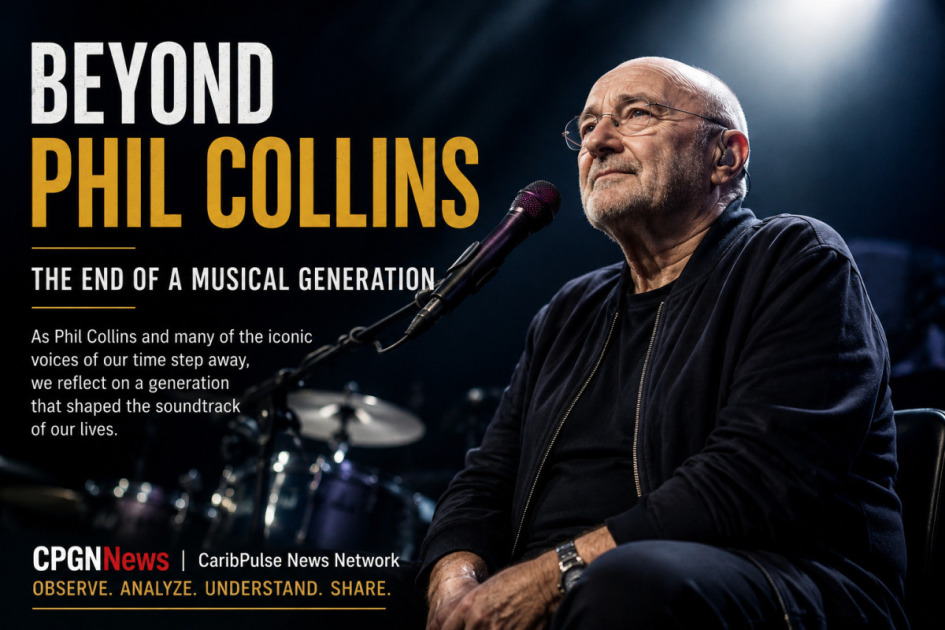
And What This Elegy Fails to Name
From our editorial staff | CPGNNews – CaribPulse News Network
Port-au-Prince, Kingston, Miami, Paris
Editor’s note: This article is based on information published by ShowbizzDaily in March 2026 regarding Phil Collins’ health condition. CPGNNews has cross-referenced this information with sources close to the artist’s entourage, without obtaining official confirmation. The analysis that follows goes beyond the scope of this information to offer a broader reflection on the end of a musical generation.
The question is no longer really whether Phil Collins will ever return to the stage. What is moving through the cultural world today is much larger: what becomes of a civilization when the voices that accompanied several generations begin to fall silent?
It is not just a voice that is fading away. It is an entire regime of presence that is disappearing. The one where music traveled through bodies, global tours, roaring stadiums, television shows watched by hundreds of millions of people in a single evening. The spotlights are going out, one by one. Not for lack of public love. But because human machines wear out.
According to information reported by ShowbizzDaily, Phil Collins’ health condition would no longer allow for a return to the stage in the near future. The artist, 75, suffers from accumulated neurological and physical after-effects that considerably reduce his ability to play drums and to undertake a world tour. CPGNNews attempted to contact his agent for confirmation, with no response at the time of this writing.
The Golden Age of a Universal Language
Between the 1960s and the end of the 1990s, popular music was one of the most powerful vectors of cultural globalization in contemporary history. Before social networks, before digital platforms, before artificial intelligence, artists such as Phil Collins, Michael Jackson, Tina Turner, Elton John, Whitney Houston, and Lionel Richie created a shared emotional language between peoples often separated by thousands of miles.
The numbers speak for themselves. Phil Collins has sold more than 150 million records worldwide. His album No Jacket Required sold more than 25 million copies. In the Air Tonight continues to win over new generations and now has more than one billion streams on digital platforms. In 2025, the track recorded an additional 47 million streams on Spotify, proof that the song continues to reach an audience much younger than its author.
Before algorithms decided our moods. Before the continuous stream abolished scarcity and anticipation. Before each user lived inside their own musical bubble. These songs were listened to on fragile formats. Vinyl. Cassettes. CDs. In teenagers’ bedrooms. In family cars. On FM radios that turned the world into a single room.
The hits of that era had something universal about them. They crossed linguistic, cultural, and geographical borders with an almost inexplicable ease.
The Caribbean, a Land of Particular Resonance
From Port-au-Prince to Nassau, from Kingston to Miami, from Paris to Montreal, the same songs traveled through the airwaves. They accompanied family celebrations, love stories, departures, reunions, and periods of crisis.
In the Caribbean, musical memory has always been a pillar of cultural resistance. From Haitian kompa to Antillean zouk, from dancehall orchestras to popular music, influences circulate, cross paths, and transform.
Some Western songs from the 1980s were covered, adapted, sometimes reinterpreted locally. “Against All Odds” can still be heard in Creole versions in some evangelical churches in Kingston. “Easy Lover” long played on beach sound systems in Freeport, mixed with dancehall. These songs did not remain foreign. They were adopted, naturalized, transformed.
The Ordeal of the Body
Born in 1951, Phil Collins belongs to a generation of artists confronted with biological limits that neither fame nor talent can push back indefinitely.
For several years, his health has progressively deteriorated. A spinal dislocation diagnosed in 2007. Ulnar neuritis that partially paralyzed his hands. Chronic pancreatitis linked to his past alcoholism. The man who was one of the most influential drummers of his era can no longer play as he once did.
His story is not isolated. Michael Jackson left at 50, while preparing his comeback. Tina Turner passed away in 2023 at 83 after years of illness. George Michael left us on Christmas night 2016. Prince died alone in an elevator at 57. David Bowie turned his own death into a final masterpiece.
The Paradox of the Digital
The paradox of our era is that artists have never been so physically absent and so digitally present at the same time.
Phil Collins is no longer capable of undertaking the global tours that marked the 1980s and 1990s. Yet his songs can be discovered instantly anywhere in the world. A teenager in Abidjan, a student in Manila, a retiree in Lisbon can listen to “In the Air Tonight” in less than three seconds.
The body weakens.
The work becomes ubiquitous.
The Elegy and Its Silences
But one essential truth must be added: this global musical memory was never entirely balanced.
What is presented as a universal golden age was also a system where certain musics dominated global circuits, while others remained confined to local or regional spaces.
Let us take a concrete example. In the 1970s and 1980s, while Phil Collins was churning out global hits, artists such as the Haitian Coupé Cloué, the Jamaican Burning Spear, or the Antillean group Kassav’ were filling regional stadiums but remained largely invisible on French, British, or American mainstream radio. Their songs were no less beautiful. They were no less universal. They simply moved through less powerful economic and media circuits.
The Caribbean produced its own cultural giants. Bob Marley, of course, succeeded in crossing over to the global stage. But how many others remained in the shadow of a media system concentrated between New York, London, and Los Angeles?
Today, digital fragmentation has changed this balance. It allows local artists to exist without going through traditional circuits. It restores visibility to long-invisible musical archives. A Swedish listener can discover Haitian kompa. A Brazilian fan can listen to 1980s Jamaican dancehall. Fragmentation has a price, but it also has a virtue: it makes visible what the unified golden age rendered invisible.
Memory Against the Algorithm? Or With It?
Cultural history does not stop. It transforms.
Songs become generational landmarks, but also digital objects circulating freely between different contexts and audiences.
Transmission is no longer solely vertical from parents to children. It has also become horizontal, algorithmic, unpredictable. A TikTok algorithm can propel a 1985 track to millions of teenagers in a single week. That is what happened to “In the Air Tonight” in 2021, when the track experienced a spectacular resurgence thanks to viral videos. Phil Collins had asked for nothing. He had done nothing. The song simply came back to life, through other hands, on other ground.
A Generation Passes the Torch
What is fading today is not just a musical aesthetic, but a collective way of experiencing music.
What is being born is more fragmented, more personalized, less event-driven. But also more accessible, more democratic, less dependent on traditional intermediaries.
“It’s Not Sad, It’s Life”
“I remember seeing him in Miami in 1990,” says Jean-Robert, a 52-year-old Haitian listener, met during a CPGNNews broadcast. “My father saved for three months to buy the tickets. We both cried during ‘Against All Odds.’ Today, my son listens to the same song on his phone. The music remains. We are the ones who pass.”
“The first time I heard ‘In the Air Tonight,’ I was 16,” recalls Marie-Claude, 58, a teacher in Fort-de-France. “I was in my sister’s bedroom. We listened to the record on repeat until our mother yelled at us to turn it off. Today, my granddaughter discovered that song on a TikTok video. She asked me to teach her drums. It’s funny, isn’t it? The announced death of music, and it comes back through the kids.”
In his autobiography published in 2016, Phil Collins wrote:
“I am no longer capable of being the musician I once was. My hands no longer follow my heart. But the songs, they don’t age.”
The Strange Presence of the Absent
If one day his voice no longer resonates on stage, it will continue to exist elsewhere.
In memories. In ordinary moments. In unexpected emotions triggered by a song when you walk through a train station, when you clear out an empty room, when you drive at night after bad news.
That is where Phil Collins remains: not as a frozen icon, but as a diffuse, persistent presence. The invisible companion of millions of inner lives.
What We Will Pass On
The story of Phil Collins is no longer just that of an artist facing the limits of time. It is that of an entire generation that soundtracked the end of the 20th century.
A generation that knew a world without cell phones, without the internet, without streaming. A generation that bought records, that flipped through album covers, that listened to the radio waiting for “their” song.
This generation is now passing the torch.
Not in noise. Not in easy nostalgia.
But in silent continuity. The artists fade. The voices change. The eras transform. Dominant narratives are corrected, completed, challenged.
But the music, it never stops.
It simply changes hands. Like a song that you cover, that you transform, that you make your own. That is how civilizations survive the disappearance of their voices.
CPGNNews | CaribPulse News Network
Observe. Analyze. Understand. Transmit. And revise your perspective.
