


By the Caribbean Political & Global News Desk
CPGNNews – CaribPulse Global News Network
Special Report | May 14, 2026..
SANTO DOMINGO —
Along the southern coast of the Dominican Republic, a new skyline is rising. Glass towers pierce the tropical haze. Cranes swing over expanded free zones. At the Port of Caucedo, automated terminals unload Chinese-made electronics and Brazilian soybeans destined for North American markets just two maritime days away.
For much of the past decade, the Dominican Republic has posted annual GDP growth above 5%, attracting multinationals from Medtronic to Adidas. The country has become one of the clearest beneficiaries of the post-pandemic restructuring of global supply chains, as companies seek manufacturing and logistics hubs closer to the United States.
Its tourism sector alone brought in nearly 11 million visitors in 2025, one of the highest tourism arrival rates per capita in the Caribbean basin.
“This is no longer just a beach destination,” says Maria Isabel Fernández, an economist at the Pontificia Universidad Católica Madre y Maestra in Santo Domingo. “The Dominican Republic is systematically building itself into the logistics, finance and manufacturing hub of the insular Caribbean.”
But beneath this polished narrative lies a geological reality carved into the island of Hispaniola, which the Dominican Republic shares with a much poorer, younger, and potentially far more populous neighbor: Haiti.
I. Two Trajectories, One Island
According to 2026 estimates from the United Nations Population Division, Haiti’s population is approximately 12.1 million, compared to the Dominican Republic’s 11.3 million. By 2035, Haiti is projected to reach 13.5 million inhabitants; by 2050, roughly 16.5 million.
Over the same period, the Dominican Republic’s population is expected to plateau between 12.5 and 13 million, partly because of a falling fertility rate now hovering near 2.1 births per woman — below replacement level in many urban areas.
Haiti’s fertility rate (2.7) and much younger age structure (median age 24 versus 29 in the DR) suggest that its labor force will continue expanding long after the Dominican workforce begins aging and slowing.
“Demography is not destiny, but it is a powerful constraint,” says Robert Fatton Jr., a Haiti scholar at the University of Virginia. “You cannot build a regional powerhouse next to a state whose central authority no longer exercises effective control over large parts of its territory and whose population will inevitably seek work and safety across the border.”
Cartographic Note: Hispaniola, 2026–2050
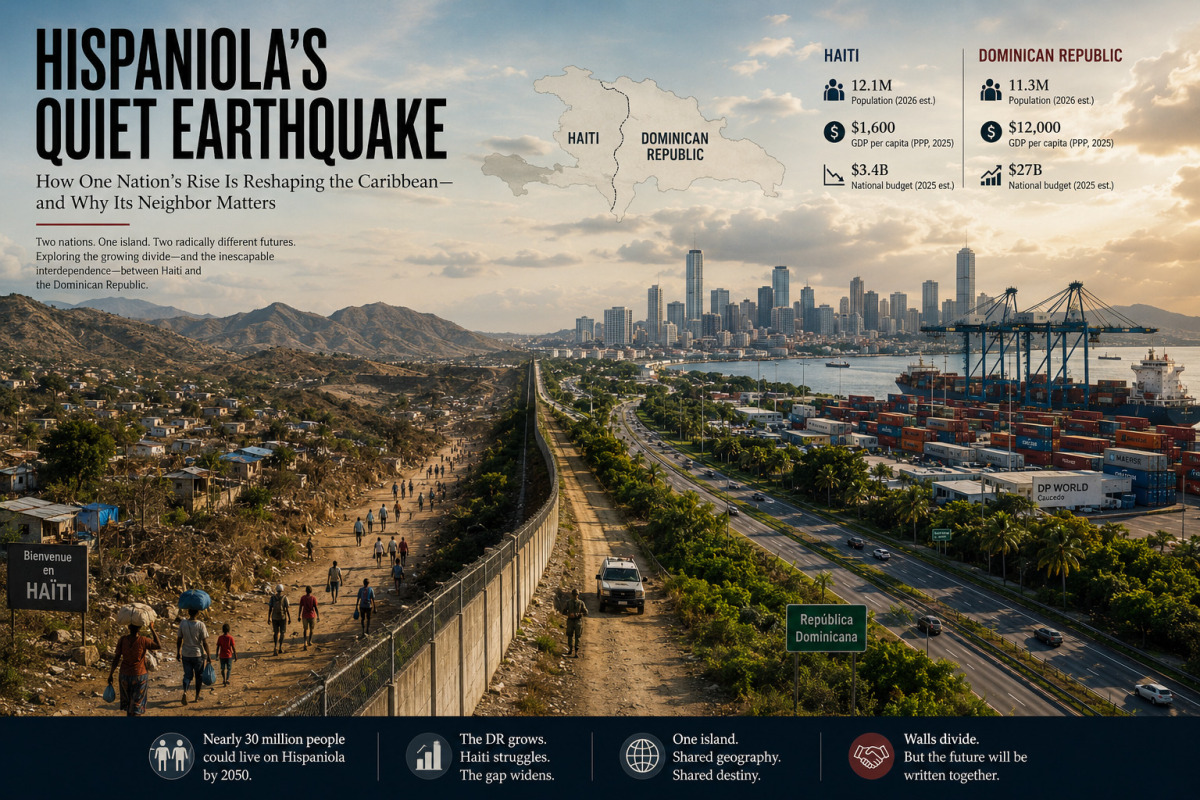
Imagine a map of the 76,000 km² island. Two nations share it, separated by a 380-kilometer border — now partially marked by a 164-kilometer concrete wall on the Dominican side, punctuated by six official crossings and dozens of unofficial paths through riverbeds and mountain passes.
On the eastern two-thirds of the island, the map shows dense clusters of port infrastructure: Santo Domingo, Caucedo, Puerto Plata, Manzanillo. Highways radiate like arteries. Population density concentrates along the coast and through the fertile Cibao Valley.
On the western third, the picture changes dramatically: diffuse rural settlements, a single major port in Port-au-Prince operating below capacity, and road networks that often dissolve into unpaved tracks. Along Haiti’s border regions, deforestation, informal settlements and periodic displacement camps have become increasingly visible.
By 2035, Haiti’s population is projected to exceed that of the Dominican Republic by nearly one million people despite occupying a territory roughly one-third smaller. By 2050, the demographic gap could surpass three million.
The demographic weight shifts westward even as economic gravity pulls eastward. That is the central contradiction of Hispaniola.
II. The Dominican Ascent: Real and Fragile
The Dominican Republic’s economic transformation is real.
Foreign direct investment reached approximately $4.5 billion in 2025, according to the Dominican central bank. Free zones now employ nearly 200,000 workers assembling medical devices, electrical harnesses and apparel for export markets.
A new $2 billion mega-port in Manzanillo, on the northwest coast, is designed to rival some of the region’s major transshipment hubs.
Infrastructure spending has averaged roughly 5% of GDP annually since 2020, financing highways, energy grids and plans for a rail-linked logistics corridor connecting the Atlantic and Caribbean coasts.
President Luis Abinader, re-elected in 2024, has framed the transformation as a national strategic project: “Una plataforma logística para las Américas” — a logistics platform for the Americas.
International lenders including the IMF, World Bank and Moody’s have steadily upgraded the country’s investment outlook.
Yet the same government has simultaneously expanded border enforcement with Haiti, accelerated deportations, and restricted access to public health and education services for undocumented migrants, most of them Haitian.
“The wall is not only about security — it is also about signaling,” argues a Western diplomat in Port-au-Prince, speaking on condition of anonymity to discuss bilateral tensions. “Santo Domingo wants to reassure its population that economic growth can continue independently from Haiti. But geography makes complete separation impossible.”
III. The Haitian Abyss: A Regional Externality
Haiti’s collapse is now extensively documented.
Armed groups control large sections of Port-au-Prince. No elected president has governed the country since the 2021 assassination of Jovenel Moïse. The previous UN-backed security presence had largely withdrawn by 2024, leaving behind an international support mission widely viewed as insufficient to stabilize the capital.
The economy has contracted sharply since 2022. Inflation remains severe. Cholera, food insecurity and mass displacement have returned to levels unseen since the aftermath of the 2010 earthquake.
For the Dominican Republic, this is not merely a humanitarian tragedy. It is increasingly perceived as a strategic vulnerability.
“A failed Haiti creates opportunities for drug trafficking, arms smuggling and human trafficking,” says retired Dominican general Miguel Ángel Peña, now a security analyst. “We cannot become the Singapore of the Caribbean if our land border remains a zone of chronic insecurity.”
But the arithmetic is unforgiving.
Even modest migration pressure — for example, if 1% of Haiti’s population moved toward the Dominican Republic annually — would represent more than 120,000 people per year. Deportation capacity alone cannot fundamentally alter that demographic dynamic.
IV. Comparative Indicators: Two Nations, One Island
The following indicators summarize the widening structural divergence between the Dominican Republic and Haiti as of 2025–2026.
| Indicator | Dominican Republic | Haiti |
|---|---|---|
| Population (2026 est.) | 11.3 million | 12.1 million |
| Population (2035 projection) | 12.5 million | 13.5 million |
| Population (2050 projection) | 12.8–13.0 million | 16.5 million |
| Fertility rate (births per woman) | 2.1 | 2.7 |
| Median age | 29 years | 24 years |
| GDP per capita (PPP, 2025) | $12,000 | $1,600 |
| GDP growth (avg. 2022–2025) | +5.2% | -4.1% |
| Inflation rate (2025) | 4.8% | 42% |
| Foreign direct investment (2025) | $4.5 billion | $62 million |
| National budget (2025 est.) | ~$27 billion | ~$3.4 billion |
| Public infrastructure spending | ~5% of GDP annually | Limited / donor-dependent |
| Population living below $3.65/day | 12.4% | 58% |
| Migrant stock in the other country | ~40,000 Dominicans in Haiti | ~500,000–800,000 Haitians in DR |
| Border wall length | 164 km (planned: 380 km) | 0 km |
Interpretation
The two economies are not merely unequal; they increasingly operate according to entirely different developmental realities.
The Dominican Republic has reached middle-income status with a demographic dividend that is gradually fading. Haiti remains trapped in prolonged institutional and economic crisis while its population continues to grow rapidly, generating persistent migratory pressure across the island.
V. A Decade of Containment: Dominican Migration Policy Since 2013
The following chronology traces the Dominican state’s evolving response to Haitian migration.
2013 — Sentencia 168-13
The Dominican Constitutional Court rules that children born to undocumented migrants most of them of Haitian descent since 1929 are not automatically entitled to Dominican citizenship. Hundreds of thousands are affected.
2014: National Regularization Plan (PNRE)
Authorities create a temporary registration process for undocumented migrants. Fewer than 300,000 applications are submitted despite estimates placing the undocumented population far higher.
2015: Deportation Surge
Under international pressure, some affected individuals regain documentation, but many remain in legal limbo. Deportations accelerate.
2018: Inter-American Court Ruling
The Inter-American Court of Human Rights rules against the Dominican Republic over citizenship and migration policies. Santo Domingo rejects the ruling as interference in sovereign affairs.
2021: Border Closure
The Dominican Republic closes the border during the COVID-19 period and maintains several restrictions afterward, citing security concerns following the assassination of President Moïse.
2022: Wall Construction Begins
Construction starts on sections of a planned 380-kilometer border barrier equipped with surveillance technology and patrol roads.
2023: Expedited Deportations
New administrative measures allow faster deportations with limited judicial review. Human rights groups criticize the procedures.
2024: OAS Report
The Organization of American States raises concerns over collective expulsions and non-refoulement violations. Dominican authorities reject aspects of the report.
2025: Record Deportations
Human rights organizations document large-scale deportations and allegations of abuse affecting vulnerable migrants, including women and minors.
2026: Biometric Border Controls
The wall reaches approximately 164 kilometers. Authorities introduce expanded biometric systems for temporary Haitian labor permits. Critics argue the measures institutionalize precarious labor conditions.
Key Insight
Each major phase of Dominican economic expansion has coincided with tighter migration enforcement rather than greater openness.
The Dominican economy depends heavily on Haitian labor in agriculture, construction and informal services, yet Dominican politics increasingly frames Haitian migration as a security issue. The contradiction produces recurring instability.
VI. The Nearshoring Paradox
The Dominican Republic’s pitch to foreign investors is straightforward: relatively low labor costs, political continuity, expanding infrastructure and tariff-free access to US markets through CAFTA-DR.
What investors hear less often is that large sections of construction, agriculture and informal labor remain deeply dependent on Haitian workers — many undocumented, underprotected and vulnerable to abrupt deportation.
“Employers want a compliant and inexpensive workforce,” says Bridget Wooding, co-director of the Observatory on Migrations at the Instituto Tecnológico de Santo Domingo (INTEC). “The state effectively sustains that system by keeping many Haitians in legal uncertainty. But the same precarity fuels exploitation, instability and international criticism.”
In 2024, the Inter-American Commission on Human Rights expressed concern over arbitrary detentions, collective expulsions and alleged violations of non-refoulement principles. Dominican officials rejected the accusations as politically biased and interventionist.
VII. What Would a Rational Strategy Look Like?
If the Dominican Republic’s long-term objective is to reduce uncontrolled migration pressure and avoid becoming the primary destination for Haiti’s expanding labor force, then one conclusion becomes difficult to avoid: Haiti must eventually stabilize and develop.
That would likely require:
- A shift from pure containment toward conditional engagement with Haitian institutions and regional actors;
- Greater coordination with CARICOM, the United States and multilateral lenders;
- Long-term investment in infrastructure, agriculture and security reform inside Haiti;
- Legal labor frameworks allowing Haitian workers to enter the Dominican economy with enforceable rights and protections.
“Santo Domingo often behaves as if Haiti were a separate planet,” says Haitian economist Kesner Pharel. “But every major crisis in Haiti reaches the Dominican border within days. Walls do not stop instability, disease, weapons or economic desperation. They only obscure the depth of the problem.”
VIII. The Caribbean’s Uncomfortable Future
For now, the Dominican Republic continues its upward trajectory.
GDP per capita roughly $12,000 in purchasing-power terms in 2025 is nearly eight times Haiti’s estimated $1,600. Santo Domingo’s skyline increasingly resembles that of Panama City. Foreign investors continue competing for port concessions, logistics contracts and hotel developments.
But demography operates on a longer timeline than politics.
By 2050, if current projections hold, Hispaniola could be home to nearly 30 million people approximately 16.5 million on the Haitian side and 13 million on the Dominican side.
The island’s balance of pressure may gradually shift not because the Dominican Republic failed economically, but because population growth, labor demand and regional instability cannot remain permanently separated by concrete barriers.
“The DR can probably continue growing for another decade without fundamentally resolving the Haiti question,” says economist Maria Isabel Fernández. “But eventually the structural imbalance will become impossible to ignore. Sustained prosperity beside prolonged state collapse creates pressures that no border wall can permanently contain.”
That transformation, if it comes, will not begin with a press release from a glass-towered free zone.
It will begin quietly on the dusty border roads where Haitian women walk south carrying children on their hips, while Dominican patrol trucks move north beneath the heat and dust of the frontier.
And on that road, no wall, no GDP statistic and no investment-grade rating will ultimately decide the outcome.
Only the difficult arithmetic that the Caribbean, Washington and much of the international community have spent decades postponing.
Appendix: Sources and Methodology
This report is based on data from:
- United Nations Department of Economic and Social Affairs (UN DESA), World Population Prospects 2024;
- World Bank, World Development Indicators (2025 updates);
- International Monetary Fund, Country Reports: Dominican Republic and Haiti (2025);
- Inter-American Commission on Human Rights, Situation of Human Rights in Haiti and the Dominican Republic (2024);
- OXFAM, Labor Exploitation in Dominican Free Zones (2025);
- Central Bank of the Dominican Republic, Foreign Direct Investment Statistics (2026);
- UNHCR, Monitoring of Collective Expulsions at the Hispaniola Border (2025);
- Instituto Tecnológico de Santo Domingo (INTEC), Observatory on Migrations, Annual Report 2025;
Interviews and attributed statements reflect discussions conducted between January and April 2026.
End of Report
CPGNNews | CaribPulse Global News Network
Santo Domingo / Port-au-Prince / Miami
For reprint permissions and republication inquiries: editors@cpgnnews.com
