



GRAND INTERNATIONAL STRATEGIC DOSSIER
A historical, geopolitical, economic, institutional and strategic analysis of Mia Mottley’s leadership, the future of the Caribbean Community (CARICOM), and the conditions required for the emergence of a more integrated, resilient and influential region on the international stage.
Mia Mottley and the Future of CARICOM | STRATEGIC REPORT SR-003/2027 | By Yvon Bonhomme | Editor-in-Chief and Geopolitical Analyst.
CPGNNews | CaribPulse Global News Network │ Independent International Public Interest Media.
OPENING
There are moments when the future of a region can no longer be measured solely by the quality of its political declarations, the frequency of its summits or the symbolic stature of its leaders. It must instead be measured by its ability to transform a shared vision into implemented decisions, commitments into tangible results, and geographical proximity into genuine strategic solidarity. The Caribbean is confronted with a fundamental question: can it turn its history, institutions and shared interests into a collective capacity for action commensurate with the challenges of the twenty-first century?
The political trajectory of Mia Mottley, Prime Minister of Barbados and an influential figure in international discussions on reforming development finance, offers a particularly relevant starting point for examining this question. Her actions and public positions have helped place the vulnerabilities of small island states, the constraints of the international financial architecture and the need for strengthened cooperation at the centre of global discussions. Nevertheless, the significance of leadership cannot be measured solely by diplomatic visibility. It must also be assessed by the ability of regional institutions to translate the ambitions they advocate into applicable policies, operational mechanisms and tangible improvements in people’s lives.
This is precisely where the central challenge facing CARICOM lies. The Caribbean Community possesses an institutional history, consultative bodies and cooperation mechanisms that constitute significant achievements. Yet the existence of these instruments does not, in itself, guarantee fully operational economic integration, a sufficiently coordinated collective response to transnational threats or financial capacity commensurate with development needs. Gaps persist between decisions adopted at the regional level and their practical implementation within member states. Their scale and consequences must therefore be examined rigorously.
For Haiti, this question is of particular importance. Its membership in CARICOM represents a regional anchor, a framework for diplomatic cooperation and an opportunity to participate in broader economic and institutional dynamics. However, legal membership alone does not guarantee effective economic participation, fully accessible professional mobility or influence commensurate with the country’s interests. Security challenges, administrative constraints, fragile infrastructure and limitations in implementation capacity complicate such participation. They do not make regional cooperation less necessary; on the contrary, they make a more precise examination of its instruments, responsibilities and results indispensable.
This dossier examines these issues in their interdependence. Economic integration cannot be separated from the security of trade and exchanges. Climate resilience cannot be sustainable without appropriate infrastructure, institutional capacity and accessible financing. Digital transformation cannot deliver its full benefits without skills, connectivity, data governance and accountability safeguards. Finally, no regional ambition can be sustainably realised unless collective decisions are accompanied by sufficiently clear implementation, monitoring and evaluation mechanisms.
The objective is neither to celebrate the initiatives of Caribbean leaders uncritically nor to reduce regional difficulties to the failure of a single institution or individual. It is to establish a structured assessment of the progress achieved, the observable limitations, the shared responsibilities and the available options. A credible analysis must distinguish declarations from decisions, commitments from funds actually disbursed, institutional arrangements from measurable outcomes, and strategic possibilities from achievements already established.
Through Mia Mottley’s political trajectory and the challenges confronting CARICOM, one central question therefore runs throughout this study: Can the Caribbean transform its collective potential into a strategic power capable of protecting its interests, improving the living conditions of its people and exercising greater influence over international decision-making?
The answer will not depend on a single leader, a single summit or an ambitious declaration. It will depend on the ability of member states to bring their priorities closer together, implement shared commitments, strengthen existing mechanisms and assess outcomes transparently. It will also depend on the ability of Caribbean societies to regard integration not as an abstract objective, but as a practical instrument of security, prosperity, dignity and collective influence.
It is from this perspective that CPGNNews presents this major strategic dossier: to examine CARICOM against the realities on the ground, investigate the conditions required for more effective integration and place Haiti at the heart of a regional debate whose significance extends far beyond national borders.
CPGNNews — CaribPulse Global News Network
Born in the Caribbean, Open to the World!
Pro Dignitate, Inclusione et Progressu
The Caribbean at a Strategic Crossroads: Between Regional Fragmentation and Collective Ambition
The Caribbean is going through a period in which the political achievements secured through independence are no longer sufficient, in themselves, to guarantee that the region can shape its own future. For several decades, the states of the region have been building their institutions, consolidating their sovereignty, developing their foreign relations and seeking the resources needed to advance their economic and social transformation. They are pursuing these objectives in an international environment in which market size, technological capabilities, control over infrastructure and access to financing exert a profound influence on development prospects. Yet the constraints they face are evolving. Climate change is increasing the risks threatening territories and economies; digital technologies are transforming the conditions of production and competition; criminal networks are exploiting cross-border vulnerabilities, while rivalries among major powers are reshaping the conditions under which small nations can defend their interests. The central question, therefore, is no longer simply how to preserve each state’s sovereignty, but how to give that sovereignty practical substance in a world where isolation can narrow economic, diplomatic and strategic room for manoeuvre.
From this perspective, the future of the Caribbean Community, CARICOM, deserves in-depth examination. Since its establishment, the organisation has served as one of the principal instruments of cooperation among the states of the region. Its institutional architecture includes decision-making bodies, sectoral ministerial councils and a Secretariat responsible for supporting the coordination and implementation of Community decisions. The Revised Treaty of Chaguaramas provides the legal framework for this cooperation, particularly in the areas of economic integration, foreign policy coordination and functional cooperation. These instruments embody an ambition that extends beyond conventional diplomatic consultation. They express the determination to build a regional space capable of bringing economies closer together, pooling certain capabilities and defending shared interests more effectively. However, the existence of an institutional framework does not, in itself, establish that integration has been fully achieved. The decisive question is how to measure what common commitments actually deliver within public administrations, businesses and the everyday lives of the region’s people.
This distinction between institutional ambition and implementation capacity is one of the central themes of this dossier. A regional organisation may possess treaties, ministerial councils, cooperation programmes and ambitious declarations without managing to mobilise all the resources required to put them into practice. The obstacles may be political, legal, administrative or financial. They may also stem from differences among member economies, their national priorities, their institutional capacities or their unequal exposure to crises. It would therefore be insufficient to explain CARICOM’s difficulties through an assumed, generalised lack of political will. A rigorous analysis must examine decision-making procedures, the responsibilities of the various stakeholders, available resources, the mechanisms through which commitments are implemented and the results that can be observed. It must also distinguish shortcomings attributable to regional institutions from those for which national governments are responsible. The credibility of the Caribbean project will depend as much on the quality of its strategic direction as on its ability to demonstrate that its objectives can be translated into measurable progress.
The trajectory of Mia Amor Mottley offers a particularly illuminating perspective from which to approach this discussion. At the helm of the Government of Barbados since 2018, she has established herself as a prominent figure in the international debate on reforming development finance and recognising climate vulnerabilities. The Bridgetown Initiative, which emerged from a high-level meeting held in the Barbadian capital in July 2022, helped give a stronger political expression to the difficulties facing countries that must finance their development while confronting climate disasters, the cost of borrowing and the constraints of the international financial architecture. Presented in its successive versions as a call to reform the mechanisms governing development finance and climate action, the initiative placed at the centre of the debate the question of whether international financial institutions are adequately equipped to meet the contemporary needs of vulnerable countries. Its strategic significance lies precisely in this attempt to transform a national and regional experience into a proposal with international reach.
Nevertheless, the influence of an initiative must not be confused with the achievement of all its objectives. A proposal may reshape diplomatic debate, encourage the formation of coalitions and influence negotiations without being fully translated into reforms, new financing flows or tangible outcomes for populations. The study of Mia Mottley must therefore go beyond portraying her as a leader recognised on the international stage. It will examine the foundations of her vision, the constraints that Barbados continues to face, the alliances she seeks to build and the conditions necessary for her proposals to contribute to lasting change. It must also consider the limits of her actions and the possible divergences between stated ambitions and actual results. The reach of her leadership cannot be assessed solely through media visibility or the favourable reception of her speeches. It must be evaluated in terms of the institutional and financial transformations to which her initiatives have effectively contributed.
This reflection naturally leads to Haiti. A member of CARICOM since 2 July 2002, the country occupies a distinctive place in the region’s political history. The Haitian Revolution and the independence proclaimed in 1804 profoundly shaped the history of slavery, colonialism and political emancipation in the Americas. This legacy gives Haiti a historical significance that cannot be reduced to its contemporary circumstances. Yet historical centrality does not automatically translate into the capacity to influence the economic and institutional mechanisms of regional integration. The prolonged crisis of institutions, insecurity, production difficulties, fragile infrastructure and constraints affecting public administration all reduce the country’s ability to turn its CARICOM membership into benefits that are fully accessible to its population. The contrast between Haiti’s potential and the obstacles hindering its regional integration calls for an analysis that avoids both fatalism and exaggerated claims.
Haiti’s position cannot be examined exclusively through the lens of the crises confronting the country. Such an approach would confine the analysis to a representation of Haiti primarily as a problem to which other states must respond. Yet any reflection on CARICOM’s future must also consider the productive capacities, trade opportunities, human capital, territorial resources and prospects for cooperation that Haiti could mobilise under more favourable conditions. This does not mean minimising its difficulties or assuming that its potential will spontaneously translate into results. It means identifying the institutional, economic and logistical conditions that would enable Haiti to participate more actively in regional trade, strengthen its production base, support its businesses and contribute to common initiatives. More effective integration cannot be limited to facilitating the activities of the better-equipped economies. It must also address the obstacles preventing certain members from making full use of regional opportunities.
The CARICOM Single Market and Economy illustrates this challenge. The mechanism is based on several regimes, including the movement of goods, capital and services, as well as the movement of certain categories of nationals of member states who meet the established requirements, together with the right of establishment. However, membership in the Community does not mean that all states participate in every aspect of these arrangements on equal terms. CARICOM indicates that Haiti does not yet participate in all the regimes of the system. This situation must be analysed in light of the applicable legal commitments, implementation arrangements and national capacities required to put them into effect. It raises a broader question: what adjustments would make it possible to strengthen Haiti’s economic integration without disregarding the administrative, productive and security-related difficulties that condition its participation? The answer must be grounded in verifiable facts and an examination of concrete obstacles, rather than merely reaffirming regional solidarity.
This issue becomes more urgent in a context where international trade and supply chains are subject to geopolitical tensions, more assertive industrial policies and a growing pursuit of economic security. For Caribbean economies, which are frequently exposed to fluctuations in global markets and high transportation costs, regional cooperation can create opportunities for diversification, resource pooling and capacity-building. However, these possibilities must not be taken for granted. They must be established through comparable data on trade flows, products, logistical costs, regulatory barriers and production capacities. Trade between Haiti and CARICOM member states will therefore be a central focus of our investigation. It will be necessary to identify the trade flows actually recorded, distinguish exports from imports, examine imbalances and determine the extent to which existing obstacles can be reduced. Where statistics are incomplete or contradictory, these limitations must be made clear to readers rather than concealed behind unreliable estimates.
Economic integration, however, cannot be separated from collective security. Transnational criminal networks exploit weaknesses in controls, differences between national laws, shortcomings in cooperation and vulnerabilities in infrastructure. Illicit trafficking, criminal financial flows and new forms of digital crime do not stop at national borders. Consequently, no state can assess its security solely on the basis of its own resources. CARICOM already has security cooperation mechanisms in place, and its specialised agency began the process of developing a new regional strategy in April 2025 to respond to the changing nature of threats. This process incorporates, among other considerations, geopolitical transformations, challenges associated with artificial intelligence and the need to take rights and responsibilities into account. Nevertheless, the existence of this work is not enough to establish the extent to which it has been implemented. It will be necessary to examine the resources mobilised, coordination among states, information-sharing, preventive capacities and the safeguards required to protect populations.
These challenges are compounded by technological transformation. Artificial intelligence, automation and digital services are changing the conditions governing economic activity, public administration, education, research and information. For small states, these transformations may create new opportunities for modernisation and access to markets. They also entail risks associated with dependence on foreign infrastructure, data concentration, access costs, inequalities in skills and the absence of appropriate governance frameworks. A CARICOM looking towards the future cannot treat these issues as a merely technical matter. It must examine training capacities, digital infrastructure, data protection, cybersecurity and the means of ensuring that the benefits of technological transformation are not reserved for the better-equipped economies. For Haiti, this reflection has a direct bearing on prospects for economic diversification, the modernisation of public services and the development of the skills required for more active participation in the regional economy.
The environment represents another unavoidable dimension. Climate risks, pressure on natural resources, ecosystem degradation and the costs of reconstruction following disasters impose constraints on Caribbean states that extend beyond national borders. Their consequences affect food security, infrastructure, public finances, population displacement and the continuity of essential services. CARICOM has adopted a regional framework devoted to the environment and natural resources, covering, among other areas, climate resilience, sustainable energy and disaster risk reduction. This framework provides a foundation for cooperation, but its effectiveness will depend on available resources, its alignment with national policies and the ability to measure progress. The issue of international development finance, which lies at the heart of the Bridgetown Initiative, is thus directly connected to the capacity of Caribbean states to protect their populations and prepare for the future.
Finally, CARICOM cannot reflect on its position in the world without broadening its horizons beyond its traditional relationships. The Second Africa-CARICOM Summit, held in Addis Ababa on 6–7 September 2025, reaffirmed the ambition to strengthen the partnership between the two regions and deepen cooperation around shared priorities, particularly reparatory justice, development, trade and institutional relations. This initiative opens up a space that goes beyond historical memory and symbolic solidarity. The prospects also encompass investment, transportation, training, health, research, innovation and diplomatic coordination. Historical ties alone, however, are not enough to create lasting economic relationships. Such relationships require appropriate infrastructure, financing mechanisms, greater knowledge of markets, accessible connections and projects whose results can be evaluated. For Haiti, as for the other CARICOM members, this opening could broaden opportunities for partnership, provided it is accompanied by a realistic strategy and the capacity to implement it.
The question running throughout this entire dossier is therefore how to move from ambition to the capacity to act. What kind of CARICOM do member states wish to build? What institutional, economic, financial, security and technological reforms would bring their commitments closer to tangible results? What role can Haiti play in this evolution, and what transformations would it need to undertake to make better use of its regional membership? To what extent can Mia Mottley’s international leadership help advance an integration process whose success also depends on the decisions and capabilities of numerous governments? These questions do not prejudge the answers. They define the ground on which facts, comparisons and critical analysis must provide the means to establish them.
The future of the Caribbean will not be determined solely by its leaders’ declarations or by the texts enshrining their aspirations. It will depend on the ability of states to transform common interests into lasting mechanisms, commitments into actionable decisions and dispersed resources into collective capabilities. A region made up of countries with unequal resources can increase its influence if it learns to coordinate its priorities, share certain capacities and negotiate with greater coherence. This ambition, however, requires a clear-eyed assessment of obstacles, results and responsibilities. It is in this spirit that CPGNNews undertakes this strategic investigation: not to replace the reality of difficulties with a narrative of power, but to examine what the Caribbean can reasonably achieve, what continues to stand in its way and what decisions could bring its potential closer to its future.
MIA MOTTLEY: A BARBADIAN LEADER CONFRONTING THE CHALLENGES OF A REGION
1.1. A Political Journey Rooted in the History of Barbados
The career of Mia Amor Mottley provides a valuable starting point for understanding the transformations taking place in Caribbean political leadership and the opportunities available to small states to exercise influence on the international stage. At the head of the Barbadian government since 2018, she has gradually gained visibility beyond her country’s borders, particularly through her interventions on development finance, climate vulnerabilities and the limitations of the international financial architecture. Her journey, however, cannot be reduced to that of a political figure who has succeeded in attracting the attention of major powers. It must be understood within the institutional history of Barbados, the particular characteristics of its political system and the constraints confronting small island economies.
Barbados has a parliamentary and administrative tradition that has helped shape its political system since independence. Within this environment, Mia Mottley built her career in the Barbados Labour Party (BLP), of which she became one of the leading figures. Her political trajectory developed within a system where elections, parliamentary institutions, changes of government and the management of public policy are central components of governmental legitimacy. This national experience is important to understanding how she connects Barbados’s domestic priorities with the diplomatic and economic challenges facing the region.
Her accession to the office of Prime Minister in May 2018, following a decisive electoral victory by her party, opened a new phase in her career. The result gave the BLP a particularly strong parliamentary position and placed Mia Mottley at the centre of state leadership. The party’s re-election in 2022 confirmed the continuity of her leadership and the electoral confidence it enjoyed at the time. These victories constitute essential reference points, but they are not sufficient, in themselves, to establish the quality of governance. Evaluating a government also requires examining the decisions it has made, the economic constraints it has faced, the results it has achieved and the effects of its policies on the population’s living conditions.
The Barbadian experience is of particular interest to other Caribbean countries. It demonstrates how a relatively small state can seek to combine institutional stability, active diplomacy and the defence of its economic interests. It also highlights the fact that international influence depends on a range of factors extending beyond the personality of a political leader: the quality of public administration, the credibility of public policies, diplomatic continuity, alliances and the ability to transform a political position into a proposal capable of attracting the support of other stakeholders.
1.2. From Parliamentary Experience to Leadership of the State
Mia Mottley’s leadership has been shaped at the intersection of parliamentary experience, party leadership and the management of government. This trajectory has enabled her to develop an understanding of national institutions and the mechanisms of political negotiation. It has also helped shape an approach in which economic and social issues are closely connected to the state’s ability to preserve its decision-making autonomy in a demanding international environment.
Leading a small island state requires the management of complex balances. The limited size of the domestic market restricts certain economies of scale, dependence on imports exposes the country to fluctuations in international prices, while natural disasters can cause substantial losses and increase public financing requirements. These constraints are compounded by the demands of competitiveness, economic diversification, the maintenance of public services and the protection of the most vulnerable populations. State leadership must therefore operate with limited resources while managing risks, some of which remain beyond the government’s direct control.
In this context, political leadership cannot be assessed solely on the basis of speeches or electoral victories. It must be examined through the policy choices made, the coherence of public policies, implementation capacity and observable results. This distinction is particularly important in an international analysis of Mia Mottley. The visibility she enjoys may facilitate the mobilisation of partners and the opening of negotiations, but it does not eliminate the need to examine the results achieved in Barbados or the limitations her government continues to face.
Barbados’s transition to republican status in November 2021 represents another major institutional milestone. This change replaced the British monarch as head of state with a Barbadian presidency, while the country remained within the Commonwealth. It constitutes an important constitutional and symbolic transformation in Barbados’s postcolonial history. However, it does not, in itself, mean that all economic dependencies or historical asymmetries have disappeared. The change in institutional status must be distinguished from the longer-term transformations affecting the productive structure, trade relations and capacity for economic decision-making.
Mia Mottley’s experience must therefore be studied on two complementary levels: the conduct of national political affairs and the projection of influence internationally. The first makes it possible to examine how her government responds to the constraints specific to Barbados. The second demonstrates how the challenges confronting a small state can be framed as collective issues and brought before multilateral institutions. The strategic significance of her political journey lies, to a considerable extent, in the relationship between these two dimensions.
1.3. Small-State Diplomacy: Turning Vulnerability into Influence
Small states rarely possess the economic, military or demographic resources available to major powers. Nevertheless, they can exercise diplomatic influence when they identify common challenges, build coalitions, develop recognised expertise and propose solutions capable of attracting international support. Mia Mottley’s diplomacy partly reflects this approach: bringing the concerns of vulnerable economies beyond the limits of their material weight and seeking to reshape the debate over international responsibilities for development and climate action.
The vulnerability of island states does not arise from a single factor. It results, in particular, from their exposure to extreme weather events, the concentration of certain activities within limited territories, dependence on imports and the high cost of infrastructure. Disasters can destroy essential facilities, interrupt economic activity and force governments to borrow even as their revenues are being affected. Financing difficulties are therefore connected to physical and economic risks that are not always adequately reflected in the terms under which these countries access credit.
By placing these issues at the centre of international debate, Mia Mottley has helped advance the argument that development finance rules should take greater account of the vulnerability and investment needs of the countries concerned. This approach seeks to shift the terms of discussion. Rather than treating each disaster as an isolated event requiring a response after the fact, it calls for closer examination of the financial mechanisms, preventive instruments and financing conditions that determine a state’s ability to prepare for crises and rebuild afterwards.
The reach of this diplomacy also depends on its ability to create common ground among countries whose circumstances are not identical. Small island states share certain vulnerabilities, but their economic structures, levels of indebtedness, institutional capacities and development needs differ. A lasting coalition cannot therefore be based on the assumption that all states face equal exposure or automatically defend the same priorities. It requires proposals that are sufficiently precise to make agreements possible while recognising national differences.
Diplomatic influence must nevertheless be assessed with caution. Bringing an issue into the international debate constitutes a political achievement, but it is not equivalent to an adopted reform. A proposal may receive considerable attention without immediately producing new financing, transformed borrowing conditions or tangible improvements in people’s lives. To assess the reach of Mia Mottley’s leadership, it is therefore necessary to distinguish between international visibility, coalition-building, institutional decisions and the results actually achieved.
1.4. The Bridgetown Initiative: A Reform Proposal with International Reach
The Bridgetown Initiative is one of the most important elements of the international profile associated with Mia Mottley. Launched in 2022 and subsequently developed through successive versions, it calls for changes to the international financial architecture so that it can better respond to the financing needs of development and climate action. Its starting point is a clear observation: vulnerable countries often have to finance public services, infrastructure, climate adaptation and post-disaster reconstruction simultaneously, while facing debt constraints and sometimes unfavourable conditions for accessing capital.
The Bridgetown approach seeks, in particular, to strengthen the capacity of multilateral development banks, improve long-term financing conditions and mobilise additional capital to meet investment needs. It also draws attention to instruments capable of distributing risks more effectively, crisis-response mechanisms and the need to prevent the most vulnerable states from becoming trapped in a recurring cycle of shocks and emergency financing.
The significance of this initiative lies in its attempt to transform difficulties experienced by Barbados and other vulnerable economies into a proposal for systemic reform. Rather than limiting the discussion to emergency assistance following a disaster, it invites consideration of the rules that determine the volume, cost and availability of financing. In doing so, it establishes a connection between climate change, debt, long-term investment and the ability of states to safeguard their development.
It is nevertheless essential to distinguish between announced objectives and resources that are actually available. A proposal to mobilise capital does not constitute financing that has already been granted to a country. An announced reform does not mean that all the corresponding mechanisms have entered into force. Similarly, a potential increase in the lending capacity of a multilateral institution does not guarantee that every vulnerable state will receive a predetermined share of those resources. The analysis must identify the measures adopted, the amounts approved, the funds actually disbursed and the effects observed, without confusing these different stages.
The Bridgetown Initiative must therefore be viewed both as a contribution to international debate and as a programme of proposals whose reach depends on their institutional implementation. Its influence may be reflected in changing priorities, negotiations among states, decisions by multilateral banks and the financial instruments made available. Its actual effectiveness, however, must be assessed through the verifiable changes it helps bring about. This requirement does not diminish the importance of the initiative; on the contrary, it makes it possible to evaluate its value with greater precision.
1.5. Leadership, Results and Constraints: Beyond International Visibility
The international recognition of a political leader is not a sufficient measure of the effectiveness of that leader’s actions. It may indicate an ability to articulate ideas, mobilise partners or draw attention to neglected issues. However, the transition from influence to results depends on negotiations, institutional decisions, financial resources and implementation capacities that are often beyond the control of any single political figure.
Mia Mottley’s case illustrates this distinction. Her role in promoting the Bridgetown Initiative has given her an important position in discussions on reforming development finance. Nevertheless, transformations in the international financial architecture depend on numerous institutions and governments whose interests do not always coincide. Multilateral banks operate under their own rules, creditor and debtor states sometimes have divergent priorities, and reforms require agreements that can take considerable time to negotiate. A political leader’s influence may help accelerate these processes, but it cannot, by itself, guarantee their completion.
Assessing leadership therefore requires several levels of observation. The first concerns the policy directions articulated and the coalitions established. The second relates to the decisions actually adopted by the institutions and governments concerned. The third examines the resources mobilised, the conditions governing access to them and the terms under which they are used. The final level concerns observable economic, social and environmental outcomes. These dimensions are interconnected, but they are not interchangeable. A diplomatic achievement may be real even if it has not yet produced measurable results for the population.
It is also important to avoid presenting Barbados as a model that can be directly replicated by every CARICOM country. The states of the region differ in size, productive structure, administrative resources, financial circumstances and vulnerabilities. A policy suited to one country may require substantial adjustments in another. The value of the Barbadian experience therefore lies less in the mechanical reproduction of its choices than in examining the methods, instruments and alliances that could be adapted to different national contexts.
The central question is not whether Mia Mottley enjoys a favourable international reputation, but what her actions have actually helped change, what remains to be accomplished and what depends primarily on collective decisions. This approach makes it possible to avoid both uncritical praise and criticism based on unrealistic expectations. It places leadership within the framework of institutions, power relations and implementation capacities that ultimately determine results.
1.6. Haiti and Regional Capacity for Action: An Issue That Goes Beyond Individual Leadership
An analysis of Mia Mottley naturally leads to an examination of Haiti’s position within CARICOM. A member of the Community since 2 July 2002, Haiti occupies a distinctive position in the political history of the region. The Haitian Revolution and the independence proclaimed in 1804 shaped the history of political emancipation in the Americas. This legacy gives the country considerable historical importance, but it does not automatically translate into economic or institutional influence within contemporary integration mechanisms.
The difficulties confronting Haiti, particularly insecurity, fragile infrastructure, administrative constraints and limitations in its productive capacities, complicate its participation in regional trade and several Community mechanisms. CARICOM membership provides a legal and diplomatic framework, but the benefits of integration also depend on the ability of businesses to produce, the efficiency of transportation systems, compliance with standards, access to financing and the capacity of public administrations to implement applicable commitments.
Haiti’s place in the Community must not, however, be reduced to that of a country in crisis to which regional solidarity must provide a response. A strategic analysis must also examine the country’s potential contributions, its human resources, its market, its productive capacities and the opportunities for cooperation that improvements in security and governance could make accessible. Haiti’s regional participation must be understood in terms of reciprocity: what opportunities can CARICOM make more accessible to Haiti, and what capacities must the country develop to participate more fully in the Community’s economic and institutional life?
This perspective connects with some of the concerns advanced by Mia Mottley, particularly the need to take account of the specific vulnerabilities and constraints facing small states. It does not, however, mean that her actions determine all CARICOM policies or that she can resolve Haiti’s difficulties on her own. Regional participation rests on collective decisions, common institutions and national responsibilities. For Haiti, the challenge is to make better use of existing mechanisms, strengthen its implementation capacities and define cooperation priorities consistent with its needs and resources.
CARICOM’s future will depend, in part, on its ability to turn the diversity of its members into a source of complementarity rather than a factor perpetuating inequalities in access to the benefits of integration. This requires a better understanding of the obstacles faced by less-equipped economies, without overlooking the responsibilities of national governments. A more operational regional community must be able to distinguish between difficulties requiring collective cooperation and those arising from the need for domestic reforms, and then organise appropriate responses.
Conclusion 1: From Personal Leadership to Collective Capacity
Mia Mottley’s career offers important insights into the opportunities for influence available to leaders of small states in an international environment characterized by inequalities in resources and power. Her diplomatic engagement, particularly through the Bridgetown Initiative, has helped place development financing needs and climate vulnerabilities at the centre of a broader international debate. This contribution deserves to be examined in terms of the proposals she has advanced, the coalitions she has helped mobilize, and the institutional changes in which she has effectively participated.
However, analysis must not confuse the visibility of leadership with the achievement of its objectives. Financial reforms, economic integration, collective security and climate resilience depend on institutional mechanisms, government decisions, available resources and implementation capacity. The reach of leadership must therefore also be measured by its ability to foster transformations that extend beyond an individual personality and can be sustained over time.
For Haiti, Barbados’s experience provides a basis for comparison and reflection, not a model to be reproduced without adaptation. The country must consider how to strengthen its participation in CARICOM, develop its productive and administrative capacities, and contribute more actively to shared regional priorities. This approach requires national reforms, more operational regional cooperation and transparent evaluation of results.
The question now extends beyond Mia Mottley’s individual trajectory: Can CARICOM transform its political ambitions into an integration process that delivers measurable results for all its members? The following chapter examines this question by revisiting the foundations of the Community, its institutional architecture and the obstacles that continue to limit the realization of its regional project.
CARICOM: Founding Ambitions, Institutional Architecture and Unfinished Integration
2.1. From West Indian Cooperation to the Construction of a Regional Community
The Caribbean Community, known by the acronym CARICOM, emerged from a political and economic conviction that remains highly relevant today: when acting in isolation, the states of the region rarely possess the weight required to exert lasting influence over major international decisions, diversify their economies on a large scale or independently address the shared vulnerabilities of their environment. Caribbean cooperation is therefore not merely a matter of geographical proximity or a shared historical heritage. It responds to the need to transform a collection of territories and states, with differing dimensions, resources and capacities, into a space capable of organizing common interests, negotiating collectively and producing coordinated responses to challenges that extend beyond national borders.
This ambition gradually took shape during the second half of the twentieth century. The experience of the West Indies Federation, which came to an end in 1962, revealed the political difficulties inherent in a regional unification project. Its dissolution did not, however, signify the abandonment of all forms of cooperation. Rather, it led governments to seek forms of association compatible with national sovereignty while allowing closer coordination of economic policies and external relations. The establishment of the Caribbean Free Trade Association, CARIFTA, in 1968 represented an important stage in this evolution. The Treaty of Chaguaramas, signed on 4 July 1973 and entering into force on 1 August of the same year, subsequently established the Caribbean Community.
CARICOM’s history is therefore structured around a compromise between two requirements. The first is to preserve the political autonomy of member states, which remain accountable to their populations and national institutions. The second is to recognize that certain policies become less effective when pursued separately, particularly in the fields of trade, transport, public health, security, diplomacy and disaster management. Caribbean integration has developed within this space of tension between national sovereignty and collective effectiveness.
This tension should not automatically be interpreted as an institutional weakness. In a region shaped by different constitutional histories, varied territorial statuses and heterogeneous economic structures, gradual integration can represent a reasonable political choice. The difficulty arises when the caution required for cooperation becomes a permanent justification for delays in implementing commitments. A regional community cannot indefinitely remain satisfied with the quality of its intentions: it must also demonstrate its ability to change the economic and social conditions in which its populations live.
2.2. The Treaty of Chaguaramas and the Legal Foundations of the Community
The founding treaty of 1973 laid the legal foundations for regional cooperation. Changes in the economies, the expansion of the Community’s ambitions and the need to strengthen integration subsequently led governments to revise this framework. The Revised Treaty of Chaguaramas was signed on 5 July 2001 and entered into force on 1 January 2006. It notably establishes the framework for the CARICOM Single Market and Economy, known by the English acronym CSME, while consolidating provisions relating to the coordination of foreign policies and functional cooperation.
This legal framework goes beyond general declarations of intent. It defines the objectives of the Community, establishes the powers of its organs, organizes decision-making mechanisms and specifies the treaty obligations of the states that are parties to it. It also recognizes differences in levels of development across regional economies. Integration should therefore not be understood as a uniform opening of markets, independent of national capacities, but as a process in which common rules must be implemented within unequal economic and administrative contexts.
Three dimensions must be distinguished when assessing this process. The first is the existence of a shared legal commitment. The second concerns its translation into national laws, administrations and practices. The third relates to its effective application and the observable consequences for businesses, workers, consumers and citizens. These dimensions are interconnected, but they are not interchangeable. The presence of a provision in a treaty does not guarantee its uniform application, just as the adoption of a regional policy does not automatically guarantee economic or social results.
Haiti’s situation illustrates this distinction. The country signed the Revised Treaty of Chaguaramas on 4 July 2003 and ratified it on 8 February 2008. This participation places it within the Community’s legal framework, but it does not mean that all the conditions for full economic integration are in place. Institutional membership, national capacity to apply the rules and effective participation in the various regional market arrangements must be examined separately. This distinction is essential to understanding why formal membership in CARICOM does not necessarily translate into immediately accessible trade benefits.
The treaty therefore provides an indispensable foundation, but it does not eliminate administrative constraints, differences in capacity between states or national political trade-offs. Its effectiveness also depends on decisions taken by governments, the resources available to implement them and monitoring mechanisms capable of identifying difficulties. The challenge is not simply to understand the legal commitments, but to determine the extent to which they are understood, implemented and translated into tangible benefits.
2.3. Community Organs and the Allocation of Responsibilities
CARICOM has an institutional architecture that brings together political leadership, ministerial coordination, administrative expertise and technical cooperation. The Conference of Heads of Government is its principal decision-making organ. It defines the Community’s general political orientations, participates in major decisions concerning its future and plays a central role in relations with external partners. It is also the forum in which national interests, regional priorities and the compromises required for collective action are brought into discussion.
The Community Council of Ministers performs an important strategic coordination function. It contributes to the planning of Community policies and ensures continuity between political orientations and the work of the administrations responsible for their implementation. Alongside it, specialized ministerial councils address the main areas of cooperation. The Council for Trade and Economic Development, known by the acronym COTED, deals in particular with trade and economic matters. The Council for Foreign and Community Relations, COFCOR, contributes to diplomatic coordination. The Council for Human and Social Development, COHSOD, addresses social and human development issues. The Council for Finance and Planning deals with economic and financial matters, while the Council for National Security and Law Enforcement addresses issues falling within its mandate.
The CARICOM Secretariat, headquartered in Georgetown, Guyana, is the Community’s principal administrative organ. It supports the work of Community bodies, assists in coordinating programmes and contributes to the implementation of regional decisions and initiatives. Specialized institutions complement this architecture by providing sector-specific expertise in areas such as public health, disaster management, standards, education and judicial cooperation.
This organization should not, however, be confused with that of a supranational government possessing general authority over member states. CARICOM remains an organization whose functioning relies largely on cooperation among governments, accepted treaty obligations and the decision-making mechanisms established by its treaties. National responsibilities remain central, and the implementation of many Community decisions requires measures to be taken at the level of each state.
The existence of several bodies is therefore not, in itself, a guarantee of effectiveness. Institutional evaluation must focus on the clarity of responsibilities, continuity between decision-making and implementation, the availability of resources and the quality of monitoring. Between a political decision, its translation into a programme, its financing, its national implementation and the assessment of its results, several stages can slow down or weaken collective action.
A more effective CARICOM would not necessarily require the creation of additional structures. It could first strengthen coordination among existing bodies, clarify responsibilities, improve information flows and make the results achieved more transparent. The challenge lies less in institutional existence than in operational continuity.
2.4. The Single Market and Economy: An Ambition That Requires Real Capacities
The CARICOM Single Market and Economy represents one of the most ambitious expressions of the regional integration project. The CSME seeks to establish a regional economic space in which goods, capital, services and certain categories of nationals can move under common rules, with provisions governing, among other things, the right of establishment and professional mobility. This ambition is intended to expand business opportunities, facilitate trade, improve resource allocation and support growth that is less dependent on national markets that are often limited in size.
For Caribbean economies, this approach offers clear advantages. A more integrated economic space could enable businesses to expand their activities beyond national borders, pool certain infrastructure resources, reduce costs associated with regulatory fragmentation and build regional value chains. Closer coordination could also strengthen the region’s negotiating capacity when dealing with trading partners whose markets and resources are considerably larger.
However, the existence of a common legal framework does not, by itself, guarantee an increase in trade. Businesses must be able to transport their goods at competitive costs, access financing, meet applicable standards, obtain reliable information and comply with predictable customs procedures. The quality of ports, the frequency of maritime and air connections, energy costs, the availability of skills and the stability of regulations directly influence their ability to benefit from integration.
Differences in capacity between economies are also a decisive factor. A business operating in an environment with reliable infrastructure, accessible financial services and predictable public administration is not in the same position as a small enterprise facing logistical difficulties, limited access to credit or uncertain administrative procedures. Formal market opening can therefore produce unequal benefits if it is not accompanied by measures that strengthen productive capacities and reduce structural barriers.
It is also important not to present regional mobility as a general and unconditional right of residence or establishment. CSME arrangements include specific categories, conditions and implementation procedures. The rights that can effectively be exercised depend on the applicable rules and the participation of states in the relevant arrangements. For Haiti, the analysis must therefore specify the arrangements in which the country participates, the corresponding obligations and the obstacles limiting the potential benefits of that participation.
It would be inaccurate to portray the CSME as a fully completed market whose benefits are already uniformly accessible. It would be equally imprudent to claim that the project has produced no effects. A serious assessment must compare objectives with achievements, identify the areas in which the rules are being applied, measure persistent obstacles and distinguish institutional progress from observable economic outcomes.
The challenge is to bring legal integration closer to productive integration. This requires improvements in regional transport, the facilitation of trade procedures, support for small and medium-sized enterprises, stronger recognition of qualifications, the reduction of unjustified administrative barriers and the production of comparable data on trade flows. Without these conditions, the regional market risks remaining more accessible to the economies and businesses that are already best equipped.
2.5. CARICOM’s Achievements and the Limits of Effective Integration
CARICOM has created a permanent framework for political dialogue among the region’s governments. It enables member states to coordinate certain diplomatic positions, develop joint programmes and collectively address issues that would be more difficult to tackle within a strictly national framework. It also provides a structure for technical work in economic, social and security-related fields. These institutional achievements are significant, even when they do not take the form of spectacular results that are immediately visible to the population.
The continuity of dialogue among states with different resources and capacities is one of the advantages of this structure. It provides a forum in which small island states, continental Caribbean economies and other members can bring their interests into discussion and seek common positions. It also makes it possible to maintain regional relations beyond changes of government at the national level, even though government commitment remains decisive in advancing each issue.
The limits of integration must, however, be examined with the same rigour as its achievements. Unequal capacities among states to implement common commitments can create gaps between adopted rules and their actual implementation. Economic and administrative barriers reduce the fluidity of trade. Diverging government interests can slow the adoption or application of measures requiring national compromises. Finally, political declarations do not necessarily lead to funded programmes with clearly assigned responsibilities and measurable performance indicators.
These limitations should not become general statements detached from evidence. Claiming that integration is insufficient has analytical value only if it is possible to demonstrate in which areas, for which states, according to which indicators and with what consequences. Delays in implementing decisions, barriers to regional trade, transport costs, the frequency of connections, participation in CSME arrangements and changes in trade flows are all dimensions that must be examined separately. They do not measure the same reality and should therefore not be conflated.
The distribution of costs and benefits also deserves particular attention. Economic opening can create new opportunities and economies of scale, but its effects vary according to the productive structure of each country. Governments may hesitate to deepen integration if they believe their businesses lack the means to withstand regional competition, that their public revenues could be affected or that the benefits will be concentrated in the most competitive economies. These concerns should not be dismissed as mere political resistance. They call for precise responses, particularly through technical cooperation, productive investment and measures adapted to national circumstances.
The challenge, therefore, is not to set states against the Community, nor to regard every national reservation as a rejection of solidarity. It is to design mechanisms that make integration practical and credible. Commitments must be accompanied by realistic timetables, a clear allocation of responsibilities and resources that enable administrations and businesses to adapt. Sustainable integration is integration whose benefits become sufficiently tangible and equitably distributed to consolidate the political and social support it requires.
2.6. Towards Integration Adapted to the Challenges of the Twenty-First Century
CARICOM cannot be assessed solely on the basis of the ambitions that inspired its creation. The global context has changed profoundly. Supply chains are exposed to geopolitical crises, climate risks weigh heavily on infrastructure and economies, criminal networks exploit weaknesses at borders, and digital technologies are transforming production, services, security and the circulation of information. Artificial intelligence is opening up new opportunities while raising questions about data sovereignty, skills, cybersecurity and technological dependence.
These transformations directly affect development conditions, institutional resilience and the capacity of states to defend their interests. A natural disaster can interrupt transport, disrupt trade and intensify budgetary constraints. A security crisis can affect ports, trade routes and economic activity. Excessive dependence on digital infrastructure controlled from abroad can limit governments’ ability to protect public data and develop services suited to the needs of their populations.
In this context, regional cooperation must evolve towards stronger operational capacity. This does not mean that all states must adopt identical policies or transfer all their powers to a common authority. Rather, it means identifying the areas in which pooling resources, securely sharing information, ensuring regulatory compatibility and coordinating investment can generate demonstrable added value.
Security is an important example. Criminal networks, illicit trafficking, suspicious financial flows and digital threats do not stop at national borders. An effective response requires cooperation mechanisms, investigative capacities consistent with the rule of law, protected information-sharing arrangements and coordination among the competent administrations. Similarly, climate risks call for early-warning systems, disaster preparedness and response mechanisms, and infrastructure planning that takes shared vulnerabilities into account.
Digital transformation offers another avenue. Regional cooperation could promote digital skills training, the interoperability of certain public services, data protection, cybersecurity and the development of artificial intelligence tools adapted to the languages and needs of the Caribbean. This ambition must nevertheless be based on guarantees of transparency, security and accountability. Technology is not an automatic solution to institutional difficulties: it can improve services, but it can also reproduce inequalities if infrastructure, skills and access to tools remain unevenly distributed.
The same requirement applies to economic policy. A more integrated regional market depends not only on legal texts, but also on reliable transport infrastructure, efficient payment systems, compatible standards, recognized skills and the capacity to produce more value-added goods and services. Cooperation must therefore connect trade openness with a productive development strategy, so that states are not merely consumer markets but can also participate in the creation of regional wealth.
Finally, CARICOM would benefit from strengthening its ability to measure its results. Common objectives become operational only when accompanied by comparable indicators, a timetable and clearly assigned responsibilities. A regional monitoring dashboard could distinguish between decisions adopted, measures effectively implemented, programmes financed, verified achievements and outcomes observed among populations. Such an approach would not, by itself, resolve political differences, but it would make it possible to identify bottlenecks more effectively, assess progress and bring greater rigour to public debate.
CARICOM’s future therefore depends less on repeating declarations of solidarity than on its ability to organize that solidarity in a form that is measurable, sustainable and adapted to the actual constraints facing member states. Integration is not an institutional end in itself. It must contribute to improving the region’s security, prosperity, resilience and capacity for international action.
This reflection leads directly to Haiti’s place within the Community. Given its demographic weight, geographical position, economic needs and institutional vulnerabilities, the country cannot be treated as a secondary issue in Caribbean integration. Its effective participation could alter the prospects of the regional market, but its difficulties require tailored responses and rigorous analysis. It is therefore necessary to examine the capacities, constraints and conditions that would enable Haiti to transform its regional membership into a genuine capacity for action.
HAITI IN THE CARIBBEAN REGION: DEMOGRAPHIC WEIGHT, TERRITORY, CAPACITIES AND VULNERABILITIES
3.1. Haiti’s Demographic Profile: A Strategic Factor in the Future of the Caribbean
Haiti’s position within the Caribbean Community (CARICOM) cannot be properly assessed without taking its demographic dimension into account. In a region composed of small island states and territories whose populations, productive resources, economic structures and administrative capacities differ considerably, Haiti represents a major human actor. Its demographic weight gives it considerable potential importance in shaping the regional market, organizing trade, facilitating labour mobility, developing value chains and defining collective priorities. However, this position does not automatically translate into economic, institutional or diplomatic power. It depends on the country’s ability to educate and train its population, sustainably improve public health conditions, develop productive activities, create employment, secure its territory and strengthen institutions capable of transforming human resources into effective economic and social capacities.
An analysis of this demographic dimension must first distinguish between institutional estimates, statistical projections and prospective assumptions developed for analytical purposes. These categories are not interchangeable. An estimate describes a population at a given reference date on the basis of available data and methods; a projection extends demographic trends and assumptions through a defined model; a prospective scenario explores a possible trajectory whose realization depends on conditions and developments that may differ from the initial assumptions. This distinction is particularly important in Haiti, where the lack of recent statistical operations, internal displacement, international migration and the consequences of successive crises make it more difficult to establish a comprehensive contemporary population count.
The Haitian Institute of Statistics and Informatics (Institut Haïtien de Statistique et d’Informatique, IHSI) uses a reference population of 11,867,032 inhabitants for 2024. This figure is derived from the demographic estimates and projections of the Latin American and Caribbean Demographic Centre (CELADE), revised in 2022. It is therefore not the result of a recently conducted comprehensive national census. The IHSI document published in July 2024 specifies that this national baseline was subsequently used to produce estimates disaggregated by department, commune, sex, age and place of residence. The institution also reports an average annual population growth rate of 1.28% for the 2020–2025 period. These elements provide a useful statistical foundation for national planning, provided that their origin, reference period and methodological limitations are properly acknowledged.
The revision of the national figure deserves particular attention. The 2024 population figure adopted in the IHSI’s more recent estimates is lower than the 12,394,537 inhabitants projected for the same year in earlier work jointly conducted with CELADE in 2007. This difference reflects, among other factors, the incorporation of new information and demographic developments that have influenced the country’s population dynamics, including the 2010 earthquake, population movements, natural disasters, insecurity and the COVID-19 pandemic. These events have affected the main components of demographic change, particularly mortality, fertility and migration. Earlier projections should therefore not be treated as if they constituted a definitive measurement of the population actually present in the country.
Methodological caution is also necessary when interpreting territorial data. The IHSI document on disaggregated population estimates for 2024 indicates that the work covered the country’s 140 former communes, whereas Haiti now has 149 communes following changes to its territorial administrative structure. This limitation illustrates that the availability of a national estimate does not necessarily mean that all administrative units have access to recent measurements that can be directly compared. It also highlights the importance of maintaining a regularly updated national statistical system capable of incorporating territorial changes, migration flows and transformations in population distribution.
These reservations do not diminish the strategic value of demographic data for national and regional planning. On the contrary, they make it possible to distinguish more clearly between what is established, estimated and anticipated. In Haiti’s case, this distinction is particularly important when assessing the effects of population growth on employment, education, healthcare, housing, infrastructure, food security and demand for public services. It also makes it possible to examine the country’s capacity to participate more effectively in Caribbean integration, not merely in terms of population size, but also in relation to skill levels, productivity, purchasing power and institutional quality.
The comparison of different demographic trajectories should therefore be understood as an analytical instrument rather than a competition between figures. United Nations projections provide an international institutional benchmark, developed from historical data and explicit demographic assumptions. CPGNNews prospective scenarios follow a different approach: they seek to explore possible developments and assess their implications for the country’s future and its regional environment. Comparing these approaches helps clarify the uncertainties surrounding Haiti’s population trends and, more importantly, measure the potential consequences of different trajectories for the country’s economic, social and institutional capacities.
From this perspective, Haiti’s demographic weight must be viewed simultaneously as an opportunity and a collective responsibility. A substantial population can support the expansion of the domestic market, sustain a diversified workforce and strengthen the country’s position in regional negotiations. These advantages, however, remain conditional. Without investment in human capital, improved governance, adequate infrastructure and the creation of productive activities, population growth may intensify pressure on available resources and increase existing vulnerabilities. The strategic question is therefore not simply how many inhabitants Haiti will have over the coming decades, but under what conditions this population can become a driver of national development and an effective contributor to Caribbean integration.
3.2.4. Comparative Table and Visualization of Demographic Trajectories
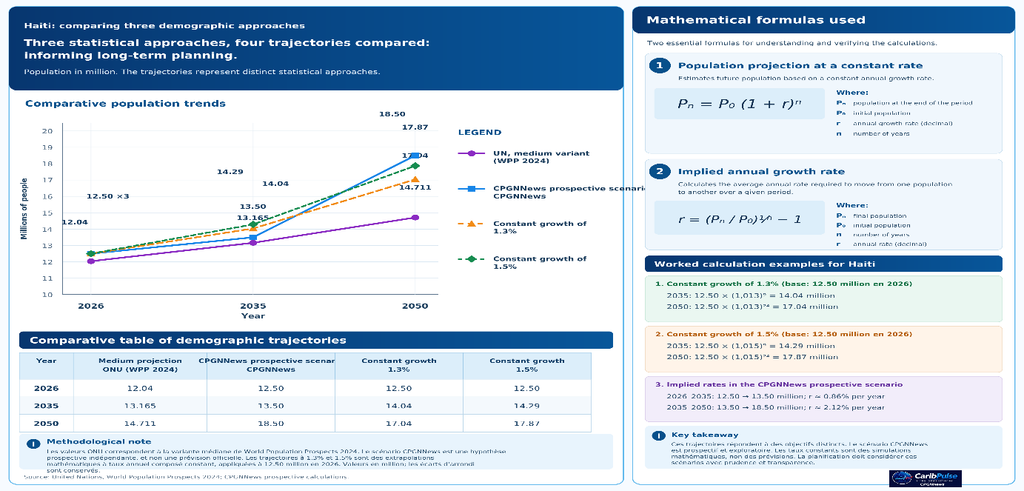
Comparing demographic trajectories makes it possible to measure the differences between the United Nations institutional benchmark, CPGNNews’ independent prospective scenario and the mathematical results obtained by applying an assumption of constant annual population growth. These three series must be interpreted according to their respective status. The first corresponds to the median variant of World Population Prospects 2024, published by the Population Division of the United Nations Department of Economic and Social Affairs. The second presents a prospective assumption developed independently by CPGNNews to explore a possible demographic trajectory through 2050. The third is a mathematical exercise designed to measure the consequences of constant annual growth ranging from 1.3% to 1.5%, starting from a hypothetical population of 12.5 million inhabitants in 2026.
The United Nations benchmark places Haiti’s population at approximately 12.04 million inhabitants in 2026, 13.165 million in 2035 and approximately 14.711 million in 2050. These figures correspond to the median variant of the 2024 revision. They must be distinguished from the IHSI estimates, which place Haiti’s 2024 population at 11,867,032 inhabitants on the basis of CELADE projections revised in 2022. The two series do not rely on the same demographic revision and should therefore not be combined as though they constituted a single homogeneous statistical series.
The CPGNNews prospective scenario, for its part, adopts a population of 12.5 million inhabitants in 2026, 13.5 million in 2035 and 18.5 million in 2050. These figures constitute independent working assumptions and are not presented as officially validated projections. Their value lies in exploring a trajectory different from that adopted by the United Nations, in order to examine the potential consequences of a higher population growth path for national needs and for Haiti’s position within the Caribbean region. It is essential, however, to emphasize that the 2026 baseline of 12.5 million exceeds the United Nations figure of 12,037,506 for the same year by approximately 462,500 inhabitants, or 3.84%. This difference must be understood as an initial assumption specific to the CPGNNews scenario, not as a discrepancy between two official population counts.
The third series makes it possible to test the consequences of assuming a constant annual growth rate. The calculation is based on the compound growth formula: [
P_n=P_0(1+t)^n]
In this formula, (P_0) represents the initial population, (t) the annual growth rate expressed as a decimal, and (n) the number of elapsed years. Using a hypothetical baseline of 12.5 million inhabitants in 2026, the results for 2035 and 2050 are approximately 14.04 to 14.29 million and 17.04 to 17.87 million, respectively, depending on whether the constant annual growth rate is 1.3% or 1.5%. These results are conditional mathematical calculations; they do not, in themselves, constitute demographic forecasts.
The following table brings together the three approaches and makes it possible to compare their respective orders of magnitude.
Table 3.X. Comparison of Three Demographic Trajectories for Haiti
| Year | United Nations, median variant | CPGNNews prospective scenario | Constant growth of 1.3% to 1.5% since 2026 |
| 2026 | 12.04 million | 12.50 million | 12.50 million |
| 2035 | 13.165 million | 13.50 million | 14.04 to 14.29 million |
| 2050 | 14.711 million | 18.50 million | 17.04 to 17.87 million |
Methodological note: Values are expressed in millions of inhabitants and rounded. The first series corresponds to the median variant of World Population Prospects 2024, published by the United Nations Population Division. The second series represents the independent CPGNNews prospective scenario; its values are working assumptions rather than institutionally validated forecasts. The third series results from applying the compound growth formula to a hypothetical initial population of 12.5 million inhabitants in 2026, using two constant annual growth rates of 1.3% and 1.5%.
The comparative reading reveals an essential point: the three trajectories do not follow the same demographic dynamics. The CPGNNews scenario anticipates relatively moderate growth between 2026 and 2035, since the increase from 12.5 million to 13.5 million inhabitants corresponds to a compound annual growth rate of approximately 0.86%. It then assumes a substantially stronger acceleration between 2035 and 2050, when the increase from 13.5 million to 18.5 million corresponds to a compound annual growth rate of approximately 2.12%. The scenario therefore cannot be interpreted as a simple continuation of a constant growth rate ranging from 1.3% to 1.5%. It implicitly assumes a substantial change in demographic dynamics during the period under consideration.
This difference must be explicitly acknowledged in the scientific presentation of the scenario. To justify such an acceleration, further analysis would need to examine possible changes in fertility, mortality and net migration, as well as the effects of economic, health, social and institutional transformations on these variables. It would also need to specify whether CPGNNews’ assumptions rely on an improvement in net migration, a particular evolution in fertility, or a combination of several factors. In the absence of such a breakdown, the trajectory reaching 18.5 million inhabitants must remain classified as an exploratory scenario rather than a demonstrated demographic projection.
The gap between the trajectories becomes particularly significant by 2050. The United Nations median projection places Haiti’s population at approximately 14.711 million inhabitants, whereas the CPGNNews scenario envisages 18.5 million. The difference amounts to approximately 3.79 million inhabitants, or nearly 25.8% above the institutional benchmark. This divergence is substantial: it would have important implications for assessing needs in infrastructure, schools, healthcare services, housing, employment and food resources. It therefore warrants careful examination of the assumptions underlying the prospective scenario rather than a simple juxtaposition of figures.
The third trajectory, based on a constant growth rate of 1.3% to 1.5%, provides a useful intermediate benchmark. It demonstrates that even relatively moderate annual population growth, when sustained over several decades, can produce a considerable increase in population size. It also shows that the CPGNNews scenario of 18.5 million inhabitants exceeds even the result obtained by maintaining a constant annual growth rate of 1.5% throughout the entire period. This comparison confirms that the CPGNNews assumption involves a specific demographic acceleration after 2035, which must be documented to strengthen the scientific credibility of the exercise.
Figure 3.X. Haiti: Comparison of Three Demographic Approaches and Four Trajectories
The comparative chart presents population levels, in millions of inhabitants, at the three reference dates: 2026, 2035 and 2050. It distinguishes the United Nations median projection, the independent CPGNNews prospective scenario, and the two mathematical trajectories based on constant annual growth rates of 1.3% and 1.5%.
The significance of this comparison extends beyond the question of population size alone. It highlights the uncertainties that must be incorporated into public policy and into strategic thinking about Haiti’s regional future. Depending on the demographic trajectory adopted, needs in education and training, infrastructure, energy, water, healthcare, food supply and employment could vary considerably. A larger population could strengthen the potential of the domestic market and increase Haiti’s demographic weight within CARICOM. However, it could also intensify pressure on public services and territorial resources if productive and institutional capacities do not advance at a comparable pace.
The methodological conclusion is therefore twofold. On the one hand, United Nations projections provide an indispensable international benchmark for comparing Haiti with other Caribbean countries and territories. On the other hand, independent prospective scenarios can enrich strategic thinking, provided that their assumptions, parameters and limitations are made explicit. For CPGNNews, the objective is not to replace an institutional benchmark with a hypothetical trajectory, but to bring several possible developments into discussion and assess their implications for national planning and Caribbean integration.
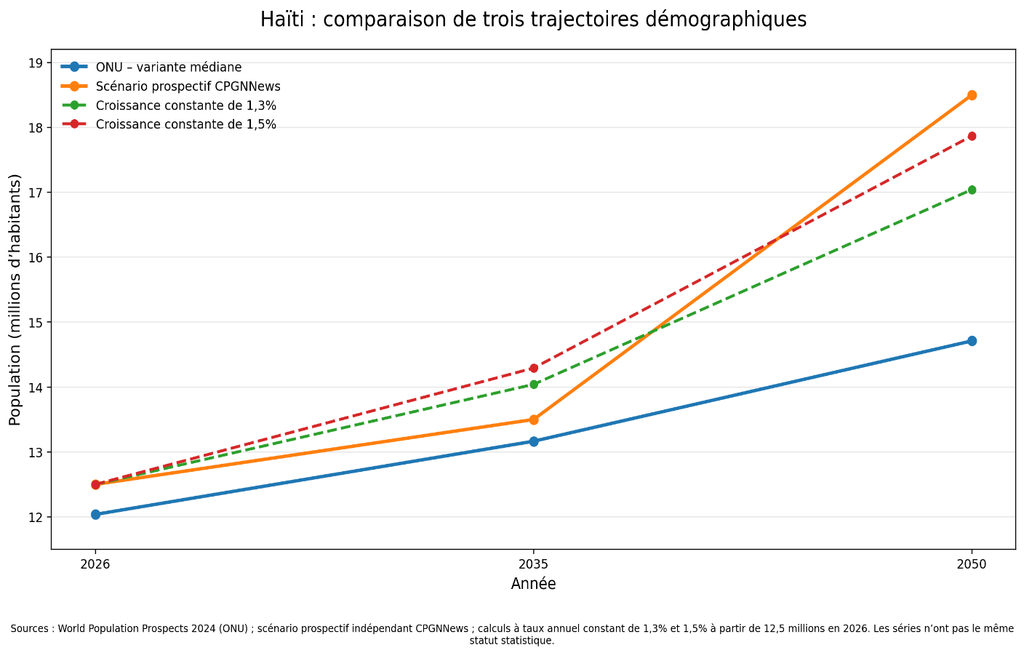
Source: United Nations, World Population Prospects 2024, medium variant, for the institutional figures reproduced in the table; CPGNNews calculations for the prospective scenarios and constant growth rates. The lines connect the three reference dates for comparative purposes only; they do not represent validated annual estimates for the intervening years.
The graphical representation highlights a central finding. Between 2026 and 2035, the CPGNNews scenario remains slightly above the institutional reference, while staying below the values obtained by applying a constant annual growth rate of 1.3% to 1.5% to a baseline population of 12.5 million. By 2050, the CPGNNews scenario reaches 18.5 million, exceeding both the institutional median projection and the results of the two constant-rate calculations. This gap reflects the milestones adopted in the scenario rather than any demonstration that its realization is probable.
The value of the graph therefore lies in visualizing the differences between the underlying assumptions, not in identifying a trajectory as necessarily the most likely. The results must be read in conjunction with the formulas, assumptions and limitations set out in the preceding sections. The table ensures numerical precision; the graph facilitates comparison; and the calculations make it possible to verify the internal consistency of the scenarios.
3.2.5. Interpretation, Limitations and Strategic Significance of the Comparison
The comparison of the three trajectories is not intended to set institutional figures against the prospective assumptions developed by CPGNNews. Its purpose is to determine what each series can reasonably establish and to demonstrate why sound demographic planning must distinguish between reference data, hypothetical scenarios and results derived from mathematical calculations.
The United Nations projections provide an institutional framework based on demographic data and assumptions relating, in particular, to fertility, mortality and migration. They offer a useful reference for planning, but should not be interpreted as certainty about Haiti’s future population. Economic, social, health, political and migration-related developments may alter the population’s actual trajectory. Estimates and projections are also subject to revision as new data become available.
The CPGNNews prospective scenario serves a different purpose. By adopting population benchmarks of 12.5 million in 2026, 13.5 million in 2035 and 18.5 million in 2050, it makes it possible to examine the potential implications of a substantially larger population over the long term. However, these three benchmarks do not, in themselves, constitute a demographic model. They are insufficient to establish the probability of such a development because they are not yet supported by a detailed demonstration of the mechanisms that could produce it. Their value is therefore prospective: they are intended to test the needs and capacities that would arise under a higher-growth hypothesis.
Mathematical verification helps clarify this limitation. Starting from a population of 12.5 million in 2026, a constant compound annual growth rate of 1.3% would produce approximately 14.04 million inhabitants in 2035 and 17.03 million in 2050. At a constant rate of 1.5%, the corresponding figures would be approximately 14.29 million and 17.87 million. The CPGNNews scenario therefore does not follow either of these two constant-growth trajectories: its 2035 benchmark implies a lower rate, whereas its 2050 benchmark assumes a substantial acceleration during the subsequent period.
This difference is confirmed by calculating the implied compound annual growth rates. The increase from 12.5 million in 2026 to 13.5 million in 2035 corresponds to an average annual growth rate of approximately 0.86%. The increase from 13.5 million in 2035 to 18.5 million in 2050 corresponds to approximately 2.11% per year. These rates are mathematical deductions derived from the initial and final values, using the following formula: [
r=\left(\frac{P_t}{P_0}\right)^{1/n}-1 ]
They are not observed future growth rates and do not demonstrate that the corresponding developments will occur. To transform the prospective scenario into a substantiated demographic projection, the assumptions concerning births, deaths and migration would need to be specified and their consistency with historical data and available demographic sources assessed.
From a strategic standpoint, this distinction is particularly important for Haiti. Even a trajectory close to the United Nations median projection would require sustained planning for public services, infrastructure and employment. A higher trajectory could increase demand for housing, drinking water, energy, food, transport, education and healthcare. It could also intensify pressure on the environment and on institutional capacity to ensure equitable territorial coverage of essential services. Conversely, slower population growth would not eliminate development challenges; it would change the conditions under which education and training, productivity, mobility and the distribution of economic activity must be planned.
These issues extend beyond the national framework. Across the Caribbean, demographic dynamics influence cooperation needs in food security, public health, mobility, vocational training, climate resilience and infrastructure development. For Haiti, understanding the different demographic trajectories can therefore help define regional cooperation priorities and improve public policy preparation. This contribution will remain relevant, however, only if the scenarios being used are clearly identified and their limitations are not concealed.
CPGNNews’s editorial decision is therefore to retain the three benchmarks of 12.5 million in 2026, 13.5 million in 2035 and 18.5 million in 2050 as an independent prospective scenario, without presenting them as official projections or validated forecasts. The comparative table and graph must include a note specifying the status of each series. The implied rates of 0.86% and 2.11% must continue to be identified as mathematical results derived from the selected benchmarks.
The methodological conclusion is clear: an institutional projection, a prospective scenario and a constant-growth calculation are three distinct instruments. Comparing them can improve planning and inform strategic choices, provided that assumptions are not confused with observations, and arithmetic results are not mistaken for demographic forecasts. By explicitly presenting the formulas, baseline data, time periods and limitations of each approach, CPGNNews enables readers to reproduce the calculations and understand the actual significance of the results. Such transparency is an essential condition for the scientific credibility of this report.
Documentary reference: United Nations, Department of Economic and Social Affairs, Population Division, World Population Prospects 2024, 2024 revision. Official portal: https://population.un.org/wpp/
Validation note: Sections 3.2.4 and 3.2.5 are now structured for direct integration into the manuscript. Before the final validation of Chapter III as a whole, I recommend retaining the precise reference to the United Nations medium variant in the bibliography and checking the numerical values against the corresponding official data file. The graph illustrates the data reproduced here; it does not replace this documentary verification.
3.3. A Young, Urbanized and Unevenly Distributed Population
The structure of a population is just as important as its size. According to IHSI estimates for 2024, approximately 66.7% of Haiti’s inhabitants live in urban areas and 33.3% in rural areas. The West Department accounts for approximately 34% of the estimated population, while Artibonite represents nearly 16%. These figures reveal a substantial territorial concentration, placing particular pressure on metropolitan infrastructure and public services in the most densely populated areas.
Urbanization can encourage the concentration of economic activities, the circulation of knowledge, access to markets and job creation. However, when infrastructure, collective services and territorial governance fail to keep pace with this concentration, urbanization intensifies congestion, housing insecurity, difficulties in accessing water and sanitation, and vulnerability to disasters and security crises. The question is therefore not whether urbanization should be regarded as an anomaly, but under what conditions it can support productivity and improve living conditions.
Population distribution also affects the State’s ability to provide services equitably. Rural areas may suffer from insufficient access to healthcare, education, transport and commercial outlets. Urban areas often concentrate institutions and economic opportunities, but they also contain neighbourhoods where basic services remain inadequate. A sound demographic policy must therefore be linked to spatial planning, agricultural development, transport infrastructure and the effective decentralization of services.
Youth is another strategic dimension. A young population can represent a significant resource for production, innovation, entrepreneurship and digital transformation, provided that young people have access to adequate nutrition, quality education, relevant skills and genuine employment opportunities. Without such investment, demographic weight can translate into increased pressure on families, schools, healthcare services and labour markets. The demographic dividend is therefore never automatic: it depends on public and private decisions made well before younger generations enter working life.
3.4. Haiti’s Territory: A Caribbean Position to Be Leveraged
With an area generally estimated at approximately 27,750 square kilometres, Haiti occupies an important geographical position within the Caribbean arc. Its location on the island of Hispaniola, its maritime access, its historical ties with North America, Latin America and the Caribbean, and the scale of its diaspora give it the potential to serve as a connecting point between several geographical areas. This position, however, guarantees neither effective trade integration nor regional influence proportional to its population. Geography becomes an advantage only when accompanied by infrastructure, reliable logistics services, predictable rules and the institutional capacity to organize exchanges.
Territorial comparisons must be conducted precisely. Guyana and Suriname each have a territory considerably larger than Haiti’s. Haiti’s strategic importance should therefore be assessed through several criteria considered together: its population, geographical position, productive capacities, cultural heritage, potential market and historical role in the region. Rigorous comparison avoids dramatic but fragile claims and makes it possible to identify the actual levers of development and influence more clearly.
Haiti’s geographical position could enable it to participate more fully in regional supply chains, develop services, diversify its exports and strengthen trade with other CARICOM members. However, transport costs, the condition of infrastructure, financing difficulties, insecurity and administrative obstacles limit the extent to which this position can be converted into an economic advantage. Regional integration must therefore be examined not merely as a matter of geographical proximity, but in terms of the ability to make exchanges possible, regular, secure and competitive.
3.5. Productive Capacities and Structural Vulnerabilities
Population size cannot be separated from the economy’s ability to produce goods and services. Haiti has agricultural resources, a substantial workforce, commercial expertise, export-oriented manufacturing activities and a network of small businesses that play an essential role in supplying households. These capacities nevertheless remain constrained by inadequate infrastructure, difficulties in accessing credit, an unstable business environment, dependence on certain imports and disruptions caused by insecurity.
Recent economic indicators highlight the scale of these difficulties. According to IHSI, real gross domestic product contracted by 2.7% over the 2024–2025 period. The Institute also reports a decline of 4.2% for the 2023–2024 fiscal year. These figures refer to distinct periods and should not be conflated. Nevertheless, they indicate the persistence of an economic contraction that reduces the room for manoeuvre available to address social and demographic needs. When productive activity contracts over an extended period, pressure on households, businesses and public finances can intensify.
Foreign trade illustrates another structural weakness. Domestic demand remains heavily dependent on imports, while the export base is concentrated in a limited number of sectors and markets. This structure reduces the economy’s ability to generate foreign currency, diversify employment and absorb external shocks. It also makes it more difficult to capitalize on the regional market. Chapter IV will examine this trade structure in greater detail; the present chapter emphasizes that demographic dynamics and the productive structure must be considered together.
Vulnerabilities are not exclusively economic. Insecurity, forced displacement, school interruptions, difficulties in accessing healthcare and the fragility of public services directly affect people’s ability to work, study, produce and invest. Estimates of internal displacement vary according to the date, methodology and scope adopted. They must therefore be dated and attributed to their sources rather than converted into permanent figures. Their strategic importance remains evident: when people are forced to leave their homes or economic activities, the consequences affect displaced families, host communities, local services and the continuity of supply chains.
The Human Development Index provides a complementary perspective to gross domestic product. The United Nations Development Programme’s Human Development Report 2025 assigns Haiti an index value of 0.554 for 2023. This indicator serves as a reminder that development cannot be reduced to economic growth: health, education and living standards are decisive dimensions of a country’s ability to benefit from its population. A demographic scenario therefore cannot be properly interpreted without examining the quality of human capital, territorial inequalities and the concrete opportunities available to younger generations.
3.6. Haiti and CARICOM: Converting Demographic Weight into Regional Capacity
Haiti’s participation in CARICOM must be assessed through the relationship between population, territory, production and institutions. The country represents a substantial human market within the Caribbean, but the size of its potential market does not automatically translate into effective purchasing power, competitive production or negotiating capacity. To become a more influential regional actor, Haiti must strengthen the conditions that enable its population to participate in the formal economy, acquire skills, produce more and trade within a more predictable environment.
This transformation requires a domestic strategy, but it also concerns regional partners. Economic integration that fails to take account of differences in productive capacity, logistical difficulties and institutional constraints risks benefiting economies that are already better equipped. Conversely, a gradual approach based on trade facilitation, recognition of qualifications within applicable frameworks, skills development, productive investment and technical cooperation could help reduce certain asymmetries.
Demographic foresight gives this discussion a longer-term horizon. Decisions made today concerning education, healthcare, employment, housing, food security and infrastructure will largely determine Haiti’s ability to meet the needs of its future population. They will also determine whether the country can contribute more substantially to the regional market or whether its domestic difficulties will continue to limit its role. The 2035 and 2050 scenarios should be used as instruments for planning and testing public policies, not as certain forecasts.
For CARICOM, the issue extends beyond Haiti’s situation alone. A regional organization seeking to deepen integration must be able to take account of the demographic and economic realities of its members without turning differences in capacity into lasting forms of exclusion. The objective is not to deny asymmetries, but to measure them and design mechanisms that enable States to participate more effectively in trade and common projects.
From this perspective, Haiti should be viewed neither as merely a humanitarian issue nor as a market whose potential can be taken for granted. It is a partner whose regional contribution will depend on concrete transformations, but also on the Community’s ability to design an integration framework in which development gaps can be taken into account without depriving common commitments of their substance.
3.7. Conclusion: Demography as a Test of Strategic Capacity
Haiti’s demographic weight represents a national responsibility, a development opportunity and a regional issue at the same time. It can be interpreted neither as a guarantee of power nor as an automatic cause of vulnerability. Its effects will depend on the ability of institutions and economic stakeholders to convert human resources into skills, productivity, employment and improved living conditions.
The available data also demonstrate that a credible strategy must be based on a rigorous reading of the figures. Institutional estimates, international projections and prospective scenarios serve different purposes. Distinguishing between them helps avoid excessive conclusions and makes it possible to use demography as a planning instrument rather than a rhetorical argument.
For Haiti, the challenge is to connect the potential of its population with coherent productive, educational, territorial and institutional policies. For CARICOM, it is to make integration a framework capable of recognizing differences in capacity while creating more effective conditions for participation. Haiti’s place in the region will therefore be measured not only by the number of its inhabitants or its geographical position, but also by its ability to produce, trade, cooperate and contribute to shared objectives.
This conclusion opens the way to an examination of Haiti’s trade structure. Having considered CARICOM’s institutional foundations and Haiti’s structural characteristics, it is now necessary to measure trade flows, identify trade asymmetries and assess concrete opportunities for diversification between Haiti and its Caribbean partners.
Editorial note: Population figures, projections and economic data must be associated with their reference year and source at the time of publication. CPGNNews’s prospective benchmarks for 2026, 2035 and 2050 remain independent working assumptions and must not be presented as official projections. Any subsequent analysis must preserve this distinction.
HAITI AND THE REGIONAL MARKET: REGULATORY, LOGISTICAL, PRODUCTIVE AND INSTITUTIONAL BARRIERS
5.1. From Membership to Effective Economic Participation
Regional integration cannot be measured solely by the number of agreements signed, a country’s presence at diplomatic meetings, or its participation in common institutions. It is primarily reflected in economic activity: when a business can sell its products beyond national borders, when a producer can access the inputs required for its operations, and when a commercial operator understands the rules well enough to plan investments without being exposed to excessive administrative uncertainty. This distinction between institutional membership and effective economic participation is essential to understanding Haiti’s position in the Caribbean. A country may be a full member of a regional community without its businesses actually having the means to benefit from the opportunities that membership provides.
Haiti has been a member of the Caribbean Community since 2002 and became a party to the Revised Treaty of Chaguaramas in 2008. This participation provides a framework for developing economic relations with other member states, contributing to cooperation mechanisms, and taking part in discussions on regional policies. It does not, however, mean that all the regimes of the CARICOM Single Market and Economy, known by the acronym CSME, are automatically accessible or fully operational under identical conditions for every member. Haiti joined the CSME process in 2010, but its participation remains partial. This situation makes it necessary to distinguish between the rights established by the legal texts, the regimes actually open to the country, and the administrative conditions required to make use of them.
The CSME covers, among other areas, trade in goods subject to Community rules of origin, capital movements, the provision of services, the right of establishment, and certain mobility arrangements for skilled nationals. It does not, however, establish a general and unconditional freedom to travel, work, or conduct business in every member state. The scope of the opportunities available depends on the provisions of the Treaty, the decisions adopted by the competent bodies, the participation of states in the relevant regimes, and the national measures required for their implementation. For Haitian businesses, this legal complexity can become an obstacle when information is difficult to obtain or when the applicable procedures are poorly understood.
The real challenge, therefore, is to determine which benefits are legally available, how businesses can access them, and why certain opportunities remain untapped. A business may have access to a potential regional market without being able to penetrate it because of insufficient financing, certification requirements, logistical limitations, or an inability to guarantee regular deliveries. Institutional membership does not automatically generate trade. It creates a framework whose effects depend on productive capacity, the quality of public administration, and the ability of economic operators to turn rules into actual transactions. Haiti’s economic participation in CARICOM must be considered in light of this reality.
5.2. Administrative, Regulatory and Commercial Barriers
Regional trade requires a clear and predictable regulatory environment. Businesses must understand the rules of origin, sanitary and phytosanitary requirements, quality standards, customs formalities, and the documentation required for exports. When this information is scattered, difficult to obtain, or interpreted differently by various administrations, transaction costs increase. Large companies may sometimes absorb these expenses by mobilizing their legal or logistics departments. Smaller businesses, which have more limited resources, are more likely to abandon a market that is theoretically accessible.
The difficulties facing Haitian operators may arise at several levels: insufficient access to commercial information, inspection costs, administrative delays, limited compliance capacity, or inadequate coordination among the relevant services. It would nevertheless be unwise to assume that these obstacles are identical across all sectors and destination countries. Their respective importance must be established through available customs data, business surveys, and an examination of the procedures actually applied. A credible trade facilitation policy begins with the precise identification of these difficulties rather than with a general list of presumed problems.
Administrative simplification does not mean abandoning the controls necessary to protect public health, consumers, animals, plants, or the environment. It means making procedures more transparent, proportionate, and predictable without weakening legitimate safety and quality requirements. Haiti could therefore improve businesses’ access to centralized commercial information that is regularly updated and presented in accessible language. Operators should be able to identify the competent authorities, required documents, applicable standards, known fees, indicative processing times, and available appeal procedures. Such a system could build on existing government administrations and support organizations, provided that their responsibilities are clearly defined.
Regional cooperation could also provide a framework for examining non-tariff barriers, bringing certain administrative practices closer together, and facilitating the recognition of certificates where the relevant legal frameworks permit it. These possibilities should not, however, be presented as uniformly applicable achievements: any mutual recognition arrangement depends on the relevant rules, technical requirements, and commitments actually adopted by the states concerned. The objective is not so much to multiply declarations of cooperation as to resolve, case by case, the difficulties that prevent businesses from trading under predictable conditions.
5.3. Logistical, Financial and Productive Constraints
Even when the rules are clear, access to a market remains dependent on the ability to produce sufficient quantities, maintain consistent quality, meet delivery deadlines, and transport goods at a cost compatible with prices in the destination country. In the Caribbean, the geographical dispersion of territories, the limited size of several economies, and dependence on maritime or air transport can make trade more expensive. Competitiveness therefore cannot be reduced to the factory-gate price or production costs. It also depends on storage, packaging, insurance, transportation, formalities, and the reliability of the entire commercial supply chain.
In Haiti, these constraints may be compounded by difficulties in accessing credit, currency fluctuations, interruptions in certain essential services, and security-related risks. A regional order may therefore appear promising without being economically viable. The producer must finance inputs before receiving payment, ensure that goods comply with applicable requirements, and organize delivery under sufficiently predictable cost and time conditions. If any one of these elements is lacking, the transaction becomes risky, even when an interested buyer is available.
The response must combine stronger production capacity with improved logistical conditions. Businesses need financing solutions suited to their operating cycles, accessible certification services, appropriate storage facilities, and reliable transportation. Chambers of commerce, financial institutions, professional organizations, and business support agencies can contribute to this effort, particularly through shared services and targeted partnerships. They cannot, however, replace the public and private investment required to modernize productive capacity and infrastructure.
Regional cooperation could also facilitate the sharing of information on maritime routes, freight capacity, transportation schedules, and opportunities for cargo consolidation. The value of such arrangements must be demonstrated through results: actual reductions in costs, improved delivery times, or fewer losses. At the same time, business support programs should address management, quality, packaging, production planning, and the ability to fulfill contracts. An export strategy that fails to strengthen these skills risks generating isolated transactions without creating lasting commercial relationships.
5.4. Languages, Skills and Professional Mobility
CARICOM’s linguistic diversity represents a cultural asset, but it can complicate trade when businesses lack the skills required to negotiate, understand standards, or prepare professional documents. English plays an important role in the Community’s institutions and commercial relations, while French and Haitian Creole shape a substantial part of Haiti’s administrative and social life. Spanish also plays a major role in relations with several neighboring areas. This plurality makes a language-training policy closely connected to economic needs essential, rather than an approach limited to general language learning.
Proficiency in business English, the drafting of professional correspondence, the understanding of contracts, and the use of digital negotiation tools can facilitate businesses’ access to regional networks. Programs developed in partnership with training institutions and professional organizations could combine language skills with knowledge of standards, customs procedures, and commercial practices. Their effectiveness should be assessed according to how participants actually use these skills, rather than solely by the number of people enrolled in training courses.
Professional mobility requires comparable attention. The CSME provides arrangements for certain categories of skilled nationals, but it does not guarantee a general and unlimited right to work in every member state. Applicable conditions depend on recognized categories, certification procedures, and the regimes in which states participate. For Haitian professionals, the recognition of qualifications, the acquisition of required documents, the cost of administrative procedures, and an understanding of professional requirements can present significant difficulties. Procedures must be verified on a case-by-case basis, without suggesting that a degree or qualification automatically confers the right to practice in every jurisdiction.
Technical cooperation could make these procedures easier to understand, improve information available to applicants, and encourage partnerships between training institutions. It should also take account of the consequences of mobility for national capacities. The objective cannot simply be to facilitate the departure of professionals trained in Haiti, but rather to develop skills, expand opportunities for cooperation, and enable beneficiaries to contribute to productive activities under lawful and transparent conditions.
5.5. Access for Haitian Businesses to Regional Markets
Diversifying market opportunities can reduce dependence on a limited number of trading partners and offer businesses new learning opportunities. The Caribbean market deserves systematic exploration in this regard. It is neither a market automatically guaranteed to Haitian businesses nor a sufficient response to the structural difficulties of the Haitian economy. Its value depends on actual demand, prices, transportation costs, applicable standards, and businesses’ ability to maintain a regular supply.
Several areas could be the subject of targeted studies: certain processed agri-food products, handicrafts, digital services, professional services, and, subject to an assessment of industrial capacity, selected manufactured goods. These possibilities should remain working hypotheses until data on demand, competition, prices, and market-access requirements allow them to be confirmed. The fact that a product is manufactured in Haiti does not, in itself, mean that it has a competitive advantage in a particular regional market.
The process should begin by identifying a limited number of products or services for which businesses already possess relevant skills, credible production capacity, or realistic opportunities to move up the value chain. For each selected product, a market study should identify potential buyers, anticipated volumes, compliance standards, logistical costs, financing needs, and commercial risks. This selection would make it possible to concentrate resources on projects whose feasibility can be assessed rather than dispersing efforts across a long list of supposedly promising sectors.
Chambers of commerce and professional organizations could play a role in gathering information, preparing businesses, and connecting them with buyers. Trade missions should nevertheless be evaluated on the basis of their concrete outcomes: contracts negotiated, orders fulfilled, continuity of commercial relationships, and revenue actually generated. Similarly, shared certification, packaging, or transportation services could reduce costs for smaller businesses, provided that their governance is transparent and their economic value can be demonstrated.
5.6. Infrastructure, Security and Economic Predictability
Infrastructure determines a substantial share of the cost and reliability of trade. Access to ports, roads, electricity, telecommunications, storage facilities, and customs services directly affects businesses’ ability to fulfill their contracts. When these systems are interrupted or inadequately maintained, costs rise, delivery times become uncertain, and buyers may turn to suppliers they consider more reliable. Commercial competitiveness therefore depends on a set of conditions that extend well beyond the capacities of individual businesses.
In Haiti, insecurity can aggravate these difficulties by disrupting the movement of people and goods, increasing transportation and insurance costs, and reducing the predictability of operations. The consequences nevertheless vary according to territory, sector, and period. They must be established through verifiable information rather than generalized across the entire economy. A credible trade strategy must incorporate the continuity of essential services, the protection of infrastructure, and the lawful security of the corridors used for productive activities.
These measures fall within public responsibilities that must be coordinated with economic policies. Security interventions must respect the law and fundamental rights, while being subject to monitoring that makes it possible to assess their impact on mobility, freight transportation, and business operations. Infrastructure protection is not an isolated objective: it must contribute to restoring conditions under which economic activities can take place regularly and predictably.
This predictability also depends on the stability of rules, the availability of public information, and the consistency of administrative decisions. Investors and commercial partners assess the ability to plan operations, fulfill contracts, and resolve disputes, just as they assess immediate production costs. For Haiti, improving access to the regional market therefore requires coordination among infrastructure, security, public finances, regulation, and administrative services. None of these elements can sustainably compensate for deficiencies in the others.
5.7. Towards Reciprocal Economic Cooperation
Effective regional integration requires more than the formal opening of markets. It assumes that businesses can use the opportunities available, that rules are understood, and that differences in capacity among members are taken into account without becoming a permanent justification for inaction. Caribbean economies differ in size, productive structure, infrastructure, and administrative resources. Cooperation must take these differences into account while preserving the consistency of common commitments.
CARICOM can contribute to this objective through information sharing, technical cooperation, business networking, improved trade statistics, and the identification of obstacles to implementing Community rules. Existing mechanisms should be mobilized as a priority, with clearly defined responsibilities and verifiable expected results. A new structure would be justified only if a specific institutional gap were demonstrated and existing arrangements could not reasonably address it.
Haiti, for its part, must strengthen its ability to prepare reliable trade dossiers, support its businesses, provide consistent information to its partners, and participate continuously in regional mechanisms. Reciprocity does not mean that all states immediately possess the same resources. It means that commitments are implemented in accordance with the rules, that difficulties are documented, and that support mechanisms enable members facing particular obstacles to participate more effectively.
Training programs, partnerships between chambers of commerce, exchanges of expertise on standards, initiatives connecting producers with buyers, and improved access to data could contribute to this process. Each initiative should nevertheless specify its objective, beneficiaries, responsible institution, timetable, and evaluation arrangements. Cooperation will gain credibility only when stakeholders can measure its effects and identify the adjustments required.
The ambition is not to transform CARICOM into a centralized administration that replaces its member states. Rather, it is to make existing cooperation more accessible, more coherent, and more useful to economic stakeholders, while recognizing national responsibilities for preparing businesses and implementing commitments.
5.8. Priority Measures and Monitoring Indicators
The implementation of a strategy for access to the regional market should begin with an assessment of the obstacles encountered by Haitian businesses. This analysis would bring together available information on administrative formalities, standards, transportation costs, access to financing, delivery times, and payment difficulties. It would combine public data with surveys of businesses and professional organizations in order to distinguish recurring difficulties from problems specific to certain sectors or markets.
On this basis, a limited number of products and services could be selected for in-depth market studies. Selection should rely on explicit criteria: production capacity, documented regional demand, compliance with standards, cost competitiveness, and the ability to ensure regular deliveries. The selected businesses would then receive support tailored to their needs, whether in the form of commercial information, training, certification, financing, or connections with buyers.
Monitoring should not be limited to the number of workshops organized, participants trained, or trade missions conducted. It should measure economic outcomes: the number of businesses that have obtained the required certifications, contracts concluded and fulfilled, the value of orders delivered, the regularity of commercial relationships, the processing times for formalities, and logistical costs per unit shipped. Where data allow, these indicators should be disaggregated by sector, business size, and destination market.
No numerical targets should be established without a reliable baseline. An initial data-collection phase will make it possible to establish starting values, define realistic objectives, and organize periodic evaluations. Results should be made public while respecting commercial confidentiality, so that institutions, businesses, and regional partners can assess progress, identify shortcomings, and redirect interventions when necessary.
5.9. Conclusion: Turning Regional Membership into Economic Capacity
For Haiti, the regional market represents an opportunity for diversification, commercial learning, productive partnerships, and skills development. It is neither a guaranteed market nor an automatic solution to the country’s economic difficulties. Its value will depend on the country’s ability to prepare its supply, meet market requirements, and build lasting commercial relationships. Opportunities will become real only if businesses can produce consistently, finance their operations, meet applicable standards, and deliver under competitive conditions.
CARICOM can contribute to this effort by improving information, facilitating technical cooperation, and clarifying the opportunities actually available to Haitian businesses. The responsibility for transforming these opportunities into national capacities nevertheless also rests with Haitian institutions, businesses, professional organizations, and partners willing to support viable projects. Integration cannot be assessed solely on the basis of proclaimed commitments or a state’s diplomatic presence in regional institutions.
The real test lies in practice: can a Haitian business understand the rules, finance its production, obtain the necessary certifications, transport its goods, fulfill its commitments, and retain its customers? It is at this practical level that regional integration can become an instrument of economic transformation and a strengthening of Haiti’s effective sovereignty. Membership in a community creates a framework; competence, production, trust, and the implementation of commitments give it economic value.
THE BRIDGETOWN INITIATIVE: DEVELOPMENT FINANCING AND THE LIMITS OF THE GLOBAL FINANCIAL ARCHITECTURE
6.1. A Caribbean Initiative Addressing the Limits of the International Financial System
The Bridgetown Initiative represents one of the most significant efforts undertaken in recent years to bring the needs of vulnerable countries back to the center of the international development financing debate. Politically championed by Mia Mottley, Prime Minister of Barbados, it is based on a structural observation: the economies most exposed to natural disasters, climate change, and external shocks do not necessarily have the fiscal room required to respond to them. They must finance infrastructure, public services, the energy transition, climate adaptation, and population protection simultaneously, while preserving their ability to meet financial obligations. The problem is particularly acute for small island states, whose economic size, concentration of certain activities, and exposure to risks can limit their capacity to absorb crises.
Launched in July 2022, the initiative evolved through successive rounds of international negotiations. Version 2.0, published in April 2023, refined its reform proposals and strengthened its call for more ambitious financial mobilization. Version 3.0, released in September 2024, continued this effort by bringing together several interconnected issues: access to liquidity, borrowing conditions, debt sustainability, the financing capacity of multilateral development banks, and the mobilization of private capital. Bridgetown does not, however, present itself as a development bank or an independent fund responsible for directly distributing resources to states. It is a platform for proposals and political mobilization intended to influence the institutions and rules that shape international financing.
This distinction is fundamental to assessing its significance. An initiative can help shift diplomatic priorities, build coalitions, and influence negotiations without all its proposals necessarily being adopted, financed, or implemented. Progress must therefore be examined through the decisions actually taken by the institutions concerned, the instruments newly made available, and the conditions under which countries can access them. Mia Mottley’s international visibility has given these issues particular prominence, but an assessment of her efforts cannot be limited to recognition of her message. It requires examining the institutional changes achieved and their impact on actual development financing opportunities.
For Haiti, this initiative is relevant well beyond the climate question alone. The country must finance reconstruction, infrastructure, education, healthcare, food security, and the restoration of state capacities in a context of substantial needs and constrained public resources. It shares with several Caribbean economies an exposure to external shocks and disasters, but its institutional, economic, and security situation has distinctive characteristics. It would therefore be erroneous to automatically transpose to Haiti the instruments used by Barbados or other island states. The challenge is instead to determine which international reforms could improve the country’s financing conditions, which instruments are genuinely accessible to it, and what national capacities are required to benefit from them.
6.2. Reforming Multilateral Development Banks and Expanding Financing Capacity
Multilateral development banks play a central role in financing infrastructure, public services, and long-term investment. They can provide loans, offer concessional financing under applicable criteria, deliver technical assistance, and help mobilize additional capital. Their capacity to intervene nevertheless depends on their resources, prudential rules, approval procedures, and assessment of risks. For vulnerable countries, the challenge is not merely to convince institutions that their needs are important. They must also secure financing whose conditions, maturities, and repayment arrangements are compatible with the beneficiary’s economic capacity.
The Bridgetown Initiative advocates, among other things, better use of multilateral banks’ balance sheets, an increase in their lending capacity, and greater mobilization of private capital in support of development. Its Version 3.0 advanced ambitious targets, including US$300 billion annually in affordable, longer-term financing from multilateral development banks, as well as the mobilization of at least US$500 billion in private capital. These figures must be understood as proposed political targets, not as amounts already mobilized, disbursed, or made accessible to every Caribbean country. Their achievement depends on institutional decisions, resource availability, market conditions, and the ability of projects to meet financing requirements.
Reforms undertaken by international financial institutions nevertheless demonstrate that room for action exists. In October 2024, the World Bank Group announced new measures intended to increase its financing capacity. Combined with previous reforms, these measures were expected to generate more than US$150 billion in additional financing over ten years, while changes to the minimum equity-to-loan ratio were also expected to help expand that capacity. Such figures describe cumulative financing potential over time. They do not represent an immediately available fund or an allocation reserved for climate adaptation or small island states.
An increase in overall lending capacity does not, by itself, guarantee better conditions for every beneficiary. Interest rates, maturities, collateral requirements, eligibility criteria, and project quality continue to determine effective access to resources. A country may therefore benefit indirectly from a system-wide reform without immediately receiving additional financing. For the Caribbean, the success of these transformations must be assessed not only through announced volumes but also by examining the actual cost of capital, the speed of procedures, the share of concessional resources, and the suitability of available instruments to the needs of the economies concerned.
Haiti would benefit from advocating an approach that combines financial institutional reform with improved operational accessibility. Reconstruction, energy, water, transportation, and resilience projects require financing that is often too substantial or too long-term to be covered solely by national budgetary resources. External financing, however, cannot deliver results without serious technical preparation, transparent cost assessments, credible procurement mechanisms, and rigorous implementation monitoring. International reform and the strengthening of national capacities are therefore complementary: the former expands available opportunities, while the latter makes it possible to turn them into feasible investments.
6.3. Debt, Vulnerability and Actual Financing Capacity
Public debt cannot be assessed solely on the basis of its nominal amount or its ratio to gross domestic product. Its sustainability also depends on repayment conditions, interest rates, the maturity structure, public revenues, economic growth, and the risks to which the economy is exposed. A state may need to invest in essential infrastructure while facing limited borrowing capacity. Conversely, financing presented as advantageous may become difficult to sustain if the project does not generate the expected economic or social benefits, or if repayment conditions do not correspond to the investment’s useful life.
Disasters often make this equation more difficult. A cyclone, flood, or earthquake can destroy infrastructure, disrupt production, reduce revenues, and generate emergency spending requirements. When budgetary reserves are insufficient, a government may be forced to redirect funding initially allocated to other priorities or seek new financing. The risk is that immediate expenditure will reduce opportunities for long-term investment, particularly in prevention and resilience. This mechanism does not operate identically in every country, but it illustrates why financing instruments must take account of the shocks to which vulnerable economies are exposed.
The Bridgetown Initiative supports, among other objectives, improved financing conditions and the development of instruments that enable countries to respond more effectively to crises. Mechanisms examined in the international debate include temporary suspension clauses for debt service in the event of a disaster or other qualifying event. When included in the relevant contracts, these clauses can provide temporary cash-flow relief during a critical period. They do not, however, mean automatic debt cancellation or a general restructuring of a country’s obligations. Their scope depends on the contract, triggering events, notification procedures, and the consequences provided for subsequent repayment schedules.
The issue of international liquidity also deserves particular attention. In August 2021, the International Monetary Fund carried out a general allocation of Special Drawing Rights equivalent at the time to approximately US$650 billion, with the aim of strengthening member countries’ reserves in the context of the pandemic. Haiti received an initial allocation of approximately 157 million Special Drawing Rights, equivalent to nearly US$224 million at the exchange rates prevailing at the time. It must nevertheless be emphasized that Special Drawing Rights are not ordinary budget grants. They are international reserve assets, and their use, exchange for currencies, and financial implications must be assessed in accordance with the applicable rules and the country’s actual circumstances.
The 2021 allocation illustrates both the potential usefulness of international liquidity and the limitations of a uniform response. Haiti’s long-term financing needs cannot be met through a single allocation of reserve assets, any more than through a succession of loans that would increase future obligations without strengthening productive capacity. A sustainable strategy must combine, according to needs and eligibility, concessional resources, grants, productive investment, risk-management mechanisms, and more effective public financial administration. The nature of financing matters just as much as its volume.
6.4. From Proposals to Results: Establishing Rigorous Financial Accounting
One of the most persistent problems in the development financing debate is the confusion between announced amounts and resources actually made available to countries. A political declaration may express an ambition; a program may establish objectives; an agreement may commit the parties under certain conditions; and approved financing may still require additional steps before the first disbursement. Finally, an amount transferred to a state does not guarantee that it has been fully spent or that it has produced the expected results. These stages must be distinguished in any serious assessment.
This distinction is particularly important when Bridgetown’s global targets are considered alongside national needs. The amounts proposed by the initiative cannot be attributed to Haiti or CARICOM without evidence of a specific allocation mechanism, an applicable agreement, or a financing decision. Likewise, an International Monetary Fund or multilateral bank program does not become Bridgetown financing simply because it addresses comparable objectives. The initiative contributes to a debate and a reform agenda; the competent institutions retain their own mandates, procedures, and decision-making powers.
Financial monitoring should therefore distinguish at least six stages: political announcement, formal commitment, institutional approval, agreement signature, actual disbursement, and executed expenditure. Where possible, these stages should be supplemented by an assessment of results and an analysis of their sustainability. This method helps prevent amounts that remain conditional from being presented as available resources, or the mobilization of private capital from being confused with public expenditure directly allocated to development.
For Haiti, such monitoring could be organized using information published by international financial institutions, budget documents, financing agreements, and project implementation reports. For each operation, it should specify the total amount, currency, type of financing, principal conditions, period covered, recorded disbursements, actual expenditure, and documented results. Missing information should be identified as such rather than replaced by estimates presented as facts.
Transparency is not merely a requirement of good governance. It also underpins partners’ confidence and the authorities’ ability to establish priorities. When announced amounts, signed commitments, and actual expenditure are presented separately, citizens and institutions can better assess the use of resources and identify bottlenecks. This rigor also makes it possible to defend Haiti’s interests more effectively in international negotiations, because a country capable of documenting its needs, financing, and results has a stronger basis for requesting appropriate instruments.
6.5. Directing Investment Towards Productive Transformation
The availability of financing does not guarantee economic transformation. The impact of an investment depends on its quality, its relevance to the country’s needs, its implementation, and its ability to generate lasting benefits. An infrastructure project may facilitate the movement of goods and reduce certain costs, but its effects will remain limited if businesses lack the financing required to increase production. Similarly, an energy investment may improve service continuity without automatically generating employment if skills, equipment, and operating conditions do not keep pace.
The central issue is therefore the relationship between financing and productive capacity. Haiti must be able to identify investments capable of strengthening domestic production, improving essential services, supporting small businesses, and reducing vulnerability to shocks. Relevant sectors may include energy, agriculture and agro-food processing, water and sanitation, transportation infrastructure, vocational training, and digital technologies. Their respective priorities must nevertheless result from an analysis of needs, costs, implementation capacity, and expected effects, rather than from a uniform list of sectors considered promising.
Project preparation is decisive. Financial institutions generally require feasibility studies, risk assessments, implementation plans, and monitoring arrangements. These requirements are not mere formalities: they make it possible to verify that resources will be used under conditions consistent with the stated objectives. However, they can be difficult to meet when public administrations have small teams or when baseline data are insufficient. Technical assistance and early project preparation can then improve project quality and reduce delays, provided that the capacities developed remain available within Haitian institutions.
Productive transformation also requires consideration of operating and maintenance costs after a project has been completed. Infrastructure built without adequate maintenance financing can deteriorate rapidly and lose part of its value. A training program disconnected from employers’ needs risks producing qualifications that are rarely used. A business support mechanism may have little impact if access to credit, electricity, or markets remains inadequate. Investment decisions must therefore take account of the entire project life cycle, from design through operation, maintenance, and evaluation of results.
The Bridgetown Initiative provides a political framework for advocating a financial architecture better suited to the needs of vulnerable countries. It does not, however, determine Haiti’s development priorities on its own. Those choices are the responsibility of a national strategy based on reliable data, relevant consultations, and public selection criteria. The objective should be to prioritize investments capable of sustainably strengthening services, productivity, and resilience, rather than measuring success solely by the volume of capital mobilized.
6.6. Haiti and International Instruments: Eligibility, Access and Implementation Capacity
Haiti maintains relations with international financial institutions and may access certain instruments subject to the applicable criteria. This does not mean that all mechanisms designed for small island states or vulnerable countries are automatically available to it. Access conditions vary according to the institution, the nature of the program, income level, vulnerability, debt sustainability criteria, and governance requirements. Any resource mobilization strategy must therefore begin by verifying eligibility and then examining the financial conditions and obligations associated with each instrument.
IMF monitoring programs, financing arrangements, grants from bilateral partners, and loans from multilateral development banks are not interchangeable. A monitoring program may help establish a framework for dialogue and document economic policies without itself constituting a financing agreement. Similarly, the existence of a program with an institution does not guarantee access to all its financing facilities. The situation must be verified against the most recent official decisions, distinguishing ongoing arrangements, approved agreements, and financing actually disbursed.
This caution also applies to climate resilience and concessional financing instruments. The fact that certain Caribbean countries have obtained financing through specific mechanisms is not sufficient to demonstrate that Haiti can access them under the same conditions. Eligibility criteria, economic policy requirements, debt conditions, project preparation, and approval procedures must all be examined. Where this information has not been established, the possibility should be presented as an avenue to investigate, not as an assured resource.
Implementation capacity is another decisive condition. Financial partners expect clearly assigned institutional responsibilities, transparent procurement procedures, financial controls, and monitoring arrangements. In Haiti, strengthening these capacities must be considered an integral component of the financing strategy itself. Negotiating resources is not enough; the country must be able to program them, disburse them, use them in accordance with the agreements, and report on the results. Inadequate preparation can delay projects, increase costs, or prevent the full use of approved amounts.
A pragmatic approach would be to establish a mapping of available instruments, indicating for each one the responsible institution, access criteria, nature of the resources, financial conditions, required documents, indicative timelines, and national responsibilities. This mapping should be updated regularly and make it possible to distinguish resources accessible in the short term from opportunities requiring reform, negotiation, or prior capacity-building. It would provide the authorities and partners with a clearer basis for prioritizing their efforts.
Caribbean cooperation can contribute to this effort through exchanges of experience, the pooling of certain areas of expertise, and the preparation of projects of regional interest. It must not, however, obscure differences between countries or lead to the assumption that a mechanism that works for one state can immediately be transferred to another. For Haiti, the objective is to identify instruments suited to its circumstances and strengthen the conditions required for their effective use within a framework of public accountability and transparency.
6.7. Measuring Results: From Financial Mobilization to Development Impact
The evaluation of development financing must go beyond amounts announced or approved. The volume of resources mobilized is a useful indicator, but it does not, by itself, provide information about the quality of investments, their distribution, their implementation pace, or their effects on living conditions. A rigorous analysis must link resources to outputs, and then outputs to observable outcomes. The construction of a facility, for example, is an output; its regular operation and the population’s effective access to the service are outcomes that must be measured separately.
A monitoring framework for Haiti should combine financial indicators with development indicators. The first group would cover commitments, disbursements, executed expenditure, implementation timelines, and differences between projected and actual costs. The second would address results specific to each program: continuity of electricity supply, access to drinking water, improved infrastructure, production capacity, sustainable employment, or reduced interruptions in essential services. Indicators should be selected according to the nature of the project and the availability of data, without assuming that a single measure can capture every dimension of development.
Evaluations must also take the context into account. A project may experience delays because of security constraints, a disaster, cost fluctuations, or institutional change. These factors must be documented to understand the results, without becoming automatic justifications for a lack of progress. The analysis should distinguish external difficulties, design problems, administrative delays, and management shortcomings in order to determine the appropriate corrective measures.
The regular publication of monitoring reports would strengthen institutional accountability and facilitate dialogue with partners. These reports should present the available data, the limitations of the information collected, and any gaps between objectives and achievements. When results cannot yet be measured, this should be stated clearly rather than presenting expenditure or activity as proof of lasting impact. Transparency also requires acknowledging insufficient results and allowing programs to be redirected in light of lessons learned.
The Bridgetown Initiative must ultimately be assessed along two complementary dimensions. The first concerns its contribution to transforming the rules and financing capacities of the international system. The second concerns the concrete effects of these changes for the countries that need them. For Haiti, the essential question will be whether reforms help make resources more accessible, less costly, and better aligned with national priorities, and whether these resources subsequently translate into services, infrastructure, and sustainable productive capacities.
Conclusion: From Diplomatic Influence to Development Capacity
The Bridgetown Initiative has helped give stronger political expression to the difficulties vulnerable countries face in financing their development. It has placed at the center of the debate the need to reconsider the capacities of multilateral banks, the conditions governing access to resources, debt sustainability, and the instruments required to respond to shocks. Its significance lies in this mobilization in favor of a financial architecture better suited to contemporary risks and needs. It must not, however, be confused with an independent financing mechanism or with the automatic achievement of its objectives.
For Haiti, the strategic value of this initiative will depend on the country’s ability to connect international reforms with a coherent national financing policy. This requires verifying which instruments are accessible, preparing sound projects, improving management procedures, and consistently distinguishing announcements from commitments, commitments from disbursements, and expenditure from results. Such discipline is essential to assessing progress, defending the country’s needs, and maintaining partners’ confidence.
The transformation of international financing cannot replace national responsibilities, just as national efforts cannot eliminate the structural limitations of the global system. Both dimensions must advance together. A more favorable architecture must offer genuine opportunities, while Haitian institutions must strengthen their capacity to use them transparently, effectively, and sustainably.
The decisive question is therefore not merely how much funding can be mobilized, but under what conditions, within what time frame, for which investments, and with what results. This is the standard by which the significance of Bridgetown for Haiti and the Caribbean must be assessed: not by the scale of its announcements, but by its ability to turn financial reform into measurable development.
CLIMATE, ENVIRONMENT AND ECOLOGICAL SECURITY: THE CARIBBEAN FACING AN EXISTENTIAL RISK
7.1. Regional Vulnerability Extending Beyond the Climate Issue
The Caribbean lies at the intersection of several environmental, economic and institutional dynamics whose convergence is turning climate change into a major collective security challenge. Ocean warming, sea-level rise, extreme heat events, changing rainfall patterns, droughts, floods and tropical cyclones affect territories where populations, infrastructure and economic activities are often concentrated along coastlines. The potential consequences extend to the safety of residents, the continuity of public services, agricultural production, maritime transport, tourism and the stability of national finances. These risks, however, are neither uniform nor identical across the region. Small islands, mountainous areas, densely urbanized coastal zones and the region’s continental territories do not share the same physical characteristics or adaptive capacities.
The Intergovernmental Panel on Climate Change (IPCC) emphasizes that small islands are particularly exposed to the effects of sea-level rise, coastal hazards and certain changes in extreme weather events. Coral reefs, coastal infrastructure, freshwater resources and economic activities dependent on marine ecosystems are among the sectors at risk. Nevertheless, it is important to distinguish scientific observations from conditional projections. Expected changes in tropical cyclones vary according to the indicators and ocean basins considered: claiming that their numbers will increase everywhere would be excessive. Risks associated with the most intense cyclones, extreme rainfall and coastal inundation should instead be assessed in light of the available scientific findings, the time horizons and the scenarios under consideration. Such caution does not diminish the seriousness of the diagnosis; it strengthens its credibility.
Caribbean vulnerability is not determined by geography alone. It also depends on infrastructure quality, territorial planning, household economic circumstances, States’ budgetary capacities, insurance availability and institutional effectiveness. A storm of comparable intensity can cause very different levels of damage depending on the strength of buildings, the maintenance of drainage networks, the quality of early-warning systems, road accessibility and the speed of emergency response. Ecological security must therefore be understood as a society’s capacity to prevent risks, protect its essential functions and recover from environmental disruptions without permanently undermining its development prospects.
This approach requires moving beyond the perception of a disaster as an isolated event. When a cyclone damages roads, interrupts electricity supplies, destroys crops and disrupts port activities, its effects spread throughout the economy. If the affected country already has limited budgetary room, fragile infrastructure or inadequate public services, the consequences may persist long after the weather event has ended. For the Caribbean Community (CARICOM), the challenge is therefore not merely to coordinate emergency relief, but to develop a permanent regional capacity for prevention, preparedness, resilient investment and recovery.
7.2. Haiti as a Revealing Case of Cumulative Vulnerabilities
Haiti occupies a particular place in this analysis because natural hazards interact there with deep economic, social, territorial and institutional vulnerabilities. The World Bank has indicated that more than 96% of Haiti’s population is exposed to natural disaster risks, including hurricanes, floods and earthquakes. This figure must be interpreted precisely: it describes exposure to different categories of hazards and does not mean that 96% of residents experience a disaster simultaneously, nor does it directly measure the proportion of the population affected solely by climate change. Exposure, vulnerability and actual risk are distinct concepts. Confusing them would weaken rather than strengthen the analysis.
The Haitian situation illustrates the interaction between physical phenomena and the conditions under which they produce their effects. Floods, landslides, droughts and storms are influenced by topography, rainfall intensity, soil conditions, settlement patterns in exposed areas and infrastructure quality. The degradation of watersheds, soil erosion, loss of vegetation cover and inadequately controlled urbanization can aggravate certain consequences. It would nevertheless be reductive to attribute all disasters to deforestation: damage generally results from several interacting factors, including the intensity of the hazard, the location of settlements, the condition of drainage systems and prevention capacity.
Economic consequences spread rapidly when damaged assets are scarce and difficult to replace. A damaged road can isolate farming communities and interrupt the movement of produce to markets. Flooding can contaminate water sources, disrupt health services, damage schools and undermine livelihoods. Prolonged drought can reduce agricultural yields, lower rural incomes and increase dependence on food imports. The effects then extend to prices, household purchasing power, emergency public expenditure and families’ ability to keep their children in school. Environmental vulnerability thus becomes a matter of human development, food security and institutional continuity.
The security crisis and population displacement further complicate this situation. People forced to leave their homes because of violence may be particularly exposed when living in temporary shelters or neighbourhoods lacking adequate services. A natural disaster can intensify their needs and place additional pressure on humanitarian structures. It is nevertheless necessary to distinguish displacement caused by violence from displacement associated with disasters, even when several factors shape the same trajectory. Such rigor is essential to producing reliable data and designing appropriate interventions.
Haiti’s experience shows that climate adaptation cannot be limited to a succession of environmental projects. It requires coordination among land-use planning, watershed management, climate-resilient agriculture, access to water, adapted infrastructure, early-warning systems and local governance. Sustainable landscape management programmes supported by the World Bank provide examples of interventions combining improved agricultural practices with land management. Reported results from certain projects, including farmers’ adoption of agricultural technologies and the application of sustainable practices across targeted areas, provide useful elements for evaluation. They do not, however, demonstrate on their own that the vulnerability of the entire Haitian agricultural system has been reduced. The challenge is to turn localized experiences into sustainable, funded, measurable and replicable policies.
7.3. Coasts, Oceans and Biodiversity: Protecting the Region’s Natural Infrastructure
The Caribbean’s ecological security also depends on the condition of its coastal and marine ecosystems. Coral reefs, mangroves, seagrass beds, wetlands and coastal forests support biodiversity, contribute to certain coastal-protection functions and sustain fishing and tourism activities. Their degradation can therefore cause ecological, economic and social losses simultaneously. Rising ocean temperatures, marine acidification, human pressures and sea-level rise are increasing the challenges faced by these environments. Their effects vary across ecosystems and territories, but their combined impact represents a long-term regional concern.
Mangroves can mitigate some wave impacts, retain sediments and provide habitats for numerous species. Coral reefs can, under certain conditions, reduce wave energy and support essential marine resources. These functions must not, however, be presented as absolute protection against cyclones or extreme coastal inundation. Ecosystem restoration must complement building standards, early-warning arrangements, urban-planning policies and appropriate protective infrastructure. It cannot replace them.
Ecological degradation is also linked to economic and territorial choices. Wastewater discharges, plastic waste, certain destructive fishing practices, excessive sand extraction and inadequately planned coastal development can weaken natural environments. Mass sargassum influxes are an additional challenge for coastlines in several parts of the Caribbean, affecting tourism, fishing and certain infrastructure. Their consequences vary according to the species involved, the volumes reaching shore, local conditions and the available collection and treatment capacities. It is therefore important not to treat all marine pressures as a single phenomenon: each requires appropriate monitoring methods and tailored responses.
For CARICOM, maritime cooperation should occupy a more prominent place on the strategic agenda. Fish stocks, floating waste, ocean currents and the effects of pollution extend beyond national borders. States have an interest in sharing data, coordinating certain monitoring operations, strengthening regional research and harmonizing relevant resource-management rules. Such cooperation can also enhance their negotiating capacity in international forums dealing with marine biodiversity and climate finance.
Ecosystem protection must finally incorporate the knowledge of coastal communities, fishers, farmers and local populations. A policy developed without their participation risks overlooking land uses, livelihoods and conflicts that may accompany conservation measures. Conversely, local participation, when based on clearly defined rights, accessible data and accountability mechanisms, can improve the relevance and continuity of decisions. Ecological security thus becomes a shared responsibility among governments, local authorities, economic actors and communities.
7.4. Food Security, Water and Energy: The Channels Through Which Climate Risk Spreads
Environmental shocks affect food security through several interdependent mechanisms. Droughts can reduce water availability for agriculture; extreme rainfall can destroy crops, erode soils and damage rural infrastructure; storms can disrupt transport, ports and supply chains. In economies heavily dependent on food and energy imports, these disruptions can combine with fluctuations in international prices and difficulties in maritime transport. Food security therefore depends not only on domestic production, but also on supplier diversification, storage capacity, market access, road conditions and household purchasing power.
In Haiti, a decline in agricultural production can reduce farmers’ incomes and increase pressure on households whose resources are already limited. If insecurity disrupts distribution channels or roads are damaged, food becomes more difficult to transport, even when some areas continue to produce. A coherent response must combine soil protection, water management, access to seeds and agricultural services, storage, maintenance of rural roads and stronger local markets. Social-protection arrangements and emergency mechanisms remain essential for households unable to absorb losses on their own.
Water requires a differentiated approach. In some territories, seasonal scarcity, watershed degradation or salinization of coastal resources can restrict access to safe water. Elsewhere, flooding, source contamination and damage to networks constitute the most immediate threats. CARICOM should therefore encourage common monitoring standards, the sharing of hydrometeorological data and the preparation of projects adapted to national contexts, rather than seeking to impose a uniform solution on every country.
Energy represents another source of vulnerability. Dependence on imported fuels exposes several Caribbean economies to fluctuations in global prices and supply interruptions. Disasters can damage power plants, electricity grids, ports and distribution systems, with consequences for hospitals, communications, water supplies and economic activity. Renewable energy development, energy efficiency and stronger grids can reduce some of these vulnerabilities. However, the transition is not simply a matter of installing solar panels or wind turbines: it requires appropriate grid-connection rules, technical skills, maintenance arrangements, storage solutions where relevant and financing compatible with the economic capacities of households and States.
Regional cooperation could facilitate pooled procurement in certain areas, technical training, the sharing of pilot-project results and the preparation of investment projects. It should nevertheless respect differences in resources, size and institutional capacities among States. Operational solidarity requires better-equipped countries to contribute to the sharing of expertise, while regional mechanisms help less-equipped administrations identify their priorities and prepare feasible projects.
7.5. From Emergency Response to a Regional Architecture for Prevention
The Caribbean already has institutions and cooperation mechanisms dealing with climate change and disaster management. The Caribbean Disaster Emergency Management Agency (CDEMA) plays a role in coordinating risk management and emergency response. The Caribbean Community Climate Change Centre (CCCCC) supports regional coordination of climate responses, technical expertise and project preparation. The Caribbean Catastrophe Risk Insurance Facility (CCRIF SPC) provides parametric insurance payouts when the conditions specified in contracts are met. These mechanisms perform complementary functions, but they do not eliminate national responsibilities or existing gaps in preparedness, investment and continuity of services.
A regional reform should therefore be designed around coordination and complementarity rather than the creation of a new structure without a clearly distinct mandate. CARICOM could strengthen links among existing organizations, national administrations and local authorities. Such an approach would seek to improve information flows, project preparation, the identification of critical infrastructure and the mobilization of resources during crises. It should be based on a documented assessment of existing capacities and gaps before establishing new obligations or creating additional mechanisms.
Early-warning systems are a central component of this architecture. A weather forecast does not automatically protect a population. Information must be disseminated in time, understood by the people concerned and translated into actionable instructions. Coastal communities must know evacuation procedures; health facilities must have continuity plans; and authorities must be able to identify the most exposed areas. Reliable communications, access to electricity, the use of local languages and trust in institutions directly influence the effectiveness of warnings.
Regional cooperation should also support risk mapping, the assessment of essential infrastructure and information-sharing among meteorological services, civil protection agencies and the administrations responsible for health, agriculture, transport and energy. Common protocols, joint exercises and post-disaster assessments can help identify weaknesses before they generate further losses. Cooperation must be designed to function under pressure, not merely during diplomatic meetings.
Insurance and risk-financing mechanisms can complement this architecture, but their functions must be clearly understood. Parametric insurance can provide rapid liquidity when an event meets contractual parameters; it does not guarantee compensation for all damage sustained. It replaces neither humanitarian assistance, preventive investment nor the full financing of reconstruction. Governments must therefore examine covered risks, trigger thresholds, limits, premiums and exclusions before treating insurance as a component of their budgetary strategy.
Another weakness in prevention policies lies in the gap between identifying a risk and financing the measures intended to reduce it. Plans may identify dangerous areas without ensuring that budgets for drain maintenance, watershed protection, renovation of public buildings or road reinforcement are subsequently secured. Member States should better connect their disaster-risk-reduction strategies to multi-year budgets, investment decisions and regular resilience audits. Priority should be given to measures that simultaneously protect human life, essential services and economic continuity.
7.6. Climate Finance, International Justice and Implementation Capacity
The financial challenge of climate adaptation in the Caribbean is not limited to insufficient resources. It also concerns the conditions for accessing finance, the nature of the instruments offered, the capacity of administrations to prepare projects and the gap between announcements and funds actually received. For small economies, the cost of preparing a complex project can be disproportionate to its financial volume. Administrations must produce feasibility studies, conduct environmental assessments, establish oversight mechanisms and meet the procedures of financial institutions. When teams are small and needs urgent, these requirements can delay investments that are nevertheless priorities.
The United Nations Development Programme highlights the region’s substantial climate-finance needs and the importance of strengthening national and regional capacities. The CCCCC can play a role in project preparation and access to certain international resources, including through its status as an accredited entity of the Green Climate Fund. This capacity does not mean that every proposed project receives funding, nor that all regional needs are covered. It does, however, demonstrate that mechanisms already exist on which cooperation can build. The priority is to improve their use, complementarity and accessibility for countries with more limited administrative capacities.
Debt is inseparable from this discussion. When a State has to borrow to rebuild after a disaster, its capacity to finance education, health, infrastructure and future adaptation may be reduced. A damaging cycle can take hold: disasters destroy assets, emergency expenditure rises, revenues decline and preventive investment is postponed. Proposals advanced under the Bridgetown Initiative seek, among other things, to improve development-financing conditions and reform certain multilateral mechanisms. However, announced objectives must not be confused with resources already allocated to a country. Announcements, contractual commitments, disbursements and outcomes must be examined separately.
Adaptation, mitigation, and loss and damage must also remain distinct. Adaptation seeks to reduce harm and strengthen the capacity to cope with climate impacts. Mitigation aims to reduce greenhouse-gas emissions or increase removals. Loss and damage concerns harm that occurs despite prevention and adaptation efforts, whether economic or non-economic. A renewable-energy project, the reconstruction of a hospital after a disaster and the relocation of a community exposed to coastal erosion serve different objectives and may require different financial instruments.
Climate justice requires recognizing differences in historical contributions to emissions, financial capacities and exposure to damage, while also demanding sound governance of the resources mobilized. Beneficiary countries must be able to demonstrate that funds are used in accordance with announced objectives, that projects address established needs and that affected populations are involved in decision-making. Transparency is not merely a requirement imposed by donors: it is a condition of public trust and development effectiveness.
For Haiti, the challenge is to reconcile substantial investment needs with institutional and security constraints that complicate project preparation and implementation. A realistic strategy should combine large-scale investment with sustained technical assistance, risk-appropriate oversight mechanisms and monitoring accessible to the populations concerned. It should also prioritize projects that can be maintained after the initial funding ends. Infrastructure without a maintenance budget, qualified personnel or a governance mechanism risks rapidly losing part of its value.
CARICOM could help reduce these obstacles by strengthening regional project preparation, sharing assessment models and developing technical assistance for less-equipped administrations. Such a mechanism would replace neither national governments nor the criteria of financial institutions. It would help structure applications, compare costs, measure expected benefits and reduce the proliferation of isolated projects. Regional cooperation would thereby become an instrument of financial capacity and implementation, rather than merely a platform for diplomatic advocacy.
7.7. Towards a Caribbean Pact for Ecological Security: Priorities, Indicators and Accountability
CARICOM would benefit from strengthening its existing mechanisms through an operational pact for ecological security. This proposal, presented here as a strategic recommendation by CPGNNews, should not be confused with a programme already adopted by governments. It would aim to better connect climate policies, disaster-risk reduction, ecosystem protection and development planning. Five priorities could structure this initiative: prevention and early warning, infrastructure resilience, ecosystem protection, food and water security, and effective access to adaptation finance.
The first priority would be to consolidate information and warning systems. States should improve the availability and comparability of data on risks, exposed populations, critical infrastructure and response capacities. The objective would not be to impose a uniform administrative model, but to enable national services to share reliable information that can be used rapidly. Regional exercises should assess forecast quality, warning dissemination, response times, emergency coordination and continuity of essential services.
The second priority would be to integrate climate resilience into investment decisions. Roads, ports, electricity grids, drinking-water systems, schools and health facilities should undergo risk assessments before construction and throughout their operation. Monitoring could focus, in particular, on the proportion of major public investments subjected to climate assessments, the share of critical infrastructure with continuity plans and the time required to restore services after a disaster. These results would help determine whether resilience is genuinely being incorporated into public expenditure.
The third priority would concern ecosystem restoration and territorial management. States could monitor changes in mangrove areas, coral-reef conditions, watershed restoration, water quality and progress in sanitation programmes. Indicators should be adapted to each territory’s characteristics and linked to social data that make it possible to assess the effects of policies on communities. An environmental measure cannot be considered fully successful if it fails to take account of the livelihoods of the populations concerned.
The fourth priority would address food and water security. Governments could monitor agricultural losses associated with extreme events, continuity of water supplies, storage capacity and the resilience of distribution chains. The objective would not be to promise complete food self-sufficiency for every country, but to reduce avoidable vulnerabilities, diversify supplies and strengthen local production capacities wherever conditions permit. Producers, community organizations, research institutions and public services should participate in defining the measures.
The fifth priority would be financial and institutional. Regional monitoring should distinguish between climate finance requested, approved, committed and actually disbursed, while separating grants, concessional loans, market-rate loans, insurance and private investment. It should also track project-preparation times, the costs of accessing resources, completion rates and outcomes. Each indicator should have a common definition, an identified data source, an update frequency and a responsible institution. Without these elements, a regional dashboard would remain declaratory and would not make it possible to measure actual progress.
The pact’s governance should rely on existing institutions. National governments would retain responsibility for their public policies, while CARICOM would facilitate political coordination and regional technical organizations would contribute according to their respective mandates. Local authorities, universities, civil-society organizations, exposed communities and the private sector should be involved in consultations and assessments. A periodic public report, based on comparable data and accompanied by explanations of statistical limitations, would make it possible to identify progress, delays and the need for corrective action.
Haiti should be fully integrated into this initiative, with priorities adapted to its constraints. Watershed protection, improved early-warning systems, flood-risk reduction, resilience of rural and urban infrastructure, and protection of health facilities and water-supply systems should feature among the priority areas. Projects should be based on clearly defined institutional responsibilities, maintenance budgets and monitoring mechanisms accessible to communities. The country cannot eliminate all natural hazards, but it can reduce avoidable losses and improve its recovery capacity.
Implementation should be part of multi-year planning. In the short term, the focus would be on data, warnings and emergency coordination. In the medium term, efforts would aim to strengthen the resilience of public investments, consolidate ecological restoration programmes and improve project preparation for financing. Over the longer term, States could deepen cooperation in coastal management, energy, agriculture and the protection of marine resources. Indicators should be revised in light of observed results and scientific developments, rather than mechanically carried over from one planning cycle to the next.
Chapter Conclusion
Ecological security has become an essential component of the Caribbean’s strategic future. Climate risks are not limited to the damage caused by cyclones or floods. They affect food production, infrastructure, water resources, marine ecosystems, public finances and social stability. Their severity depends as much on physical phenomena as on the conditions under which societies are exposed to them. Prevention, land-use planning, institutional quality and the capacity to finance necessary investments therefore determine a substantial share of the human and economic consequences of disasters.
Haiti demonstrates that environmental risks cannot be separated from poverty, institutional fragility, insecurity and inadequate public services. This combination should not, however, lead to the perception that vulnerability is inevitable. Experiences in sustainable landscape management, early-warning systems and resilient infrastructure development show that targeted interventions are possible. Their impact nevertheless depends on continuity, financing, maintenance and integration into a long-term strategy.
For CARICOM, the challenge is to move from solidarity that is primarily visible at the time of disasters towards a permanent regional capacity for prevention and preparedness. The Bridgetown Initiative provides an important framework for considering the limitations of the international financial architecture, but it cannot, by itself, guarantee the transformation of national policies. Diplomatic mobilization must be connected to implementation capacity, financing to measurable results, and regional objectives to the concrete needs of populations.
The Caribbean’s strategic strength will therefore be measured not only by its ability to defend its interests in international forums, but also by its capacity to protect its people, preserve its resources and maintain its essential functions in the face of shocks. Ecological security is not a peripheral issue in regional integration: it is one of the conditions for its continuity. A Caribbean that remains unable to protect its territories and economies will remain vulnerable to external crises. A Caribbean that invests in prevention, cooperation and resilience can, by contrast, transform shared vulnerability into a driving force for collective action.
TRANSNATIONAL CRIME, BORDERS AND COLLECTIVE SECURITY: THE CARIBBEAN FACING A STRATEGIC TEST
8.1. Caribbean Security in a Changing Geopolitical Environment
Caribbean security can no longer be understood as a mere collection of separate national challenges. The region’s geographical configuration, its proximity to major consumer markets, the strategic importance of maritime routes, the intensity of human and commercial exchanges, and the institutional disparities among states all contribute to an environment characterized by profound interdependence. Within this space, criminal threats cross administrative borders, exploit regulatory differences and take advantage of weaknesses in surveillance, customs controls and judicial cooperation. A security failure in one territory can therefore have consequences beyond the jurisdiction concerned, while coordinated action among several states can restrict the operational capacity of networks whose strength depends precisely on the fragmentation of national systems.
This interdependence must not, however, lead to the assumption that the Caribbean is a homogeneous region. Small island states, countries with major port infrastructure, continental territories and nations facing profound institutional crises do not share the same vulnerabilities or possess equivalent intervention capacities. Some must give priority to maritime surveillance and the protection of commercial networks; others face organized violence, illicit arms trafficking, corruption or weakened judicial institutions. Haiti occupies a particularly concerning position in this regard because of the expansion of armed groups, the weakening of public authority across several territories and the humanitarian consequences of insecurity. This situation must not, however, obscure the vulnerabilities specific to other Caribbean states or lead to the assumption that all regional security risks can be reduced to the Haitian crisis alone.
Transnational crime is also evolving within a geopolitical environment shaped by changing patterns of international trade, competition over strategic infrastructure, the digitalization of transactions and the development of new surveillance and communication technologies. Ports, airports, logistics platforms and financial systems are indispensable instruments of economic development, but they can also be exploited by criminal organizations capable of adapting their methods to differences in oversight between jurisdictions. This reality requires moving beyond an exclusively territorial conception of security and incorporating the financial, technological, commercial and institutional dimensions of contemporary threats.
The Caribbean’s position at the intersection of several economic and political spaces also gives its security challenges an international dimension. Relations with external partners can facilitate access to specialized equipment, training, intelligence capabilities and financial resources. International cooperation, however, cannot be assessed solely on the basis of announced commitments or the visibility of operations conducted. Its relevance depends on its actual contribution to strengthening national institutions, the continuity of programmes, the quality of coordination and compliance with applicable legal frameworks. External assistance that addresses an immediate emergency without consolidating local capacities risks keeping beneficiary states in a state of operational dependence that is incompatible with sustainable security.
In this context, national sovereignty remains a fundamental principle of regional cooperation. It should not, however, be interpreted as an obstacle to collective action. Faced with networks capable of mobilizing resources, intermediaries and infrastructure across several countries, the effective exercise of sovereignty also requires states to cooperate, exchange reliable information and coordinate their interventions within the limits of their respective powers. Collective security therefore means neither the disappearance of national responsibilities nor the automatic establishment of a supranational authority. It rests on a more coherent organization of shared responsibilities, in which each state retains its powers while contributing to the protection of the regional space.
This approach also requires recognizing that organized crime is not merely a threat to public order. It can undermine freedom of movement, disrupt trade, increase economic costs, weaken institutions, contribute to forced displacement and restrict access to essential services. Security thus becomes a condition for regional integration, economic development and civic trust. Its effectiveness cannot be measured exclusively by arrests, seizures or operations conducted. It must also be assessed in terms of the ability of institutions to provide lasting protection for people, ensure the continuity of economic activity and maintain the proper functioning of the justice system.
The Caribbean Community (CARICOM) already has institutional experience and cooperation mechanisms that can support this development. Their existence is an important achievement, but it does not in itself guarantee a sufficiently coherent regional capacity to anticipate threats, coordinate responses and measure results. The strategic challenge now is to transform political commitments and existing instruments into operational cooperation based on clearly identifiable responsibilities, sustainable resources, verifiable information and transparent evaluation mechanisms. This transformation must take account of differences in national capacities so that the most vulnerable members can participate effectively in the collective effort.
Caribbean security should therefore be understood as a shared responsibility whose success depends as much on the effectiveness of national institutions as on their ability to act together. A credible approach must reconcile border protection with the free flow of legitimate exchanges, the fight against criminal networks with respect for fundamental rights, international assistance with institutional autonomy, and immediate security requirements with the demands of long-term stability. It is from this perspective that transnational crime must be examined: not as a uniform threat, but as a set of distinct phenomena whose precise understanding is the first condition for an effective regional response.
8.2. Transnational Crime, Criminal Networks and Illicit Economies
Transnational crime is one of the most complex challenges facing Caribbean states because of the diversity of activities it encompasses, the constant evolution of its mechanisms and its ability to exploit institutional disparities between territories. It cannot be reduced to a homogeneous category of offences or to the visible manifestations of organized violence alone. Arms and ammunition trafficking, the illicit drug trade, human trafficking, migrant smuggling, kidnapping, extortion, smuggling, money laundering, document fraud and certain forms of cybercrime each operate according to distinct economic, territorial and organizational dynamics. Nevertheless, these activities can be functionally interconnected, particularly when the same network uses several illicit channels to finance its operations, conceal its resources or maintain its influence. Understanding these interactions is essential to developing security policies suited to the realities of the region.
Transnational criminal organizations derive part of their operational capacity from exploiting differences among national systems of regulation, surveillance and law enforcement. Administrative borders, which define the jurisdiction of public authorities, do not necessarily constitute equivalent obstacles for networks capable of mobilizing intermediaries, transport facilities, shell companies and financial channels distributed across several jurisdictions. Ports, airports, logistics platforms, commercial networks and payment systems can therefore be diverted from their legitimate purposes to facilitate criminal operations. This does not mean that these infrastructures, or the economic actors who use them, should be regarded as inherently suspicious. Rather, it highlights the need for proportionate control systems, reliable verification procedures and effective cooperation among the relevant administrations.
The illicit circulation of firearms and ammunition is a major concern in this environment. It can increase the capacity of criminal groups to exercise territorial control, intimidate communities, confront public security forces and protect their clandestine economic activities. However, the availability of weapons alone is not sufficient to explain the intensity or persistence of violence. Violence also depends on access to financial resources, the organization of criminal groups, local power relations, the existence of illicit markets and the ability of institutions to prevent, investigate and prosecute offences. A policy focused exclusively on intercepting weapons could therefore leave intact the economic and organizational structures that allow criminal networks to reconstitute themselves. Combating these forms of trafficking must consequently combine supply-chain controls, financial investigations, customs cooperation, the preservation of evidence and the prosecution of those involved in organizing or facilitating illicit operations.
Drug trafficking likewise illustrates the evolving nature of criminal networks. The Caribbean’s geographical position, between several continental and maritime spaces, exposes the region to movements of goods that may be exploited by criminal organizations. The routes used are neither permanent nor uniform: they can change in response to surveillance systems, transport opportunities, enforcement operations and the logistical capabilities of criminal networks. This adaptability requires authorities to move beyond an approach based exclusively on seizures. Although seizures are important operational achievements, they do not necessarily demonstrate the lasting dismantling of the organizations involved. Public policy assessments must also consider the identification of organizers and financiers, judicial outcomes, criminal assets seized or confiscated in accordance with applicable procedures, and the capacity of institutions to prevent illicit channels from being re-established.
Criminal economies, however, do not rely solely on the movement of prohibited goods. They can also develop through extortion, kidnapping, levies imposed on commercial activities, smuggling and the exploitation of certain legitimate economic functions. In territories where public authority has weakened, organized groups may seek to control transport corridors, markets or productive activities in order to extract financial resources and expand their coercive power. Such practices undermine economic freedom, increase transaction costs, discourage investment and progressively weaken trust between communities and institutions. Addressing them requires an approach that combines the protection of economic actors, the restoration of public authority, financial investigations and the effective functioning of the justice system.
Money laundering is another fundamental dimension of transnational crime. Proceeds from illicit activities may be channelled through mechanisms designed to conceal their origin, make them more difficult to trace or reintroduce them into apparently legitimate economic circuits. Shell companies, certain commercial transactions, financial intermediaries and digital instruments can be used for these purposes in different ways. The institutional response must therefore involve judicial authorities, tax and customs administrations, financial intelligence units and the relevant supervisory bodies. It must also preserve the distinction between legitimate economic transactions and conduct for which sufficiently documented evidence exists to justify an investigation. Effective financial oversight cannot be based on generalized suspicion: it requires relevant risk criteria, legal safeguards and oversight mechanisms.
Human trafficking and migrant smuggling, in turn, require a rigorous legal and operational distinction. Human trafficking involves a purpose of exploitation and may occur within a single state or across national borders. Migrant smuggling, under the criteria established by applicable legal instruments, concerns the procurement of the irregular entry of a person into a state of which that person is neither a national nor a permanent resident, in order to obtain a financial or material benefit. These phenomena may overlap in certain circumstances, but they cannot be treated as identical. People who have been exploited, displaced or exposed to criminal networks must have access to procedures capable of identifying their protection needs. The fight against the organizations responsible must not result in migrants or potential victims being automatically treated as participants in the criminal activities whose consequences they may themselves be suffering.
Corruption and possible institutional complicity can also facilitate the persistence of criminal networks. When control mechanisms are bypassed, confidential information is misused or administrative procedures are compromised, criminal organizations may gain advantages that go beyond their material capabilities. Nevertheless, it would be analytically unsound to attribute such practices indiscriminately to entire administrations or to present allegations as established responsibility. Investigations must be based on verifiable evidence, respect the presumption of innocence and allow the competent judicial authorities to determine individual responsibility. Combating criminal complicity must therefore form part of a broader policy of public integrity, administrative transparency, internal oversight and institutional accountability.
The expansion of digital technologies is simultaneously creating new opportunities for criminal organizations to coordinate, conceal activities and move resources. Electronic communications, payment systems and information technology infrastructure can be used for legitimate as well as illicit purposes. Certain forms of fraud, identity theft, cyber-extortion and data manipulation can now have a cross-border dimension that complicates the identification of perpetrators and the coordination of judicial proceedings. This development requires specialized expertise, cooperation among competent authorities and appropriate data-protection mechanisms. The use of advanced technologies to detect risks must nevertheless remain subject to principles of proportionality, reliability and human oversight, particularly when the information collected may affect individual rights and freedoms.
The analysis of criminal networks must also take account of the limitations of available data. Crime statistics depend on collection methods, recording capacities, victims’ willingness to report incidents and the resources allocated to investigations. An increase in officially recorded offences may reflect a genuine deterioration in public security, but it may also result from improved reporting mechanisms or changes in administrative practices. Conversely, a decline in recorded figures does not necessarily demonstrate improved security when institutions no longer have the resources needed to document incidents. Comparisons between states must therefore rely on explicit definitions, comparable reference periods and sufficiently transparent methodologies to support a rigorous interpretation of results.
Finally, the economic and social conditions in which criminal networks take root are an important dimension of the analysis. Weak public services, limited access to education and employment, inadequate protection mechanisms and declining trust in institutions can increase the vulnerability of certain individuals to recruitment, exploitation or coercion. These factors do not mechanically determine criminal behaviour and cannot justify equating poverty with delinquency. Communities exposed to violence are often the first victims of extortion, forced displacement and restrictions imposed on their everyday activities. Public policies must therefore avoid collective stigmatization and combine judicial and security interventions with prevention, protection and the restoration of essential services.
Ultimately, the regional response to transnational crime must move beyond isolated interventions and adopt an integrated understanding of criminal networks, their resources and their operating methods. Arrests, seizures and enforcement operations remain necessary, but their long-term effectiveness depends on the ability of states to identify organizational structures, disrupt financial channels, preserve evidence, secure judicial prosecutions and protect communities. Caribbean cooperation must therefore bring together intelligence, investigations, justice, oversight of economic flows, prevention and institutional accountability. Only under these conditions can the fight against crime help not only to reduce immediate threats, but also to strengthen the rule of law, public trust and the stability of the regional space.
8.3. Haiti and the Security Crisis: National Emergency, Regional Solidarity and Shared Responsibilities
The security crisis in Haiti is one of the most concerning manifestations of institutional fragility in the contemporary Caribbean. The expansion of armed groups, the fragmentation of public authority across several territories, the difficulties facing judicial institutions, forced population displacement and persistent disruptions to economic and social activities have progressively transformed a national crisis into a major regional stability issue. Its consequences extend beyond Haiti’s borders, particularly in relation to human mobility, maritime security, illicit arms and goods trafficking, police cooperation and the protection of populations. A rigorous analysis, however, must not reduce Haiti to a source of threats for its neighbours. The country is first and foremost facing a multidimensional crisis whose regional repercussions call for a response grounded in solidarity, shared responsibility and respect for its sovereignty.
The deterioration of security in Haiti cannot be understood solely through confrontations between armed groups and public security forces. It forms part of a broader process of weakening state capacity, characterized by structural difficulties in the administration of justice, territorial governance, border control, the monitoring of financial flows and the continuity of essential services. In certain areas, the presence of armed groups restricts the movement of people and goods, limits access to schools and healthcare facilities, disrupts commercial activity and exposes communities to violence, extortion and forced displacement. Restoring public authority therefore cannot be limited to temporarily regaining territorial control. It requires the gradual reconstruction of the institutional functions that enable the state to exercise its responsibilities sustainably and ensure that citizens receive effective protection.
Data documented by international monitoring mechanisms demonstrate the seriousness of the situation. The reference document used in this chapter, presented as the final report of the United Nations Group of Experts on Haiti under document symbol S/2026/714, reports that 3,165 people were killed and 1,551 injured between October 2025 and April 2026. It also refers to an estimated 1.5 million internally displaced people. These figures require final documentary confirmation of their source and statistical scope before publication. They should not be treated as a complete annual toll or interpreted as data necessarily collected according to an identical methodology. Nevertheless, they illustrate the importance of distinguishing reference periods, victim categories and collection methods in order to preserve the reliability of the analysis.
The protection of populations remains particularly important when assessing security operations. The same reference document presents a breakdown indicating that 65% of the victims recorded during the period under review were reportedly affected in the context of security operations, compared with 30% during gang attacks. Such a breakdown requires rigorous methodological interpretation. It does not, by itself, establish that all victims of security operations were civilians, nor does it automatically demonstrate equivalence between the different categories of incidents. It does, however, highlight the need to examine the circumstances of operations, their compliance with applicable law, the mechanisms for protecting individuals and the investigation procedures followed when allegations of abuse arise. The effectiveness of security action cannot be separated from institutional accountability, the proportionality of interventions and respect for fundamental rights.
The supply of firearms and ammunition to armed groups is another essential dimension of the crisis. Their ability to maintain a territorial presence, engage in organized violence and confront public security forces depends, among other factors, on access to equipment, financial resources and logistical networks. Supply channels may involve several territories and jurisdictions, making a response focused exclusively on the locations where weapons are ultimately used insufficient. Combating these flows requires cooperation among Haitian authorities, the relevant countries of origin or transit, and the competent international mechanisms. It calls for appropriate customs controls, investigations into supply chains, improved traceability of transfers and judicial procedures capable of establishing individual responsibility.
The financial mechanisms that sustain criminal organizations deserve comparable attention. Revenue from extortion, kidnapping, smuggling and other illicit activities can help maintain their operational capacities. Criminal networks may also benefit from complicity, failures in oversight or mechanisms designed to conceal the origin of certain funds. However, allegations involving political officials, economic actors, public servants or intermediaries must be attributed to their documentary sources and examined in accordance with the presumption of innocence. Combating criminal financing cannot be based on general accusations. It requires evidence-based investigations, cooperation between financial and judicial authorities, and credible institutional oversight mechanisms.
The geographical evolution of insecurity also demonstrates the limitations of a strategy focused exclusively on certain neighbourhoods of the capital. Information presented in the reference document indicates that operations conducted since December 2025 have slowed the expansion of armed groups in certain parts of Port-au-Prince and enabled the recovery of areas previously affected by their presence. These developments must nevertheless be assessed cautiously, since territorial gains may remain fragile when administrative, judicial and social capacities have not been restored. Reports of attacks in Bas-Artibonite, the consolidation of armed groups in the Centre Department and the risk of expansion towards the Sud-Est Department demonstrate that the crisis continues to evolve geographically. Lasting stabilization therefore requires a national approach combining the security of transport corridors, the protection of essential infrastructure, the restoration of public services and the prevention of new criminal footholds.
Haiti’s border situation gives the crisis a particular dimension in its relations with the Dominican Republic. The two countries share an island space in which commercial exchanges, population movements, economic activities and security concerns are closely interconnected. Weaknesses in territorial and institutional control can increase the risks associated with smuggling, illicit trade, trafficking and the exploitation of vulnerable people. However, measures designed to strengthen border security must preserve the distinction between criminal activities, lawful human mobility, irregular administrative situations and international protection needs. Effective border cooperation requires dialogue mechanisms, compatible procedures and mutual recognition of sovereign responsibilities, without broadly associating migrant populations with criminal networks.
For the Caribbean Community, the Haitian crisis is simultaneously a humanitarian emergency, a security challenge and a test of institutional coherence. CARICOM cannot claim to resolve a situation whose causes, manifestations and consequences involve multiple national and international responsibilities. Nevertheless, it has political and institutional coordination capacities that could contribute to information-sharing, technical assistance, judicial cooperation, stronger cross-border controls and the mobilization of external partners. This contribution must be designed to support the reconstruction of Haitian capacities rather than permanently replace national institutions. Regional stability partly depends on Haiti’s ability to recover the means to fulfil its sovereign responsibilities and participate fully in Community cooperation mechanisms.
International assistance is an important instrument in this context, but its effectiveness must be assessed against verifiable results. Funding announcements, training programmes, equipment provision and operational cooperation arrangements can address immediate needs. They do not, however, automatically guarantee lasting improvements in security. Their contribution depends on the relevance of their objectives, coordination among participating actors, continuity of resources, equipment maintenance and the effective transfer of skills to beneficiary institutions. Financial commitments must be distinguished from disbursements, actual expenditure and observed outcomes. A credible assistance policy must also include evaluation mechanisms capable of identifying achievements, shortcomings and necessary adjustments.
Rebuilding security in Haiti also requires close coordination among the institutions responsible for policing, justice, customs, public finance, territorial administration and social services. An operation may temporarily restore control over a territory without ensuring the return of judges, teachers, healthcare professionals or the public administrations essential to collective life. Stabilization becomes sustainable only when people can once again travel, work, access essential services and turn to institutions capable of applying the law predictably. Restoring public trust therefore depends on consistency between security action, judicial accountability, administrative continuity and the protection of rights.
This perspective also requires distinguishing immediate objectives aimed at reducing violence from the demands of institutional reconstruction over the medium and long term. Initial interventions may focus on protecting people, securing infrastructure and reopening certain transport routes. Sustainable reforms concern investigative capacity, the functioning of courts, prison administration, oversight mechanisms, personnel training and the prevention of criminal recruitment. These two dimensions are complementary, but they should not be assessed using the same indicators. The number of operations conducted or items of equipment supplied cannot replace an assessment of public service continuity, the quality of judicial procedures and the security actually experienced by communities.
Haiti’s participation in regional mechanisms must therefore be approached through the principle of mutual responsibility. The country must be able to define its priorities, identify the institutional capacities that need strengthening, specify the forms of assistance it requires and contribute to the development of common responses. Regional and international partners, for their part, must organize cooperation within transparent frameworks that are compatible with Haiti’s constitutional and administrative responsibilities. A relationship dominated exclusively by emergency considerations could prolong institutional dependence and limit the impact of investments. Conversely, cooperation structured around shared objectives, progressively strengthened capacities and measurable results could help restore Haiti’s more active participation in Caribbean collective security.
The Haitian crisis ultimately exposes a fundamental contradiction that regional cooperation must help overcome: no collective security strategy can be fully effective if it merely contains the cross-border consequences of a crisis without supporting the national capacities required for its lasting resolution. Reducing Haiti to a space of risk would mean overlooking shared responsibilities within criminal supply chains, illicit financial flows and international cooperation mechanisms. Conversely, minimizing the regional repercussions of the crisis would prevent the mobilization of collective instruments capable of improving prevention and coordination. The response must therefore reconcile Haitian sovereignty, the protection of populations, accountability, regional solidarity and the strengthening of the rule of law. It is through this combination that security in Haiti can become not only a national imperative, but also an essential component of the Caribbean’s collective stability and future.
8.4. Maritime Security, Borders and the Protection of Strategic Infrastructure
Maritime security and border management are two inseparable dimensions of Caribbean stability. In a region characterized by geographical dispersion, extensive commercial exchanges, multiple maritime spaces and the dependence of many economies on port infrastructure, protecting transport routes is a security, economic and institutional imperative. Ports, airports, energy facilities, telecommunications networks and logistics platforms perform essential functions in maintaining national and regional activities. Their vulnerability to illicit trafficking, sabotage, cyber intrusions, natural disasters or operational disruptions can have consequences extending far beyond the borders of the state directly concerned. The security of strategic infrastructure must therefore not be regarded as an exclusively national responsibility. It requires cooperation adapted to the interdependence of Caribbean economies, while respecting the sovereign powers of each state.
The region’s geography imposes particular constraints on surveillance and control systems. The vast extent of maritime areas, the diversity of port facilities, the coexistence of major commercial terminals and small coastal installations, and the differences in resources available to national administrations make uniform surveillance across all relevant areas difficult. Criminal organizations may exploit these disparities to relocate their activities, seek less closely monitored points of passage or use intermediaries operating across several territories. However, the existence of vulnerabilities does not justify assuming that certain ports, coastal communities or economic operators are involved in illicit activities. Effective controls depend precisely on their ability to identify documented risks, target relevant operations and avoid generalized suspicion that could undermine legitimate trade.
Maritime surveillance is, in this regard, an essential instrument of prevention and intervention. It may involve naval and aerial resources, vessel identification and tracking systems, port information, observation capabilities and intelligence-sharing mechanisms among competent authorities. Nevertheless, the availability of technical equipment does not automatically guarantee operational effectiveness. Systems must be maintained, personnel trained, information analysed and intervention procedures clearly defined. Differences in national capacities can limit the continuity of surveillance and complicate operational coordination. A credible regional strategy should therefore prioritize interoperability, the quality of shared information and the sustainability of the resources deployed, rather than simply accumulating equipment whose long-term operation cannot be guaranteed.
The protection of commercial ports deserves particular attention because of their role in supply chains and the movement of essential goods. These facilities connect national economies with international markets and regional transport networks. Securing them requires effective customs controls, cargo verification procedures, rigorous access management, measures to prevent document fraud and cooperation among port authorities, security services and private operators. Control systems must nevertheless preserve the smooth flow of trade. Excessively burdensome, poorly coordinated or insufficiently transparent procedures can increase commercial costs without producing a proportionate improvement in security. The challenge is to establish a balance between trade facilitation and risk management, particularly through targeting methods based on reliable information.
The security of port infrastructure must also be considered in conjunction with the protection of energy facilities and communications networks. Fuel terminals, electrical equipment, computerized cargo-management systems, data transmission networks and facilities essential to public supply form a set of technical dependencies whose failure can produce major economic and social disruptions. A prolonged interruption of port operations can affect the importation of food, medicines, fuel and materials required by public services. Protection policies must therefore include the identification of critical infrastructure, risk assessments, continuity plans and recovery procedures suited to national capacities.
The multiplication of risks also requires moving beyond an exclusively law-enforcement-based conception of maritime security. Natural disasters, extreme weather events, industrial accidents and technical failures can, in certain respects, produce consequences similar to those of disruptions caused by criminal activity. This does not mean that these phenomena, whose causes and responsibilities differ, should be confused. It means recognizing that the continuity of strategic infrastructure requires institutional preparedness for several categories of disruption. Civil protection mechanisms, maritime administrations, port authorities, emergency services and risk-management agencies should therefore be involved in an integrated approach to resilience.
Land, maritime and air border management is another fundamental component of this architecture. Borders serve purposes related to sovereignty, security, economic regulation and legal protection. They enable states to control entry and exit, collect customs revenue, inspect goods and enforce the rules governing the movement of people. Their effectiveness, however, depends on coordination among administrations, reliable documentation, adequate infrastructure and the capacity to distinguish illicit conduct from legitimate movement. A border policy that indiscriminately equates human mobility with criminality risks undermining individual rights without reaching the organized networks that exploit institutional vulnerabilities.
Border issues are particularly important for territories that share closely connected land or maritime spaces. In the case of Haiti and the Dominican Republic, the challenges of control, trade, migration and security require dialogue and coordination mechanisms capable of responding to complex economic and human realities. Each state’s legitimate concerns regarding sovereignty and territorial protection must be reconciled with respect for applicable legal obligations, the protection of vulnerable people and the continuity of authorized exchanges. Control measures can produce lasting results only when accompanied by administrative and judicial cooperation that makes it possible to identify criminal networks, document offences and prevent bilateral tensions from further weakening border communities.
Information-sharing among national authorities is a decisive condition for the effectiveness of maritime and border systems. Information concerning vessel movements, suspicious cargoes, falsified documents, smuggling methods or incidents affecting infrastructure can contribute to crime prevention when it is sufficiently reliable and transmitted in a timely manner. However, information-sharing must not be equated with unrestricted circulation of data. It must be based on identifiable legal grounds, confidentiality procedures, verification mechanisms and safeguards against misuse. Operational cooperation also requires clearly defined responsibilities to prevent institutional overlap, delays in intervention and coordination difficulties among services.
Existing regional instruments can help address these needs, particularly through training, technical assistance, the harmonization of certain procedures and coordination among competent institutions. CARICOM and its specialized mechanisms provide a relevant framework for cooperation, although they do not automatically possess direct authority over all operations falling within the jurisdiction of national authorities. The actual scope of these instruments must be assessed in light of their mandates, applicable agreements, available resources and observable results. It is also important to distinguish political commitments, announced projects, programmes actually implemented and mechanisms whose effectiveness has been evaluated. A credible regional architecture cannot rest solely on the existence of institutional structures; it must demonstrate an ability to facilitate concrete actions within a clear legal framework.
Cooperation with international partners can strengthen surveillance and protection capacities, particularly in states with limited resources. Assistance programmes may include personnel training, equipment modernization, information-system development, improved customs controls and the protection of strategic facilities. Such initiatives must nevertheless be designed around needs identified by national authorities and accompanied by effective skills transfer. Purchasing sophisticated equipment without sufficient maintenance funding, qualified personnel or integration into existing procedures may produce limited results. The sustainability of assistance is therefore as important a criterion as its financial scale.
Finally, maritime and border security must be assessed through indicators that go beyond the number of interceptions or operations conducted. Reductions in port disruptions, improvements in cargo traceability, faster information-sharing, the quality of customs procedures, continuity of essential supplies and the ability to recover after an incident are all relevant dimensions. These indicators must be adapted to national circumstances and interpreted cautiously to avoid artificial comparisons between states whose resources, infrastructure and responsibilities differ considerably.
The protection of borders, maritime spaces and strategic infrastructure is therefore far more than a territorial control function. It is a condition for economic continuity, public safety, effective sovereignty and regional integration. In the Caribbean, where national vulnerabilities can quickly produce collective consequences, the response must combine proportionate surveillance, operational cooperation, infrastructure resilience, respect for the law and the preservation of legitimate exchanges. The objective is not to transform the regional space into a succession of security barriers, but to build national and collective capacities that protect essential flows while reducing opportunities for criminal exploitation. It is from this perspective that the control of illicit flows, particularly weapons, narcotics and criminal financial resources, must be examined as a specific component of Caribbean collective security.
Maritime and border cooperation must also preserve a fundamental distinction between combating criminal networks and managing human mobility. Controls can be strengthened without treating migrants as traffickers or undermining the legal safeguards applicable to vulnerable individuals. This requirement is particularly important in relations between Haiti and the Dominican Republic, where security, economic exchanges and human movement require bilateral cooperation that respects sovereignty and fundamental rights.
The protection of strategic infrastructure ultimately requires a preventive approach. Ports, energy facilities, communications networks and logistics systems must be subject to regular risk assessments, continuity plans and procedures for recovery after an incident. Resilience does not consist solely of preventing intrusions or trafficking; it also involves maintaining essential supplies and limiting the economic and social consequences of disruption.
Maritime and border security must therefore not become a source of fragmentation within the Caribbean. On the contrary, it should help create a regional space in which legitimate exchanges are facilitated, criminal activities are more effectively detected and essential infrastructure is protected. The success of this approach will depend on the ability of states to reconcile sovereignty, operational cooperation, proportionate controls and institutional accountability.
8.5. Arms Trafficking, Narcotics, Money Laundering and the Financing of Criminal Networks
The illicit circulation of arms, drug trafficking, money laundering and the financing mechanisms of criminal organizations are closely interconnected dimensions of transnational insecurity in the Caribbean. Although these activities follow distinct patterns, they can reinforce one another through commercial, financial and logistical channels that extend beyond national borders. Their interaction enables certain criminal organizations to sustain their operational capabilities, diversify their sources of revenue and exploit weaknesses in control systems. Understanding these mechanisms requires moving beyond an approach focused exclusively on visible manifestations of violence and examining the economic structures, networks of intermediaries and institutional conditions that allow criminal activities to persist.
The illicit trafficking of arms and ammunition represents a particularly serious threat to states confronted with the expansion of armed groups and organized violence. Access to military-grade equipment, firearms and ammunition can strengthen the coercive capacity of criminal organizations, increase their territorial influence and undermine the operations of public security forces. In Haiti, this issue is especially significant because of the role weapons play in consolidating groups capable of disrupting movement, controlling certain economic activities and subjecting populations to repeated acts of violence. However, the analysis of supply channels must distinguish between information established through judicial investigations or institutional reports and hypotheses concerning routes, intermediaries and individual responsibilities. The seriousness of the situation cannot justify allegations unsupported by documentary evidence.
Combating arms trafficking requires cooperation that is not confined to the territories where illicit equipment is ultimately used. It must also involve jurisdictions in which weapons may be acquired, diverted, transported, resold or introduced into clandestine networks. Customs, police and judicial authorities must be able to exchange relevant information concerning seizures, weapon characteristics, commercial documents and evidence that can help trace supply chains. Such cooperation must be grounded in applicable legal instruments and procedures for preserving evidence that may support prosecutions. The strategic objective is not merely to intercept shipments, but to identify the financing, organizational and facilitation mechanisms that allow illicit operations to be repeated.
Drug trafficking follows a different pattern, but reveals comparable institutional vulnerabilities. The Caribbean’s geographical position, close to several areas of production, transit and consumption, can be exploited by criminal organizations capable of adapting their routes to surveillance conditions and available logistical opportunities. Maritime routes, port facilities, commercial channels and transport systems may be used for illicit purposes, but their importance in trafficking networks does not justify treating legitimate economic operators as inherently suspicious. Responses must be based on risk assessments, targeted investigations and coordination among the competent authorities, so that the fluidity of trade can be preserved while the detection of criminal operations is strengthened.
The economic dimension of drug trafficking deserves particular attention. The profits generated by these activities can encourage the diversification of criminal operations, the recruitment of intermediaries and the corruption of certain control mechanisms. The organizations involved may seek to reinvest their resources in other illicit activities or conceal them within apparently legitimate transactions. Nevertheless, it is important to avoid generalizations suggesting that networks involved in drug trafficking necessarily participate in every other form of criminal activity. Connections must be established through evidence and documented analysis. An effective regional policy must therefore make it possible to identify concrete links between criminal markets without assuming the existence of a single structure governing all illicit activities.
Money laundering is an essential mechanism in the consolidation of certain criminal economies. Proceeds from trafficking, extortion, fraud or other offences may be subjected to transactions intended to conceal their origin, destination or beneficial owners. Traditional financial channels, certain commercial activities, complex legal structures and digital instruments may all be misused for this purpose. The varying sophistication of these methods requires authorities to develop appropriate financial analysis, judicial cooperation and supervisory capabilities. It also calls for collaboration with economic actors subject to due diligence obligations, in accordance with the applicable legal framework and safeguards governing data protection.
Combating money laundering, however, cannot be reduced to increasing the number of administrative reports or formal compliance obligations. Its effectiveness depends on the ability of institutions to use the information collected, identify transactions presenting relevant indicators, conduct investigations and obtain appropriate judicial decisions when the legal requirements are met. Preventive measures must be proportionate to the risks and must avoid unnecessarily restricting access to financial services for the population. In several Caribbean economies, where remittances, cross-border commercial activities and financial services play an important role, balancing financial integrity with economic inclusion is a major public policy challenge.
The financing of criminal networks does not originate exclusively in transnational markets. It may also result from local practices of extortion, kidnapping for ransom, levies imposed on merchants, control over certain transport routes or the exploitation of clandestine markets. These resources sometimes enable the groups concerned to maintain their presence, pay participants, acquire equipment and develop mechanisms of coercion. In territories where public authority is weakened, the capture of revenue from ordinary economic activities can gradually transform violence into an instrument of social and economic domination. Combating these practices therefore requires effective protection for populations and businesses, as well as the restoration of judicial and administrative mechanisms capable of safeguarding freedom of trade.
Corruption and governance failures can expand the opportunities available to criminal networks when they undermine the integrity of controls, the confidentiality of information or the enforcement of judicial decisions. However, responsible analysis must distinguish general institutional vulnerabilities from individual responsibilities that have actually been established. Suspicions, reports and public accusations do not, in themselves, constitute proof of guilt. Regional cooperation must promote independent investigations, procedural transparency and accountability among the officials concerned, without allowing political assessments to replace the safeguards of the rule of law. Institutional integrity is therefore a fundamental component of collective security, just as much as operational surveillance and intervention capabilities.
New financial technologies also introduce additional challenges. Electronic payments, digital platforms and certain virtual assets can facilitate legitimate transactions, but they may also be exploited to conceal illicit flows or complicate investigations. Responses must be based on up-to-date risk assessments and a precise understanding of the instruments concerned. It would be excessive to equate all financial innovation with criminal activity. Regulation should instead seek to ensure appropriate transaction traceability, prevent abuse and promote cooperation among competent authorities, without unnecessarily obstructing innovation and financial inclusion.
The international nature of financial channels requires coordination that extends beyond national capabilities alone. Investigations into criminal assets may require information exchanges, requests for mutual legal assistance, freezing or confiscation procedures and cooperation among specialized agencies. These mechanisms must comply with the requirements of legality, proportionality and judicial oversight. Their effectiveness depends on the quality of the files transmitted, the compatibility of procedures and the trust between participating institutions. CARICOM can help facilitate this cooperation, but the results remain closely dependent on the actual powers of national authorities and the agreements applicable between jurisdictions.
The assessment of policies aimed at combating trafficking and criminal financing must consequently rely on a combination of operational, judicial and institutional indicators. The volume of seizures, the number of arrests or the estimated value of identified assets can provide useful information, but they are not sufficient to demonstrate a lasting reduction in criminal activity. Results must also be assessed through the quality of investigations, judicial outcomes, the ability to disrupt networks, the protection of victims and the reduction of opportunities for illicit channels to be reconstituted. An increase in seizures may reflect improved controls without necessarily indicating an expansion of trafficking; conversely, a decline in interceptions does not automatically prove that criminal activity has decreased. Methodological rigour therefore remains essential when comparing states or different periods.
Combating criminal economies must ultimately be integrated into a broader strategy of prevention and institutional reconstruction. Illicit networks are more likely to prosper where controls are inadequate, judicial procedures are weakened and certain populations are exposed to coercion or exploitation. Strengthening customs administrations, investigative services, financial authorities and judicial institutions must go hand in hand with policies designed to protect legitimate economic activities and reduce social vulnerabilities. This approach does not seek to replace security obligations with social policies; rather, it recognizes that lasting stability requires both the reduction of criminal capabilities and the restoration of conditions conducive to the exercise of rights.
From this perspective, arms trafficking, narcotics, money laundering and the financing of criminal networks must be addressed as interconnected phenomena without being artificially conflated. The Caribbean response must bring together the monitoring of flows, customs cooperation, financial investigations, mutual legal assistance, population protection and stronger public integrity. It must also recognize that responsibility for combating these activities cannot rest exclusively with the states where their consequences are most visible. Jurisdictions involved in supply chains, transactions and capital movements also have a role to play in preventing and prosecuting offences. The development of credible collective security will therefore depend on the ability of Caribbean states and their partners to address the economic mechanisms of criminality rather than responding solely to its immediate manifestations.
8.6. CARICOM and the Instruments of Police, Judicial and Security Cooperation
Combating transnational crime in the Caribbean cannot produce lasting results without institutional cooperation capable of overcoming the fragmentation of national responsibilities. The mobility of criminal networks, the diversity of legal systems, differences in operational capabilities and the interdependence of maritime and commercial spaces require coordination among states that cannot be limited to political declarations or occasional interventions. In this context, the Caribbean Community (CARICOM) occupies a strategic position as a framework for regional consultation, technical cooperation and collective mobilization. Its role must nevertheless be assessed precisely: it is not a federal state, it does not possess general police powers over the territories of its members, and it cannot replace national judicial authorities. The value of its action lies in its ability to facilitate coordination, strengthen institutional capabilities and encourage responses consistent with the sovereignty and legal obligations of participating states.
Regional security cooperation rests on an institutional architecture whose components perform complementary functions. Among them, the CARICOM Implementation Agency for Crime and Security (IMPACS) plays an important role in supporting the implementation of Community priorities relating to crime and security. Its work is based on coordination, capacity development and support for regional mechanisms, rather than on the exercise of direct powers by a supranational police authority in place of the states. This distinction is fundamental to understanding the actual scope of Caribbean security integration. The existence of a specialized agency can improve information flows, operational planning and programme coherence, but it does not eliminate the limitations of national legislation or the specific responsibilities of the administrations in charge of investigations, arrests and prosecutions.
The effectiveness of this architecture depends first and foremost on the quality of cooperation among national institutions. Police services, customs authorities, maritime administrations, financial intelligence bodies and judicial authorities address different aspects of the same threat. Their coordination requires compatible procedures, clearly identified points of contact, secure transmission mechanisms and a shared understanding of the conditions under which certain information may be used. Information collected for intelligence purposes does not necessarily constitute admissible evidence before a court. Similarly, the rapid transmission of operational information does not exempt investigators from complying with legal requirements governing the collection, preservation and presentation of evidence. Regional cooperation must therefore reconcile operational effectiveness with legal certainty, without sacrificing either.
Information-sharing mechanisms are an essential dimension of this cooperation. Criminal networks may operate across several territories, use falsified identities or documents and relocate their activities when controls are strengthened in a particular jurisdiction. The ability to compare information held by different authorities can help identify connections that would remain invisible within strictly national investigations. However, intelligence sharing must not be confused with unlimited centralization of personal data. Exchanges must serve clearly defined purposes, rest on appropriate legal grounds and incorporate safeguards concerning confidentiality, information accuracy, retention and use. Trust among partners depends as much on the reliability of systems as on the predictability of the rules governing their operation.
Police cooperation must also strengthen investigative and intervention capabilities in response to organizations whose activities extend beyond national borders. Training programmes, technical assistance, exchanges of professional practices and the coordination of duly authorized operations can improve institutional responses. However, differences in human resources, equipment and specialized expertise among states require a differentiated approach. The needs of a small island state with limited maritime surveillance resources are not necessarily the same as those of a country confronting armed groups exercising territorial control. An effective Community strategy must recognize this diversity and promote solidarity mechanisms that enable less well-equipped institutions to participate fully in the regional effort.
The judicial dimension is another indispensable pillar of collective security. Investigations into arms trafficking, money laundering, narcotics, human trafficking or cybercrime may require evidence, witness testimony, banking documents or technical information located in several jurisdictions. International mutual legal assistance makes it possible, under the conditions established by applicable instruments, to request certain investigative measures and facilitate the transmission of information relevant to legal proceedings. Its effectiveness depends on the quality of requests, the compatibility of legal frameworks, the speed of exchanges and the ability of institutions to preserve the validity of evidence. Cooperation difficulties cannot be resolved through political commitments alone; they require specialized expertise, reliable administrative procedures and regular coordination among judicial authorities.
Differences between legal traditions constitute an additional source of complexity in the Caribbean. Not all states and territories in the region operate under the same legal systems, procedural rules or institutional arrangements. This diversity should not be regarded as an insurmountable obstacle to cooperation, but it requires particular attention to jurisdictional authority, the conditions governing the transmission of evidence, procedural safeguards and assistance mechanisms. Harmonizing certain practices can facilitate exchanges without requiring the complete uniformity of national legislation. Priority should be given to areas where practical difficulties hinder investigations and prosecutions, so that efforts toward legal convergence respond to clearly identified operational needs.
The fight against illicit financial flows particularly illustrates this need for coordination. Investigations into money laundering, concealment of assets or the financing of criminal organizations may involve authorities from several countries. Financial intelligence units, supervisory bodies, investigative services and competent courts must be able to cooperate while respecting their respective mandates. This cooperation can be strengthened through relevant international standards and specialized regional mechanisms, particularly those dedicated to preventing money laundering and the financing of terrorism. However, it cannot be assessed solely on the basis of the existence of laws or procedures. Results must be measured by the ability to detect suspicious transactions, conduct appropriate investigations and bring sufficiently substantiated cases before the courts.
Maritime and border cooperation also occupies an important place among regional priorities. Surveillance of maritime areas, the security of port facilities, cargo verification and the detection of illicit movements require information-sharing and coordination among the competent authorities. Community instruments can help improve this cooperation, particularly through training, the establishment of links between services and the development of shared capabilities. Their implementation must nevertheless take account of applicable international obligations relating to navigation, the powers of coastal states and the rules governing interventions in different maritime zones. Effective cooperation cannot be based on an expansive or imprecise interpretation of intervention powers; it must have a sound legal basis and be operationally controlled.
The participation of external partners is an additional element of the Caribbean security architecture. States in the region maintain cooperative relationships with countries and organizations possessing significant technical, financial or operational capabilities. These partnerships can contribute to strengthening controls, training personnel, modernizing infrastructure and coordinating certain initiatives. However, their proliferation can also create overlapping programmes, divergent priorities and monitoring difficulties when interventions are not part of a sufficiently coherent regional strategy. CARICOM can play a coordinating role by encouraging better alignment between the needs expressed by member states, Community initiatives and the commitments of international partners.
This coordinating function requires a rigorous distinction between announced commitments and capabilities that are actually available. The creation of a programme, the signing of an agreement or the announcement of funding does not, by itself, establish that a lasting operational capability exists. Projects must be assessed according to their actual implementation status, the resources effectively mobilized, personnel training, equipment maintenance and the results achieved. Regional strategic documents must also be described according to their precise institutional status: a proposed initiative, an approved text, an officially adopted strategy and an operational programme are not equivalent categories. This documentary rigour is essential to a credible assessment of Community action.
Regional mechanisms must also be examined in terms of institutional accountability. Security cooperation sometimes involves the use of sensitive data, the mobilization of substantial public resources and the conduct of operations that may affect individual rights. It must therefore incorporate oversight procedures, confidentiality rules, evaluation mechanisms and appropriate channels for reporting abuses. Effectiveness and respect for the rule of law are not competing objectives. Cooperation without adequate safeguards can undermine public trust and weaken the legitimacy of institutions responsible for protecting the population. Conversely, transparent mechanisms operating within a clear legal framework can strengthen the public acceptability of interventions and support the continuity of public action.
Strengthening national capabilities ultimately remains the fundamental condition for any collective security architecture. Regional institutions can facilitate coordination and support states, but they cannot sustainably compensate for the absence of qualified personnel, functioning judicial procedures, credible administrative controls or sufficient budgetary resources. Investments in training, information systems, institutional integrity and equipment maintenance must be regarded as essential components of cooperation. A regional strategy that prioritizes visible operations at the expense of consolidating national administrations risks producing temporary results without changing the structural vulnerabilities exploited by criminal networks.
In Haiti’s case, this requirement is particularly important. Regional cooperation must contribute to the gradual restoration of national capabilities in security, investigation, border control and the administration of justice. It must also encourage Haitian institutions to participate in Community mechanisms, in accordance with their mandates and actual capabilities. Regional solidarity cannot be limited to managing the cross-border consequences of insecurity in Haiti. It must support the institutional reconstruction required for the country to participate fully and sustainably in collective efforts to prevent and combat crime.
CARICOM is therefore facing a challenge of institutional transformation: moving from cooperation organized primarily around specialized mechanisms and political commitments towards coordination based more firmly on complementary mandates, reliable information-sharing, continuity of resources and the evaluation of results. This evolution does not necessarily require the creation of a new supranational structure. It first requires more coherent use of existing mechanisms, clearer responsibilities, better coordination between national and regional authorities and the definition of measurable objectives. Caribbean collective security will acquire genuine strategic significance only if institutional instruments effectively help reduce vulnerabilities, support investigations, protect populations and strengthen the ability of states to fulfil their sovereign responsibilities.
8.7. Human Security, Population Protection and Violence Prevention
Caribbean collective security cannot be assessed exclusively through border protection, maritime surveillance, the fight against trafficking or the strengthening of police and judicial capabilities. These dimensions remain essential to preserving public order and state sovereignty, but they do not, on their own, guarantee the security of populations. A society may have relatively developed control mechanisms while still experiencing profound forms of vulnerability linked to violence, food insecurity, economic hardship, forced displacement, weakened essential services or declining trust in institutions. The concept of human security specifically seeks to place people, their rights and the actual conditions of their lives at the centre of strategic analysis. In the Caribbean, this perspective is particularly important because of the interdependence between social vulnerabilities, environmental risks, economic constraints and manifestations of organized crime.
The concept of human security does not replace the sovereign responsibilities of states or the obligations of institutions responsible for enforcing the law. Rather, it broadens the assessment of security policies by examining their consequences for the daily lives of citizens. The ability to move freely, attend school, access healthcare, engage in economic activity or seek justice constitutes a tangible expression of security. When organized violence undermines these possibilities, its effects extend far beyond crime statistics. It can disrupt communities, weaken economic relationships, deepen inequalities and produce lasting consequences for individual life trajectories. A genuinely effective security policy must therefore seek not only to reduce the operational capacity of criminal organizations, but also to restore the conditions required for the exercise of rights and the continuity of collective life.
Populations exposed to violence do not constitute a homogeneous group. Children, adolescents, women, older persons, persons with disabilities, displaced persons and those living in territories where public services are inadequate may face particular risks, whose nature and intensity vary according to local circumstances. The consequences of insecurity may also affect merchants, informal workers, farmers, healthcare professionals and education personnel in different ways. This diversity requires authorities to design protection mechanisms adapted to needs that have actually been identified, rather than applying uniform responses to distinct situations. Identifying vulnerabilities must nevertheless avoid stigmatization and respect the dignity of the people concerned, whose social or territorial circumstances must never be treated as grounds for presuming involvement in criminal activities.
The situation of children and adolescents deserves particular attention. Prolonged exposure to violence can disrupt their education, undermine their development and increase the risks of exploitation, forced recruitment or coerced participation in criminal activities. Prevention therefore requires interventions extending beyond the police framework. It depends on continuity in education, access to protection services, support for families and the establishment of mechanisms to identify and assist minors exposed to serious risks. When children become associated with armed groups or criminal organizations, their circumstances must be examined in light of child-protection standards and their individual situations. Reintegration policies, where legally and materially appropriate, can help reduce the risk of repeated victimization and restore prospects for social inclusion.
The protection of women and girls is also an essential dimension of human security. In contexts of organized violence, risks may include sexual violence, threats, exploitation, restrictions on freedom of movement and difficulties in accessing complaint and support mechanisms. A credible institutional response must combine prevention, access to medical and psychosocial services, confidentiality of procedures, victim protection and the ability of judicial authorities to investigate reported offences. It must also recognize the role of women in economic, family and community resilience, without transferring to them the responsibility for compensating for failures in public institutions. Women’s participation in the development of security and prevention policies can improve the identification of needs and the relevance of responses, provided that it is based on effective consultation and representation mechanisms.
Forced displacement is another major consequence of insecurity. When populations are compelled to abandon their homes, economic activities or networks of solidarity, the security crisis also becomes a crisis of protection, housing, public health and access to essential services. Displaced persons may face particular difficulties in obtaining documents, continuing their education, accessing employment or receiving appropriate assistance. Host communities, in turn, may experience additional pressure on infrastructure that is already fragile. Public policies must therefore connect immediate assistance, legal protection and the search for durable solutions, while avoiding the treatment of displacement as a mere statistical movement. The return of people to their places of origin can be a credible objective only when conditions of safety, dignity and sustainability make it possible.
The Haitian crisis particularly illustrates the interaction between organized violence, population displacement and weakened protection capabilities. In territories affected by insecurity, restrictions on movement and interruptions to economic activities can simultaneously undermine access to markets, schools, healthcare facilities and public administrations. The humanitarian consequences of this situation cannot be addressed independently of stabilization efforts. A security operation that temporarily restores access to an area does not necessarily guarantee the restoration of services or enable residents to resume their activities sustainably. The restoration of security must therefore be assessed through the actual conditions for returning to civilian life, the effective presence of institutions and the ability of populations to exercise their rights without being subjected to new forms of coercion.
From this perspective, violence prevention is an indispensable complement to law enforcement. It does not mean minimizing the seriousness of offences or replacing the obligations of police and judicial authorities with social programmes. Its purpose is to reduce the conditions that facilitate exploitation, criminal recruitment, the recurrence of conflicts and the lasting establishment of systems of domination. Preventive interventions may include education, vocational training, support for young people, access to legitimate economic opportunities, community mediation where appropriate and protection for people facing threats. Their effectiveness depends on sound programme design, adaptation to local realities and the existence of mechanisms capable of evaluating their results.
It is nevertheless important to avoid a simplistic interpretation of the relationship between poverty and crime. Economic hardship, unemployment and social exclusion do not automatically lead to participation in criminal activities. The overwhelming majority of people experiencing precarious conditions do not participate in organized networks and may, on the contrary, suffer disproportionately from their presence. Criminal organizations have their own mechanisms of coercion, financing, recruitment and territorial control, which cannot be explained solely by social conditions. Prevention must therefore be based on a differentiated analysis of risk factors, while recognizing that better economic prospects and improved access to public services can reduce certain vulnerabilities exploited by criminal networks.
Trust between populations and institutions is a decisive factor in prevention and stability. When citizens believe that the authorities cannot protect them, that judicial procedures are inaccessible or that filing complaints may expose them to reprisals, their willingness to cooperate with public services may be undermined. Conversely, institutions capable of acting impartially, protecting victims, respecting legal safeguards and accounting for their interventions can gradually strengthen their legitimacy. Collective security therefore cannot be separated from the quality of governance, the integrity of public officials and the existence of credible oversight mechanisms. Institutional trust cannot be decreed; it is built through continuity of services, predictability of decisions and compliance with the obligations of the rule of law.
Community organizations, professional associations, educational institutions, religious institutions and humanitarian actors can contribute to prevention, the identification of needs and support for affected individuals. Their knowledge of local realities can be an important resource in designing appropriate interventions. However, their participation must not be interpreted as a transfer of the sovereign functions of the state to non-governmental organizations. Civil society organizations do not necessarily possess the resources, expertise or mandate required to assume police and judicial responsibilities. Their contribution must take place within clearly defined frameworks that respect their independence, the safety of their personnel and the confidentiality of information concerning the people they assist.
Community-based prevention also requires particular vigilance regarding informal mechanisms that may reproduce relationships of domination. Some local initiatives can facilitate dialogue and the peaceful resolution of disputes, while others, in the absence of adequate safeguards, may expose participants to pressure, reprisals or forms of arbitrary justice. Mediation cannot replace judicial procedures in cases involving serious offences, sexual violence, human trafficking or other situations requiring specialized intervention. The search for local solutions must therefore remain compatible with victims’ rights, the criminal accountability of alleged perpetrators and the responsibilities of public institutions.
Social resilience is another fundamental dimension of human security. In the present context, it refers to the ability of individuals, communities and institutions to withstand disruptions, maintain certain essential functions and recover satisfactory operating conditions after a crisis. This capacity depends, among other factors, on networks of solidarity, accessible public services, social protection mechanisms and opportunities for economic participation. It must not, however, become an argument for normalizing the prolonged exposure of populations to violence. Resilience cannot mean that citizens must learn to live indefinitely with insecurity; it must support institutional efforts to eliminate threats and restore lasting protection.
The regional dimension of human security also deserves greater attention. National crises can affect population movements, family networks, economic exchanges and assistance needs across several Caribbean territories. Regional cooperation can help improve preparedness, exchange experience, coordinate humanitarian responses and protect people exposed to cross-border risks. It must nevertheless respect national responsibilities and applicable legal obligations, particularly those relating to fundamental rights and international protection. A collective security policy that ignores the needs of affected people risks strengthening control mechanisms without addressing the human consequences of the crises it claims to contain.
Finally, the assessment of human security policies requires indicators suited to the diversity of situations. Reducing homicides, kidnappings and extortion is an essential objective, but it must be complemented by monitoring school attendance and continuity, access to healthcare, freedom of movement, protection for displaced persons, the functioning of markets and victims’ ability to obtain justice. Data must be collected through transparent methods and interpreted with due regard for differences between territories and population groups. Community participation in identifying needs can improve the relevance of these assessments, provided that the confidentiality of testimonies is protected and the risk of reprisals is addressed.
Human security is therefore not a secondary dimension of Caribbean strategy, but one of the conditions of its legitimacy and sustainability. Border protection and the fight against criminal organizations acquire their full meaning only when they help restore freedoms, safeguard livelihoods and strengthen trust in institutions. For CARICOM and its member states, the challenge is to connect security cooperation mechanisms with prevention, protection and resilience policies adapted to national realities. Such an approach does not require the conflation of police, judicial, social and humanitarian responsibilities, but rather recognition of their complementary roles in building lasting regional stability. Ultimately, Caribbean collective security must be assessed not only by its ability to contain threats, but also by the conditions of dignity, freedom and trust that it helps restore for populations.
8.8. Cybersecurity, Intelligence and Emerging Technological Threats
The digital transformation of Caribbean societies is gradually changing the conditions under which states exercise their responsibilities in matters of security, infrastructure protection and the fight against transnational crime. The expansion of electronic communications, the digitization of financial services, the interconnection of public administrations and the growing dependence of economic activities on computer systems create new opportunities for development. At the same time, they expose institutions and populations to risks whose effects may extend beyond national borders. Cyberattacks, digital fraud, intrusions into information systems, the illicit exploitation of data and the criminal use of certain technologies have become concerns that must be incorporated into regional security policies. The Caribbean cannot regard these transformations as exclusively technical phenomena, because their consequences directly affect the continuity of public services, economic stability, institutional trust and the exercise of sovereignty.
Cybersecurity should be understood as a cross-cutting institutional responsibility, without being confused with the entire range of digital transformation policies. Whereas the latter seek, among other objectives, to improve access to technology, productivity, innovation and the modernization of services, cybersecurity is more specifically concerned with preventing, detecting and managing threats to the confidentiality, integrity and availability of systems and information. This distinction is essential in an analysis devoted to collective security. The issue here is not to examine every opportunity offered by emerging technologies, but to identify the vulnerabilities they may create or amplify, as well as the institutional capabilities required to protect infrastructure, support investigations and safeguard fundamental rights.
Critical infrastructure is one of the main areas of concern. Port management systems, energy networks, telecommunications facilities, banking services, payment platforms and certain public administrations depend on computer systems whose disruption can affect essential activities. A malicious intrusion, ransomware attack, data alteration or prolonged communications outage can have significant economic and social consequences, even when no physical infrastructure has been directly damaged. In small island states, the concentration of certain strategic functions and the sometimes limited availability of technical backup capabilities can heighten these vulnerabilities. The protection of digital systems must therefore be integrated into business continuity and infrastructure resilience policies, alongside the prevention of physical and environmental risks.
Criminal organizations may also exploit digital technologies to facilitate certain transnational operations. Electronic communications, online platforms, payment methods and digital services can be misused to organize fraud, conceal identities, coordinate illicit activities or transfer resources. These uses do not mean that the technologies concerned are inherently criminal. Their importance in legitimate exchanges makes it all the more necessary to favour proportionate prevention and investigative mechanisms capable of targeting conduct supported by relevant indicators without imposing generalized surveillance on users. The effectiveness of responses depends on investigators’ expertise, the quality of digital evidence and cooperation among legally authorized authorities.
Cybercrime presents a particular difficulty because the location of an alleged perpetrator may be separate from the location where data is hosted and from the place where the consequences of the offence occur. An attack targeting a Caribbean public administration may rely on technical infrastructure located in several jurisdictions, complicating the identification of those responsible and the acquisition of evidence required for prosecution. This cross-border dimension requires judicial cooperation mechanisms adapted to electronic evidence, particularly regarding the preservation, transmission and authentication of data. Procedures must comply with applicable legislation, privacy safeguards and the rights of the defence. The speed of investigations cannot justify abandoning the requirements of legality and judicial oversight on which the credibility of public action depends.
The protection of personal data is, in this context, inseparable from digital security. Public administrations, healthcare facilities, financial institutions and essential service providers may hold sensitive information whose disclosure, alteration or misuse could harm the individuals concerned. System security must therefore incorporate data governance rules, access controls, incident-management procedures and clearly defined accountability mechanisms. Regional information exchanges, when necessary to prevent or prosecute offences, must be based on legitimate purposes and appropriate safeguards. A security cooperation framework built on indiscriminate data accumulation could undermine public trust without ensuring a corresponding improvement in operational effectiveness.
Intelligence plays a particular role in anticipating transnational threats. It can help identify trends, bring together information from several territories and guide the actions of competent authorities. However, it is important to distinguish strategic intelligence, intended to inform the overall assessment of risks, from operational information used to prepare specific interventions and from evidence required in judicial proceedings. These categories are subject to different requirements for collection, validation, retention and use. Confusing them can lead to errors of assessment, compromise investigations or expose individuals to unjustified measures. A credible regional intelligence architecture must therefore rest on explicit mandates, reliable procedures and oversight mechanisms proportionate to the powers exercised.
Automated analytical technologies can help improve the processing of complex information, particularly when identifying anomalies, comparing datasets or detecting trends requiring human verification. Artificial intelligence and advanced statistical tools may be useful in certain cybersecurity, risk-management and document-analysis functions. Their use nevertheless involves significant limitations relating to data quality, classification errors, bias and the difficulty of explaining certain results. An indication generated by an automated system does not, by itself, constitute proof of participation in criminal activity. Decisions that may affect individual rights must remain subject to identifiable human responsibility, appropriate procedures for challenge and controls capable of verifying the relevance of the information used.
Emerging technologies may also be exploited to produce forged documents, impersonate individuals or disseminate misleading content. Audiovisual manipulation techniques, particularly those capable of generating realistic artificial images or recordings, make it more difficult to assess the authenticity of certain information. In the security field, such practices can facilitate fraud, damage the reputation of individuals or institutions and disrupt the circulation of reliable information. It is nevertheless important to distinguish content deliberately used to commit offences, errors in dissemination, questionable communication practices and legitimate expression protected by fundamental freedoms. Combating digital manipulation must not become a pretext for broadly restricting freedom of expression or freedom of the press.
Cyberattacks and information manipulation campaigns also raise questions of responsibility and attribution. Identifying the technical origin of malicious activity does not necessarily establish the identity of the person or entity that commissioned it, much less justify automatically attributing the operation to a particular state or organization. Compromised infrastructure, technical intermediaries and concealment mechanisms can complicate investigations. Public authorities and the media must therefore exercise particular caution when publicly attributing digital operations to identified actors. Conclusions must be based on verifiable evidence and distinguish technical findings, investigative hypotheses and legally established responsibility.
National cybersecurity capabilities remain uneven across the Caribbean. Differences in budgetary resources, the availability of specialized personnel, the maturity of administrative systems and access to certain infrastructure can create vulnerabilities that do not remain confined to the borders of the state concerned. In an interconnected environment, a weakness affecting an essential service can disrupt commercial partners, financial institutions or communications networks located in other territories. This interdependence justifies regional cooperation focused on training, the sharing of alerts, technical assistance and incident preparedness. It does not, however, mean that every state must adopt identical systems. Priorities should be determined according to actual risks, available resources and institutional responsibilities.
Developing incident-response capabilities is a particularly important priority. Public administrations and essential service operators must be able to identify attacks on their systems, limit their consequences, preserve evidence useful to investigations and restore their activities within timeframes compatible with the needs of the population. Specialized computer security incident response teams, where they exist, can play a central role in this organization. Their effectiveness nevertheless depends on clear mandates, the availability of technical expertise, incident-notification procedures and their ability to cooperate with the competent authorities. Regional mechanisms can help strengthen these capabilities through joint exercises, exchanges of experience and targeted assistance to the most vulnerable institutions.
Cooperation with private operators is also an indispensable dimension of cybersecurity. A substantial share of digital infrastructure, telecommunications networks, financial services and technical platforms is operated by economic actors whose decisions directly influence the resilience of national systems. Public authorities must therefore establish cooperation frameworks that support incident prevention, the transmission of relevant alerts and the protection of essential services. Such cooperation must safeguard legitimate commercial confidentiality, users’ rights and the responsibilities specific to each category of actor. It must also avoid indiscriminately transferring investigative or surveillance functions to companies when those functions belong to legally authorized authorities.
For Haiti, cybersecurity issues must be incorporated into the gradual reconstruction of institutional capabilities. Modernizing public administrations, developing digital services and improving identification or information-management mechanisms can help strengthen public-sector effectiveness. However, digitizing weakened institutions without adequate technical and organizational safeguards can create new vulnerabilities. The protection of administrative registers, personal data, financial systems and institutional communications must therefore be considered from the design stage of modernization projects. The objective is not to delay necessary transformations, but to prevent insufficiently secured digital investments from compromising service continuity and public trust.
CARICOM can contribute to a regional approach to these issues by promoting consultation, skills development, the exchange of good practices and cooperation among national authorities. This contribution must be distinguished from the direct responsibilities of states, specialized agencies and technical operators. A credible collective architecture could prioritize the identification of critical digital infrastructure, improvements in incident-notification procedures, the preparation of crisis-management exercises and the strengthening of digital investigation capabilities. It should also incorporate data-protection mechanisms, institutional oversight and regular evaluation, so that increased technical capabilities remain compatible with the principles of legality, proportionality and accountability.
The assessment of regional cybersecurity cannot be limited to the number of tools acquired, platforms installed or personnel trained. It must also take account of institutions’ ability to detect incidents, reduce their consequences, restore essential services and preserve evidence required for investigations. Response times, operational continuity, the quality of notification procedures and the results of preparedness exercises may constitute relevant indicators, provided that comparable definitions and transparent methods are used. A policy based on measurable results would make it possible to identify progress, persistent vulnerabilities and priority investments without confusing technological sophistication with institutional effectiveness.
Cybersecurity, intelligence and emerging technologies have therefore become indispensable components of Caribbean collective security. Their integration must nevertheless respect a fundamental requirement: digital instruments must strengthen institutions’ ability to protect populations and enforce the law without weakening the safeguards on which their legitimacy rests. The regional response must combine prevention, technical expertise, judicial cooperation, infrastructure protection and human accountability in the use of automated systems. Technological transformation cannot replace institutional quality; on the contrary, it raises the standards expected of institutions. Only under these conditions will the Caribbean be able to develop security cooperation suited to contemporary threats while preserving state sovereignty, fundamental freedoms and public trust.
8.9. Towards a Caribbean Pact for Collective Security and Human Resilience
The multiplication of transnational threats, the persistence of institutional vulnerabilities and the growing interdependence of Caribbean economies call for renewed reflection on the conditions required to achieve lasting collective security. Existing cooperation mechanisms represent important achievements, but their effectiveness remains dependent on the ability of states to coordinate their priorities, mobilize sufficient resources and translate political commitments into measurable results. Challenges involving illicit trafficking, organized violence, criminal financial flows, maritime security and emerging digital threats cannot be resolved through exclusively national interventions. They require an integrated approach capable of respecting national sovereignty while establishing a more coherent framework for regional responsibility. It is within this perspective that CaribPulse Global News Network (CPGNNews) proposes initiating a discussion on a Caribbean Pact for Collective Security and Human Resilience, conceived as a strategic framework for strengthened cooperation, institutional accountability and the protection of populations.
This proposal is neither an existing treaty nor a decision formally adopted by the Caribbean Community. It is a forward-looking and doctrinal initiative developed by CPGNNews, intended to contribute to public and institutional debate on the future of regional security. Its purpose is not to artificially establish a new organization that would compete with existing structures, but rather to examine the conditions under which national and Community instruments could be coordinated around shared commitments, operational priorities and evaluation mechanisms. The proposed Pact should therefore prioritize institutional complementarity, clear lines of responsibility and the rational use of available capacities, while allowing for adaptation to the specific realities of each state.
The first principle underlying this framework is the recognition of national sovereignty as the foundation of cooperation. Collective security cannot be equated with a general delegation of police, judicial or military powers to a regional authority. States must retain their constitutional prerogatives and international responsibilities while developing voluntary coordination mechanisms suited to the cross-border nature of the threats they face. Such an approach requires explicit agreements, clearly defined mandates and procedures establishing the conditions for information exchange, technical assistance and joint intervention. Cooperation would therefore not weaken sovereignty; on the contrary, it could strengthen it by providing access to collective capabilities that some states cannot develop independently.
The second principle concerns the centrality of the rule of law and fundamental rights. A regional security strategy cannot be sustainable if the methods employed undermine the legitimacy of institutions or expose populations to arbitrary practices. Surveillance operations, investigations, border controls and intelligence mechanisms must remain subject to applicable legal frameworks, proportionality requirements and accountability procedures. Victim protection, the presumption of innocence, the confidentiality of sensitive information and access to appropriate remedies must constitute structural safeguards. The proposed Pact should therefore combine operational effectiveness with oversight mechanisms capable of preventing abuses, documenting incidents and preserving public trust.
The third principle is based on differentiated solidarity among states. CARICOM members do not possess the same budgetary resources, technical capabilities, geographical conditions or institutional constraints. A uniform framework could reproduce existing imbalances and restrict the participation of the most vulnerable countries. The Pact should therefore provide for forms of assistance adapted to identified needs, particularly in training, equipment, maintenance, financial intelligence, customs control and responses to digital incidents. Such solidarity should not create permanent dependence on better-resourced states or external partners. Its purpose should be to foster the gradual development of autonomous national capacities capable of contributing sustainably to the collective effort.
The fourth principle concerns shared responsibility in addressing criminal economies. States in which organized violence produces its most visible consequences are not necessarily the only territories involved in the supply, transit, financing or concealment of criminal resources. A credible response must therefore recognize the plurality of responsibilities and encourage cooperation among the jurisdictions concerned. Efforts to combat arms trafficking, narcotics, money laundering and networks involved in trafficking in persons or exploitation must bring together the authorities of countries of origin, transit and destination, in accordance with each party’s powers and obligations. This approach would help prevent regional security from being reduced to the containment of national crises, without sufficient action against the transnational mechanisms contributing to their persistence.
The fifth principle concerns human security and institutional resilience. The protection of populations must be regarded as a fundamental objective of cooperation, rather than as a secondary consequence of security operations. Prevention strategies, assistance to victims, protection of displaced persons, continuity of essential services and the restoration of public confidence in institutions must be integrated into efforts to combat criminal networks. This orientation does not mean that security agencies should replace social or humanitarian administrations. Rather, it calls for coordination among distinct functions so that operational gains can produce lasting improvements in citizens’ lives. Collective security should therefore be assessed through its effects on freedom of movement, access to services, protection of rights and continuity of economic activity.
The sixth principle concerns transparency and the evaluation of results. Security policies are frequently presented through financial commitments, equipment announcements, isolated operations or seizure statistics. Such information is useful, but it does not always provide a reliable assessment of the actual effectiveness of interventions. The proposed Pact should therefore prioritize explicit objectives, appropriate indicators and monitoring mechanisms capable of distinguishing between resources pledged, resources actually mobilized, activities carried out and outcomes observed. This requirement would help strengthen institutional accountability, identify shortcomings and direct investment towards areas where it can produce the most relevant results.
On this basis, CPGNNews proposes organizing the Pact around six complementary operational pillars. The first would focus on police and judicial cooperation, particularly through improved information exchange, stronger investigative capacities and the facilitation of mutual legal assistance under applicable instruments. The second would address maritime security, border management and the protection of critical infrastructure, with particular attention to the interoperability of systems and the continuity of essential supplies. The third would target criminal economies by combining customs controls, financial investigations and prosecution procedures against networks involved in trafficking and money laundering. These first three pillars would form the operational foundation of strengthened cooperation.
The fourth pillar would focus on cybersecurity, data protection and responses to technological incidents. It would seek to develop national capacities, exchange relevant alerts and establish common crisis-management procedures, while respecting legal safeguards. The fifth pillar would address violence prevention, population protection and social resilience, ensuring that the human consequences of crises are incorporated into regional strategies. The sixth pillar would concern governance, financing and evaluation, with the objective of ensuring coherent interventions, transparent commitments and programme continuity. Coordinating these six dimensions would make it possible to move beyond a fragmented conception of security without confusing the responsibilities of the different institutions.
The implementation of such a Pact should prioritize realistic progress rather than immediate and comprehensive institutional transformation. An initial phase could be devoted to evaluating existing mechanisms, identifying priority needs and clarifying responsibilities between national authorities and regional bodies. This stage would make it possible to determine the areas in which cooperation is already producing satisfactory results and those in which shortcomings persist. It should also include consultation with the relevant institutions, technical partners and, where appropriate, organizations representing affected populations. The objective would be to avoid creating additional structures before establishing the actual limitations of the mechanisms already available.
A second phase could focus on implementing pilot programmes in areas where needs are particularly identifiable and results can be assessed. Maritime cooperation, specialized training, financial investigations, the protection of selected critical infrastructure or responses to digital incidents could provide relevant fields for experimentation, subject to the agreement of the states concerned and the availability of the necessary resources. These programmes should be accompanied by precise objectives, clearly assigned operational responsibilities and evaluation mechanisms independent of the statements made by the bodies responsible for their implementation. Lessons drawn from this phase would make it possible to adjust procedures before any expansion.
A third phase could envisage the gradual consolidation of mechanisms that have demonstrated their relevance. This would include improving procedural compatibility, ensuring the continuity of training programmes, strengthening judicial cooperation mechanisms and establishing regular evaluations. Such consolidation should not be interpreted as an obligation to standardize institutions. States would retain the ability to adapt their participation to legally accepted commitments, their needs and their capacities. The success of the Pact would depend less on the scale of its formal architecture than on the quality of the mechanisms actually implemented.
Financing would represent a decisive condition for this development. Regional cooperation initiatives can be weakened when their operation depends exclusively on occasional commitments or insufficiently coordinated external contributions. The Pact should therefore seek a sustainable combination of national resources, regional contributions and international partnerships, under arrangements to be defined by the competent authorities. Financial commitments should be accompanied by monitoring procedures capable of identifying disbursements, expenditures, operating costs and maintenance obligations. Budgetary transparency would serve as a guarantee of credibility, but also as a means of reducing duplication, poor resource allocation and operational dependence.
The Haitian question should occupy an important place within this framework, without turning the initiative into an arrangement exclusively centred on one state. Haiti’s security crisis demonstrates the need for mechanisms capable of combining immediate assistance, cross-border cooperation and the reconstruction of public-sector capacities. It also reveals the limitations of an international response focused primarily on the visible consequences of violence when supply chains, criminal financial resources and institutional weaknesses are not addressed in a sufficiently coordinated manner. Under the proposed Pact, Haiti could benefit from support adapted to its needs while participating in the definition of regional priorities and the development of shared capacities. Such an approach should be based on the consent of the competent authorities, respect for national sovereignty and clearly identified institutional-strengthening objectives.
The relationship between CARICOM and international partners should also be clarified. States and organizations outside the Community can make significant contributions to training, financing, intelligence, infrastructure protection and judicial cooperation. However, their interventions should be coordinated with regional and national priorities to avoid overlaps and contradictions. The Pact could serve as a reference framework for improving this coordination without claiming to impose obligations on partners that have not accepted them. It should also encourage a clearer distinction between technical assistance, financial commitments, authorized operations and institutional responsibilities, thereby preserving the clarity and legitimacy of cooperation.
One of the main risks associated with such a proposal would be the creation of an ambitious architecture in declaratory terms but insufficiently supported by national capacities. The multiplication of committees, consultation mechanisms and political commitments does not guarantee improved security. It may even increase administrative complexity when responsibilities remain unclear or existing institutions lack the means to perform their functions. This is why the Pact should be designed as an instrument for rationalizing and strengthening cooperation rather than as another bureaucratic layer. Its relevance would depend on its ability to resolve identified operational difficulties, improve coordination and produce verifiable results for populations.
Another challenge concerns differences in priorities among Caribbean states. Concerns relating to armed violence, maritime trafficking, financial fraud, cybercrime or infrastructure protection do not have the same intensity everywhere. A collective framework must recognize these differences without abandoning the definition of shared objectives. It could prioritize a common foundation of principles, accompanied by operational programmes in which states would participate according to their needs, capacities and applicable agreements. Such flexibility should nevertheless be governed by sufficiently precise commitments to prevent cooperation from remaining purely optional in areas where one actor’s inaction may compromise the security of others.
Public participation and transparency in public action would also be essential conditions for legitimacy. Collective security cannot be sustainably built at a distance from the societies it is intended to protect. Institutions must be able to explain the objectives of their policies, report on results and establish mechanisms for identifying unintended consequences of interventions. Consultation with competent civil-society actors can improve understanding of risks, particularly in victim protection, violence prevention and continuity of essential services. Such participation must not, however, compromise the confidentiality of investigations or the safety of the individuals concerned. It should be organized through arrangements suited to the responsibilities and constraints of each institution.
The Caribbean Pact for Collective Security and Human Resilience proposed by CPGNNews is therefore based on a central conviction: regional stability cannot be achieved sustainably through the mere addition of national responses, any more than through the creation of regional institutions lacking effective resources. It requires cooperation founded on clearly defined responsibilities, strengthened national capacities, appropriate legal instruments, solidarity proportionate to needs and rigorous evaluation of results. Its purpose would not be to replace states with a collective authority, but to strengthen their ability to act together against threats that specifically exploit their divisions and vulnerabilities.
In a Caribbean region confronted with the transformation of criminal networks, the fragility of certain institutions and the emergence of new technological threats, this proposal seeks to contribute to strategic reflection on the future of regional cooperation. Collective security should not be regarded as an exceptional response reserved for periods of crisis, but as a permanent institutional capacity, developed progressively and subject to accountability requirements. In this perspective, moving from predominantly declaratory solidarity to measurable operational cooperation would represent a decisive development. It would bring the protection of national sovereignty closer to the protection of populations and make security not only a condition for stability, but also a foundation for Caribbean integration and sustainable development.
FROM DECLARATORY SOLIDARITY TO OPERATIONAL COLLECTIVE SECURITY
Collective security has become one of the most decisive issues shaping the political, economic and institutional future of the Caribbean. In an international environment marked by the reconfiguration of power relations, the diversification of criminal networks, the acceleration of technological change and the multiplication of cross-border vulnerabilities, Caribbean states face a fundamental contradiction: their sovereignty remains legally national, while an increasing proportion of the threats they must address develops across spaces extending beyond their borders. This contradiction does not undermine the principle of sovereignty; rather, it reveals the need to rethink the instruments through which states can exercise it effectively. Regional cooperation therefore emerges not as a concession imposed by circumstances, but as a strategic condition for Caribbean nations to protect their institutions, economies and populations.
The analysis developed in this chapter shows that transnational crime cannot be reduced to a succession of independent offences or exclusively local phenomena. Arms and narcotics trafficking, money-laundering channels, the financing mechanisms of criminal organizations, cross-border fraud and certain forms of human exploitation may form part of complex networks whose activities span several jurisdictions. These networks take advantage of regulatory differences, inadequate controls, budgetary constraints and difficulties in judicial cooperation. Their capacity to adapt requires a response that goes beyond intercepting illicit flows or temporarily neutralizing individual actors. It demands an understanding of the economic structures, logistical mechanisms and institutional vulnerabilities that enable criminal activities to persist or reconstitute themselves.
The geographical position of the Caribbean is simultaneously a strategic asset and a source of exposure to certain threats. Maritime spaces, ports, transport infrastructure and commercial networks play an essential role in regional and international exchanges. They can, however, be exploited by criminal organizations seeking to conceal illicit goods, move resources or circumvent control systems. This reality calls for a balanced approach to maritime and border security. Protecting territories must not lead to indiscriminate restrictions on exchanges, just as the requirements of commercial fluidity cannot justify weakening necessary controls. The strategic objective is to strengthen the ability of authorities to distinguish legitimate activities from criminal operations through procedures based on risk analysis, institutional cooperation and respect for applicable law.
The Haitian crisis occupies a particular place in this reflection. Through its intensity, humanitarian consequences and regional repercussions, it highlights the limitations of an approach that treats insecurity as an exclusively national issue. Organized violence, restrictions on movement, population displacement and disruption of essential services constitute, first and foremost, a tragedy for Haitian citizens. They also raise cooperation issues involving illicit flows, the protection of people, the stability of exchanges and the responsibilities of international partners. However, the scale of the crisis must not lead to portraying Haiti as the sole or principal source of all Caribbean security vulnerabilities. Regional criminal dynamics are diverse, and their analysis requires distinctions between national situations, cross-border networks and the specific responsibilities of different jurisdictions.
The response to the Haitian crisis must consequently combine urgent security requirements with a perspective of institutional reconstruction. Restoring freedom of movement, protecting populations and reducing the disruptive capacity of armed groups are immediate priorities. Their lasting achievement, however, also requires stronger police forces, judicial institutions, control administrations and public accountability mechanisms. Stabilization that is not accompanied by the effective restoration of institutions risks remaining precarious. Conversely, institutional reform undertaken without sufficient improvement in security conditions would face considerable obstacles. Coherent public action therefore requires a connection between immediate protection, continuity of services, the fight against impunity and the gradual consolidation of the state’s legitimate authority.
This requirement leads to a reassessment of the very notion of regional solidarity. Solidarity cannot be limited to statements of support, diplomatic meetings or the announcement of programmes whose effects remain difficult to measure. It must be translated into concrete cooperation mechanisms, clearly assigned responsibilities, resources actually mobilized and results that can be evaluated. CARICOM has consultation and cooperation instruments that provide an important foundation for this development. Their strengthening must nevertheless take account of institutional mandates, national powers and differences in capacities among states. Credible collective security will not necessarily result from multiplying regional bodies, but from improving coordination among existing institutions and addressing identified operational shortcomings.
Police and judicial cooperation represents a priority area in this regard. Criminal networks exploit discontinuities between national systems, while the authorities responsible for combating them remain subject to territorial jurisdictions and specific procedures. The circulation of intelligence, mutual legal assistance, preservation of evidence and coordination of investigations are therefore indispensable conditions for effective regional action. This cooperation must, however, be governed by law. Requirements of speed and effectiveness cannot justify arbitrary restrictions on freedoms, uncontrolled exchanges of personal data or procedures that undermine the rights of the defence. Collective security must strengthen the rule of law, not create an exceptional space in which fundamental safeguards are treated as obstacles.
The analysis of criminal economies also reveals the need for more clearly shared international responsibility. Weapons used in one territory may originate in supply chains located elsewhere; profits from illicit activities may be transferred or concealed in other jurisdictions; and trafficking operations may successively involve several transit areas. Combating these phenomena cannot therefore be assigned exclusively to states where their consequences are most visible. It must involve the competent authorities throughout the supply, movement and financing chains. This shared responsibility does not mean that all jurisdictions bear identical responsibility, but that each must act within its powers and obligations, on the basis of verifiable information and appropriate procedures.
New technological threats intensify this interdependence. Growing dependence on digital infrastructure, the spread of electronic fraud, the risks of cyberattacks and the criminal use of certain technologies require capacities that several states may find difficult to develop independently. Cooperation in cybersecurity, incident response and digital investigations must therefore become a permanent component of regional security. It must, however, remain distinct from general digital-transformation policies and be based on precise mandates. Protecting computer systems cannot be confused with granting a general authorization for surveillance. Technological innovation must be accompanied by requirements for accountability, data protection and human oversight, particularly when automated tools contribute to decisions that may affect individual rights.
Beyond operational instruments, human security emerges as the essential purpose of any collective strategy. The stability of a territory cannot be measured solely by the number of operations conducted, weapons seized or individuals arrested. It is also reflected in whether children can attend school, families can move without fear, businesses can operate without extortion and victims can obtain protection and justice. Violence-prevention policies, support for displaced populations, continuity of essential services and the rebuilding of institutional trust must therefore complement police and judicial responses. This complementarity does not erase the distinctions between security functions, social policies and humanitarian action; it recognizes that their outcomes reinforce one another when organized within a coherent framework.
Regional resilience must also be understood in its institutional dimension. It does not simply mean enabling populations to endure repeated crises, but strengthening the capacity of states and societies to prevent disruptions, maintain essential functions and rapidly restore normal conditions of activity. This capacity depends on the quality of public administrations, the availability of human resources, the reliability of infrastructure and the existence of proven cooperation mechanisms. It requires sustained investment in training, maintenance, crisis preparedness and public-policy evaluation. Resilience cannot be decreed; it is built through institutions capable of functioning over time and accounting for their responsibilities.
It is within this perspective that CPGNNews’s proposal for a Caribbean Pact for Collective Security and Human Resilience should be understood. Presented as a forward-looking contribution to regional debate, rather than as an institutional instrument already adopted, the Pact seeks to bring together the requirements of sovereignty, operational cooperation and population protection. It rests on the idea that the Caribbean would benefit from organizing its efforts around common objectives, explicit responsibilities and transparent evaluation mechanisms. Its ambition is not to replace states with a regional authority, but to strengthen their ability to act collectively in areas where national isolation limits the effectiveness of responses. Police and judicial cooperation, maritime security, the fight against criminal economies, cybersecurity, violence prevention and institutional governance would constitute the complementary dimensions of this approach.
The feasibility of such an initiative would nevertheless depend on several conditions. It would first require sufficiently consistent political will to overcome changes of government and fluctuations in priorities. It would then require clarification of mandates to prevent institutional overlap and conflicts of jurisdiction. It would also require sustainable financing mechanisms, transparent allocation of responsibilities and procedures for measuring results. Finally, it would need to recognize differences among states and prioritize progress adapted to available capacities. An ambitious framework without effective resources would risk reproducing the limitations of the initiatives it seeks to overcome.
Relations with international partners would constitute another condition for success. External contributions can play an important role in training, technical assistance, cross-border investigations and infrastructure modernization. They must, however, be aligned with clearly established priorities and respect the powers of national and regional institutions. International cooperation should neither be reduced to occasional assistance dictated by emergencies nor create dependency mechanisms that weaken local capacities over the long term. Its effectiveness should be assessed through actual skills transfer, programme continuity and the strengthening of the institutional autonomy of beneficiary states.
CARICOM therefore faces a strategic choice that extends beyond the instruments of security themselves. It can continue cooperation based primarily on sector-specific initiatives, whose results depend on the mobilization capacity of each period, or seek to strengthen the coherence of collective action progressively around shared priorities and verifiable commitments. These two approaches are not entirely mutually exclusive, but they do not produce the same institutional effects. The second requires a stronger commitment to coordination, better integration of existing mechanisms and a culture of accountability based on evaluation. It could help make security a more predictable area of regional cooperation without undermining the political and legal diversity of member states.
For Haiti, the challenge is twofold. The country must regain the means to protect its citizens and ensure the functioning of its institutions, while fully participating, in accordance with its capacities and commitments, in Caribbean cooperation mechanisms. Its stabilization cannot be conceived as a permanent external operation, nor as a responsibility that regional partners could assume in place of national authorities. It must rest on the gradual reconstruction of public capacity, supported by coherent and legally grounded international cooperation. Haiti’s security future and that of the Caribbean are not identical, but they are sufficiently interconnected to justify an approach that goes beyond merely managing the immediate consequences of the crisis.
At the end of this analysis, one conclusion emerges: Caribbean collective security cannot be sustainably strengthened through the mere accumulation of surveillance resources, diplomatic commitments or cooperation programmes. It requires a transformation in how states identify threats, allocate responsibilities, coordinate institutions and evaluate results. Sovereignty, solidarity and human security must cease to be regarded as competing objectives. When grounded in legitimate institutions and clearly regulated cooperation mechanisms, they can become complementary components of a single regional strategy.
The Caribbean’s true strategic test is therefore not merely to contain threats crossing its borders, but to build the collective capacity to address them without compromising freedoms, human dignity and the autonomy of its states. Moving from declaratory solidarity to operational collective security is, in this perspective, both a governance necessity and a political ambition. It calls for realistic commitments, accountable institutions and cooperation whose results can be assessed in the everyday lives of populations.
For CPGNNews, this development represents one of the possible foundations of a safer, more resilient Caribbean that is better able to shape its own future. Security must not become an objective detached from development, justice and regional integration. It must constitute a lasting condition for them, serving a Caribbean space capable of protecting its citizens, preserving its sovereignties and transforming solidarity into effective collective responsibility.
ARTIFICIAL INTELLIGENCE, DIGITAL TRANSFORMATION AND TECHNOLOGICAL SOVEREIGNTY: THE CARIBBEAN FACES THE CHALLENGE OF A NEW ECONOMY OF POWER
9.1. Digital Transformation: A New Sphere of Economic and Institutional Power
Digital transformation is no longer simply a matter of administrative modernisation. It is reshaping the conditions of economic competitiveness, knowledge production, national security and the exercise of sovereignty. States capable of managing their digital infrastructure, developing specialised skills and effectively governing the use of their data have additional means to improve public services, reduce certain transaction costs and participate in contemporary value chains. Conversely, countries that depend almost entirely on imported technologies, platforms and expertise risk remaining primarily consumers of solutions designed elsewhere, with limited capacity to negotiate the terms under which those solutions are used, control the associated risks or retain a share of the economic value they generate.
For CARICOM member states, this transformation represents both an opportunity to catch up and a structural challenge. Fragmented markets, geographically dispersed territories, differences in financial capacity and the small size of certain economies make it difficult for each country to develop comprehensive technological capabilities independently. Regional cooperation can help overcome some of these constraints by pooling training resources, developing compatible standards, sharing expertise and coordinating certain digital services. It cannot, however, eliminate differences in resources among member states. Its effectiveness will depend on the resources mobilised, the quality of institutional coordination and the ability to translate common policy directions into programmes that are actually implemented.
Technological sovereignty does not mean that a state must manufacture all its equipment, develop every software application or necessarily keep all its data within its own territory. For many Caribbean economies, complete autonomy would be costly and difficult to sustain. Sovereignty instead means understanding existing dependencies, making informed choices, negotiating balanced contracts, protecting sensitive information and retaining a genuine capacity for oversight. It also requires national expertise capable of assessing technologies, supervising providers and changing solutions when those selected no longer meet the country’s needs.
This approach makes it possible to move beyond the opposition between complete autonomy and total dependence. International partnerships can contribute to development when they strengthen local capabilities, ensure service continuity and preserve a degree of decision-making authority for Caribbean institutions. They become more problematic when costs, access conditions, data processing or infrastructure continuity escape effective oversight. The strategic question, therefore, is not whether the Caribbean should cooperate with foreign providers, but under what conditions such cooperation can support development without undermining the decision-making capacity of its states.
9.2. Connectivity, Infrastructure and Digital Inclusion
Access to digital infrastructure is the foundation of any technological strategy. Without sufficiently reliable and affordable connectivity, the opportunities offered by distance education, online administrative services, e-commerce and artificial intelligence remain unevenly distributed. Connectivity quality, however, depends on several factors: territorial coverage, subscription costs, the stability of electricity supply, network capacity, equipment availability and users’ skills. Improvement in just one of these areas does not automatically guarantee overall progress.
Governments must therefore distinguish between technical coverage, financial affordability, service quality and the ability of populations to use available tools. A connection may exist without being economically accessible to lower-income households. A service may be affordable yet remain unstable. Finally, access to the Internet does not necessarily mean that users know how to verify information, protect their data or understand the limitations of automated systems. The digital divide is therefore a matter of infrastructure, but also of income, education and effective access to services.
Regional cooperation could support infrastructure compatibility, the development of more reliable connections, the exchange of expertise and the establishment of common standards. Payment systems and digital identity services could also facilitate certain cross-border transactions. Their deployment nevertheless requires prior assessment of the risks of fraud, identity theft, service outages and unauthorised access to data. Investments must incorporate maintenance costs, staff training, user protection and continuity procedures in the event of an incident.
For Haiti, improving connectivity must be considered in light of the country’s economic and institutional constraints, territorial disparities and possible interruptions to essential services. Priorities should be determined according to their direct usefulness to the population and the functioning of the state: continuity of communications, access to education, reliability of administrative services, connectivity for healthcare facilities and support for productive activities. Equipment is only one part of the solution. Its effectiveness also depends on maintenance, electricity availability, training and institutional capacity to ensure service continuity.
Digital inclusion must ultimately take account of people who face particular obstacles because of their income, place of residence, disability or limited access to training. Digital public services should not become the sole means of accessing essential rights while genuinely accessible alternatives remain unavailable. Administrative modernisation must reduce barriers rather than create new forms of exclusion.
9.3. Artificial Intelligence: Economic Opportunities and Governance Requirements
Artificial intelligence opens up opportunities in several sectors of the Caribbean economy. In education, it can help prepare teaching materials, support teachers and facilitate certain forms of personalised learning. In healthcare, it can support research, organisational and analytical tasks without replacing the professionals responsible for clinical decisions. In agriculture, it can help interpret weather data, monitor crops and plan certain resources. In public administrations, it can facilitate document searches, translation, case processing and data analysis, provided that adequate safeguards are in place for confidentiality, security and human oversight.
These opportunities should not be confused with results that have already been achieved. Acquiring software or announcing a project does not demonstrate an increase in productivity or a lasting improvement in services. Every initiative should begin with a clearly defined problem and undergo an assessment covering total cost, data quality, required skills, identified risks and expected outcomes. Integration, maintenance, training and updating expenses must also be taken into account, as they may represent a significant share of the actual cost.
Artificial intelligence governance directly concerns public accountability. The collection and use of data, the operation of automated systems and the consequences of their recommendations affect individual rights, information security and trust in institutions. Existing legal frameworks covering data protection, cybersecurity, employment, consumer protection and administrative liability provide a foundation. Their adequacy should be assessed before concluding that new laws or institutions are necessary. An additional rule is useful only if it addresses an identified need and the authorities have the means to enforce it.
In July 2026, CARICOM heads of government called for the development of a robust regional framework for artificial intelligence and envisaged the establishment of an advisory commission bringing together regional and international experts. This direction demonstrates political recognition of the issue, but it should not be presented as the definitive adoption of a comprehensive regulatory framework. The initiative’s scope will depend on the commission’s mandate, timetable, available resources and the follow-up given to its recommendations. Regional endorsement of UNESCO’s roadmap on artificial intelligence in the Caribbean is also relevant to understanding the common policy directions.
CARICOM must avoid two opposite mistakes. The first would be to adopt technologies without assessing their risks, costs and effects on rights. The second would be to abandon useful applications because local capabilities are insufficient to develop every tool independently. A balanced strategy must identify priority uses, support training, establish transparency criteria and provide for human oversight whenever systems influence important decisions.
9.4. Data Sovereignty, Cybersecurity and Infrastructure Continuity
Public administrations, banks, healthcare facilities, schools and businesses generate or retain information, some of which is sensitive in personal, economic or strategic terms. Its processing requires clear rules concerning the purpose of collection, retention periods, access rights, security measures and responsibilities in the event of a breach. Storing data abroad does not automatically constitute an infringement of sovereignty, just as storing it nationally does not, by itself, guarantee security. The issue lies in the legal safeguards, the quality of technical controls, audit capacity and the management of risks.
Cybersecurity must be treated as a permanent governance function. It requires identifying critical systems, updating equipment, controlling access, training users, backing up data and preparing incident-response procedures. Institutions must determine which functions can be interrupted, which information must be restored as a priority and who is responsible for coordinating operations in the event of an outage or attack.
Regional cooperation can facilitate the sharing of alerts, specialised training, coordinated responses and the development of compatible practices. It must, however, define the conditions under which sensitive information may be shared and preserve the responsibilities of national authorities. Regional mechanisms can improve risk analysis and support member states, but they do not replace decisions that fall within the authority of governments or legally competent bodies.
Infrastructure continuity is particularly important in a region exposed to natural disasters and logistical disruptions. A network outage or data loss can simultaneously affect communications, transactions, administrative services and access to certain essential services. Digital continuity plans must therefore be coordinated with environmental resilience and collective security policies. This coordination does not require institutional responsibilities to be merged, but it does require anticipating the interactions between systems and services.
For Haiti, strengthening cybersecurity must be proportionate to available capabilities and priority risks. Initial steps could include identifying the most critical systems, clarifying responsibilities, improving backup and access-control practices, training staff and preparing recovery procedures. These measures are less visible than major technology acquisitions, but they are essential to service reliability. Digital security depends as much on organisation and expertise as it does on sophisticated equipment.
9.5. Skills, Education and Innovation Capacity
Digital transformation cannot be sustainable if it relies exclusively on imported equipment and a small number of professionals. Caribbean states have an interest in developing skills in information technology, data analysis, cybersecurity, service design and technological governance. The objective is not to require every country to build a complete high-tech industry, but to ensure that a sufficient number of professionals can understand the tools, assess providers, manage projects and train users.
Education systems can play a decisive role, provided that curricula correspond to the actual needs of economies and available employment opportunities. Digital literacy must be accompanied by critical thinking, information verification, data protection and responsible use of artificial intelligence. The objective is not merely to train users, but to enable part of the population to design, adapt and govern technologies.
Regional cooperation could encourage the recognition of qualifications, joint programmes, academic exchanges and partnerships among educational institutions, businesses and public administrations. Such pooling is particularly useful when the cost of a specialised programme is too high for a single country. It must nevertheless take account of languages, differences between training systems and the conditions under which qualifications are recognised across multiple jurisdictions.
Innovation also requires an economic environment in which businesses can test solutions, access financing and respond to clearly identified needs. Public administrations can contribute by defining specific public-sector problems and assessing proposed solutions without artificially favouring a provider or committing expenditure whose results cannot be verified. Digital public procurement should prioritise transparency, interoperability, security and the ability to assess performance.
The international mobility of professionals represents a challenge, but it should not be regarded solely as a loss of skills. Caribbean specialists living abroad can contribute to training, research, mentoring and economic partnerships. To produce lasting results, these collaborations must be based on concrete objectives and continuity mechanisms. The diaspora can become a valuable skills network, provided that initiatives do not depend exclusively on temporary individual commitments.
9.6. Haiti and Artificial Intelligence: Constraints, Opportunities and Priorities
Haiti’s situation requires digital ambitions to be connected to institutional capabilities, social needs and economic constraints. Access to electricity, communications reliability, equipment availability, training and budgetary resources all influence the possibility of deploying solutions on a large scale. These constraints do not justify abandoning digital transformation, but they do require rigorous project prioritisation and particular attention to total cost.
International AI readiness indices can help identify capability gaps, provided that their methodology and reference year are taken into account. The Government AI Readiness Index 2024, cited in the initial manuscript, ranked Haiti 184th out of 188 countries. This ranking must be checked against the original publication before final approval. It does not, by itself, describe all the expertise available in the country or initiatives that may exist outside the institutions covered by the index. It nevertheless signals the importance of strengthening infrastructure, public governance, skills and innovation capacity.
Initial applications should be selected according to their demonstrable usefulness and feasibility. Digitising administrative documents, improving access to public information, translation, supporting the preparation of educational content and analysing non-sensitive data could provide areas for experimentation. Each project must be adapted to available resources, accompanied by human oversight and evaluated before any possible expansion. Tools should not automate important decisions affecting citizens without adequate safeguards, the possibility of appeal and quality control of their outputs.
Artificial intelligence could also support certain productive sectors where reliable data are available and a specific operational problem has been identified. In agriculture, it may help interpret weather information or organise certain activities. In small businesses, it may facilitate administrative tasks, communication or commercial data analysis. These opportunities remain conditional: their effectiveness depends on information quality, connection availability, user training and the ability to verify the results produced.
Caribbean cooperation can help Haiti access training programmes, technical resources and joint cybersecurity initiatives. It can also facilitate the exchange of experience and access to tools whose independent development would be too costly. To benefit from these opportunities, Haiti must identify the responsible institutions, establish priorities and prepare sufficiently precise projects to be assessed and funded. A credible national strategy must specify needs, costs, the skills to be developed, data-protection safeguards and the criteria for deciding whether a project deserves to continue.
9.7. Governance, Fundamental Rights and Accountability for Automated Decisions
Artificial intelligence systems can reproduce or amplify errors present in the data used to develop them. They may also produce results that are difficult to explain, particularly when their methods are complex or providers do not disclose sufficient information. These limitations become especially important when systems are used in education, employment, healthcare, public services or access to benefits. Institutions must therefore assess possible consequences before deployment and establish mechanisms to detect and correct errors.
Responsibility cannot be transferred to software. When a public administration uses an automated tool to support a decision, it must remain able to explain the framework governing its use, identify the persons responsible and review a contested result. The level of oversight must be proportionate to the consequences of the decision. A document-search tool does not present the same risks as a system influencing access to an essential service or the handling of an individual’s case.
Data protection requires particular attention to personal information and secondary uses. Data collected for a specific purpose should not be reused without legitimate justification and appropriate safeguards. Institutions must also avoid transmitting confidential information to systems whose processing, retention or reuse conditions are not sufficiently understood. Contracts with providers must specify responsibilities, security measures, data-access conditions and the procedures applicable in the event of an incident.
Regional artificial intelligence governance can help establish common principles, facilitate technical cooperation and reduce unnecessary differences between national frameworks. It must nevertheless take account of differences in state capacities and legal systems. The objective should not be to impose abstract uniformity, but to promote compatible minimum safeguards, assessment methods and practical cooperation. The effectiveness of such arrangements will depend on their enforceability and the capacity of institutions to ensure compliance.
Public trust cannot be secured through institutional communication alone. It rests on understandable rules, effective protection of individuals, the ability to report errors and the publication of credible information about the results and limitations of systems. A responsible policy must acknowledge uncertainty and adjust arrangements when evaluations reveal undesirable effects.
9.8. A Results-Oriented Regional Digital Roadmap
CARICOM’s digital cooperation should be organised around a limited number of measurable priorities. Areas for consideration include infrastructure resilience, cybersecurity, training, data protection, compatibility of selected services, cross-border payments and artificial intelligence governance. The choice of initiatives must take existing arrangements into account to avoid duplicating mandates and creating new structures without a clearly demonstrated need.
The first step should be to establish a comparable assessment of national capabilities. This should cover connectivity, the availability of skills, data-protection mechanisms, incident preparedness, existing digital services and priority needs. Such an assessment would help identify areas in which regional cooperation can add value and those that fall primarily within national policy responsibilities.
A second step should involve selecting pilot projects for which the problem, cost, responsibilities and expected results are clearly defined. Projects must provide for operating expenses, maintenance, training, data protection and exit arrangements in the event that a provider or solution no longer meets requirements. Evaluation should begin before deployment so that a baseline is available and the project’s effects can be distinguished from changes occurring independently of it.
Indicators must be tailored to the nature of each intervention. For infrastructure, they may concern service availability and continuity. For training, they may measure the acquisition and effective use of skills. For cybersecurity, they may relate to incident preparedness, recovery times and compliance with procedures. For artificial intelligence, they should include output quality, total costs, detected errors, opportunities for human oversight and effects on users. No numerical target should be set without credible baseline data.
Institutional accountability is as important as technology. Each initiative must have a clearly identified lead, a realistic timetable and a reporting mechanism. States must know which obligations fall to them, what results are expected from regional bodies and what resources will be needed to maintain the arrangements. External partnerships can contribute funding and expertise, but their conditions must preserve the decision-making capacity of Caribbean institutions.
Artificial intelligence and digital transformation open up new opportunities for Caribbean economies, but they also create dependencies, security risks and new responsibilities. Their contribution to development depends on more than the availability of technology. It rests on the quality of infrastructure, skills, data governance, the protection of rights and the ability of institutions to assess results.
For Haiti, the priority is to connect digital ambitions to concrete needs and realistic capabilities. Projects must be selected according to their usefulness, total cost, feasibility and the safeguards they offer users. Well-designed regional cooperation can reduce certain costs, support training and strengthen resilience, provided that technological announcements do not replace the construction of lasting capabilities.
CARICOM has undertaken initiatives concerning digital resilience and regional governance of artificial intelligence. The next step is to translate these directions into responsibilities, resources, projects that can be evaluated and verifiable results. Technological sovereignty is not measured by the absence of foreign partners, but by the ability to choose, negotiate, protect and be accountable.
The challenge, therefore, is less about chasing every innovation than about building a collective capacity to determine which technologies genuinely serve the region’s development. For the Caribbean, digital sovereignty is becoming a dimension of economic and institutional sovereignty: it requires skills, reliable infrastructure, enforceable rules and cooperation that strengthens states rather than making them permanently dependent.
THE INSTITUTIONAL ARCHITECTURE OF CARICOM: POWERS, COORDINATION, IMPLEMENTATION AND COLLECTIVE ACCOUNTABILITY
10.1. An Established Institutional Framework Whose Effectiveness Must Be Assessed
The Caribbean Community does not suffer from a lack of institutional architecture. It has a revised founding treaty, political and ministerial bodies, a permanent Secretariat, specialised institutions and judicial mechanisms. The essential question, therefore, is not how many additional structures could be created, but to what extent those already in place can translate collective policy directions into coordinated action and measurable results. An institution does not demonstrate its effectiveness merely through its legal status, just as a political decision does not, by itself, prove that change has taken place on the ground.
The Revised Treaty of Chaguaramas, signed on 5 July 2001 and entering into force on 1 January 2006, provides the legal foundation for the Community and the Caribbean Single Market and Economy. Haiti signed the Treaty on 4 July 2003 and ratified it on 8 February 2008. These dates illustrate the country’s formal legal participation in the regional project, without implying that all integration mechanisms are fully accessible or implemented under the same conditions in every member state.
Three levels must be distinguished to understand how CARICOM operates. The first is political decision-making, through which governments determine common policy directions. The second concerns administrative and technical coordination, which must prepare decisions, organise the work and facilitate implementation. The third is national application, since many commitments require legislative, regulatory, budgetary or administrative measures in each state. A failure at any one of these levels can reduce the effectiveness of the entire system, even when political intentions are shared.
This distinction must guide any serious assessment. An adopted decision does not prove that the necessary resources have been mobilised. Announced funding does not mean that funds have been disbursed. A procedure harmonised on paper does not guarantee that businesses and citizens can actually use it. Institutional analysis must therefore follow the chain connecting rules, decisions, resources, implementation and observed effects.
10.2. Decision-Making Bodies and Governance Rules
The Conference of Heads of Government is CARICOM’s supreme organ. It determines the Community’s broad political direction and exercises the responsibilities assigned to it under the Treaty. The Community Council, composed of ministers responsible for Community affairs or their designated representatives, contributes to strategic planning and the coordination of cooperation among governments. These two bodies are complemented by ministerial councils and technical structures responsible for specific areas, including foreign relations, economic and trade matters, human and social development, and finance.
This intergovernmental structure reflects a fundamental political choice: states remain the principal holders of collective authority. CARICOM is not a federation with a central government possessing general authority over national administrations. Common decisions are based on the rules laid down in the Treaty, the powers assigned to each body and the procedures applicable to the matter under consideration.
Decision-making rules are not identical in every circumstance. They vary according to the body concerned, the nature of the decision and the relevant provisions of the Treaty. It is therefore necessary to verify the applicable legal framework before stating that a decision was adopted unanimously, by majority vote or through another procedure. Formal decisions must also be distinguished from non-binding recommendations, political declarations and cooperation commitments.
This precision is not a minor matter of terminology. It determines what states have genuinely accepted, the obligations that may follow and the monitoring or dispute-settlement mechanisms that can be used. Confusing a declaration of principle with a legal obligation leads to an exaggerated assessment of the degree of integration and an inaccurate identification of implementation obstacles.
The intergovernmental model offers an important advantage: it protects state participation and the political legitimacy of collective decisions. It can, however, slow action when national interests diverge, administrations have unequal capacities or commitments require coordinated measures across several jurisdictions. The answer is not to automatically assign Community institutions powers that states have not granted them. It is to make responsibilities clearer, improve the preparation of decisions and organise sufficiently rigorous follow-up so that delays and obstacles can be identified.
10.3. The Secretariat: Expertise, Continuity and Coordination
The CARICOM Secretariat performs an essential function in ensuring administrative continuity. It supports decision-making bodies, facilitates coordination, contributes to the preparation and follow-up of work within its mandate and participates in institutional cooperation activities. In an organisation whose policy directions are determined by member states, preserving expertise, maintaining analytical quality and ensuring continuity of files across successive presidencies are particularly important.
Its role must nevertheless be assessed within the limits of its powers. The Secretariat does not replace national governments and has no general authority to compel each state to amend its laws, budgets or administrative practices. Implementation depends on the competent bodies, government decisions and responsibilities expressly established by the applicable legal instruments.
A useful assessment should therefore address practical questions: Are files adequately prepared before political meetings? Is the necessary data available and comparable? Are previous commitments regularly monitored? Do national administrations receive appropriate technical assistance? Are obstacles reported to the competent bodies? Is acquired expertise retained despite staff changes?
Two equally simplistic conclusions must be avoided. The first would attribute every delay in regional cooperation to the Secretariat. The second would assume that the existence of administrative procedures is sufficient to guarantee effective implementation. Each matter must be examined in light of its mandate, the actors legally responsible, available resources, the constraints encountered and the decisions required to make progress.
One possible improvement would be to use standardised monitoring sheets consistently for priority commitments. Each sheet would identify the reference decision, the responsible body, participating institutions, timetable, confirmed resources, implementation status, difficulties encountered and next steps. This is a proposed working method, not a claim that such a uniform system already exists for all CARICOM decisions.
10.4. Specialised Institutions: Complementary Mandates
Regional cooperation relies on several specialised institutions that address needs extending beyond the capacity of any single state. Their diversity is a potential asset, provided that their mandates are clearly understood and coordination mechanisms are sufficiently robust.
The Caribbean Public Health Agency (CARPHA) supports cooperation in public health and health surveillance. The Caribbean Disaster Emergency Management Agency (CDEMA) contributes to disaster management and the coordination of regional responses. The Caribbean Community Implementation Agency for Crime and Security (CARICOM IMPACS) supports cooperation in security and transnational crime matters. The Caribbean Community Climate Change Centre supports analysis and coordination of responses to climate risks. Other organisations, including the Caribbean Regional Organisation for Standards and Quality (CROSQ) and the Caribbean Agricultural Research and Development Institute (CARDI), operate in technical areas related to quality, agricultural research and development.
These institutions are not interchangeable. They do not necessarily have the same status, resources, governance structures or administrative relationships with the Community. Their effectiveness partly depends on the ability of states to understand the services they provide, formulate appropriate requests and integrate their work into national policies.
The challenge is to avoid unnecessary overlap without confusing coordination with institutional merger. Cooperation protocols, shared work schedules, appropriately governed data exchanges and sectoral assessments can improve the complementarity of interventions without erasing the distinct mandates of each organisation.
This coordination is particularly important when crises cut across several sectors. A natural disaster can simultaneously affect healthcare, transport, communications, food security and public finances. A security crisis can disrupt supply chains and prevent access to essential services. The value of the regional architecture lies in its ability to mobilise several areas of expertise around a common problem while preserving the responsibility of each institution.
10.5. From Regional Decisions to National Implementation
National implementation is one of the major determinants of CARICOM’s effectiveness. A regional commitment may require legislation, regulations, administrative procedures, budget appropriations, information systems or professional training. Delays may therefore result from national constraints, coordination difficulties between ministries, insufficient resources or inadequate technical preparation.
This difficulty must not, however, be treated as a general and undifferentiated explanation. For every commitment, the measures expected must be identified. Recognition of qualifications becomes effective only when the competent authorities establish the necessary procedures. A trade agreement is insufficient if customs formalities and payment systems prevent businesses from benefiting from it. Security cooperation becomes operational only when the necessary legal foundations, information-sharing protocols and technical capabilities are in place.
CARICOM already has strategic frameworks and performance-monitoring mechanisms. A credible reform should therefore begin by examining their coverage, use and effects rather than assuming that no arrangements exist. In particular, it should determine whether the indicators are relevant, whether national administrations provide the required information and whether assessments lead to corrective action.
A clear accountability chain could link each priority commitment to five elements: an identifiable decision, a coordinating authority, a national focal point, a realistic timetable and a review procedure. Financial and human-resource requirements should be specified whenever information is available. Where a measure depends on funding that has not been confirmed, that dependency must be clearly stated.
Transparency must not become an instrument for arbitrarily penalising states with weaker capacities. It should make it possible to distinguish delays caused by administrative limitations from those resulting from unfunded commitments, legal difficulties or political disagreements. It should also make it more difficult for unimplemented commitments to disappear silently from the institutional agenda.
Collective accountability therefore requires two complementary obligations: each state must report on the measures falling within its jurisdiction, while regional bodies must help identify obstacles requiring coordination, assistance or collective decisions.
10.6. Community Justice, Dispute Settlement and Trust
The Caribbean Court of Justice (CCJ) occupies an important place in the region’s legal architecture. A distinction must be made between its original jurisdiction, which concerns, among other matters, the interpretation and application of the Revised Treaty of Chaguaramas, and its appellate jurisdiction, which operates as the final court of appeal for states that have adopted that jurisdiction. Member states do not all participate in this second function in the same way.
The original jurisdiction contributes to the consistent application of Community law. Disputes between states, questions concerning obligations arising under the Treaty and certain disputes involving private actors may raise issues of regional law. However, access by individuals or legal entities to this jurisdiction is subject to the applicable legal conditions. It would be inaccurate to describe such access as automatic or unrestricted, just as it would be inaccurate to claim that only governments can necessarily raise a question.
The reach of Community justice also depends on awareness of regional law. Businesses, public administrations and legal professionals must be able to identify the applicable obligations, relevant procedures and available remedies. Legal information that is difficult to access can reduce the practical exercise of rights recognised by the relevant instruments.
Dispute settlement should not be regarded solely as a mechanism for managing crises. It contributes to legal predictability and trust among states and economic actors. Its effectiveness must nevertheless be assessed through case law, actual access to proceedings and the implementation of decisions, rather than through the Court’s formal existence alone.
10.7. Strengthening the Architecture Without Multiplying Structures
A serious institutional reform should begin with a functional mapping of bodies, mandates, procedures, resources and monitoring mechanisms. This mapping would help distinguish clearly assigned powers, shared responsibilities, functions that are inadequately coordinated and needs that are not currently covered by any appropriate mechanism.
This process should examine the flow of information among political bodies, the Secretariat, specialised institutions and national administrations. It should also assess continuity in handling files, data quality, implementation timelines and institutional capacity to retain the technical expertise required. Language barriers and differences in administrative capacity deserve particular attention, especially for states whose participation in technical work is limited by insufficient human or documentary resources.
The question of financial resources must be addressed with equal rigour. An institution cannot be held responsible for outcomes beyond its mandate or the resources available to it. Conversely, a lack of resources should not serve as an automatic explanation without an analysis of priorities, resource utilisation and opportunities for pooling.
The first step should be to identify demonstrated problems. The second should determine whether existing instruments can be used more effectively. The third should address the necessary adjustments: clarifying responsibilities, improving information-sharing, providing training and technical assistance, harmonising procedures or, where justified, amending applicable rules. A new structure should be created only after demonstrating that an unmet need exists and comparing its establishment with less costly alternatives.
Performance indicators should measure more than the number of meetings held or documents adopted. They could assess the proportion of priority commitments with an identified lead, compliance with deadlines, funding availability, implementation of national measures and observed effects on trade procedures, services or sectoral cooperation. Numerical targets should be set only after reliable baseline data have been established.
Conclusion
CARICOM has a real and diverse institutional architecture. Its effectiveness nevertheless depends on the quality of relations among political bodies, the Secretariat, specialised institutions, judicial mechanisms and national administrations. Decision-making rules and legal mandates are indispensable, but they do not, by themselves, guarantee that commitments will be implemented.
The priority is to measure the gaps between decisions and their effects, clarify responsibilities, make better use of existing monitoring mechanisms and strengthen coordination among institutions. Reforms must be based on demonstrated shortcomings, respect the powers established by the Treaty and distinguish adopted decisions from results actually achieved.
For Haiti, institutional participation must become an organised capability. This requires stable national coordination, competent focal points, rigorous preparation for meetings and systematic monitoring of commitments. CARICOM cannot substitute for national institutions, but Haiti cannot fully benefit from integration without the necessary administrative and technical resources either. The central challenge is therefore not to multiply structures, but to make the existing architecture clearer, better coordinated and more capable of delivering results.
TOWARD A FULLY OPERATIONAL CARICOM: REFORMS, ROADMAP AND HAITI’S STRATEGIC REPOSITIONING
11.1. From Institutional Diagnosis to a Results-Oriented Strategy
The future of CARICOM depends not only on the ambition of its leaders or the relevance of its founding instruments. It depends on its ability to translate collective decisions into observable economic, institutional and social transformations. The Community already has a legal architecture, decision-making bodies, a Secretariat, specialized institutions and strategic frameworks covering several essential areas. The priority now is to connect these instruments more effectively, clarify responsibilities, reduce implementation gaps and establish evaluation methods capable of determining what works, what needs to be corrected and what remains to be accomplished.
This chapter proposes an analytical roadmap for the 2026–2030 period. It is a CPGNNews proposal, not a programme formally adopted by CARICOM. It draws on existing frameworks and seeks to strengthen their implementation rather than create a parallel institutional architecture. Its guiding principle is straightforward: every reform should begin with a demonstrated problem, identify the institutions already vested with the relevant authority, specify the resources required and define the results against which its effectiveness can be assessed.
The first step should be to establish a common baseline. For each priority commitment, the relevant decision or framework should be identified, together with the level of implementation achieved, the States and institutions concerned, the resources confirmed, the obstacles encountered and the data available. This process must distinguish between announcements, formal decisions, action plans, approved financing, amounts actually disbursed, expenditures incurred and results achieved. These categories are not interchangeable. A political commitment may signal an important direction without guaranteeing that an action is funded or that it is already producing tangible effects.
CARICOM already has instruments for strategic planning, performance monitoring and institutional learning. The challenge is to determine how these mechanisms are being used, whether the necessary information is being collected and whether evaluations lead to corrective measures. A monitoring system becomes useful only when those responsible can explain delays, propose solutions, revise deadlines when justified and report on results. The priority should therefore be to consolidate existing mechanisms rather than multiply dashboards or coordination structures without demonstrating their added value.
11.2. A Common Method for Improving the Implementation of Commitments
A more operational CARICOM requires a working method that connects collective decisions to the concrete responsibilities of institutions and States. For each priority issue, the first question should concern its legal or political basis: which body adopted the decision, what commitment was made and what is its scope? The next step should be to identify those responsible for coordination, the measures expected from national administrations, the resources required and the obstacles preventing implementation.
This method would make it possible to distinguish between several situations that call for different responses. A legally adopted measure that has not been implemented may require administrative or legislative action. An approved project that has not received funding may require a budgetary decision or negotiations with partners. An initiative producing limited results despite the availability of resources may require a review of its design or implementation arrangements. Finally, a commitment that has become unsuitable may call for political reassessment rather than a simple extension.
Responsibilities should be allocated according to existing competencies. The Secretariat can contribute to coordination and monitoring within the limits of its mandate. Specialized institutions should act within their respective areas of competence. Governments remain responsible for measures falling under their national authority. Political bodies should examine difficulties requiring a collective decision. This distribution helps prevent the same issue from being assigned to several actors without a clear definition of their respective roles, or responsibility from being attributed to an institution that lacks the authority required to discharge it.
Transparency should accompany the process. Monitoring reports should, to the extent permitted by confidentiality rules and legal constraints, present the state of progress, confirmed resources, delays and corrective measures. The purpose is not to establish a simplistic ranking of States, whose capacities and circumstances differ, but to make implementation gaps understandable and create the conditions for collective improvement.
The proposed method is therefore based on a continuous cycle: define the priority, assign responsibilities, confirm resources, implement, measure results and correct gaps. This approach is more demanding than a succession of declarations, but it is also more likely to produce lasting change.
11.3. Economic Integration: From Identified Obstacles to Feasible Projects
Economic integration must be assessed through the practical experience of businesses, workers and consumers. The existence of the Caribbean Single Market and Economy does not mean that all obstacles to the movement of goods, services, capital and people have disappeared. The applicable regimes, levels of participation and implementation arrangements must be examined separately.
The first task should be to take stock of the most significant obstacles. Depending on the sector, these may include customs formalities, certification requirements, recognition of qualifications, transport costs, air and maritime connectivity, cross-border payments or access to commercial information. Their impact should be measured using verifiable data rather than assuming that the same difficulties carry equal weight in every State.
Responses could take the form of targeted projects selected according to their feasibility, cost and expected benefits. A pilot initiative could, for example, test improvements to a trade procedure or the secure exchange of documents between public administrations. Another could improve the information available to businesses concerning standards and the conditions for accessing specific markets. Other initiatives might address payments, professional skills or logistics coordination. These examples are potential areas of work, not programmes that have already been approved or funded.
Each project should include a documented baseline, realistic objectives, a clearly designated lead institution, a comprehensive budget and impact indicators. Indicators could measure changes in processing times, administrative costs, the number of businesses using a procedure or compliance rates with applicable standards. Quantitative targets should be established only after the quality of the baseline data has been verified.
Evaluation should also take account of how benefits are distributed. Improvements in trade flows do not automatically guarantee that small businesses, producers located far from major centres or countries with weaker logistical capacities will benefit. Regional projects should therefore examine access conditions, technical assistance needs and the effects on economic actors of different sizes.
11.4. Haiti: Moving from Institutional Presence to Strategic Participation
Haiti should not be viewed solely as a beneficiary of regional solidarity. Its demographic weight, geographical position, history and reconstruction needs give it strategic importance. These characteristics, however, do not automatically translate into influence. Effective participation depends on the country’s ability to prepare coherent positions, contribute to technical work, implement commitments and propose initiatives that serve both Haitian interests and shared regional objectives.
The first requirement is national coordination. Regional issues concern several administrations, including foreign affairs, trade, finance, agriculture, transport, health, education, security, the environment and digital development. Without a stable coordination mechanism, positions may be prepared too late, decisions may be followed up in a fragmented manner and opportunities for cooperation may not be fully used.
Haiti should therefore identify focal points within the institutions concerned and organize the preparation of regional meetings, the transmission of decisions and the monitoring of commitments. A small coordination unit could be considered if a review of existing structures demonstrates that no current mechanism adequately performs this function. Its creation should not become an end in itself: it should be based on a precise mandate, rely on existing administrations and report on verifiable results.
The second requirement is to turn economic opportunities into concrete proposals. The trade data examined in Chapter IV should make it possible to identify sectors in which cooperation is realistic, without presenting theoretical potential as established demand. Haiti should identify products and services that could find regional markets, then examine the requirements relating to quality, certification, transport, payments and market access. A credible strategy must be grounded in available data and in the actual capacities of producers and businesses.
The third requirement concerns participation in the CSME. Haiti joined the process in 2010, but does not participate in every regime under the same conditions as States fully engaged in the arrangements concerned. A national strategy should establish a legal and operational map of the country’s participation, identify the conditions to be met under each regime and distinguish measures falling within the authority of Haitian institutions from those requiring a regional decision. A gradual, evidence-based approach would be more useful than a general request for full integration unsupported by an assessment of the capacities required.
The fourth requirement is diplomatic. Haiti should prepare specific positions on issues that directly affect its interests: trade, mobility, maritime security, action against trafficking networks, climate resilience, development financing, public health, connectivity and digital transformation. It should also formulate realistic proposals, provide data and mobilize the relevant administrations. The ability to contribute to technical work and propose solutions can strengthen a State’s influence within an intergovernmental organization.
Finally, this strategy must preserve reciprocity. Regional initiatives should be assessed in terms of their contribution to both Haitian interests and the collective interest. The objective is neither to seek permanent exceptions nor to assume that the same measures are appropriate for every country. It is to negotiate realistic conditions for participation, build the necessary capacities and demonstrate that cooperation can produce mutual benefits.
11.5. Linking Security, Climate Resilience and Digital Transformation
Contemporary crises do not respect the administrative boundaries separating sectors. Criminal networks can exploit weaknesses in ports, gaps in customs controls and financial vulnerabilities. Natural disasters can disrupt communications, interrupt transport services and increase healthcare needs. Cyberattacks can affect public administrations, businesses and essential infrastructure. An operational regional strategy must therefore improve coordination across these areas without merging the distinct responsibilities assigned to each of them.
In the security sector, priority should be given to strengthening existing mechanisms for cooperation, the lawful sharing of information and operational coordination. CARICOM IMPACS already performs regional functions in the areas of security and transnational crime. Intelligence arrangements, maritime security mechanisms and information-sharing systems should be assessed in light of their mandates, resources and results. The creation of a new structure should be considered only where an unmet need has been demonstrated and existing institutions are unable to address it effectively.
Cooperation must be accompanied by legal safeguards. The exchange of sensitive information must comply with applicable rules, confidentiality requirements and individual rights. Regional mechanisms do not replace the national authorities responsible for investigations, prosecutions and judicial oversight. Their value lies in their ability to facilitate legitimate cooperation, improve threat analysis and support States within the limits of their respective mandates.
In the fields of climate action and disaster management, CARICOM already has established frameworks and specialised bodies, notably CDEMA and the Caribbean Community Climate Change Centre. Priorities should focus on preparedness, early-warning systems, continuity of essential services, data exchange, infrastructure protection and the ability to mobilise available resources rapidly. Results should be measured through the reach and public understanding of warnings, the quality of preparedness plans, response times and continuity of services, rather than solely by the number of meetings held.
Digital transformation can support both areas. Interoperable data systems, secure communications and analytical tools can strengthen disaster preparedness and certain forms of cooperation against trafficking networks. They also create new risks: technological dependence, system vulnerabilities, exposure of sensitive data and opportunities for misuse. The guidelines set out in Chapter IX must therefore be aligned with the mandates of the competent institutions, appropriate safeguards and adequate resources.
11.6. Financing, Human Skills and Partner Accountability
No roadmap can be credible unless it specifies how its measures will be financed. CARICOM and its Member States have unequal resources, while several regional priorities require investment in infrastructure, training, security, transport and digital services. External financing can contribute to these efforts, but it cannot replace the definition of priorities by the institutions concerned or their responsibility to ensure the continuity of services.
For each initiative, the budget should distinguish between preparation costs, initial investments, operating expenditure, maintenance, training and evaluation. Funding sources must be identified: national appropriations, regional contributions, grants, loans or other instruments. Announced amounts should not be treated as available until the relevant approval and disbursement conditions have been met. Likewise, approved financing does not prove that the funds have been spent or that the expected results have been achieved.
Human capacities are equally decisive. Regional projects require trained personnel, officials capable of coordinating public administrations, legal and technical expertise, and systems that allow knowledge and experience to be retained. Staff turnover and the departure of specialists can weaken programme effectiveness. Training activities should therefore be linked to specific functions, deployment plans and mechanisms designed to preserve institutional skills and expertise.
International partners can contribute through financing, investment, training and knowledge-sharing. Their participation should, however, be guided by priorities defined by regional and national institutions. Better coordination among partners could reduce duplication, facilitate the allocation of resources and limit the risk of creating incompatible systems. Responsibilities, recurring costs, maintenance obligations and expected results should be established from the project-design stage.
For Haiti, resource mobilisation should be based on rigorously prepared projects, realistic objectives, comprehensive budgets and credible evaluation mechanisms. The ability to demonstrate results, explain difficulties and ensure programme continuity is essential to strengthening partners’ confidence and safeguarding the sustainability of investments.
11.7. Proposed Roadmap for 2026–2030
English version
The following roadmap is a proposal put forward by CPGNNews. It should be adjusted after a baseline has been established, the institutions concerned have been consulted, and the availability of resources has been confirmed. The proposed deadlines indicate a suggested sequence of work, not commitments already approved by CARICOM.
Phase I: Establishing the Baseline and Clarifying Responsibilities, Late 2026–2027
The first phase should begin with an inventory of priority regional commitments and existing monitoring mechanisms. For each area, the relevant instrument or reference framework, implementation status, responsible authorities, participating States, funding requirements, available indicators, and obstacles should be identified. This stage should also examine how the monitoring instruments already provided for in CARICOM’s strategic planning are being used.
The areas to be examined could include implementation of the CSME, cross-border payments, regional transportation, maritime security, climate resilience, cybersecurity, and artificial intelligence governance. The final selection should be made by the competent bodies, in accordance with collective priorities and available resources. Each selected area should have a designated coordination lead, a realistic timetable, and a monitoring method.
For Haiti, this phase should make it possible to establish a national mapping of the commitments and regimes in which the country participates, identify the competent focal points, and specify the measures required to improve its participation. It should also identify a limited number of economic and institutional priorities that can be consistently advanced in regional discussions.
Phase II: Implementing Targeted Projects and Addressing Obstacles, 2027–2028
The second phase should concentrate resources on pilot projects whose objectives, responsibilities, and financing arrangements are clearly defined. Depending on the decisions taken by the competent institutions, these projects could seek to reduce certain trade-related delays, improve payment interoperability, provide digital training, strengthen the continuity of essential services, or improve cooperation in maritime security.
Each project should have a documented baseline and appropriate indicators. Results should be assessed on the basis of the effects achieved, rather than solely on the number of activities organized. Projects facing difficulties should be adjusted. Those for which the necessary legal or financial conditions have not been met should be postponed, redesigned, or reconsidered.
Haiti should use this phase to strengthen national coordination, participate in regional initiatives that correspond to its priorities, and develop the skills required for their implementation. Technical assistance should be linked to skills-transfer objectives and to the development of national continuity capacity, so that the gains achieved do not disappear when funding ends or an expert leaves.
Phase III: Evaluating Results, Expanding Demonstrated Successes, and Preparing the Next Cycle, 2029–2030
The third phase should measure the results of pilot projects and determine which ones can be expanded. Evaluations should compare outcomes with the baseline, take costs into account, and examine the effects on citizens, businesses, and public administrations. Initiatives that have not produced the expected effects should be revised or discontinued, rather than maintained solely because they were announced or funded.
At the regional level, the findings should inform the preparation of the next strategic cycle. States and institutions should identify effective practices, persistent obstacles, and reforms requiring political or legal decisions. For Haiti, the evaluation should measure progress in preparing national positions, implementing commitments, participating in regional mechanisms, and converting cooperation into verifiable economic or institutional benefits.
Indicators and Conditions for Success
The final indicators should be defined after the baseline has been established. They could include the proportion of priority commitments with an identified lead authority, compliance with deadlines, availability of funding, changes in the duration of certain trade procedures, the number of projects evaluated, continuity of essential services, and documented progress in Haiti’s participation in regional arrangements.
No quantitative target should be set without sufficient baseline data and an analysis of the capacities required. Indicators must also distinguish between activities, immediate outputs, and actual effects. The number of meetings held is an activity measure; the publication of a procedure is an output; a verified reduction in time or cost is a result more directly connected to the objective being pursued.
Success will depend on four conditions. First, responsibilities must be clearly assigned without implicitly altering the powers established under the Treaty. Second, financial and human resources must be confirmed and consistent with the ambitions announced. Third, States must possess the capacities required for national implementation. Fourth, evaluations must lead to corrective decisions and improved resource allocation.
Chapter Conclusion
A fully operational CARICOM will not be built through an increase in declarations or institutions. It will make progress if its organs, Secretariat, specialized agencies, and Member States succeed in better coordinating their responsibilities, monitoring commitments, and demonstrating the effects of their decisions. Existing frameworks provide a foundation that should be used and evaluated before new structures are considered.
The proposed 2026–2030 roadmap prioritizes a gradual approach: establish a baseline, clarify responsibilities, launch targeted projects, evaluate results, and expand initiatives whose effectiveness has been demonstrated. It does not prejudge decisions that fall within the remit of CARICOM’s competent bodies. Rather, it proposes a method for making regional action more transparent, more accountable, and more directly connected to the needs of the population.
For Haiti, strategic repositioning requires transforming institutional presence into the capacity to act. This entails stable national coordination, verifiable economic priorities, better knowledge of regional arrangements, well-prepared diplomacy, and systematic monitoring of commitments. The country cannot automatically convert its demographic weight into influence, but it can strengthen its ability to contribute to decision-making by developing its expertise and presenting specific proposals.
CARICOM’s future will be shaped by the relationship between collective ambition and implementation. The Community has significant legal and institutional frameworks at its disposal. Its challenge is to make them more effective, measure its results, and ensure that the benefits of integration become more visible to citizens and businesses. For Haiti, as for the other Member States, the central question remains: how can regional cooperation be transformed into concrete, sustainable capacities that are equitably accessible?
THE CARIBBEAN PUT TO THE TEST: FROM REGIONAL AMBITION TO COLLECTIVE POWER
The future of the Caribbean will depend less on the multiplication of declarations of solidarity than on the ability of States to turn their shared interests into lasting results. The region possesses geographical, human, economic, diplomatic, and cultural assets that enable it to defend a more substantial place in international affairs. It also benefits from an institutional history of cooperation, of which CARICOM is the central expression. Yet significant gaps remain between the ambition of integration and its practical implementation. These gaps constrain the movement of goods and services, the coordination of public policies, the pooling of capacities, and the collective influence of Member States. The challenge of the twenty-first century is therefore not simply to preserve the Caribbean Community, but to determine how to give it a more predictable, effective, and measurable capacity for action.
Mia Mottley provides a relevant starting point for examining this question. Her diplomatic leadership and international initiatives, particularly those concerning reform of the global financial architecture, have helped bring greater attention to the vulnerabilities of small island States and the limitations of existing development-financing mechanisms. This visibility is a political asset. It must not, however, be confused with an already accomplished transformation of the international financial order or with the automatic achievement of the objectives being advocated. The impact of an initiative depends on the ability to secure decisions, mobilize the competent institutions, build coalitions, finance commitments, and measure their effects. Leadership can open up possibilities; continuity, implementation, and cooperation determine what those possibilities ultimately become.
This distinction runs throughout the entire subject. Economic integration cannot be measured solely by the existence of treaties or the holding of ministerial meetings. It requires businesses to be able to access markets, trade procedures to be understandable, infrastructure to facilitate exchanges, and agreed rules to be effectively applied. Financial cooperation cannot be reduced to announced amounts: it must be examined in terms of resources committed, funds actually disbursed, projects implemented, and results achieved. Environmental resilience requires prevention systems, suitable infrastructure, and continuity of services. Collective security requires operational mechanisms that respect national powers, legal safeguards, and individual rights. Finally, digital transformation must improve productive, knowledge, and governance capacities without creating new technological dependencies that cannot be managed.
These areas are not separate policy files. They reinforce or undermine one another. A security crisis can interrupt trade, weaken public revenues, and disrupt essential services. An environmental disaster can destroy infrastructure, increase financial needs, and interrupt communications. Digital weaknesses can compromise administrative continuity, data protection, and businesses’ ability to access markets. Conversely, reliable institutions, resilient infrastructure, more widely distributed skills, and more coherent regional procedures can simultaneously strengthen security, productivity, and the region’s negotiating capacity. Integration should therefore be understood as a collective capacity to solve interconnected problems, rather than simply as a diplomatic rapprochement.
The Haitian question occupies a decisive place in this reflection. Haiti is a CARICOM member whose effective participation in regional mechanisms remains limited in certain areas. Its situation illustrates the difficulties faced by a State when legal membership in an organization is not accompanied by sufficient capacity to fully benefit from the opportunities available. The obstacles are institutional, economic, logistical, security-related, and human. They cannot be reduced to a single factor or resolved through an isolated initiative. More effective participation requires public administrations capable of preparing policy files, following up on decisions, coordinating national stakeholders, defending the country’s interests, and implementing the commitments undertaken.
Haiti’s strategic repositioning should not, however, be conceived as a mere request for assistance. It should combine the defense of national interests with an identifiable contribution to the Caribbean’s collective priorities. The country can prepare proposals on trade, maritime security, disaster prevention, digital skills, public health, and development financing, in accordance with its capacities and established needs. Such an approach requires defining priorities, documenting constraints, identifying responsible institutions, and negotiating realistic forms of cooperation. Strategic participation is built through the ability to propose, implement, and report, just as much as through presence in regional forums.
The Haitian crisis also serves as a reminder that no integration process can be sustainable if populations do not experience tangible improvements in their security, living conditions, and access to essential services. Regional cooperation can help strengthen national capacities, reduce opportunities for transnational networks to operate, and maintain coherent diplomatic engagement. It cannot replace the responsibilities of Haitian institutions or, by itself, guarantee an exit from the crisis. Responsibility must be shared without being diluted: every actor must be able to explain the commitments undertaken, the resources mobilized, the results achieved, and the difficulties encountered.
CARICOM’s future will also depend on its ability to improve implementation without unnecessarily multiplying structures. The Community already has decision-making bodies, a Secretariat, and specialized institutions. The priority should be to understand where existing mechanisms are functioning, where their implementation remains inadequate, and where specific gaps would justify reform. A new structure should be created only after examining its usefulness, financing, mandate, and complementarity with existing arrangements. Multiplying organizations does not, in itself, constitute reform; it can even increase coordination costs if responsibilities remain poorly defined.
A pragmatic approach could begin by establishing baseline data on the implementation of regional commitments, followed by the selection of a limited number of shared priorities. Each priority should have an institutional lead, a realistic timetable, identified resources, and appropriate indicators. Evaluations should distinguish activities undertaken from effects achieved and acknowledge attribution limits when several actors contribute to the same outcome. Such a method would enable governments to correct mechanisms that are not working, regional institutions to account for the fulfillment of their mandates, and citizens to better understand what cooperation actually delivers.
The aim is not to impose a uniform model on all States. Differences in size, resources, economic structure, and administrative capacity are a permanent reality of the Caribbean. Effective integration must recognize these differences while building common rules that are sufficiently predictable to foster trust. Solidarity does not mean erasing national interests or requiring the same solutions to be applied everywhere. It means organizing cooperation in which responsibilities, benefits, constraints, and results can be discussed transparently.
The Caribbean’s place in the world will ultimately depend on its ability to defend its interests without adopting a framework of systematic confrontation among major powers. Caribbean States have an interest in diversifying their partnerships, negotiating mutually beneficial cooperation, and preserving their decision-making capacity. Diversification does not mean automatically replacing one dependency with another. It requires assessing the terms of agreements, their compatibility with national priorities, their long-term costs, and the capacity of local institutions to implement them. Effective diplomacy is measured not merely by the number of partners, but by the quality of the results it makes possible.
The initial question raised by this report can therefore be answered with appropriate nuance. CARICOM can move towards a more operational and influential community, but this evolution is neither automatic nor guaranteed. It will depend on collective decisions, governmental consistency, the application of rules, institutional quality, and the ability to demonstrate results. Mia Mottley can help advance this ambition in international forums, but its realization depends on a collective effort that extends beyond any political figure. Haiti can play a more active role, provided that its regional repositioning is accompanied by stronger national capacities and a sustained participation strategy.
True Caribbean power will therefore reside not only in the visibility of its leaders or the symbolic force of their declarations. It will be measured by the ability of States to protect their populations, strengthen their economies, preserve their resources, master technological transformations, and defend their shared interests in an uncertain international environment. A fully operational CARICOM would not be an organization that promises to solve everything, but a community capable of setting priorities, assuming responsibilities, correcting failures, and making its progress verifiable.
For Haiti and the region as a whole, the central challenge is the transition from membership to the capacity to act. The Caribbean future will not be built through ambition alone, but through the patient alignment of institutions, resources, skills, and public accountability. It is in this transformation, more than in proclamations of power, that the possibility lies of a more united, resilient Caribbean, better prepared to defend its place in the world.
THE CPGNNews PERSPECTIVE
Caribbean Power Will Be Measured by the Test of Results
The Caribbean does not need to abandon its ambitions in order to acknowledge the limits of its resources. Rather, it must learn to bring the two closer together. The region has developed instruments of cooperation, built common institutions, and advanced proposals that have resonated in international debates. Yet the decisive question remains: to what extent do these initiatives tangibly improve the capacities of States and the living conditions of their populations? This question is not an indictment of regional integration. It is a demand for accountability in relation to its objectives.
Mia Mottley’s international leadership illustrates how a small State can help place structural issues at the centre of global debate. But diplomatic visibility cannot sustainably compensate for weaknesses in implementation. A financial reform proposal does not become available financing simply because it receives international attention. A regional commitment does not automatically produce an implemented policy. An institution does not become effective merely because its mandate is ambitious. In every case, moving from intention to results requires resources, organization, continuity, and verification mechanisms.
For CARICOM, the priority is therefore not necessarily to multiply new initiatives. It is first to determine what existing arrangements already make possible, where obstacles lie, and which decisions could improve their functioning. A serious reform must be able to identify its own success criteria. It must also accept that some measures may fail to produce the expected effects and may need to be corrected, redirected, or discontinued when the results do not justify their continuation.
In this respect, Haiti represents an important test of regional solidarity. Its future cannot be separated from that of the Caribbean, but its integration cannot be reduced to a succession of declarations of support. It must translate into genuine opportunities for cooperation, stronger institutional capacities, more substantial participation in decision-making, and better alignment between national priorities and regional commitments. This ambition also requires responsibility on Haiti’s part: preparing proposals, improving public-sector coordination, establishing reliable data, and following up on decisions.
A realistic regional policy must neither minimize constraints nor turn them into an unavoidable fate. Security, economic development, climate resilience, and digital transformation require long-term efforts. Progress may be uneven, and results may depend on external factors. Yet this complexity makes honest evaluation all the more necessary. It is essential to distinguish what has been announced from what has been decided, what has been financed from what has actually been disbursed, and what has been completed from what has genuinely improved the situation.
CPGNNews considers that the credibility of the Caribbean will be built through this ability to connect ambition with accountability. The region does not have to choose between sovereignty and cooperation, or between international openness and the defense of its interests. It must be able to negotiate with several partners without losing control of its priorities, deepen integration without erasing national differences, and pursue solidarity without abandoning the requirement for results.
The question, therefore, is not whether the Caribbean can present itself as a power that is already fully established. It is how to determine the collective capacities it can build, the obstacles it must overcome, and the results it can demonstrate. The region’s future will not be decided by a single leader, a single agreement, or a single reform. It will depend on the coherence of the decisions taken, their implementation, and the confidence they are able to generate over time.
METHODOLOGICAL NOTE
1. Purpose and Approach
This strategic report examines regional leadership, CARICOM integration, Haiti’s place within the Caribbean region, and the principal dimensions likely to influence the region’s future: development financing, the environment, collective security, digital transformation, and institutional governance. Mia Mottley provides a political and diplomatic point of entry for this analysis, but the report is not limited to a biography or a personal assessment of her leadership.
The approach adopted is one of geopolitical and journalistic analysis. It seeks to bring together institutional facts, economic data, diplomatic initiatives, and implementation constraints in order to assess the possibilities and limitations of collective Caribbean action. The central thesis is treated as a proposition to be examined: regional influence depends in part on the ability of States to deepen their integration, strengthen their institutions, and turn their commitments into verifiable results.
2. Distinguishing Facts, Statements, and Analysis
The report distinguishes between three main levels. The first comprises documented facts, including dates, legal texts, institutional mandates, and quantitative data that can be linked to an identifiable source. The second concerns statements, announcements, objectives, and commitments made by governments, officials, or organizations. These are attributed to their respective authors and are not automatically treated as established results. The third consists of CPGNNews analysis, which interprets the available information and examines its possible implications without presenting a hypothesis as a certainty.
Particular attention is given to financing initiatives and institutional reforms. A proposal does not constitute an adopted decision; a funding announcement does not prove that an amount has been contractually committed; a financial commitment does not demonstrate that a disbursement has taken place; and expenditure alone is insufficient to establish a lasting impact. These distinctions must be maintained throughout the text, tables, and conclusions.
3. Sources and Documentary Hierarchy
The final version should prioritize primary sources whenever they allow information to be verified directly: official CARICOM texts, treaties, statements from competent institutions, government reports, budget documents, and publications by international organizations. Independent sources and research studies may supplement this documentation, particularly when official data are incomplete, disputed, or insufficient to assess outcomes.
The nature of each source must be taken into account. An institutional document is particularly useful for establishing an organization’s mandate or the substance of a decision, but it does not necessarily constitute an independent assessment of its effects. Similarly, a political statement establishes its author’s position, not the achievement of the announced objective. When sources diverge, the final version should present the relevant discrepancy, date the information, and avoid reaching a conclusion without sufficient evidence.
4. Quantitative Data, Timing, and Limitations
Economic, trade, demographic, and institutional data must be accompanied by a reference period and a sufficiently clear definition to avoid misleading comparisons. Figures concerning Haiti’s global trade must not be presented as bilateral trade figures with CARICOM. Vulnerability estimates must not be equated with losses that have already been observed. Rankings derived from international indices must be checked against the original editions and interpreted in light of their methodologies.
This report constitutes an analysis situated within a particular time frame. Official positions, institutional decisions, agreements, and programmes may evolve. Facts that may have changed must be verified close to the date of publication. When data are unavailable or a claim cannot be sufficiently corroborated, that limitation must be stated rather than filled with an assumption.
5. Treatment of Proposals and Scenarios
The roadmaps, recommendations, and scenarios presented in this report are analytical and editorial proposals, unless explicitly identified as having been officially adopted. They should be assessed in terms of institutional feasibility, financing requirements, timelines, potential responsible authorities, and monitoring criteria. The proposed 2026–2030 deadlines constitute a working projection and must not be interpreted as a timetable officially approved by CARICOM.
The report seeks to distinguish realistic possibilities from objectives that would require capacities, agreements, or resources that have not yet been demonstrated. It does not claim to attribute to a single leader, organization, or partner outcomes that depend on several actors.
6. Editorial Review and Documentary Limitations
Final preparation must include cross-checking dates, figures, official positions, references, and institutional claims. The chapters must also be reviewed together to limit repetition and preserve a clear distribution of subjects among economic integration, financing, the environment, security, digital transformation, and institutional reforms.
This note describes the method adopted for finalizing the report. It does not mean that all references and data have already undergone an exhaustive audit. The definitive bibliography must be established on the basis of sources actually used and verified, and every important factual claim must be traceable to an identifiable reference.
REFERENCES AND DOCUMENTATION
A. Institutions and Regional Integration
- Caribbean Community (CARICOM): Revised Treaty of Chaguaramas establishing the Caribbean Community, including the CARICOM Single Market and Economy. Official text and implementing documents.
- Caribbean Community (CARICOM): Official documents concerning the Community’s decision-making bodies, Secretariat, ministerial councils, and specialized institutions.
- Caribbean Community (CARICOM): Official publications and reports on the CARICOM Single Market and Economy (CSME), authorized categories of mobility, and implementation arrangements in participating States.
- Caribbean Community (CARICOM): Official statements and documents concerning regional cooperation against transnational organized crime and gangs, particularly the Montego Bay text of July 2025, which must be checked against its official version before publication.
B. Development Financing and International Financial Reform
- The Bridgetown Initiative: Presentation documents and successive versions of the initiative concerning reform of the international financial architecture, particularly the Bridgetown 3.0 proposals. Announced objectives must be distinguished from financing actually mobilized.
- World Bank: Official documents concerning the financing capacity of multilateral development banks, resilience, and investment in vulnerable countries.
- International Monetary Fund (IMF): Official documents on the 2021 general allocation of Special Drawing Rights, programmes concerning Haiti, and financing and resilience instruments. Every amount mentioned in the text must be linked to the corresponding document and period.
- United Nations and International Financial Institutions: Relevant publications on financing for sustainable development, sovereign debt, the vulnerabilities of small island States, and resilience-financing mechanisms.
C. Trade, the Economy, and Haiti’s Development
- United Nations Conference on Trade and Development (UNCTAD): Data and publications relating to international trade, supply chains, maritime transport, and economic vulnerabilities.
- World Bank: Data and reports on the Haitian economy, trade, infrastructure, poverty, and disaster risks.
- Haitian Institute of Statistics and Informatics (IHSI): Available official statistical publications, to be used according to the period and definition of the indicators concerned.
- Relevant International Organizations: Reports on logistical constraints, food security, population displacement, and development conditions in Haiti, to be cited precisely according to the claims retained.
D. Climate, the Environment, and Disaster Management
- Caribbean Community Climate Change Centre (CCCCC): Technical publications and regional documents relating to climate change, adaptation, and resilience.
- Caribbean Disaster Emergency Management Agency (CDEMA): Official documents on comprehensive disaster management, preparedness, regional coordination, and response arrangements.
- World Bank: Reports on Haiti’s exposure to natural hazards, infrastructure resilience, and the economic consequences of disasters. Exposure percentages must be reproduced with their definitions and dates.
- Intergovernmental Panel on Climate Change (IPCC): Reference reports on climate risks, adaptation, and the vulnerability of island regions, used to contextualize the issues without automatically attributing every disaster to climate change.
E. Security, Justice, and Transnational Crime
- CARICOM IMPACS: Official documents on mandates, programmes, and regional cooperation mechanisms relating to crime and security.
- Regional Security System (RSS): Official documents on its mandate, participating States, and security cooperation activities, specifying that participation does not automatically cover all CARICOM members.
- United Nations Office on Drugs and Crime (UNODC): Reports and data on organized crime, illicit trafficking, human trafficking, and criminal financial flows, insofar as they directly illuminate Caribbean issues.
- INTERPOL and Relevant United Nations Bodies: Relevant documents on international police cooperation, transnational crime, and judicial cooperation mechanisms.
F. Digital Transformation and Artificial Intelligence
- UNESCO: Recommendation on the Ethics of Artificial Intelligence and documents relating to its implementation.
- International Telecommunication Union (ITU): Data and reports on connectivity, digital infrastructure, and access to information technologies.
- Oxford Insights: Government AI Readiness Index, the edition relevant to the data used on Haiti. The ranking and methodology must be checked against the original report before final publication.
- CARICOM: Official documents on digital transformation, technology governance, and any regional initiatives relating to artificial intelligence. Any recent decision mentioned in the text must be linked to a verified official document.
G. Rule for Finalizing the Bibliography
This list constitutes a thematic documentary foundation, not yet a certified definitive bibliography. Before publication, each reference should be supplemented, where possible, with its exact title, issuing organization, date, official URL, and date of consultation. Sources that do not support any claim in the final text should be removed. Any important factual claim that remains unsupported by a verifiable source must be reformulated, qualified, or deleted.
EDITORIAL SIGNATURE
Yvon Bonhomme
Editor-in-Chief
CPGNNews — CaribPulse Global News Network
Independent International Public Interest Media
International multimedia and multilingual editorial platform born in the Caribbean
Pro Dignitate, Inclusione et Progressu
