



A MAJOR EXCLUSIVE CPGNNews DOSSIER
An investigation into the global Haitian diaspora, transnational identity, and the new frontiers of human power.
YVON BONHOMME
Independent and Engaged Researcher | Essayist | Geopolitical Analyst | Journalist
Research, analysis, and reflection on Haiti, diasporas, geopolitical dynamics, and emerging forms of human power.
CPGNNews, CaribPulse Global News Network.
Born in the Caribbean, Open to the World!
THE NAME THAT CROSSES OCEANS
When a Champion Becomes a Question Addressed to a Nation
There are names that eventually come to transcend the person who bears them. They first appear on a screen, in a sports arena, beneath a photograph, or in the headline of a newspaper, and then begin to circulate from one society to another, carrying meanings that their owner does not always control. Naomi Osaka belongs to this rare category. Her name is immediately associated with Japan because of her birthplace and the place she occupies in the Japanese sporting imagination; it also points to Haiti through the history of her father, Leonard François, who is from that country; it is deeply connected to the United States through the environment in which she grew up and developed as an athlete; and it has ultimately become global through the scale of her career, her media visibility, and the debates she has generated around identity, representation, culture, and the place of people shaped by multiple heritages in contemporary societies. Yet reducing this trajectory to a simple addition of nationalities or origins would mean missing the essential question her story allows us to ask. Behind the champion lies an inquiry far older than tennis and far broader than celebrity: what becomes of a nation when its children cease to live exclusively within its borders?
This question could remain theoretical if it were not embodied by human trajectories as visible as Naomi Osaka’s. Born in Osaka, Japan, to a Japanese mother and a Haitian father, and later raised in the United States after her family settled there while she was still a child, Naomi Osaka grew up in a space where several cultural heritages intersected long before her international career required her to respond to public questions about her identity. Tennis subsequently amplified this condition by giving her trajectory exceptional visibility. Once she became a champion recognized around the world, her family history was no longer simply a private matter. It became a public subject, narrated differently according to countries, media environments, and cultural sensibilities. In Japan, her journey became associated with a new representation of Japanese identity; in Haiti, her paternal heritage generated a particular sense of pride; in the United States, her story became part of a society accustomed to understanding identity through migration and multiple forms of belonging; and internationally, she gradually came to embody a generation for whom national borders are no longer always sufficient to explain individual trajectories.
It is nevertheless essential to resist the temptation to turn this story into a narrative of symbolic ownership. Naomi Osaka is not a national possession that several countries could claim, nor does she constitute proof that family ancestry alone is sufficient to determine identity. Her journey demonstrates, rather, that several heritages can coexist within a single life without one necessarily having to erase the others. This distinction is essential, because the purpose of this report is not to proclaim that Naomi Osaka is “more” Haitian, “more” Japanese, or “more” American. Such a hierarchy would neither help us understand her personal trajectory nor allow us to grasp the deeper transformation of which she is an especially visible example. What matters is precisely the complexity of her experience and what it reveals about a world in which categories inherited from the nation state can sometimes be too narrow to account for human reality.
For much of modern history, the nation was understood through territory, a population, and political authority exercising power within defined borders. This representation remains indispensable for understanding the functioning of contemporary states, their sovereignty, law, institutions, and international relations. Yet it is no longer sufficient to describe every reality produced by migration, international mobility, transnational families, communication technologies, the movement of capital, the globalization of knowledge, and the multiplication of human networks that today connect territories sometimes separated by thousands of miles. Entire generations can now be born in a country different from that of their parents, grow up within several cultural environments, work in a third region of the world, and nevertheless maintain family, emotional, economic, or symbolic relationships with the territory from which their family history originates. Geographic distance therefore does not necessarily eliminate belonging; it can transform it, fragment it, reshape it, and sometimes even give it entirely new forms.
Haiti offers a particularly revealing setting in which to observe this transformation. Its contemporary history is inseparable from migratory movements that have carried generations of Haitian men and women toward other territories in the Caribbean, North America, Latin America, Europe, and other parts of the world. This dispersion has not produced the disappearance of the national community, but rather a multiplication of the places in which it is present. Haiti naturally exists within the territorial space defined by its political borders, but its human history also extends through families living in Montreal, Miami, New York, Paris, Santo Domingo, Santiago, Panama, Tokyo, and countless other cities. It exists in households where several languages meet, in businesses created by descendants of emigrants, in universities where researchers from Haitian families work, in medical practices, laboratories, international institutions, artistic workshops, and economic organizations where skills are deployed whose family histories may begin in a municipality or neighborhood of Haiti. This extraterritorial presence constitutes a considerable human reality, yet it remains difficult to represent through the traditional tools of national geography.
This is precisely where one of the principal difficulties of any serious reflection on the diaspora emerges. A state can measure its resident population, monitor certain migration categories, record flows, observe financial transfers, and produce administrative statistics when it possesses the necessary instruments. It is far more difficult to quantify with the same precision family memory, the sense of belonging, cultural transmission, the circulation of skills, professional networks, or the international influence generated by communities established abroad. Territory can be mapped through relatively precise borders; belonging unfolds across far more fluid spaces. It can be inscribed in a language spoken at home, in a recipe passed down by a grandmother, in music listened to thousands of miles from the country of origin, in the story of a family migration, in participation within a community, in the preservation of a name, or simply in a memory that remains present without being expressed every day.
Naomi Osaka becomes particularly significant in this context because her public existence makes visible a reality that political maps struggle to represent. A person may be born in one country, grow up in another, carry several family heritages, develop a distinctive personal culture, represent a nation in an international competition, and simultaneously maintain an emotional or memorial relationship with another part of their history. National categories remain indispensable for law, diplomacy, and sporting competitions, but they do not necessarily tell the whole story of a person. This distinction between the administrative category and human experience constitutes one of the central threads of our investigation.
Naomi Osaka’s 2018 return to Haiti following her US Open victory gives this relationship a particularly powerful dimension. The visit received extensive attention and generated a strong emotional response in the country, bringing exceptional visibility to the connection between a global champion and the family history linking her to Haiti. Yet the real journalistic question is not simply how many people welcomed Naomi Osaka or how long she remained in the country. It is to understand why a presence lasting only a short time can sometimes produce a collective resonance far greater than its actual duration. An international figure can become, for a few hours or days, the vehicle for a national memory that long predates her. Her appearance can give a population the sense of seeing one of its family histories projected onto a global stage, while simultaneously revealing a society’s need to recognize, among its dispersed generations, figures capable of changing the way it is perceived from the outside.
This emotion must nevertheless be examined without idealization. The Haitian diaspora is neither a homogeneous bloc nor a community whose members all share exactly the same relationship with the country. It is shaped by differences of generation, language, migration trajectory, social circumstances, country of residence, political experience, professional background, and personal relationship with Haiti. Some descendants of Haitians maintain daily connections with the country; others return only rarely; some lived there during part of their childhood; others have never resided there. Some speak Creole and French, while others were socialized primarily in English, Spanish, or Canadian French. Some define themselves primarily through their country of residence, others strongly embrace their Haitian heritage, while many experience a composite form of belonging that cannot be adequately described through a single category. The diaspora is therefore not a perfectly homogeneous human territory that can be mechanically added to the population living in Haiti. It is a collection of trajectories, relationships, and memories that intersect without necessarily merging.
This diversity leads directly to a broader question concerning the nature of the nation. Benedict Anderson demonstrated how modern national communities rely upon forms of collective imagination and upon the capacity of people who do not personally know one another to imagine themselves as belonging to the same community. Research on diasporas and transnationalism subsequently provided a deeper understanding of how social, cultural, economic, and family ties can continue to operate beyond state borders. The Haitian question belongs within this body of scholarship, but it also introduces a particular dimension: when dispersion becomes lasting and several generations are born abroad, the nation is no longer dealing solely with the emigration of citizens. It must also engage with new generations whose relationship with the country of origin is constructed through family, memory, narratives, networks, visits, culture, and sometimes an identification that evolves over time.
A person born in Montreal into a family whose grandparents originated in Haiti will not necessarily experience Haitian belonging in the same way as those who came before them. A young adult raised in Miami may know certain aspects of their family history intimately while having limited direct experience of Haitian society. A student living in Paris may maintain a profound relationship with Haiti without having lived there long enough to know the same everyday realities as a young person in Port au Prince or Jacmel. These differences do not automatically signify the disappearance of identity. Rather, they demonstrate that transmission changes when the place of residence changes. The next generation does not always receive exactly what the previous one possessed; it receives an interpretation, a memory, practices, and fragments of experience that it reorganizes within its own environment.
International sport gives this transformation exceptional visibility. On a tennis court, national identity initially appears simple: a name, a flag, an official representation, a competition between nations. Yet behind this apparent simplicity there is often a much more complex personal history. An athlete represents a country within a precise institutional framework, without that representation necessarily summarizing their family history, culture, emotional relationships, or personal understanding of who they are. Sport thus becomes an especially visible laboratory for the tension between national categories and contemporary identities. It allows the public to see the flag and the person simultaneously, official representation and individual trajectory, the state and the individual.
This tension lies at the heart of Naomi Osaka’s story, but it extends far beyond her case. It concerns a global generation for whom borders remain fundamental legal and political realities while becoming considerably less impermeable in social life. Families move, languages meet, careers become international, communities form across distance, and individuals can maintain simultaneous ties to several territories. The nation has not disappeared as a result. It remains a powerful political, legal, and symbolic structure. What is changing is the way certain individuals experience it and the way states must now think about their relationship with populations that live permanently beyond their borders.
It is from this perspective that Jacmel assumes particular importance. Behind Naomi Osaka’s globally recognized name lies a Haitian family history whose paternal roots lead us back to this city in southeastern Haiti. Jacmel thus becomes much more than a biographical location. It becomes a starting point from which to consider what happens to the memory of a territory when the generations that originate from it live elsewhere. A city can continue to exist within the family imagination long after a family has moved to another continent. A family name can preserve a geography that subsequent generations no longer know directly. A local history can become a transmitted memory. A relatively small city can therefore leave an indirect global imprint when one of the human legacies connected to it enters a space of international visibility.
This observation opens a fundamental question for Haiti: what travels with a population when it leaves its territory? The answer cannot be reduced to money sent to families, even though financial remittances constitute a major dimension of the relationship between the diaspora and the country. Skills also travel, as do memories, languages, cultural practices, professional relationships, family values, representations of the country, and sometimes a desire to contribute to its future. But fractures can travel as well, along with misunderstandings, political differences, experiences of discrimination, generational conflicts, and cultural distances that emerge over time. Any serious reflection on the diaspora must therefore acknowledge both its potential power and its real complexity.
This report begins with Naomi Osaka in order to follow this transformation across several levels. It will begin with the individual trajectory, with birth, family, and the different environments in which an identity was formed. It will then return to Jacmel and to family history in order to understand how a place of origin can continue to shape several generations despite distance. The perspective will progressively expand toward Haitian populations living abroad, their languages, professions, networks, and relationships with their country of origin. It will then address questions of nationality, identity, transnationalism, and representation before shifting the analysis toward geopolitics, diasporic soft power, and extraterritorial human capital. Finally, it will examine the experiences of other nations and seek to determine what these comparisons can genuinely teach Haiti, without falling into the temptation of copying models developed within different historical and institutional contexts.
This approach requires particular discipline because the subject lies at the intersection of several registers that are too often confused. Legal nationality is not family ancestry; family ancestry is not necessarily cultural identity; cultural identity cannot be reduced to language; emotional belonging does not automatically constitute citizenship; and international visibility does not necessarily mean political power. The report must maintain these distinctions throughout its development in order to avoid turning a complex reality into a simplified narrative. Likewise, diaspora statistics must be presented together with their definition, year, source, and limitations, because a demographic estimate, an administrative figure, and a projection cannot be used as though they described exactly the same reality.
Another simplification must also be avoided: presenting the diaspora as an automatic solution to Haiti’s difficulties. Communities established abroad possess considerable skills, capital, and networks, but they do not constitute a single institution capable of acting according to a common will. They are composed of individuals, families, businesses, associations, researchers, artists, professionals, students, and citizens who have their own priorities and experiences. Any national strategy seeking to engage them should therefore begin by recognizing this diversity rather than denying it. The real question will never be how to bring the diaspora to Haiti’s rescue, but how to create conditions in which people living across several continents can contribute freely and effectively to a nation whose history they continue, to varying degrees, to carry with them.
It is in this shift of perspective that the true significance of this report lies. At first, Naomi Osaka appears as an international champion whose family history includes a particularly visible Haitian dimension. As the investigation progresses, this individual trajectory opens onto a much broader collective reality: that of a people a significant part of whom now live beyond the national territory, without that dispersion being equated with disappearance. The question is therefore no longer simply what Naomi Osaka represents for Haiti. It becomes a question of what Naomi Osaka’s story allows us to understand about Haiti itself, about its ability to maintain connections beyond its borders, and about how a nation can continue to conceive of itself when its human experience has progressively become global.
It is from this question that we will move from the champion to the city, from the city to the family, from the family to transmission, and from transmission to the diaspora. We will then go further, toward the space where geography meets identity and identity meets power. For Haiti remains, of course, a territory, but through the history of its migrations it has also become a human community dispersed across several continents. Understanding this reality does not mean abolishing borders or inventing a virtual nation. It means recognizing that the contemporary national space has several dimensions and that some of them are not visible on a traditional political map.
The initial question can therefore be reformulated with greater precision: Does a nation cease to be present when some of its children leave its territory, or does it simply learn to exist differently? Naomi Osaka’s story does not provide the answer by itself, nor is it intended to. It does, however, allow us to pose the question with particular force because it brings together, within a single trajectory, several of the major transformations defining our time: migration, cultural plurality, globalization, mobility, national representation, family transmission, and the emergence of new forms of belonging.
Thus begins our investigation into a Haiti that is not confined to the political map we know. A Haiti made of territories, certainly, but also of families, memories, languages, skills, networks, and generations that have learned to live between several worlds. We will therefore not begin with Naomi Osaka in order to tell the story of a celebrity; we will begin with Naomi Osaka in order to understand what it means to be Haitian in a world where a nation can be experienced simultaneously from Jacmel, Montreal, Miami, New York, Paris, Santo Domingo, Tokyo, and many other places. It is within this fluid and profoundly contemporary human geography that the true question of this report lies: how far can a nation travel without ceasing to be itself?
NAOMI OSAKA: THE CHILD OF THREE WORLDS
Japan, Haiti, the United States: An Identity That Fits No Single Category.
Naomi Osaka was born on October 16, 1997, in Osaka, Japan, into a family where two national histories, two cultural inheritances, and two family trajectories that had themselves already crossed borders came together. Her father, Leonard François, is Haitian, while her mother, Tamaki Osaka, is Japanese. The WTA states that Naomi left Japan for the United States at the age of three, meaning that her childhood and personal development took place primarily within an American environment, even as her family history remained deeply connected to Japan through her mother and to Haiti through her father. These biographical elements are straightforward to establish; their significance, however, is considerably more complex. From childhood, Naomi Osaka stood at the intersection of several spaces that do not correspond to a single national category. Her birthplace is Japanese, her paternal heritage is Haitian, her social environment is largely American, and her sporting career would gradually become international.
This distinction between the different dimensions of identity is essential to understanding Naomi Osaka’s trajectory without reducing it to a simplified narrative. Place of birth is a geographical and administrative fact; it is not sufficient to determine the whole of a person’s identity. Family ancestry refers to genealogical history; it does not necessarily coincide with the culture experienced in everyday life. Nationality belongs to the legal sphere; it does not automatically encompass the affective, linguistic, or memorial dimensions of belonging. Socialization refers to the environments in which a person learns how to live, communicate, behave, and interpret the world; it can take place across several societies, successively or simultaneously. Personal identity, finally, is a lived construction that may evolve with age, experience, relationships, and historical circumstances. In Naomi Osaka’s case, these dimensions overlap without being perfectly identical, and it is precisely this overlap that makes her trajectory particularly valuable for understanding contemporary identities.
Tennis gave this complexity exceptional visibility. In most ordinary situations, a person shaped by multiple heritages can live that plurality without having to explain it constantly. International sport operates differently. Competitions organized among representatives of different nations rely on visible categories, rankings, flags, and institutional affiliations that make national identity immediately perceptible. When Naomi Osaka appears on an international stage, the public does not see only an athlete. It also sees a national representation, a name, a family history, and a media personality. As her sporting achievements grew in importance, the question of her identity therefore ceased to be a private dimension of her existence and became part of the public narrative surrounding each of her major appearances.
This situation became particularly visible in 2018, the year in which Naomi Osaka established herself at Indian Wells before winning the US Open, her first Grand Slam title. Her victory in New York immediately gave her considerable international stature and placed her family history at the center of numerous media representations. At the same time, she was already associated with Japan within the context of her sporting career, while her Haitian ancestry was becoming an important element in the way she was received in Haiti. The phenomenon reveals a broader transformation: a global personality can be interpreted simultaneously through several national frameworks, each selecting a different part of her history in order to construct its own narrative.
Japan could see in her a champion representing a new generation of Japanese society. Haiti could recognize in her paternal ancestry a connection to one of its own dispersed family histories. The United States, meanwhile, constituted the environment in which she grew up and developed much of her early athletic trajectory. None of these perspectives was necessarily false; none, however, could claim to summarize her entire identity on its own. This is where the notion of multiple identity becomes more useful than that of divided identity. Being connected to several worlds does not necessarily mean being torn between them. It can also mean having learned to carry them together, with different degrees of proximity depending on periods and circumstances.
Naomi Osaka’s story therefore makes it possible to distinguish between a question that is often poorly framed and another that is far more meaningful. It is relatively easy to ask which nation a person belongs to when that person was born, raised, lives, and works in the same country. The situation becomes considerably more complex when birth, ancestry, socialization, residence, and international representation are distributed across several territories. Under such circumstances, asking “What country is she from?” may produce a legally correct answer while remaining humanly incomplete. A more productive question is to ask which spaces have contributed to the formation of that person and how each of them continues to operate within her story.
This approach also helps avoid a common mistake when discussing diaspora: treating family origin as an automatic and immutable identity. A person whose father or mother is Haitian may have a very strong relationship with Haiti, a more distant relationship, or a relationship that changes throughout life. They may speak Haitian Creole, French, English, or none of these languages. They may have lived in Haiti or never resided there. They may know their family history intimately or have received only fragments of it. They may define themselves as Haitian, American, Canadian, French, Japanese, or through several of these forms of belonging at once. Family connection is an important dimension of identity, but it should not be turned into an automatic mechanism through which an outside observer determines what a person ought to feel.
Naomi Osaka’s case is all the more interesting because her family history is not merely one of abstract lineage. Her father, Leonard François, is associated with Jacmel, and this territorial dimension became publicly significant when Naomi came to Haiti and visited the city in November 2018. Haitian press archives reported on her visit to Jacmel and her appearance at a school founded by her father in the locality of Morne Oger. This episode gives the relationship between Naomi Osaka and Haiti a concrete dimension: her paternal heritage is not merely genealogical information mentioned in an international sports biography; it is also connected to a family history rooted in a specific territory and to relationships maintained with that territory.
The 2018 visit is particularly significant because it took place only a few weeks after Naomi Osaka’s triumph at the US Open. She arrived in Haiti at a moment when her name had already become globally recognizable. Haitian media reported that she arrived in Haiti on November 6, 2018, for a visit expected to last several days, and that she traveled to Jacmel on November 8, where she notably took part in the inauguration of a school connected to her father. The same sources reported that the Haitian government had granted her official recognition and that her visit had generated a significant reception. These facts allow one conclusion to be established with sufficient confidence: the relationship between Naomi Osaka and Haiti went beyond the mere mention of paternal ancestry in sporting biographies and developed into a public relationship between the champion, her family, and the country associated with her father’s history.
It would nevertheless be excessive to use this episode to claim that the visit definitively determined Naomi Osaka’s identity or automatically transformed her relationship with Haiti. A visit, even one of powerful symbolic significance, cannot by itself measure personal identity. It is an event within a much longer trajectory. Its importance lies rather in what it makes visible: a relationship between an international personality and a family territory that, until then, might have appeared distant from the global stage. When Naomi Osaka arrived in Jacmel after becoming US Open champion, the city was no longer merely a place within her father’s family history. For a moment, it became a meeting point between a local geography and global recognition.
This encounter deserves close attention because it reveals a fundamental characteristic of diasporic societies. Identity does not necessarily travel as an intact set of elements that is simply transported from one country to another. It changes through contact with new environments. A Haitian family settled in Japan does not reproduce exactly the cultural conditions of a family living in Jacmel. A generation raised in the United States does not necessarily maintain the same relationship with Haiti as its parents. Transmission operates through selection, adaptation, and reinterpretation. Some practices are preserved, others disappear, some are reinvented, while still others become important precisely because they have ceased to be part of everyday life.
Naomi Osaka’s trajectory must therefore be understood as a story of circulation as much as a story of origin. It begins in Japan, passes through the United States, remains connected to Haiti through family, and subsequently becomes part of a global sporting environment. This geography should not be understood as a succession of territories replacing one another. It more closely resembles a network of relationships in which each space performs a different function. Osaka represents the place of birth. Haiti refers to paternal history and part of the family memory. The United States constitutes an essential environment of childhood, development, and athletic formation. The international circuit then becomes the framework within which these different dimensions are made visible to a global audience.
This is why the expression “child of three worlds” itself must be used with caution. It is useful as a journalistic formulation to describe the encounter between Japan, Haiti, and the United States, but it should not suggest that Naomi Osaka is divided into three sealed identities. She grew up as one person, with a particular family and cultural history. The three spaces are not three separate characters living inside the same existence. They are components of a trajectory whose relationships have evolved over time. This distinction is fundamental if the language of the dossier is to avoid transforming a complex human reality into an object of classification.
Language illustrates this complexity particularly well. In a transnational family, the language spoken by parents, the language used at school, the language employed in professional activities, and the language chosen to communicate with the public may all be different. Language then becomes not only a means of communication but also a space of transmission and, at times, distance. One generation may retain an emotional understanding of a family language without fully mastering it; another may lose that language while retaining certain cultural elements associated with it. The gradual disappearance of a language therefore does not necessarily mean the disappearance of all memory, just as mastery of a language does not by itself guarantee a particular cultural belonging.
The same caution must be applied to nationality. In everyday language, nationality, origin, and identity are often used as synonyms. They are not. Nationality is a legal relationship between a person and a state. Origin may refer to ancestry, place of birth, or family history, depending on the context. Identity describes a much broader reality that includes how a person perceives themselves and how others perceive them. Culture refers to practices, values, representations, languages, and forms of life that can cross borders. Diaspora adds another dimension, since it refers to dispersed populations whose relationships with a territory or society of origin can take very different forms.
These distinctions are not an unnecessary academic complication. They are necessary to understand the phenomenon this dossier seeks to analyze. If nationality is confused with ancestry, the diaspora risks being transformed into a rigid ethnic category. If identity is confused with residence, one risks assuming that anyone who has left Haiti has automatically ceased to be connected to it. If culture is confused with language, it becomes impossible to understand generations that continue to feel connected to Haiti even though the dominant language in their lives has become that of their country of residence. If sporting representation is confused with personal identity, an athlete may ultimately be expected to become the exclusive symbol of a nation when her own history is precisely one of acknowledged plurality.
Naomi Osaka therefore allows us to shift the discussion from the question “Who is she?” toward a more productive question: “How can multiple forms of belonging function together within a single human trajectory?” This formulation changes the perspective considerably. It no longer seeks to confine the individual within a category, but to understand the relationships among the different dimensions of her experience. It also makes it possible to move beyond the individual case and enter a global reality. Naomi Osaka is not an absolute exception. She belongs to an increasingly large generation for whom birth, residence, family, language, culture, and public representation may be distributed across several spaces.
This phenomenon is particularly important for societies experiencing substantial emigration. When several generations live abroad, the country of origin can no longer think about its population solely in terms of those residing within its territory. It must also consider how relationships are maintained, transformed, or disappear within communities abroad. The issue is not merely demographic. It is also cultural, economic, scientific, diplomatic, and geopolitical. The children and grandchildren of emigrants may become researchers, entrepreneurs, physicians, artists, engineers, athletes, or leaders of international organizations. Some will maintain a strong relationship with the family country; others will develop a more distant relationship. But all participate, to varying degrees, in this new human geography produced by migration.
It is at this point that Naomi Osaka’s personal history begins to intersect with the collective history of Haiti. Her trajectory should not be used to suggest that all members of the diaspora share a comparable experience. Rather, it shows that a family history connected to Haiti can remain visible on a very large scale when subsequent generations develop elsewhere. It also demonstrates that the symbolic power of a diaspora does not depend solely on the number of people who compose it. A community can exert influence disproportionate to its size when some of its members acquire exceptional international visibility. This influence may be cultural, scientific, economic, artistic, or sporting; it can contribute to changing the external image of a country without necessarily constituting an official state policy.
Naomi Osaka is precisely one of these points of visibility. But the true interest of this dossier does not lie in counting celebrities of Haitian origin. It lies in understanding what exists behind them: families, migratory trajectories, networks, generations, skills, and memories that allow part of the Haitian experience to continue elsewhere. Behind a global personality there is often a much more ordinary history, made up of parents who left their country, families that adapted to a new environment, children who grew up between several cultural references, and generations that had to decide, consciously or otherwise, what they wished to preserve from their heritage.
Naomi Osaka’s story therefore leads naturally to the question that will structure the next stage of this dossier: if an identity can cross several borders without disappearing, what happens to the nation that lies behind that identity? Can it continue to conceive of itself solely as a territory? Can it recognize its populations abroad as a lasting component of its history without seeking to confine them within a single definition of belonging? And above all, can it transform this human dispersion into a collective capacity while respecting the freedom of the individuals who make up the diaspora? These questions now lead us toward Jacmel, not simply as the place associated with Naomi Osaka’s father’s history, but as an entry point into a much broader Haitian geography, one made up of territories whose histories continue to travel with their inhabitants.
JACMEL, THE SMALL CITY BEHIND A GLOBAL NAME
A Real City Behind an Identity That Has Become Global
When a name becomes global, the territory behind that name may paradoxically disappear from the story. Naomi Osaka now belongs to the extraordinarily visible world of international sport. Her name is associated with the greatest competitions, the major metropolitan centers of global tennis, and a personal trajectory that crosses several societies. Yet behind this planetary visibility lies a much more precise geography, made up of families, journeys, memories, and places. Among these places, Jacmel occupies a distinctive position. The city should not be regarded as a mere backdrop added afterward to Naomi Osaka’s story. It is one of the points of anchorage that help explain the depth of her Haitian heritage and, more broadly, the way a territorial origin can continue to produce meaning long after a family has left.
Jacmel has a history that predates the contemporary fame associated with the Osaka name by several centuries. UNESCO indicates that the city was founded in 1698 on the site of a former pre Columbian village and developed around a port and commercial function. Its urban organization preserves an important part of this history, including its original layout, former defensive structures, and distinctive architectural heritage. After a fire destroyed much of the city in 1895, Jacmel was rebuilt while largely preserving its urban framework, with architecture characterized notably by the use of iron, cast iron, wood, and masonry. The historic center of Jacmel has been on UNESCO’s Tentative List of World Heritage Sites since 2004. This distinction is essential: it is not a definitive inscription on the World Heritage List, but an official recognition of the site’s heritage value within the preparatory process established by UNESCO.
This historical depth helps explain why Jacmel occupies a distinctive place in Haiti’s cultural history. The city has developed an identity strongly associated with the arts, craftsmanship, and popular forms of expression. In 2014, UNESCO included it in the Creative Cities Network in the category of Crafts and Folk Art. The organization notably highlights the importance of Jacmel’s carnival, giant papier mâché masks, painting, sculpture, and traditional craftsmanship, all of which continue to shape the city’s cultural identity. Jacmel is therefore not simply a place whose past is preserved in old buildings. It remains a space where collective memory is reproduced through living practices, artists, craftspeople, and generations that reinterpret their heritage.
This distinction is important to our investigation. When a family leaves a city, the territory of origin does not necessarily disappear from its history. It changes form. A city may continue to exist within family memory even when its descendants live thousands of kilometers away. It may appear in stories told to children, photographs kept in a home, the name of a relative, a visit made decades after departure, a family conversation, or an emotion that is difficult to translate with precision. Territory then ceases to be merely a geographical space. It becomes a component of memory. It is precisely this transformation that interests us here, because it allows us to move from a strictly territorial conception of the nation toward a more human conception of belonging.
In Naomi Osaka’s case, Jacmel enters this history through her father, Leonard Max François. International sporting sources establish that Naomi was born in Osaka, Japan, to a Japanese mother and a Haitian father. They also establish that her family moved to the United States while she was still a child. This trajectory creates a family configuration that deserves careful attention. Haiti represents a family origin, Japan represents the place of birth and an essential dimension of her identity, while the United States represents the environment in which she grew up and developed her career. None of these spaces is therefore sufficient on its own to tell her story. Each contributes a different dimension to a trajectory that gradually took shape across several worlds.
Naomi Osaka’s visit to Haiti in November 2018 made this relationship particularly visible. A few weeks after her success at the US Open, she traveled to Haiti following an invitation from the Haitian government. The WTA reported the particularly warm welcome she received and highlighted the symbolic significance of her return to the country of her father. The importance of this episode lies not only in the presence of an international champion on Haitian territory. It lies in the encounter between a global celebrity and a society that recognized in her trajectory a part of its own history. A person born in Japan, raised in the United States, and subsequently becoming one of the major figures in world tennis could thus be welcomed in Haiti as a descendant whose success extended far beyond the country’s borders.
Her passage through Jacmel gives this visit an additional depth. It allows us to move from the abstract national space to a concrete family territory. In the international narrative, Haiti may appear as a general category: a country, a nationality of origin, a diasporic community, or a cultural reference. Jacmel, by contrast, forces us to return to the human scale. A family always comes from somewhere. Behind the categories of diaspora, migration, and transnationalism are cities, neighborhoods, homes, parents, memories, and particular stories. It is at this scale that the idea of origin acquires its full force. Origin is no longer an administrative label. It becomes a relationship between a person and a territory that continues, in different forms, to remain part of that person’s history.
This relationship should nevertheless not be romanticized. It would be too easy to present Jacmel as some kind of mystical source that directly produced the champion known to the world. Naomi Osaka was not born in Jacmel, did not grow up there, and did not build her sporting career there. She therefore cannot be presented as a direct product of the city in social or sporting terms. What Jacmel represents is different. The city belongs to the family and ancestral geography through which one dimension of her identity can be understood. This distinction protects our analysis from excessive appropriation. Recognizing an origin does not mean attributing an entire person to that origin. A human trajectory is almost always the result of a combination of places, relationships, circumstances, learning processes, and choices.
This nuance is particularly important when dealing with people shaped by multiple heritages. The national gaze often seeks to classify individuals. It asks which nation they belong to, which flag they represent, which language they speak, and which territory they can legitimately claim as their country. Real life is often much more complex. Naomi Osaka illustrates precisely this complexity. She can be Japanese without that identity erasing her Haitian heritage. She can have grown up in the United States without that experience cancelling her family connection to a Caribbean history. She can represent Japan in international sport while remaining associated, within the Haitian imagination, with a family history that began elsewhere. Identity is therefore not necessarily a zero sum game in which the presence of one belonging automatically eliminates the others.
Jacmel also helps explain why diaspora should not be studied solely through population statistics. Statistics are indispensable for measuring migration, financial transfers, communities established abroad, and different forms of mobility. They do not, however, suffice to measure memory. An administrative register can indicate how many people reside in a country. It cannot easily measure how many families continue to speak about a city of origin, how many descendants know the names of their grandparents, how many return to visit a family territory, or how many still feel a form of belonging to a place they no longer inhabit. Diaspora therefore has both a quantitative and a qualitative dimension. The first can be counted through statistical methods. The second also requires history, sociology, anthropology, and attention to individual trajectories.
The history of Jacmel illustrates this relationship between territory and circulation particularly well. The city has long been connected to commercial exchange and the movement of people and goods. Its identity as a port city is therefore not foreign to mobility. Its history is that of a space open to the outside, shaped by influences and capable of integrating different cultural forms. UNESCO emphasizes precisely this heritage and creative dimension, presenting Jacmel as a city where heritage, crafts, folk art, and international openness continue to meet. This history does not demonstrate a direct continuity between Jacmel’s former port functions and the contemporary migration of any particular family. It does, however, remind us that openness to the outside world is not foreign to the city’s history.
The January 12, 2010 earthquake added another dimension to this history. Jacmel was affected by the disaster, and the preservation of its heritage became one of the focuses of several national and international interventions. UNESCO notably emphasized the importance of safeguarding the city’s tangible and intangible heritage and supported initiatives involving the built environment, cultural activities, and creative industries. This experience recalls a fundamental reality: a territory of origin is not merely a reservoir of memories for those who have left. It is also a territory inhabited by those who stayed and who continue to build their own future there. The diaspora must therefore never be studied at the expense of the population living on the ground. The relationship between territory and diaspora has meaning only when both dimensions are considered together.
This precaution is fundamental to our dossier. Naomi Osaka’s story should not become another way of looking at Haiti solely through those who have succeeded abroad. Such an approach would reproduce an implicit hierarchy in which the national territory is regarded as incomplete until one of its children has achieved international recognition. Yet Jacmel possesses historical and cultural value independently of Naomi Osaka’s fame. Its memory, heritage, artists, craftspeople, and residents do not need a global champion to justify their importance. Naomi’s trajectory simply allows us to look at this city from a different angle. It shows us how a territory can continue to produce symbolic effects far beyond its geographical boundaries.
This is where Jacmel becomes truly significant for the study of the transnational nation. The city forces us to distinguish between two movements that are often confused. The first is that of the person leaving the territory. The second is that of the territory continuing to travel through the person. The first can be observed as migration. The second belongs more to the realm of transmission. When a parent tells children about their childhood, when a family maintains ties with relatives who remained in the country, when a descendant returns years later, or when an international personality publicly claims part of their heritage, the territory of origin acquires a new existence beyond its borders. It does not move physically. It circulates in the form of memory, culture, relationships, and representations.
This idea gradually leads us toward a different conception of diaspora. A diaspora is not merely a population located elsewhere. It is also a network of relationships that continues to connect those who left with those who remained. It consists of financial flows, but also cultural flows. It rests on families, but also on professional networks. It operates through languages, media, associations, religious institutions, universities, businesses, artists, and new technologies. It can survive across several generations, even when descendants no longer know their ancestral territory directly. It can also change profoundly over time. The second generation does not necessarily experience Haiti in the same way as the first. The third may construct yet another relationship. Belonging then becomes an evolving reality rather than a fixed inheritance.
Naomi Osaka’s case makes this evolution particularly visible because her trajectory brings several generations and several spaces into view at the same time. Her father carries a Haitian history belonging to an earlier generation. Naomi receives this history within Japanese and American environments. She then becomes a global personality whose image circulates in societies that may have no direct connection to Haiti. Through her, part of this family history acquires new visibility. This does not mean that Naomi represents the entire Haitian diaspora. She cannot. Her trajectory is exceptional, and her personal experience cannot be used as a representative sample of a population as diverse as the diaspora. Its analytical value lies precisely in its particularity: it allows us to observe, with extraordinary visibility, mechanisms that exist in much more discreet forms within countless diaspora families.
This distinction between representation and observation must remain at the heart of our method. Naomi Osaka is not the Haitian diaspora. She is an exceptional window onto certain transformations within the diaspora. Jacmel is not Haiti as a whole. It is a particular territory that allows us to observe the relationship between local origin, family memory, and international circulation. Leonard Max François is not the history of all Haitian migrants. He represents a specific family trajectory through which we can study mechanisms of transmission between generations. It is precisely by refusing to confuse these levels that our investigation can move from individual narrative to collective analysis without sacrificing rigor.
Behind Jacmel, therefore, appears a question much deeper than the geographical origin of a champion. What remains of a territory within a family when several generations have lived elsewhere? The answer cannot be given solely through nationality or place of residence. We must also examine what is transmitted, what is forgotten, what is transformed, and what sometimes returns unexpectedly. An identity can survive without remaining identical to that of the previous generation. A memory can change language without disappearing. A family relationship can cross an ocean without retaining exactly the same form. And a city such as Jacmel can continue to exist within a global trajectory without ever becoming an international metropolis itself.
The question of Jacmel therefore naturally brings us back to Leonard Max François. To understand how a territory can continue to live within a generation born elsewhere, we must understand the human mechanisms of transmission. We must return to the man who left Haiti, reconstruct, as far as the available sources allow, his trajectory, understand the environments in which he lived, and examine how his Haitian heritage became inscribed in the lives of his children. This movement from territory to person constitutes the next stage of our investigation. After observing Jacmel as a place of origin, we must now observe the family as a place of transmission.
It is within this intimate space, between personal memory and collective heritage, that the history of diaspora as a transgenerational phenomenon truly begins. A territory can be left in a single day. Memory, by contrast, may take several generations to disappear, or may instead grow stronger with time. In Naomi Osaka’s case, this memory crossed Japan and the United States and ultimately returned to Haiti before the eyes of the entire world. To understand this journey, we must now look at one of its earliest carriers: Leonard Max François.
THE FATHER, TRANSMISSION AND MEMORY
Before Naomi Osaka, There Was Leonard Max François.
When a public figure becomes known worldwide, public perception tends to reconstruct that person’s story from the moment fame begins. Everything that came before is then reorganized to explain the success that follows. In Naomi Osaka’s case, this temptation is particularly strong because her journey seems almost naturally to tell a story of several worlds: a birth in Japan, a childhood in the United States, a Japanese mother, a Haitian father and a sporting career built under the colors of Japan. Yet this reading carries a major risk. It can create the impression that the different components of her identity were already destined to produce the international personality the world knows today. But no human trajectory is built that way. Before Naomi Osaka, there was a family. Before the family, there were movements across borders. And before Haitian heritage became visible through an international champion, there was, among others, the story of a man named Leonard Max François.
The strongest available sports sources allow several essential elements of this trajectory to be established without embellishment. The WTA states that Leonard Max François was born in Haiti, attended a university in New York before leaving for Japan, where he lived for thirteen years. The same source establishes that Naomi was born in Osaka and that her family moved to the United States when she was three years old. The US Open also confirms that Leonard Max François is Naomi’s Haitian father and that he played a decisive role in introducing both her and her older sister, Mari, to tennis. These elements are relatively straightforward. Yet their significance becomes considerable when placed within a broader reflection on diaspora. They describe the movement of one man from Haiti to the United States and then to Japan, before a new generation of his family continued that trajectory in another space.
Here, it is important not to turn the few firmly documented biographical elements into a complete story that the sources do not yet allow us to reconstruct. We know that Leonard Max François was born in Haiti. We know that he studied in New York. We know that he subsequently lived in Japan for thirteen years. We know that he founded a family with Tamaki, a Japanese woman, and that Naomi and Mari were born in Japan. Finally, we know that he helped introduce his daughters to tennis and accompanied their athletic development. By contrast, publicly accessible sources do not necessarily allow us to reconstruct with the same precision every stage of his childhood in Haiti, the exact circumstances of his departure, his initial family environment, his first years in New York or the entirety of his experience in Japan. This distinction between what is established and what remains documentary incomplete is fundamental for a publication aspiring to an international reference standard. Family memory must never be replaced by journalistic imagination.
This caution does not diminish the importance of his journey. On the contrary, it allows us to measure its full significance. Leonard François belongs to a generation for whom international mobility could represent a major transformation of one’s life. Leaving Haiti, studying in New York and then settling in Japan means crossing not only geographical borders, but also profoundly different linguistic, cultural and social environments. Movement is therefore not merely spatial. It requires an individual to learn new codes, develop new relationships and construct a new way of positioning oneself in the world. When a child is subsequently born within such a context, that child does not simply receive a nationality or a place of birth. Consciously or unconsciously, the child receives traces of several journeys that took place before them.
This is where the notion of transmission becomes more important than that of origin. Origin answers a relatively simple question: where does the family come from? Transmission poses a much more complex question: what remains of that origin when the next generation is born elsewhere? It may be a language, a name, a cuisine, a way of telling the family story, a relationship with relatives, a geographical reference, an awareness of one’s ancestors or simply a diffuse feeling that part of one’s history begins in a place one does not directly know. These forms of transmission are not equivalent. Some are visible. Others are silent. Some are consciously taught. Others are absorbed by the child through everyday life.
In Naomi Osaka’s case, the father’s role in this transmission is particularly interesting because it was not limited to the abstract preservation of a Haitian origin. Leonard François also transmitted a practice. He taught tennis to his daughters and accompanied them throughout their sporting development. The US Open reports that he coached Naomi and Mari on public courts in New York, drawing in particular on the method used by Richard Williams to support Venus and Serena Williams. This information gives transmission a very concrete dimension. The father does not simply transmit a family history. He participates directly in building a skill that would later become his daughters’ principal international language.
This dimension deserves emphasis because it changes the way we understand the relationship between heritage and achievement. Identity is often discussed as a set of characteristics received at birth. Yet an essential part of identity is also built through what parents do with their children. An origin can be transmitted through stories, but it can also be transformed into discipline, ambition, educational values or everyday practices. In Naomi Osaka’s case, Haitian family history and the learning of tennis are not two completely separate stories. They belong to a single family trajectory in which the father acts as a mediator between his own past and the future of his children.
This transmission should not, however, be interpreted as exact reproduction. Naomi Osaka is not a cultural copy of her father. She was born in Japan, grew up in the United States and developed within a family environment composed of different references. Her identity belongs to her own generation. That is precisely what makes transmission so interesting. Successful transmission is not necessarily the transmission that faithfully reproduces the past. It can be the transmission that allows the past to continue existing in a new form. Family heritage then changes language, context and sometimes even meaning. The child does not simply receive the heritage. The child reinterprets it.
This idea helps explain why the relationship between Leonard François and Naomi Osaka extends beyond the framework of a simple family biography. It raises a fundamental question for millions of migrant families: what happens to an identity when it enters a new generation? The first generation generally has a direct relationship with the territory it left behind. It knows its landscapes, voices, habits, institutions, tensions and memories. The next generation may have a much more indirect relationship. It knows the territory through its parents. It may feel attached to it without ever having lived there. It may consider it an important part of its history without considering it its only home. It may even discover certain dimensions of that origin only after reaching adulthood.
Naomi’s trajectory therefore shows that transmission can operate without geographical reproduction. Her father leaves Haiti. Naomi is born in Japan. The family subsequently settles in the United States. Yet Haiti does not disappear from her story. Geographical movement does not necessarily produce cultural disappearance. It can produce recomposition. The family’s Haitian identity enters a Japanese environment, then an American environment, and eventually contributes to the development of a personality whose career becomes international. The territory of origin is no longer the only place where this story can be lived.
This observation allows us to return to an essential question at the heart of this dossier: does a nation cease to exist for its children when they leave its territory? Leonard François’s experience suggests an answer more complex than a simple yes or no. Departure necessarily changes the relationship with the country. It can create distance, transform habits and alter perceptions. But it can also strengthen certain bonds. Distance can sometimes create a new awareness of origin. The country one inhabits then becomes different from the country one left, while the memory of the country left behind can also evolve. Diaspora is therefore not a photograph of the nation preserved abroad. It is a permanent transformation of the relationship between people and their territory of origin.
Naomi Osaka’s visit to Haiti in 2018 provides a particularly powerful illustration of this transformation. Following her success at the US Open, she was invited to Haiti by the government and received a major welcome. The WTA presents the visit as a return to her father’s country. It thus shows that her relationship with Haiti was not merely a category used by the media to describe her ancestry. It could take the form of an actual journey to the family territory. Only a few weeks after winning one of the greatest titles in world tennis, Naomi found herself in a place that belonged to another part of her history.
This encounter between global fame and family territory helps us understand a particular characteristic of diasporic identities. Belonging can remain relatively discreet for long periods and suddenly become highly visible at certain moments. For Naomi, the US Open victory considerably increased international attention to her origins. Sporting success did not create her Haitian heritage. It made that heritage much more visible. Millions of people who previously knew only her name simultaneously discovered that she had been born in Japan, had a Japanese mother, a Haitian father and had grown up in the United States. Fame therefore transformed the visibility of family identity without necessarily transforming the identity itself.
This distinction between identity and visibility is fundamental. A person may possess a complex history throughout their entire life without the outside world taking an interest in it. Fame changes that relationship. It transforms a private history into an object of public attention. In Naomi Osaka’s case, media interest quickly focused on her nationality, ancestry and appearance, sometimes at the risk of reducing her personality to those categories. An investigation published by ESPN in 2019 reported that Naomi herself wanted attention not to be focused solely on questions of nationality or ethnic origin. This reaction offers a valuable methodological reminder: analyzing an identity does not mean confining a person within that identity.
The father’s role appears here from another perspective. Leonard François is not merely the biological link between Naomi and a Haitian ancestry. He is one of the human actors through whom this family history was transmitted. But it is also important to recognize that Naomi constructed her own relationship with this history. Family transmission is never entirely controlled by the person who transmits it. The recipient interprets, accepts, transforms, questions or sometimes distances themselves from the heritage they receive. This is particularly true in transnational families, where each generation grows up in a different environment. Heritage then becomes a dialogue between what comes from the past and what the new generation makes of it.
Leonard François’s journey also allows us to move beyond an overly simple representation of the Haitian diaspora as a single movement between Haiti and North America. His documented trajectory connects at least three spaces: Haiti, the United States and Japan. This geography reminds us that Haitian migration cannot be reduced to a single axis. Families may move between several countries, and generations may be socialized in different environments. A Haitian family can therefore become transnational not merely because it has members abroad, but because its history itself is constructed across several societies.
This reality is particularly important when analyzing generations born abroad. When Naomi is born in Osaka, she enters a family whose geography already extends beyond the borders of a single country. Her father has a Haitian and American history before settling in Japan. Her mother is Japanese. Naomi is then born in Japan and grows up in the United States. Plurality therefore does not appear after her birth. It is already embedded in the family structure. This is an essential distinction. Multiple identities are not always the result of a conscious individual choice. They can emerge naturally from several generations of mobility, encounters and family formation.
Transmission also operates through practices. In Naomi’s case, tennis is probably the most visible example. A sporting discipline becomes a family language, then a professional language and finally a global language. This evolution is remarkable. What begins within the family circle becomes an individual skill, then an international career and finally a platform of visibility for different dimensions of her identity. Tennis does not turn Naomi into an official representative of Haiti. It nevertheless gives her a level of visibility that few traditional mechanisms could have offered. Sport thus becomes a space in which a family history can be observed by audiences who previously knew nothing about that history.
It would nevertheless be dangerous to attribute total responsibility for his daughter’s success to Leonard François. An international sporting career results from a complex combination of factors: individual ability, family environment, resources, training, opportunities, institutions, professional support, health, chance and personal work. The father’s role is documented and important, particularly in the early stages of tennis instruction, but it should not be transformed into a single explanation. Once again, rigor requires us to distinguish what the sources establish from what interpretation might be tempted to add.
This caution also allows us to better understand the notion of cultural transmission. To transmit a culture does not necessarily mean transmitting all of its components intact. One generation may preserve certain practices and abandon others. It may speak a different language while retaining a family memory. It may live in a different society while maintaining certain relationships with the territory of origin. It may also develop a new identity that previous generations could not have predicted. Diasporic culture is therefore not a culture frozen in time. It is a culture in motion.
Perhaps this is one of the deepest dimensions of Leonard François’s journey. His story does not merely teach us that a Haitian can live elsewhere. It shows that an individual movement can produce consequences across several generations. One man’s departure from Haiti toward the United States and then Japan precedes the birth of a daughter who will become an international public figure. That daughter subsequently grows up in the United States and represents Japan on the global sporting stage. Yet her name eventually becomes associated with Haiti in public conversations, in the media and among a population that recognizes part of its own heritage in her journey. An individual trajectory thus becomes a meeting point between several national geographies.
The phenomenon extends far beyond Naomi Osaka. In thousands of Haitian diaspora families, comparable trajectories exist in less visible forms. A parent leaves. A child is born elsewhere. A language changes. A profession develops in a new country. A family maintains relationships with Haiti. A young child returns years later. A subsequent generation sometimes discovers its origins through a photograph, a story or a visit. Most of these stories never become international. They are nevertheless essential for understanding the transformation of the Haitian nation. Naomi simply makes visible, on an exceptional scale, a dynamic that exists across thousands of ordinary lives.
This is why it would be reductive to consider Leonard Max François solely as Naomi Osaka’s father. The designation is accurate, but it is not enough to understand his importance in our investigation. He also represents a man whose trajectory connects several spaces and several generations. He belongs to a category of people whose individual movements create new family geographies. His story allows us to see how migration can become a transnational family structure and how that structure can, in turn, produce a new generation whose identity no longer corresponds to traditional territorial categories.
The question that now emerges is that of transmission itself. How far can an origin travel? How many generations can it cross? What happens when descendants speak another language, live in another society and develop an identity different from that of their parents? And above all, at what point does a family identity become a personal identity? These questions lead us directly toward the issue at the heart of the next part. Naomi Osaka represents Japan in international sport. She carries Haitian ancestry. She grew up in the United States. She therefore belongs simultaneously to several national histories, but these histories do not all possess the same legal, cultural or symbolic status.
We must then enter the more delicate territory of representation. Can a person represent a nation without being defined exclusively by that nation? Can someone belong to several worlds without having to choose only one? And when a state, a family, a society or the media seek to define a person’s identity, who truly possesses the power to say what that person is? It is from these questions that our investigation must now move from family transmission to national representation.
The next stage will therefore focus on this fundamental tension: REPRESENTING JAPAN WITHOUT ERASING HAITI. We will gradually leave the family history behind and enter the public space where identities are named, classified, interpreted and sometimes contested. This is where Naomi Osaka’s journey ceases to be merely a family story and becomes an exceptional laboratory for understanding the contemporary transformation of national identities.
REPRESENTING JAPAN WITHOUT ERASING HAITI
A Nation Represented by an Identity That Extends Beyond Its Borders.
Naomi Osaka’s trajectory becomes truly distinctive when we move from the family to the public sphere. Within the family, several forms of belonging can coexist without needing to be explained. A child can have a Japanese mother, a Haitian father, be born in Japan and grow up in the United States without this plurality necessarily becoming a problem. The family knows the story. The people involved understand the bonds that connect them. Identities can then fit together naturally. The problem emerges when that person enters a public space that operates through categories. International sport requires a flag. The media seek a nationality. Competitions produce national rankings. Audiences sometimes want to know who represents whom. This is when human complexity encounters the apparent simplicity of institutional categories.
Naomi Osaka faced this tension early in her international career. Official tennis sources present her as born in Osaka, the daughter of a Haitian father and a Japanese mother, raised in the United States and representing Japan in international competitions. The contrast is immediately visible. Her birthplace points to Japan. Her paternal heritage points to Haiti. Her childhood points primarily to the United States. Her sporting representation points to Japan. None of these elements is false. The difficulty comes precisely from the fact that they are all true at the same time. A complex identity is not necessarily a confused identity. It may simply be a plural identity that traditional categories struggle to contain.
This distinction is essential because sporting nationality does not necessarily correspond to the whole of a person’s identity. When an athlete steps onto a court under a national flag, the symbol indicates the national space represented in the competition. It does not necessarily claim to summarize the athlete’s entire family history. In Naomi Osaka’s case, the Japanese flag corresponds to her sporting representation. It does not erase the fact that her father is Haitian, that her family has a history connected to Haiti and that she grew up in the United States. The problem arises when the sporting symbol is interpreted as an exhaustive definition of the person. Representing a nation in a competition does not necessarily mean belonging exclusively to that nation in every dimension of one’s existence.
Tennis makes this distinction particularly visible because it relies heavily on national presentation. Players appear in draws under a nationality. Results are then incorporated into the sporting narratives of countries. An individual victory becomes a national victory in media language. A player can therefore become a symbol of a country’s success while possessing a personal history far broader than the national narrative constructed around them. Naomi Osaka is a particularly revealing example. When she became the first Japanese player to win a Grand Slam singles tournament, her success naturally acquired historic significance for Japan. But that Japanese dimension did not erase the other components of her trajectory.
The phenomenon becomes even more interesting when we observe the way the media themselves seek to name this identity. Depending on the period and the publication, Naomi Osaka has been described as Japanese, American, Haitian, Japanese Haitian or Japanese American. Each of these categories may correspond to a real aspect of her journey, but they produce different effects on the reader. Saying that she is Japanese emphasizes her sporting representation and her connection to Japan. Emphasizing her Haitian ancestry highlights her family lineage. Presenting her as American refers to the environment in which she grew up. Describing her as the product of several heritages finally highlights a more complex reality, that of an identity constructed across several spaces.
Naomi Osaka herself has publicly reflected on this difficulty. In an interview reported by ESPN, she explained that people quickly sought to categorize her as American because she lived in the United States, as Haitian because her father was Haitian or as Japanese because her mother was Japanese. She expressed frustration with the tendency to regard nationality or origin as the primary characteristic through which a person should be defined. In the same conversation, she also emphasized that she wanted her Japanese identity to be understood in ways other than through physical appearance or command of the Japanese language. These remarks are particularly important for our dossier because they shift the discussion. We are no longer simply dealing with an identity described by outside observers. We are dealing with a person reflecting herself on the way others define her.
This statement also allows us to distinguish between two notions that are often confused: lived identity and attributed identity. Lived identity corresponds to the way a person situates themselves within their history, relationships, forms of belonging and experiences. Attributed identity corresponds to the way others classify them. These two dimensions may coincide, but they may also diverge. In contemporary societies shaped by migration, mixed couples and international movement, this divergence is becoming increasingly common. A person may regard themselves as belonging simultaneously to several worlds while their environment attempts to assign them a single category.
Naomi’s case is all the more instructive because the question of her identity is not merely cultural. It is also institutional. In an international competition, a determination must be made as to which flag the athlete participates under. This representation carries symbolic and media consequences. The Japanese public may see Naomi as a major figure in national sport. The Haitian public may see her as a descendant of Haiti who became a global personality. The American public may recognize an athlete who grew up on its territory and whose sporting development largely took place in the United States. These perceptions are not necessarily contradictory. They become contradictory only when we assume that one of them must be declared legitimate.
This is precisely the logic that Naomi Osaka’s journey puts to the test. She does not necessarily demand that every dimension of her history be placed at the same level in every circumstance. Rather, she shows that they can coexist. Japan can constitute her national framework of sporting representation without that representation requiring her Haitian ancestry to be erased. Her American childhood can constitute an essential dimension of her development without automatically transforming her identity into an exclusively American identity. Plurality therefore does not imply indecision. It can be a stable structure of existence.
The problem also arises from the tendency to regard national identity as something that can be visually identified. Naomi Osaka has described how complex this question could be in the Japanese context. Part of her public experience developed around the fact that she did not necessarily correspond to the traditional image some observers might have of a Japanese person. Her story therefore challenges an implicit equation linking appearance, language, family origin and nationality. This issue extends far beyond Japan. It concerns every society in which international mobility and unions between people from different backgrounds produce generations whose appearance, language and cultural references no longer correspond to inherited categories.
It would nevertheless be reductive to present this question solely as a Japanese problem. Western societies also struggle to classify multiple identities. A person born in the United States to Haitian parents may be considered American in one context, Haitian in another and Black or Caribbean in a third. In Montreal, Paris, Miami or Santo Domingo, the categories may change again. The same person can be described differently depending on the country, the language being used, the professional context or the family generation. Globalization has therefore not eliminated identity categories. It has multiplied them.
This is why Naomi Osaka’s case must be analyzed with particular attention to language. Saying that she is “Haitian” can have several meanings. It may refer to legal nationality. It may refer to paternal ancestry. It may refer to a cultural or family relationship with Haiti. It may also describe the way a community recognizes her as one of its own. These meanings are not interchangeable. A serious analysis must therefore always specify what type of belonging it is discussing. The same rigor applies to the word “Japanese.” It may refer to nationality, personal identity, sporting representation, maternal origin or cultural belonging. Language then becomes an essential methodological instrument.
This precision becomes even more important when a public figure becomes a collective symbol. A society may seek to symbolically claim a figure who gives it international visibility. Such identification can be legitimate when it expresses a form of collective recognition. It becomes problematic when it seeks to reduce the person to a single origin. The fact that part of Haitian society feels pride in Naomi Osaka’s success does not mean that Haiti can claim to explain her entire person. Likewise, the fact that Japan has embraced her as a major national sporting figure does not mean that her Haitian family history can be erased from the narrative.
The reaction of the Haitian public following her 2018 US Open victory illustrates this dynamic. Naomi did not represent Haiti in the competition. Yet her success was widely received as a source of pride by many Haitians. This reaction cannot be reduced to a legal question. It reveals another form of belonging, one based on lineage and collective recognition. A person can become a source of pride for a community without being its official representative. The distinction between institutional representation and collective identification therefore becomes fundamental.
The phenomenon also operates in the opposite direction. In Japan, Naomi Osaka became a major figure in a new representation of the country. She demonstrated that a person from a multicultural family could occupy a central place in the Japanese sporting narrative. Her journey thus helped broaden the international representation of what a Japanese public figure can be. She did not simply add an exception to an existing category. Her visibility contributed to transforming the category itself. When a society regularly sees public figures from multiple family backgrounds occupying central positions in public life, older definitions of belonging necessarily begin to evolve.
This transformation does not mean that national identities disappear. Quite the opposite. Naomi’s case shows that nations continue to possess considerable symbolic power. Japan remains important because it is the country she represents in international tennis. Haiti remains important because it constitutes an essential part of her family history and of the way a portion of the public recognizes her. The United States remains important because it is the environment in which she grew up and built much of her experience. All three dimensions remain present. What changes is the idea that a person must necessarily choose one of these forms of belonging in order to be intelligible.
We are touching here on a major transformation in the contemporary notion of nation. For a long time, national narratives were constructed around a relatively simple correspondence between territory, population, language, culture and state. International migration has progressively complicated this correspondence. A person may be legally a citizen of one country, culturally connected to several societies, born in another state and professionally active in yet another space. Families may be dispersed across several continents while maintaining close ties. Children may inherit several national histories without regarding this plurality as a contradiction.
The nation therefore remains present, but it is no longer necessarily contained entirely within its borders. Naomi Osaka’s case allows us to observe this with exceptional clarity. Japan can project itself through an athlete born in Japan, raised in the United States and originating from a multicultural family. Haiti can likewise see part of its family history achieve global visibility through a person who does not live on its territory. The United States can recognize as one of its own an athlete who was not born there but grew up there. Three national spaces can therefore simultaneously find a form of presence within a single individual trajectory.
This situation forces us to reconsider the very notion of the border. A political border defines a territory. It does not necessarily define memory. It does not define lineage. It does not define family networks. It does not define cultural influence. Nor does it define the circulation of people, ideas and representations. States naturally continue to control their borders according to their own rules, but the human societies they organize have become far more transnational. The border therefore remains a powerful political reality while becoming an increasingly imperfect boundary for describing human belonging.
In this respect, Naomi Osaka is a particularly revealing figure of a new generation. She is not the first person to possess multiple heritages. Nor is she the first athlete to represent a country different from the one in which she lives. What makes her trajectory exceptional is the combination of these elements with global visibility and a particular capacity to bring the questions they raise into the public sphere. Her existence forces media organizations, audiences and institutions to confront a question they sometimes prefer to avoid: what do we do with a person who does not fit perfectly into a single national category?
The answer cannot be to eliminate categories. States need nationalities to organize their institutions. Sporting competitions need rules governing representation. Passports remain essential legal instruments. Statistics require precise definitions. Multiple identities therefore do not mean that all categories become useless. They mean rather that we must stop asking those categories to perform a function they cannot perform. A passport can establish legal nationality. It cannot by itself tell the story of a childhood, a family memory, a language, a culture or a sense of belonging.
This distinction between law and identity will be fundamental to the remainder of the dossier. A state may determine who possesses its nationality according to its domestic law. A sporting federation may determine under which flag an athlete competes. A family may transmit a history. A community may recognize a person as symbolically belonging to its heritage. The person themselves may define their own identity. These four levels may intersect, but they are not identical. Confusing them produces superficial analyses and sometimes artificial conflicts.
Naomi Osaka’s story also shows that identity can become a form of diplomatic language without the person necessarily having sought such a role. When she represents Japan, her family history remains visible. When she is welcomed in Haiti, her international success returns symbolically to her father’s country. When she is recognized in the United States, her American story is also present. One person can therefore create bridges between societies that do not always maintain strong institutional relationships with one another. This capacity for connection constitutes one of the first manifestations of what we will later call diasporic soft power.
Before reaching that notion, however, we must understand a particular moment when all these dimensions came together in spectacular fashion. In September 2018, Naomi Osaka won the US Open at the age of twenty against Serena Williams. The result constituted a major sporting event for Japan. But it simultaneously became a symbolic event for Haiti and for communities of the diaspora. A young woman born in Osaka, raised in the United States and the daughter of a Haitian had just become champion of a tournament whose significance extended far beyond tennis. A few weeks later, she would travel to Haiti and be received as a figure whose achievement had acquired collective meaning.
It is this sequence that we must now examine. The return to Haiti was not simply a geographical journey following a sporting victory. It represented an encounter between a global public figure, a family, a community and a territory of origin. It also raised an essential question: why can a relatively short visit generate such strong national emotion? And why can the return of a child of the diaspora who has become globally known sometimes carry symbolic significance disproportionate to the actual length of their stay in the territory?
The next part will therefore take us to 2018: THE SYMBOLIC RETURN TO THE SOURCE. We will examine the US Open victory, the reception in Haiti, the visit to Jacmel, the initiatives associated with that visit and, above all, the difference between a family visit, a national reception and symbolic appropriation. The objective will be to understand why, in a nation deeply shaped by its diaspora, the temporary return of a child who has achieved global prominence can create a sense of presence that extends far beyond the duration of the stay.
2018, THE SYMBOLIC RETURN TO THE SOURCE
When a World Champion Returns to Her Father’s Homeland
There are moments in an individual trajectory when geographical movement acquires a meaning that extends far beyond the journey itself. Naomi Osaka’s stay in Haiti in November 2018 belongs to this particular category. Only a few weeks earlier, she had won the US Open in New York, her first Grand Slam title, defeating Serena Williams in the final. At twenty, she had entered an entirely new dimension of her career. Her name was now known far beyond the world of tennis. Japan could celebrate the emergence of a new national champion. The United States could recognize an athlete who had grown up on its territory. And Haiti could look at this same young woman as the daughter of a Haitian who had become a global figure. When Naomi Osaka arrived in Haiti on November 6, 2018, these different dimensions of her identity were suddenly going to meet in the same space.
The timing gives the visit particular significance. The US Open victory had taken place on September 8, 2018. Two months later, almost to the day, Naomi was standing on her father’s homeland. This temporal proximity is not insignificant. A success achieved in New York, on one of the world’s greatest sporting stages, was followed by a journey toward a country that had not been the place of her birth, childhood, or career, but that belonged to her family history. The movement therefore went in a different direction from the one usually associated with international success. The champion was not leaving her country of origin to conquer the world. She was returning toward a part of her history after having secured her place in the world.
The WTA reports that Naomi Osaka traveled to Haiti following an invitation from the Haitian government and received an exceptionally warm welcome. Haitian authorities wished to highlight her success and her potential to inspire young people involved in sports. Foreign Minister Edmond Bocchit had publicly presented her arrival as a response to a government invitation and as an opportunity to honor a champion capable of inspiring young Haitians. The visit was therefore not merely a family affair. From the outset, it possessed an institutional dimension. It is precisely this overlap that makes the event so interesting: Naomi arrived simultaneously as the daughter of a Haitian, as an international public figure, and as a champion whose success had become an object of public pride.
This plurality of meanings was apparent from the moment she arrived. Haitian media reported that she was welcomed in Port au Prince by several government officials and that she was accompanied by her mother Tamaki, her father Leonard François, and her sister Mari. Her presence was therefore immediately framed by three different dimensions: family, state, and public. Under ordinary circumstances, these dimensions can remain separate. In the case of a global personality, they inevitably converge. The family brings personal history. The state seeks to give national meaning to the person’s presence. The public projects onto her its own expectations, hopes, and sometimes frustrations. Naomi’s visit thus became a space in which several Haitis could meet: family Haiti, institutional Haiti, and popular Haiti.
This convergence helps explain, at least in part, the intensity of the welcome. Naomi’s success was not simply a sporting result for those watching from Haiti. It also offered an international image with which part of the public could identify. The context matters enormously here. In 2018, Haiti continued to face an international representation often dominated by political crises, economic difficulties, natural disasters, and social problems. Within this media environment, the appearance of a young woman with a Haitian father who had just won one of the greatest titles in world tennis could acquire considerable symbolic value. Naomi did not need to deliver a political speech to alter, even temporarily, the image associated with Haiti in part of the international public sphere.
However, this observation must not be turned into an excessive claim. Naomi Osaka did not single handedly change Haiti’s international image. One sporting personality cannot erase decades of historical representations within a matter of days. What her visit produced was more precise and more interesting. It opened a window. For several days, media outlets and audiences that usually viewed Haiti through other narratives were able to see the country through the trajectory of a world champion. The distinction is essential. The point is not to claim that one individual can single handedly rewrite a state’s international reputation. It is to recognize that a transnational personality can introduce new narratives into the global public sphere.
This narrative function appears clearly in statements reported by several Haitian media outlets at the time of the visit. Naomi had expressed her enthusiasm at the prospect of returning to Haiti and discovering more about her father’s country. Her stay was expected to include cultural visits, meetings with young people, and activities connected to sports. Before her arrival, her father had explained that he wanted her to preserve beautiful memories of the country and discover more about its history, historic sites, and cuisine. This was therefore not simply about bringing a famous champion back to Haiti. At the family level, it was also about allowing a daughter born in Japan and raised in the United States to deepen her direct knowledge of a country that had primarily been transmitted to her through her family.
This family dimension is essential because it prevents the visit from being reduced to an institutional communications operation. Before the Haitian government transformed Naomi into a public symbol, she was a daughter accompanying her parents on a journey toward a part of her family history. Her father had prepared the trip. The program included historical and cultural visits. Part of the itinerary was connected to Jacmel and to an educational project supported by the family. The public dimension of the journey was therefore superimposed upon a much older private dimension. The nation was attaching itself to a family history that already existed.
The visit to Jacmel constitutes, in this respect, the symbolic heart of the journey. On November 8, Naomi traveled there and took part in the inauguration of the International Outreach preschool, located in Morne Ogé and founded by her father, Maxime Léonard François, according to local sources. She was welcomed by municipal authorities, students, and educational officials. The mayor of Jacmel also presented her with the keys to the city. This highly symbolic gesture transformed a family connection into public recognition. The city was no longer simply saying that the François family belonged to its history. It was publicly affirming that a descendant of that history could be welcomed as a figure whose success had now become associated with Jacmel’s image.
Two facts must be carefully distinguished here. The first is documented: Naomi Osaka traveled to Jacmel and participated in the inauguration of a school associated with her father. The second is interpretive: the visit can be understood as a symbolic return toward a family homeland. This interpretation is legitimate because it is grounded in the very structure of the journey, but it must not be presented as though Naomi herself had defined the entire political or historical meaning of the event. Rigorous journalism must allow facts and different possible interpretations to coexist.
The presentation of the city keys also deserves attention. In many societies, symbolically handing the keys of a city to a personality signifies a form of honor and symbolic belonging. In Naomi’s case, the gesture carried particular resonance because Jacmel was specifically associated with her father’s history. The ceremony did not mean that Naomi had been born in Jacmel. It meant something different: a city was publicly recognizing as connected to its history a person whose trajectory had now acquired international significance. The institutional gesture therefore translated into symbolic language a relationship that was initially familial and ancestral.
The educational dimension of the visit is equally important. Sources report that the school in Morne Ogé had been founded by Naomi’s father and constituted a longstanding project associated with the education of children. A Haitian sports source reported that Leonard François had explained before the visit that the project had begun approximately twenty years earlier and that children were also introduced to tennis there. According to the same source, the facility had been expanded before the 2018 inauguration. These elements give Naomi’s return a dimension different from that of a simple celebrity ceremony. She was returning to a place where her family had already established a concrete relationship with children in the community.
The distinction between visibility and engagement is essential. A famous personality can visit a country, be welcomed by authorities, take photographs, and leave. A family or educational project that existed before the celebrity tells a different story. It shows that the relationship with the territory was not necessarily created by international success. In Naomi’s case, the available evidence instead suggests that part of the family’s relationship with Jacmel substantially preceded her US Open victory. The success of 2018 primarily gave that relationship a new level of public visibility.
The visit also had a sporting dimension. Haitian authorities presented Naomi as a source of inspiration for young people and brought her into contact with children and figures involved in national sports. The Minister of Sports emphasized at the time that her journey should encourage officials to improve sports infrastructure and parents to provide greater support for their children. This discourse reveals an interesting tension. An international champion can become a symbolic role model, but her existence also highlights the material conditions necessary for the emergence of other champions. Naomi could inspire young Haitians. She could not, of course, replace the infrastructure, coaches, equipment, funding, or public policies required to transform inspiration into genuine opportunities.
The Haitian government went further by appointing her a goodwill ambassador for the promotion of Haitian sports. The ceremony at the National Palace on November 8, 2018 therefore gave her presence an officially national dimension. Haiti’s National Radio reported that President Jovenel Moïse presented her with the official copy of the presidential decree appointing her goodwill ambassador for the promotion of Haitian sports. This decision is particularly interesting for our investigation because it transformed a family connection into an institutional symbolic function. Naomi had not become Haiti’s official representative in tennis. She had been given a goodwill role intended to promote Haitian sports. The distinction is important.
This appointment also reveals how states sometimes seek to mobilize the visibility of their diasporas. A person may not live in the country, may not have been trained there, and may not represent that country in a sporting competition, while still being regarded as a national symbolic resource. The state recognizes in that person a capacity for international visibility that it wishes to associate with its own narrative. Naomi officially represented Japan in tennis. Haiti simultaneously assigned her a goodwill function in the field of sports. The two dimensions could coexist because they did not perform exactly the same function.
But this symbolic appropriation was not without debate. Haitian media reported questions surrounding the decision to make Naomi an ambassador for Haitian sports, with some observers asking why the role had not instead been assigned to an athlete trained directly in Haiti. The debate surrounding Naomi Osaka and Nérilia Mondésir illustrates an important tension: a diaspora can produce international figures capable of giving exceptional visibility to a country, but that visibility can also enter into symbolic competition with people who built their careers within the country itself.
This debate deserves to be taken seriously because it prevents an overly romantic reading of the diaspora. It would be easy to conclude that the success of a child of the diaspora automatically belongs to the nation of origin. Yet such a conclusion can create discomfort among those who live and work on the territory. An athlete trained in Haiti can legitimately consider herself part of the country’s sporting effort. A personality born abroad can legitimately be recognized for her family heritage. Both realities can be true simultaneously. The question is therefore not to determine who is the most authentically Haitian. The question is to understand how a nation can recognize multiple forms of contribution without turning belonging into a competition.
This is where Naomi’s stay becomes much more interesting than the media event itself. It reveals three different forms of relationship to the nation. First, there is territorial belonging, that of people who live and work in Haiti. Second, there is family and diasporic belonging, that of people who live elsewhere but whose history remains connected to the country. Finally, there is symbolic belonging, which allows an international personality to be mobilized to represent a national image or cause. These three dimensions can reinforce one another. They can also come into tension. An intelligent diaspora policy must therefore know how to articulate them without automatically privileging one over the others.
The November 2018 visit also allows us to observe another characteristic of a transnational nation: return does not have to be permanent to be meaningful. Naomi did not return to settle in Haiti. She did not abandon her life in Japan and the United States. She did not make Jacmel the center of her career. Her stay was brief. Yet this brevity does not diminish its symbolic significance. In a diasporic society, a return can be temporary and still matter greatly. A person may live abroad for an entire lifetime while maintaining a strong relationship with the family homeland. The duration of physical presence therefore does not, by itself, measure the intensity of belonging.
This observation leads us to distinguish physical return from symbolic return. Physical return means that a person actually comes back to a territory. Symbolic return means that this presence reactivates a relationship between the individual, the family, and the community. In Naomi’s case, the two forms came together. She physically visited Haiti and Jacmel. But her arrival also reactivated in the public sphere questions about her origins, her father, her family, and her relationship with the country. The visit was therefore geographical and memorial at the same time.
It was also generational. Naomi belonged to a generation that had not experienced her father’s history in the same way he had. Leonard François had known Haiti directly. Before her own visits, Naomi knew it partly through him. The 2018 journey can therefore be understood as a passage between two forms of knowledge. The first is inherited knowledge. The second is personal experience. When a daughter visits the country from which her father originates, she does not become her father. She begins to construct her own relationship with that territory.
This distinction is crucial for understanding diaspora generations. A child born abroad may inherit an identity without having lived the experiences that shaped the identity of his or her parents. The child may know the names, stories, and certain practices, but the relationship with the country will necessarily be different. A visit can then play a particular role. It transforms an abstract representation into personal experience. The country is no longer only the place spoken about by one’s father. It becomes a place the child has seen, heard, tasted, traveled through, and encountered.
In Naomi’s case, the available accounts of her stay show precisely this desire for discovery. Her father wanted her to learn more about Haitian history and culture. The planned activities included historic sites, meetings with young people, and sporting activities. This approach reveals a conception of transmission that does not rely solely on words. For heritage to become experience, one sometimes has to return to the territory. The diaspora can then produce a movement in the opposite direction: after carrying part of the memory beyond the country, it can bring new generations back toward the place where that memory began.
Nevertheless, this process must not be idealized. Not all descendants of migrants want to return. Not everyone feels the same attachment. Not everyone knows their parents’ language. Not everyone has the resources necessary to travel. Some may even feel a considerable distance from the country of origin of their family. Naomi’s visit should therefore never be presented as a mandatory model of diasporic behavior. It is a particular case, made even more visible by her fame.
This exceptional visibility is precisely what allows us to measure the power of the symbol. An ordinary person can return to the city of his or her parents without attracting international attention. A world champion making the same journey almost automatically turns the trip into a public event. Cameras amplify the gesture. Media amplify the presence. Institutions amplify the meaning. The person then becomes a mirror in which a society can look at itself. By welcoming Naomi, part of Haiti was not simply receiving a champion. For several days, it was also seeing itself through the eyes of the world.
This reversal of the gaze is essential to understanding the next stage of our investigation. Until now, we have primarily looked at Naomi from Haiti. We have asked what part of Haiti exists within her history. But we must now reverse the question. What does Naomi reveal about Haiti itself? What does her existence reveal about the limits of a territorial definition of the nation? And what happens when the children of a country live abroad, succeed in other societies, and nevertheless continue to be recognized as belonging to the national story?
The answer leads us toward a change of scale. Naomi’s case can no longer be studied solely as a family story. It becomes an entry point into the question of the contemporary nation. A nation whose children live outside its territory in significant numbers cannot be understood solely through the geography of its borders. It must also be understood through the geography of its populations, families, networks, skills, and memories.
This is precisely the moment when the dossier gradually moves beyond Naomi Osaka and returns to Haiti. The champion remains our thread of continuity, but the question has now become much broader. What becomes of a nation when its children live across several continents? Where does national belonging begin and end when physical territory no longer contains the entire human community that recognizes itself within that nation? And can a country’s power still be understood by looking only at what lies within its borders?
Naomi’s return in 2018 gives us an initial answer: borders can contain a territory without containing the whole history of a people. A few days of presence were enough to reconnect a world champion, a family, a city, a community, and a state. But this reconnection should not be treated as a sentimental exception. It may instead be the visible manifestation of a much broader phenomenon: that of a nation whose human existence has long extended beyond its territory.
We are therefore entering the conceptual core of the dossier. After following Naomi from Japan to the United States, then from her family to Jacmel and from Jacmel to Haiti, we must now ask the question that goes beyond her own trajectory: can a nation survive, transform itself, and radiate beyond its territory?
This is the question that opens the next part: VI: THE NATION AFTER TERRITORY. We will then move from the story of Naomi Osaka toward the intellectual history of the nation, the diaspora, and transnationalism, in order to understand why the case of a champion born in Japan can ultimately lead us to rethink what it means to be Haitian in the twenty first century.
THE NATION AFTER TERRITORY
When a National Community Begins to Live Across Several Spaces at Once
For a long time, thinking about a nation almost naturally meant thinking about territory. A line on a map, recognized borders, a capital, a population settled within a defined space, and a state exercising authority over that space: this representation has profoundly shaped modern political thought. It remains fundamental, because no serious reflection on the nation can eliminate the territorial dimension of sovereignty, law, institutions, and political responsibility. Yet it becomes insufficient when it claims to describe, by itself, the contemporary experience of millions of people whose family, cultural, professional, emotional, or economic lives unfold simultaneously across several countries. Naomi Osaka’s trajectory allows us to see this transformation at the human level. Born in Japan, the daughter of a Haitian father and a Japanese mother, raised in the United States, and eventually becoming a global sporting figure representing Japan, she is not an anomaly that must be corrected within an older definition of belonging. Rather, she reveals the growing complexity of a world in which individuals can carry several national histories without one necessarily having to cancel the others.
This is where Benedict Anderson’s reflection retains all its power. In Imagined Communities, first published in 1983, Anderson profoundly reshaped the study of nationalism by showing that the nation does not rest solely on the physical proximity of its members. A nation is an imagined community because most of those who compose it will never meet one another and will never personally know the vast majority of their fellow citizens. Yet they can imagine themselves as belonging to the same community. The word “imagined” therefore means neither fictional nor unreal. It refers to the social, cultural, and political process through which dispersed individuals recognize themselves as belonging to the same larger whole. Anderson notably examined the role played by print, shared languages, maps, institutions, and collective representations in the formation of national consciousness.
This idea allows us to understand something essential about the Haitian case. If the nation is partly a community of representation, memory, and mutual recognition, its existence cannot be mechanically interrupted when some of its members cross a border. Geographical movement changes the way belonging is experienced, but it does not necessarily destroy it. A child born in Montreal may hear Creole within the family, know certain stories told by grandparents, recognize cultural references that are absent from the school environment, return occasionally to Haiti, or never have visited at all. A young woman living in Miami may work for an American company while sending money to her family, participating in Haitian associations, and following events in Port au Prince every day. A physician living in Paris may spend an entire career working in France while continuing to transmit to his or her children a family memory deeply connected to Haiti. These situations are not identical, and they do not produce the same degree of belonging. They nevertheless show that the territory of settlement and the territory of origin are no longer necessarily the two endpoints of an irreversible rupture.
Contemporary migration thus adds a new dimension to the old national question. A migrant is not always someone who leaves one world in order to enter another permanently. A migrant can become a point of connection between several spaces. Family relationships, financial transfers, cultural practices, travel, professional activities, community engagement, and even digital habits can maintain regular connections between several societies. Contemporary research on transnationalism describes precisely these relationships and practices that cross borders and structure lives across multiple places. The International Organization for Migration also uses the concept of transnational communities to describe migrants and descendants of migrants whose identities and senses of belonging have been shaped by migration experiences and connections with several countries.
The distinction between nation, state, territory, citizenship, culture, and diaspora therefore becomes indispensable. The state is a political and legal organization exercising institutional authority over a given territory. Citizenship is a legal status that creates rights and obligations. Territory constitutes the space over which this sovereignty is exercised, among other dimensions. Culture refers to practices, languages, symbols, memories, values, and forms of transmission that never perfectly coincide with political borders. Diaspora refers to populations dispersed outside a real or historically claimed territory of origin. The nation, meanwhile, belongs to a much broader collective construction in which history, memory, a sense of belonging, institutions, culture, political imagination, and shared experience can intersect. Confusing these categories leads to considerable errors. A person can be legally a citizen of one country, culturally connected to several spaces, familially attached to another national history, and professionally integrated into yet another society. This is not necessarily a contradiction. It is sometimes simply the ordinary condition of an increasing part of the contemporary world.
Naomi Osaka’s trajectory makes this distinction particularly visible because it unfolds within the highly exposed arena of international sport. When she steps onto a court under the Japanese flag, millions of people can immediately associate her image with a state, a sports federation, and national representation. Yet that public image does not summarize her entire personal history. Behind the flag are a birth in Japan, Haitian ancestry, a childhood in the United States, a transnational family history, and a process of cultural socialization that cannot be confined to a single category. Sport makes visible what many families experience without ever appearing on a global stage: the coexistence of multiple forms of belonging within a single life. What appears exceptional in a champion thus becomes an enlarged reflection of a much broader reality.
This evolution does not mean that borders have disappeared. It would even be intellectually dangerous to present the contemporary world as a society without borders. Borders continue to determine political rights, access to territories, migration regimes, legal protection, taxation, security, education, mobility, and the exercise of sovereignty. They can deeply separate families and produce considerable differences in living conditions. Globalization has therefore not eliminated territory. Rather, it has multiplied the situations in which individuals must organize their lives across several territories. This distinction matters. We have not entered a world without territories; we have entered a world in which more lives are structured by several territories simultaneously.
Arjun Appadurai helped shift the discussion toward the global circulation of people, images, ideas, and cultural practices. His approach helps explain why contemporary forms of belonging are not necessarily produced within a single closed geographical space. Migration, media, communication technologies, and cultural circulation create environments in which individuals can be physically settled in one country while maintaining references, relationships, and imaginaries connected to several others. The development of digital communications has further strengthened this possibility. A family separated by thousands of kilometers can now share images, conversations, family events, political debates, and cultural practices on a daily basis. The experience of distance has not disappeared, but distance itself no longer organizes human relationships in quite the same way as it once did.
For Haiti, this transformation is particularly important because the national experience has long been shaped by mobility. Haitian history cannot be told exclusively from Port au Prince, Cap Haitien, Jacmel, or the other cities and communities within the national territory. It must also be observed from the places where generations of Haitians and people of Haitian descent have settled. Yet recognizing this reality does not mean artificially moving Haiti outside Haiti. The national territory remains the historical site of the Haitian state, its institutions, its sovereignty, and an essential part of its history. The new question is rather how to articulate this territory with the immense human space constituted by people who, to very different degrees, maintain relationships with Haiti from abroad.
This articulation also requires abandoning an overly romantic vision of the diaspora. Not everyone of Haitian ancestry experiences their relationship with Haiti in the same way. Some speak Creole, while others primarily speak French, English, or Spanish. Some return to the country regularly, while others have never visited. Some maintain daily family relationships with Haiti, while others have seen those connections weaken over generations. Some spontaneously define themselves as Haitian, others as Haitian American, Haitian Canadian, French of Haitian descent, or according to entirely different categories. Some invest in the country, some work there temporarily, some engage in philanthropic activities, while others have no economic connection to it. The diaspora is therefore not a homogeneous bloc. It is a human community shaped by generations, social classes, languages, trajectories, political sensibilities, migration experiences, and very different degrees of belonging.
This is precisely why the concept of a transnational nation must be used with caution. It does not mean declaring that the Haitian nation has ceased to be territorial, nor does it mean claiming that every person of Haitian descent is automatically an active member of a transnational community. The concept instead identifies an analytical possibility: that of a nation whose collective life extends significantly beyond its borders through human, family, economic, cultural, intellectual, and symbolic relationships that durably connect several spaces. Transnationalism therefore does not replace the nation. It allows us to observe how certain dimensions of national life continue, transform, and sometimes reinvent themselves elsewhere.
This distinction is fundamental for avoiding two opposite errors. The first would be to consider that Haitians living abroad ceased to belong to Haitian history as soon as they left. The second would be to claim that every person descended from the diaspora automatically maintains an identical and permanent relationship with the country of origin. Reality lies between these two simplifications. Belonging can be strong, weak, intermittent, conflicted, renewed, or almost entirely reconstructed from one generation to the next. It can also vary according to different dimensions of life. A person may feel deeply connected to Haitian family history while having a weak relationship with Haitian institutions. Another may invest financially in Haiti without culturally identifying as Haitian. A third may possess a very strong cultural identity without ever participating in economic or political activity connected to the country.
Naomi Osaka therefore allows us to understand a phenomenon deeper than the simple celebration of an international personality. Her public existence forces us to distinguish what the national gaze tends to merge together: family origin, legal nationality, sporting representation, cultural socialization, place of residence, language, memory, and self definition. When a country sees part of itself in a global personality, that recognition reveals something about the country as much as about the individual. When millions of Haitians see Naomi as a figure connected to their own history, they are not necessarily making a legal statement about her nationality. They are also expressing a symbolic relationship with a trajectory that reminds them that part of Haitian history can take shape elsewhere, within another society, under different institutions, and through different cultural references.
The real question therefore becomes broader: what remains of a nation when its children disperse? The answer cannot be reduced to a demographic statistic. A nation can lose part of its population without losing its memory. It can see its languages change without seeing all of its cultural references disappear. It can experience massive migration without losing the capacity to produce new forms of belonging. But it can also lose part of its human capital if its institutions no longer know how to maintain relationships with those who have left. Dispersion can therefore be simultaneously a loss, a transformation, and an opportunity. Everything depends on how the relationship between territory and population is organized.
For Haiti, this question becomes particularly strategic. If the nation is understood solely as the population physically present within the territory at a given moment, a considerable part of its human experience remains invisible. If it is understood solely through the diaspora, the national territory and the realities experienced by those who live there risk being marginalized in turn. Between these two extremes lies a more demanding conception: to view Haiti as a sovereign territorial space surrounded by a much larger human space composed of families, generations, skills, memories, relationships, and networks that do not all exist within the borders. This conception does not automatically transform the diaspora into a legal territory. Rather, it recognizes the existence of a human, cultural, and relational territory whose dimensions must now be studied through precise data.
This is the point at which the story of Naomi Osaka joins a question that her trajectory alone cannot resolve. A nation can live beyond its borders, but how far? Across how many countries? Through how many generations? With what family connections? With what economic resources? With what scientific, medical, entrepreneurial, cultural, and professional skills? With what real capacity for transmission? And above all, what do we actually know about this dispersed population? These questions require us to leave the realm of impressions and enter that of measurement. After observing, through Naomi Osaka, how an identity can cross borders, we must now seek to understand the human scale of this presence.
The next stage of the dossier will therefore focus on the diaspora itself. It will not be a matter of repeating frequently cited figures without specifying their definition, year, source, or method of calculation. We will need to distinguish people born in Haiti from their descendants, Haitian citizens living abroad from people of Haitian descent, demographic estimates from administrative data, migration flows from population stocks, and financial transfers from other forms of contribution. In other words, after posing the question of the nation beyond territory, we must now attempt to measure this new human space. This is the necessary transition toward an even more ambitious question: can the diaspora be considered a second territory of Haiti, not in the legal sense of sovereignty, but in the human, relational, and strategic sense?
THE DIASPORA, A SECOND TERRITORY OF HAITI?
Measuring a Dispersed Nation Without Reducing Its People to a Statistic.
There comes a point when an idea ceases to be merely an intuition and becomes a question of knowledge. After observing, through Naomi Osaka, how a family history can cross several borders, and after examining the relationship between nation and territory, we must now ask a much more difficult question: how many Haitians actually live beyond the country’s national borders, and what exactly does the word “diaspora” mean when we seek to count them? The question appears simple. It is not. Depending on the definition used, the figure may refer to people born in Haiti who live abroad, Haitian citizens settled outside the country, people of Haitian ancestry, the children and grandchildren of migrants, or the much broader population that maintains a family, cultural, economic, or memory based relationship with Haiti. These categories overlap without being identical. Conflating them may produce a spectacular figure, but one that is scientifically fragile.
The first solid point of reference must therefore be the one that makes it possible to measure emigration from a precise demographic definition. Data from the United Nations international migrant stock database indicate that in 2024, approximately 1.99 million people born in Haiti were living in another country. This measure corresponds to the emigrant stock and not to the diaspora as a whole in the cultural or genealogical sense. It therefore does not automatically include generations born abroad to Haitian parents or grandparents. Nevertheless, it provides an essential starting point because it allows us to move beyond broad estimates and work from a clearly defined statistical category. The main destination countries recorded in 2024 were the United States, with approximately 798,000 people born in Haiti, the Dominican Republic with approximately 535,000, Chile with approximately 172,000, France with approximately 117,000, and Canada with approximately 107,000. Other significant communities are found notably in Mexico, Brazil, and the Bahamas.
These figures already tell a remarkable geographical story. The Haitian presence abroad is not concentrated in a single North American or European power. It traces several migration spaces, with different temporalities and trajectories. The United States constitutes the largest major center of presence for people born in Haiti, while the Dominican Republic represents a major migration space in the Caribbean and on the island of Hispaniola itself. Chile has become an important destination over the past several decades, illustrating the diversification of Haitian migration routes in South America. France and Canada, meanwhile, correspond to historically important spaces of Haitian presence in the Francophone world. This geography should nevertheless not be interpreted as an exhaustive picture of the diaspora. It primarily measures people born in Haiti who reside elsewhere. On its own, it cannot capture the generational depth of Haitian communities established abroad for several decades.
This distinction becomes essential as soon as we move from the concept of emigration to that of diaspora. A person born in Port au Prince and settled in Montreal appears in international statistics as a person born in Haiti living in Canada. Their child, born in Montreal, does not necessarily appear in the same category, even if that child may speak Creole at home, carry a Haitian name, know the family history, participate in Haitian cultural activities, and define themselves as Haitian. The grandchild of that same family may have yet another relationship with Haiti. They may speak none of their grandparents’ languages while retaining certain practices, family memories, and a sense of belonging. Classical demography captures the first migrant generations relatively well. It becomes progressively less precise when attempting to measure inherited identities, multiple forms of belonging, and transgenerational ties.
This is why it would be methodologically incorrect to claim that the roughly two million people born in Haiti and living abroad constitute “the Haitian diaspora” by themselves. They represent a measurable and particularly important component of that diaspora. The broader concept also encompasses descendants whose birth abroad places them outside statistical categories based on country of birth. The difference is not merely technical. It profoundly changes our understanding of the nation. A person born in Haiti who has lived in New York for thirty years may have a very different relationship with Haiti from that of a person born in New York to Haitian parents. Yet both may belong to the same family and cultural history. The first represents migration directly experienced. The second represents transmission. Between the two lie several generations, varying degrees of assimilation, multiple languages, and an infinite number of individual trajectories.
The geography of this population must also be read with caution. International data make it possible to identify major centers, but they do not necessarily constitute homogeneous censuses of everyone of Haitian ancestry. National methodologies differ, definitions of migrants differ, reference years differ, and administrative circumstances are not always comparable. The OECD also notes that international migration statistics rely on different categories concerning foreign born populations, foreigners, migration flows, acquisitions of nationality, and demographic or professional characteristics. Any serious comparison must therefore specify precisely what is actually being measured.
This caution is particularly important in the Haitian case because population movements themselves are complex. Mobility cannot be reduced to permanent settlement in a destination country. Some migrants move between several countries. Some pass through one country before continuing their journey. Some return to Haiti before leaving again. Others spend several years abroad and later return. Data on forced returns illustrate this mobility particularly strongly. According to the IOM, nearly 200,000 people were returned to Haiti in 2024 from different countries, after periods abroad that could have lasted months or years. These people should obviously not be mechanically added to the diaspora stock, but their trajectories remind us of a fundamental reality: Haitian migration does not produce departures alone. It also produces circulation, returns, resettlement, and sometimes new departures.
It is also necessary to distinguish migration stock from migration flows. Stock answers a specific question: how many people born in a given country reside elsewhere at a particular point in time? Flow answers another question: how many people move during a defined period? An increase in departures during a given year therefore does not automatically mean an equivalent increase in the number of people permanently settled abroad. Similarly, a return does not necessarily mean the end of a migration trajectory. The distinction may appear elementary to a demographer, but it becomes essential in public debate because migration figures are often used without their definitions. A statistic removed from its context can then create the impression of measuring a population that it does not actually measure.
The diaspora has another measurable dimension, perhaps even more striking: its capacity to transfer resources to Haiti. World Bank data show that personal remittances received by Haiti represented approximately 16.3 percent of gross domestic product in 2024. This proportion places migrant transfers among the most important external flows for the national economy. More importantly, it shows that the relationship between Haiti and its population abroad is not merely cultural or emotional. It is also economic. Millions of family relationships cross borders through transfers intended for food, housing, education, healthcare, economic activities, and other household needs.
Yet we must resist another simplification: financial transfers do not constitute the diaspora’s entire contribution. They are simply the most easily quantifiable part of certain transnational economic relationships. A doctor who shares knowledge with a colleague in Haiti does not necessarily appear in remittance statistics. An engineer who advises a Haitian company remotely is not automatically recorded as an economic contributor from the diaspora. A university professor who mentors a Haitian student, an entrepreneur who opens a commercial network, a researcher who collaborates with a Haitian institution, an artist who contributes to the country’s international visibility, or a professional who helps a Haitian start up gain access to a foreign market can all produce effects that are not directly visible in remittance statistics. Diaspora capital is therefore far broader than money sent to families.
This reality leads to a fundamental distinction between financial capital and human capital. Financial transfers can be recorded in economic accounts. Human capital is much more difficult to measure. It includes knowledge, skills, qualifications, professional experience, networks, entrepreneurial capacities, scientific practices, technological expertise, medical, legal, or administrative knowledge, as well as relational capacities accumulated by people living within different educational and professional systems. When a country has a population dispersed across societies with universities, companies, laboratories, hospitals, international institutions, and diversified professional networks, part of that experience can potentially become a collective resource. But potentially does not mean automatically. Human capital becomes a national resource only when mechanisms exist to connect it to real needs.
The question then becomes one of mapping. Where are Haitian or Haitian origin doctors? Where do engineers work? Which universities host researchers? How many entrepreneurs are creating businesses? How many students are pursuing advanced degrees? In which sectors are Haitian professionals particularly present? Which networks connect these skills to Haitian institutions? What organizations already exist? In which areas does the diaspora contribute on a regular and documented basis? And above all, how many of these skills remain invisible because no institution systematically records them? These questions cannot be answered through a simple search for figures on the Internet. They require a genuine data architecture combining migration statistics, national surveys, professional databases, university research, consular data where available, and sector specific studies.
The problem is even more important because the Haitian diaspora is not a socially homogeneous population. It includes low skilled workers and highly specialized professionals, students and retirees, entrepreneurs and employees, recent arrivals and families established for several generations. It exists within very different economies and under different legal regimes. The experiences of a Haitian family in Montreal are not those of a family in Miami, Santiago, Santo Domingo, Paris, or São Paulo. The languages used, conditions of integration, relationships with the country of origin, and possibilities of return can vary considerably. Even within the same city, two people of Haitian origin may have radically different relationships with Haiti.
This diversity also makes it impossible to speak of “the diaspora” as though it possessed a single political will. There are associations, community organizations, churches, businesses, professional networks, cultural groups, academics, artists, and public figures of Haitian origin. Yet their visions of Haiti may differ profoundly. Some defend a strong relationship with the country of origin. Others prioritize integration into their society of residence. Some wish to invest in Haiti. Others consider the economic and institutional conditions too risky. Some want to participate in Haitian political life. Others want no political involvement whatsoever. The diaspora must therefore be understood as a plural human ecosystem rather than as an already constituted collective organization.
This plurality does not diminish its importance. It simply requires abandoning the idea of an external force ready to act as a single body. The real strategic question is not whether the diaspora can be mobilized like an economic, political, or cultural army. It is whether a country can create sufficient mechanisms of trust to allow different individuals and networks to contribute according to their skills, interests, and possibilities. A sophisticated diaspora policy should therefore not seek to manufacture an artificial unity that does not exist. It should build bridges flexible enough to allow different communities to participate without losing their autonomy.
The Haitian case thus reveals a profound contradiction. The country has an external population large enough to produce major demographic and economic effects, yet it still lacks a complete and regularly updated map capable of describing that population in all its generational, professional, and geographical depth. We know a great deal about certain segments of migration. We know much less about descendants as a whole, available skills, transnational professional networks, and contemporary forms of cultural transmission. This asymmetry between the real importance of the phenomenon and the institutional knowledge available already constitutes a strategic problem.
The diaspora can therefore no longer be reduced to remittances. Financial transfers are powerful evidence of the continuity of ties between populations living abroad and those who remain in Haiti. But they represent only part of the transnational architecture. There are also transfers of knowledge, practices, technologies, professional standards, ideas, university relationships, entrepreneurial models, artistic creations, and international visibility. Some of these contributions are direct. Others are indirect. Some are measurable. Others require specific research. A nation that looks only at the dollars sent by its migrants therefore risks seeing only a fraction of its external capital.
The concept of extraterritorial human capital becomes particularly valuable here. It allows us to look at Haitians living abroad not merely as a population that has left the territory, but as a group of people who have acquired experience within several social, economic, scientific, and cultural systems. This perspective does not mean that all of these individuals should return to live in Haiti. Nor does it assume that emigration is necessarily beneficial. Migration can represent a loss of skills for the country of origin, family separation, weakened communities, or the consequence of difficult economic and political conditions. But it can also produce flows of knowledge and resources. The phenomenon is therefore ambivalent. It can simultaneously represent territorial loss and human extension.
This ambivalence is precisely what makes the Haitian case so important for thinking about the contemporary nation. If nearly two million people born in Haiti live abroad according to international data for 2024, and if several additional generations live in host societies without appearing in that measure, then the real geography of the Haitian experience necessarily extends beyond the country’s political map. But it does not replace it. It surrounds it with another geography made up of families, cities of residence, places of birth, universities, businesses, communities, professional networks, and financial flows. This geography is not a sovereign territory. It is nevertheless a human reality that deserves to be mapped with the same rigor as the physical territory.
The real challenge, therefore, is to move from an imagined diaspora to a documented diaspora. This means knowing populations without trapping them in artificial categories; identifying skills without reducing people to their professions; measuring transfers without treating money as the only form of contribution; understanding generations without assuming that they all share the same identity; analyzing countries of residence without forgetting individual trajectories; and above all recognizing the limits of the available data. A serious map must not pretend to know what it does not know. It must identify areas of uncertainty, non comparable categories, and populations that still escape statistical instruments.
Only under this condition can the expression “a second territory of Haiti” become intellectually productive. It does not designate an additional legal territory, still less a claim to sovereignty over the countries where Haitians live. It designates a human reality: a set of places outside the national territory where people, families, and generations live with varying degrees of affiliation, memory, culture, economic connection, or engagement with Haiti. The metaphor then becomes an invitation to rethink national geography. The physical territory remains the institutional heart of the Republic. But around it exists a human constellation whose extent, diversity, and resources remain insufficiently known.
And it is precisely here that the dossier must shift to another generation. If the first migrant generation often carries a direct relationship with Haiti, subsequent generations may inherit an identity that changes in language, references, and form. A nation seeking to understand its global presence therefore cannot ask only where those who left now live. It must also ask what happens to identity when their children and grandchildren grow up elsewhere. What happens to Creole when it ceases to be the dominant language of the home? What remains of family memory when the country of origin becomes a place known primarily through the stories of parents? How can a young person feel deeply connected to Haiti without ever having lived there? And how far can a national identity be transmitted when it changes language, territory, and generation?
It is this quiet transformation of belonging that the next part must explore. After measuring the demographic and economic contours of the diaspora, we must enter its most intimate dimension: the transmission of identity across generations, when the child of Haitians sometimes becomes linguistically and socially closer to the country of birth than to the country of their parents, while continuing to carry a memory that does not entirely belong to them but that they have received.
THE CHILDREN OF THE DIASPORA, WHEN IDENTITY CHANGES LANGUAGE
From Montreal to Miami, When Haitian Heritage Becomes an Experience to Be Reimagined.
The first generation generally carries a memory that still has a precise geography. It remembers a city, a house, a school, a street, a church, a neighborhood, a family that remained in the country, a language heard since childhood, and landscapes whose names are not abstract. For subsequent generations, the relationship may take a different form. A child born abroad does not necessarily inherit a lived territory; they first inherit stories, family relationships, cultural practices, names, photographs, celebrations, food, music, conversations, and sometimes a language whose place in their life depends largely on the family and social environment. This is where one of the deepest transformations of the Haitian diaspora begins. Haiti, as experienced by a child of the diaspora, is no longer necessarily the country their parents left. It can become a transmitted memory, an imagined place, a family history, a local community, a cultural practice, or a claimed identity in a country where they themselves were born and socialized.
This transformation does not, however, mean the disappearance of identity. Research devoted to young Haitians and people of Haitian descent in the Americas shows, on the contrary, that identity processes are complex, ambivalent, and highly dependent on social contexts. The collective volume Les jeunes Haïtiens dans les Amériques, edited by Henri Dorvil, Louis Herns Marcelin, and Toni Cela, examines precisely these generations, identity practices, and transnational movements across several societies in the Americas. The authors emphasize that young people of Haitian origin negotiate their belonging across several spaces at once rather than simply choosing between Haiti and their society of residence.
This observation allows us to move beyond an overly simple representation of assimilation. For a long time, the debate surrounding children of migrants was often framed as an alternative: either they preserve their parents’ identity, or they gradually become members of the host society and abandon their family heritage. Reality is far less linear. A person can be deeply integrated into the society in which they were born while strongly claiming Haitian belonging. They may speak primarily English or French, live according to the habits of their country of birth, and nevertheless consider Haiti an important part of their history. Another person may retain Creole, participate actively in a Haitian community, and feel fully American, Canadian, or French. A third may move between several forms of identification depending on place, interlocutor, or context. Identity is therefore not always a definitive choice between two categories. It can be relational, evolving, and contextual.
Research conducted in Montreal among second generation young adults of Haitian origin illustrates precisely this complexity. The work of Martine Solimon, carried out as part of a master’s thesis in sociology at the Université du Québec à Montréal, is based on eleven qualitative interviews with young adults between twenty five and thirty five years old, born in Quebec to Haitian parents or who arrived at a very young age with their parents. The study reveals identities described as complex, hybrid, and contextual, whose construction varies according to social interactions and the environments in which young people live. This finding is particularly important for our analysis: it means that identity is not simply preserved as an object transmitted intact by parents. It is reconstructed in every generation.
Language occupies a particular place in this transformation because it gives an immediately visible form to continuity or rupture between generations. For many Haitian families, Creole provides a direct link to parents, grandparents, and part of the family memory. But its use is not the same from one family to another. Some children grow up in an environment where Creole remains a daily language. Others understand it without speaking it fluently. Still others know it only through a few expressions, songs, family conversations, or remembered sounds. French may occupy a different place depending on family and migration trajectories. English dominates many North American environments. Spanish may become important in communities established in the Dominican Republic, Chile, or other Latin American settings. French may shape certain Canadian or European trajectories more strongly. The Haitian diaspora therefore does not merely cross geographical borders; it also crosses several linguistic worlds.
This linguistic transformation might appear to signal a mechanical loss of identity. That would nevertheless be too quick a conclusion. A national or cultural identity never depends on a single element. Language is important, sometimes fundamental, but it coexists with family, food, music, religion, historical narratives, community practices, social relationships, experiences of discrimination, associations, media, and collective representations. A person may lose part of the family language without losing their entire sense of belonging. Conversely, speaking Creole fluently does not necessarily mean having an identical relationship with Haiti. Language may be a gateway to identity, but it does not constitute identity in its entirety.
Recent linguistic research devoted to Haitian communities in Montreal and Miami points in the same direction. A 2026 study on the valorization of Creole within the diaspora examines language as a resource for identity construction and community cohesion, particularly through discourse, cultural practices, and popular music. This perspective is especially interesting because it shifts the question: Creole is not merely an inherited language; it can also become a deliberate means of reaffirming identity. In other words, a generation may sometimes rediscover or strengthen a cultural element that it did not receive as strongly as its parents did.
There is therefore an important difference between transmission and reconstruction. Transmission assumes that an element passes from one generation to another. Reconstruction means that the next generation can take that element, modify it, combine it with other references, and give it new meaning. This helps explain why a young person may become closer to certain aspects of Haitian identity precisely after growing up far from Haiti. Music can become a language of discovery. Food can become a family practice. Travel can transform a narrated history into personal experience. Social media can make it possible to discover Haitian artists, debates, and communities that were not accessible in the parents’ immediate environment. Identity can therefore experience periods of distance followed by return without following a perfectly linear trajectory.
This generational dimension also appears in research conducted among young Haitians in Montreal. A study devoted to the school and identity experiences of first and second generation adolescents showed that young people can develop strategies of integration that do not simply correspond to abandoning family culture. The study observed, in particular, forms of integration combining elements associated with Haitian culture and Quebec society. This finding reminds us that integration and cultural belonging are not necessarily contradictory. A person can participate fully in the society in which they live without erasing the family history that preceded them.
The question becomes even more complex when we observe the major cities of the diaspora. Miami offers a particularly interesting example in this respect. In a study based on forty one in depth interviews and ten months of ethnographic fieldwork, sociologist Vadricka Y. Etienne shows that children of Haitian immigrants in Miami construct their identity within a particular racial and ethnic context. Some explicitly seek to maintain a distinction between their Haitian belonging and the dominant categories of American society. Urban context therefore matters enormously. Being of Haitian origin in Miami is not exactly the same experience as being of Haitian origin in Montreal, Paris, or Santo Domingo. Identity does not exist in a vacuum; it is formed within a particular society, in contact with particular groups and through specific social relations.
This observation also helps explain why the expression “second generation” should not be interpreted as a uniform psychological category. Two people born in the same year to Haitian parents may have radically different relationships with Haiti. One may have grown up in a neighborhood with a strong Haitian presence, attended a Haitian church, spoken Creole at home, and traveled regularly to Haiti. The other may have grown up in an environment where they were almost the only person of Haitian origin in their surroundings, spoken primarily the language of their country of birth, and known Haiti mainly through family stories. Statistically, they belong to the same generational category, but their identity experiences may be profoundly different.
We must therefore be cautious about rapid portraits of diasporic youth. To say that “young people in the diaspora” think this or that would be methodologically fragile. Available qualitative studies reveal tendencies and mechanisms, but they do not allow a few dozen interviews to become an exhaustive portrait of millions of people. Their value lies elsewhere. They allow us to observe in depth how certain people construct their identities, negotiate their belongings, and give meaning to their histories. CPGNNews must preserve this distinction between case study and statistical representation. A testimony can illuminate a reality without claiming to represent an entire population.
This caution becomes even more important when discussing racial experience. In societies where Haitian communities live, identity can be perceived from the outside before it is declared by the individual themselves. A person may be perceived as Black, Latino, immigrant, American, Canadian, French, or Haitian depending on context and on the gaze of those around them. They may also receive several of these categories simultaneously. The history of Haitian immigration to the United States shows that questions of identity have often been linked to race, social class, and the ways host societies categorize populations. Vadricka Etienne’s research in Miami shows precisely that identity boundaries can be constructed through interaction with other social groups.
This point allows us to return to Naomi Osaka with a new perspective. When she publicly explains her relationship with her different forms of belonging, she is not merely describing a particular family situation. She makes visible a problem encountered by many people from migrant families: the difference between the identity one claims and the identity others assign to them. A person may be Japanese enough for some, insufficiently Japanese for others; Haitian enough for one community, insufficiently Haitian for another; American by birth or residence while still being perceived as foreign. Identity then becomes a space of negotiation between self definition and the social gaze.
The question of language returns here with particular force. What does it mean to be Haitian when one no longer speaks Creole? The answer can be neither automatic nor accusatory. A language may be lost for historical, social, or family reasons that do not reflect any desire to renounce an origin. Parents themselves may prioritize the language of the host society to facilitate their children’s educational success. Some children may understand the family language but not be able to speak it with the same ease. Others may rediscover it later. It would therefore be unfair to turn linguistic proficiency into a test of national authenticity. Creole may be a powerful marker of Haitanness, but Haitanness cannot be confined to a language proficiency test.
Memory then plays the role of a relay. A family may preserve photographs, stories, objects, place names, migration narratives, and memories of relatives who have passed away. It may tell children why their grandparents left Haiti, under what circumstances they arrived in their new country, what they left behind, and what they tried to rebuild. These stories produce a family memory that is not exactly the same as official national memory. It may be more intimate, more fragmented, and sometimes contradictory. But it possesses considerable power. It gives a child a history that existed before their own birth.
This memory, however, is never guaranteed. It may weaken over time. Grandparents die. Families disperse. Languages change. Intermarriage across different backgrounds becomes more common. Children grow up in environments where Haitian history occupies little space. Travel may become less frequent. Political or economic events in the country may feel increasingly distant. By the third or fourth generation, the connection may therefore become much weaker. But it may also experience unexpected forms of revival. A person may discover their family history at university, through music, archives, travel, a conversation with a grandparent, or an encounter with a community. Transmission is never a perfect mechanism. It can be interrupted and later resumed.
Popular culture plays a major role here. Haitian music, artists, writers, digital creators, restaurants, festivals, churches, and community associations can become sites of transmission. They allow people who do not necessarily speak Creole to reconnect with elements of their heritage. Culture then becomes an intermediary space between family memory and contemporary experience. It makes it possible to sustain a sense of belonging without requiring the individual to reproduce exactly the way of life of their parents.
Digital technology adds another dimension to this transformation. Young people in the diaspora can now be exposed every day to content produced in Haiti or by diaspora creators. They can follow Haitian artists, journalists, researchers, athletes, or entrepreneurs without living in a geographically dense Haitian community. Transnational relationships therefore no longer depend solely on travel or telephone calls. Digital spaces can become sites of cultural socialization. Research on transnational youth also shows how multilingual digital practices allow some young people to mobilize several linguistic and semiotic resources in order to maintain relationships and construct their identities simultaneously in local and transnational spaces.
This evolution is particularly important for understanding the transition from a territorial diaspora to a relational diaspora. The first generation could maintain its connection with Haiti through travel, phone calls, letters, associations, or financial transfers. Subsequent generations have access to a media environment that allows them to encounter Haiti without necessarily traveling there. The country can appear on a screen, in a song, in a family conversation, in a program, in a publication, or in a virtual community. This obviously does not replace direct experience of the territory. But it profoundly changes the conditions under which transmission takes place.
It would nevertheless be excessive to present digital technology as a solution to the loss of identity. Social networks can bring people closer together, but they can also produce simplified representations of the country of origin. A young person may know a media version of Haiti that does not correspond to the complexity of the actual society. They may discover the political crisis without knowing the historical structures that produced it. They may consume a cultural image without understanding the social realities connected to it. Digital transmission is therefore a possibility, not a guarantee of knowledge. It must be accompanied by sufficiently strong historical and cultural education to transform exposure into understanding.
There is also another form of transmission, more discreet but often decisive: achievement. For some migrant families, transmitting identity also means transmitting a story of perseverance. Children hear about the difficulties their parents faced, the sacrifices they made, the studies they pursued, the jobs they accepted, the businesses they created, and the families they supported from afar. In this narrative, Haiti can become both the place of origin and the starting point of a trajectory of reconstruction. The child therefore inherits not only a nationality or a culture. They also inherit a story of migration, work, family responsibility, and overcoming adversity.
This dimension helps explain why diasporic identity can sometimes become stronger precisely when confronted with the outside world. Belonging becomes more visible when a person must explain their name, accent, family, food, practices, or origins. They may then become conscious of a heritage they had previously regarded as ordinary. The external gaze can produce distance, but it can also provoke reaffirmation. Research on second generation Haitian youth shows that identity is constructed in part through these interactions with the surrounding society, and not solely within the private space of the family.
This is where transnational identity becomes genuinely a generational experience. Parents may say, “we are Haitian,” thinking of a country they experienced. Their children may say the same words while thinking of their parents, their family, their community, a partially mastered language, music, history, or the experience of being a minority. The words are identical, but their meanings may be different. This difference does not necessarily signify rupture. It may be a sign of transformation. An identity that survives across several generations almost never survives in exactly the same form.
This observation also helps explain why Haitian identity can combine with other forms of belonging without losing all coherence. A person can be Haitian and Canadian, Haitian and American, Haitian and French, Haitian and Dominican, or belong to several cultural worlds without considering those identities mutually exclusive. The question is no longer simply, “Which country are you from?” It sometimes becomes, “What histories make you who you are?” This transformation in the language of identity corresponds to a broader social reality: migration has multiplied the number of people whose lives no longer correspond to the model of a single origin, a single language, and a single cultural space.
But this plurality should not be idealized. Multiple identities can create tensions. Some people may feel too Haitian in one environment and not Haitian enough in another. They may be regarded as foreigners in their country of birth and as foreigners when they return to their parents’ country. They may experience the strange feeling of being at home in several places without being fully recognized as belonging to any of them. This experience is not universal, but it constitutes an important dimension of certain diasporic trajectories.
The Naomi Osaka dossier takes on a new depth here. Her journey does not demonstrate that a person can simply add three identities together as one might add three nationalities. Rather, it shows that forms of belonging can overlap, interact, and produce a singular identity. Japan does not erase Haiti. Haiti does not erase the United States. The United States does not make the other two forms of belonging artificial. Her trajectory forces us to think of identity as a dynamic construction in which family, territory, nationality, language, public representation, and personal experience can produce a combination that traditional categories describe only imperfectly.
The question then becomes political in the broadest sense of the term, not because identity should be transformed into a partisan program, but because a nation that does not understand how its younger generations define themselves risks gradually losing part of its relationship with them. If a third generation young person no longer speaks Creole, does not read French, knows only a few elements of Haitian history, and lives thousands of miles from the country, the connection can no longer be maintained solely through the existence of family ancestry. We must understand what can still produce belonging: culture, memory, historical knowledge, exchanges, networks, institutions, artists, universities, associations, and shared experiences.
This question leads directly to another dimension of the dossier: identity is not only something individuals feel. It can also become a geopolitical resource. States that understand their diasporas do not necessarily seek to transform every descendant into an active political citizen. They sometimes seek to maintain cultural, economic, scientific, and diplomatic ties with populations living elsewhere. Dispersed communities can become bridges between societies. They can facilitate exchanges, transmit an image of the country, create economic networks, support institutions, participate in scientific collaborations, or give international visibility to a culture.
The Haitian question therefore now extends beyond family transmission alone. It becomes a question of the passage from identity to power. A young person of Haitian origin who becomes a doctor, engineer, researcher, artist, entrepreneur, academic, athlete, or international leader does not automatically represent Haiti. It would be unfair to impose a national mission upon them simply because of their ancestry. Yet their trajectory may nevertheless create a form of voluntary or involuntary visibility when their family history becomes known. It is precisely within this space between personal identity and collective visibility that what we will later call diasporic soft power begins to emerge.
Before reaching that point, however, we must understand a deeper transformation. When millions of people live across several societies and their children construct identities that are simultaneously local and inherited, the diaspora ceases to be merely a migration issue. It becomes a geopolitical question. States begin to take an interest in their populations abroad not only because of their financial transfers, but also because of their skills, networks, cultural influence, investment capacity, and diplomatic potential. The nation no longer simply looks at its citizens from within its territory; it begins to look at the human networks that extend its history beyond its borders.
This is the transformation the next part must examine. After tracing the movement from family identity to generational identity, we must now move from the individual to the state and ask a new question: what do nations do when their populations live beyond their borders, and how do some of them transform their diasporas into cultural, economic, scientific, and diplomatic resources?
THE GEOPOLITICS OF MULTIPLE IDENTITIES
When Belonging Becomes a Space of Power Across Several Territories.
For a long time, international relations were conceived primarily through states, their territories, their borders, their armies, their economies, and their diplomatic institutions. The political map of the world appeared to provide the fundamental architecture of the international system. Each state possessed a territory, a population, and institutions responsible for representing its interests abroad. Individuals living outside the country were then primarily seen as migrants, expatriates, workers, or communities established in another country. This representation is becoming increasingly insufficient as populations shaped by migration acquire a lasting capacity to connect several societies. A person may be socialized in one country, maintain family ties with another, work for a company whose activities span several continents, participate in a transnational cultural organization, and contribute to the international reputation of their country of origin without institutionally belonging to its diplomacy. The individual has not replaced the state, but has become one of the spaces through which power circulates.
This is the transformation that contemporary research on diasporic geopolitics seeks to understand. A study published in Review of International Studies emphasizes that emerging great powers such as China, India, and Turkey have progressively integrated their diasporas into their strategies of international projection. The authors identify three main dimensions: the diaspora as an economic resource facilitating trade and investment, as a soft power resource capable of projecting national identity or image, and as a diplomatic resource that can contribute to the state’s external action. This approach is particularly important for our dossier because it shows that the diaspora is no longer studied solely as a consequence of migration. It has also become an element of power politics.
But an essential nuance must immediately be introduced. A diaspora is not an administrative extension of the state. People living abroad possess their own freedom, interests, convictions, and trajectories. They may support their parents’ country, criticize it, distance themselves from it, or no longer wish to be associated with it. They may even consider that their personal identity should not be used for diplomatic purposes. The diaspora is therefore not a civilian army available at the request of a government. It is a collection of individuals and communities whose relationships with the country of origin may be extraordinarily diverse. One of the greatest mistakes of diaspora policy would precisely be to confuse cultural proximity with political availability.
This distinction transforms the way power itself must be understood. A state may possess a large population abroad without necessarily possessing genuine diasporic power. The size of a community guarantees neither its organization, cohesion, nor influence. Two million people dispersed across several countries do not automatically represent two million actors capable of pursuing a common objective. For an external population to become a strategic resource, there must be networks, institutions, relationships of trust, skills, mechanisms of cooperation, and sometimes a shared vision. Even then, the outcome is never guaranteed. Research on diaspora political mobilization in the United States shows that not all communities develop groups capable of influencing American foreign policy. A study examining diasporas originating from 110 countries finds that only a portion have organized themselves into formal interest groups capable of pursuing foreign policy objectives.
Diasporic power should therefore not be measured by numbers alone. It must be observed through the capacity to connect. A relatively small community can possess considerable influence if it is strongly organized, deeply embedded in institutions, present in strategic sectors, and capable of building bridges between several societies. Conversely, a much larger population may remain weakly coordinated if its members are dispersed, if generations no longer share the same references, or if institutions in the country of origin have failed to establish credible relationships with them. Diasporic geopolitics is therefore not simply demography multiplied. It is a geography of networks.
This transformation also changes the traditional conception of the border. A political border separates two territories. A diasporic network can simultaneously connect those same territories. A family living between Port au Prince and Miami, a company whose partners are based in Montreal, a university laboratory collaborating with a Haitian institution, a cultural association present in several cities, or a religious community organized across several countries all constitute structures that cross territorial boundaries without abolishing them. The border continues to exist legally, but it ceases to be the only organizing structure of certain human relationships. Political geography and relational geography begin to overlap.
This is where the concept of the transnational nation acquires a geopolitical dimension. In the previous part, we used it to describe a nation whose human relationships extend beyond its territory. We must now add another dimension: these relationships can become vectors of influence. An external community can facilitate the entry of companies into a market, contribute to the circulation of ideas, promote a culture, support a university, raise awareness of a cause, create professional networks, participate in solidarity campaigns, or alter the international perception of a country. It can also become a space for political debate about the country of origin. National territory is therefore no longer necessarily the only place where a nation’s international image is constructed.
India provides one of the most extensively studied examples of this evolution. Research on its diaspora policy shows how New Delhi has progressively regarded the Indian diaspora as an element of its diplomacy and soft power. The significance lies not only in the number of people of Indian origin living abroad, but in their presence within different economic, academic, cultural, and political systems. The diaspora can thus constitute a network of relays between India and the societies in which its members live. Yet academic analysis also shows that this relationship can influence domestic politics as much as foreign policy. The diaspora then becomes an actor simultaneously situated within several political spaces.
Ireland provides another instructive case, precisely because its experience shows that diaspora policy can be conceived as an instrument of national projection without relying exclusively on economic or military power. Recent research on Irish diaspora policy shows that the country has sought to activate diasporic sentiment in support of its soft power. This approach reveals something important for medium sized or relatively small states: international influence can be built through human and cultural relationships that extend beyond the material capacity of the territory. The diaspora can then become a multiplier of visibility.
But these examples should not be transformed into universal recipes. A policy that works in a country with a highly organized diaspora may produce very different results in a country where relations between the state and external communities are marked by distrust. Institutional quality matters. Government credibility matters. Legal stability matters. Financial transparency matters. Perceptions of corruption matter. The ability to protect investments matters. The quality of consular services matters. Recognition of skills matters. Trust between external communities and national institutions is probably one of the most important factors in any sustainable diaspora policy.
This question is particularly sensitive for Haiti. It would be easy to proclaim that the diaspora represents an immense reserve of power and that all that is needed is to mobilize it in order to transform the country. Such a statement would be attractive, but intellectually weak. A diaspora cannot be mobilized by decree. It cannot be transformed into a strategic instrument without taking into account its history, frustrations, generational differences, and experiences with Haitian institutions. Trust cannot be replaced by a communication campaign. A credible diaspora policy should therefore begin by listening, documenting, and understanding before asking.
The question of representation then becomes central. Who speaks for the diaspora? An association? A religious organization? An entrepreneur? An academic? An elected official? An influencer? A government? A federation of organizations? There is no automatic answer. The diaspora is not a single constituency whose spokesperson could claim to express every opinion. Haitian communities in Miami, Montreal, New York, Paris, Santo Domingo, Santiago, and elsewhere may have different priorities. Even within the same city, generations, social classes, and migration trajectories produce different visions of the country of origin.
This absence of unity is not necessarily a weakness. It can also constitute a strength. A plural diaspora possesses multiple gateways to the world. It can speak several languages, understand several markets, know several university systems, and move between different professional cultures. The diversity that makes a single strategy difficult to construct can simultaneously create an exceptional capacity for mediation. One person may understand Haiti from within and the functioning of a Canadian institution from the outside. Another may understand both Dominican and Haitian realities. Yet another may move within French or American academic circles while maintaining family ties with Haiti. This multiplicity of positions can become a form of strategic capital.
The diaspora can also act without an official mandate. A company created by a person of Haitian origin may employ others, establish commercial relationships, and give new visibility to certain products or services. A researcher may publish about Haiti in an international journal. An artist may incorporate Haitian references into their work and reach a global audience. An athlete may connect their family history to their international career. A doctor may develop a collaboration with a Haitian institution. None of these actors is necessarily a diplomat. Yet their activities can produce effects comparable to certain functions traditionally associated with international projection.
This is where the notion of power must be broadened. Power is not limited to a state’s ability to impose a decision on another state. It also includes the ability to attract, persuade, inspire, connect, influence, or make visible. Joseph Nye’s concept of soft power precisely distinguishes attraction from coercion. In the diasporic context, this attraction can acquire a particular form because it does not necessarily operate through official institutions. A community can make a culture known without being mandated by a ministry. An individual can alter international perceptions without having received a diplomatic assignment. A public figure can become a cultural reference without officially representing their country of origin.
The boundary between public diplomacy and spontaneous influence therefore becomes more subtle. When a government funds a cultural campaign intended to improve its image abroad, we are clearly within the realm of public diplomacy. When an artist from the diaspora achieves international success and voluntarily speaks about their family history, the dynamic is different. They may contribute to the visibility of their heritage without pursuing a diplomatic objective. The result may nevertheless produce an image effect. This distinction will be fundamental in the next part devoted to diasporic soft power, because it will allow us to distinguish state organized influence from influence produced by individuals and communities themselves.
There is, however, a darker dimension to this geopolitics. States do not always seek to support their diasporas. They may also attempt to monitor, control, or politically mobilize them. Contemporary research shows that diaspora policies can take very different forms, ranging from support for citizens living abroad to practices of surveillance and transnational repression. Recent research on diasporic geopolitics thus emphasizes that states may favor certain segments of their diaspora, ignore others, or seek to control particular groups according to their political and geopolitical interests.
This dimension requires us to reject any naive vision of diasporic power. A diaspora is not merely a resource. It can also become a space of conflict. External communities may be divided over the politics of the country of origin. They may support different governments. They may participate in international mobilizations. They may influence public opinion in their countries of residence. They may also become the object of influence strategies by several states at once. The transnational nature of a community therefore gives it new possibilities, but also exposes it to new tensions.
The Turkish experience shows why this nuance is indispensable. Research on diaspora governance emphasizes that some policies may be presented as mechanisms for participation and closer relations with citizens living abroad while, depending on the context, also becoming instruments of political control or surveillance. The diaspora can therefore be both a partner and an object of governance. This ambivalence is a general feature of contemporary diaspora politics: the more a state recognizes the strategic value of its external population, the more it may be tempted to influence the way that population organizes itself.
For Haiti, this lesson is important. A diaspora strategy should not seek to manufacture a uniform political identity among Haitians living abroad. It should instead create the conditions allowing the different components of the diaspora to participate freely in the country’s cultural, economic, scientific, and social life according to their own choices. The state can facilitate. It can inform. It can protect. It can create mechanisms for cooperation. It can recognize skills. It can simplify certain procedures. It can build institutional platforms. But it should not confuse engagement with political allegiance.
This distinction is equally important for generations born abroad. As generations advance, it becomes less relevant to think about the diaspora solely in terms of physical return. A grandchild of Haitians born in Montreal will not necessarily become a resident of Haiti. A young professional born in Miami will not necessarily leave the United States to work in Port au Prince. A third generation Haitian researcher living in France will not necessarily abandon their European career. Yet each may contribute to a relationship between Haiti and the wider world. Diaspora policy in the twenty first century must therefore move beyond the model in which ultimate success is defined as permanent return. The connection can take other forms: cooperation, investment, mentoring, research, artistic creation, teaching, professional networks, philanthropy, family or cultural tourism, and international representation.
This conception also transforms the notion of return. There is physical return, when someone comes back to live or work in the country. But there is also intellectual return, when a researcher brings expertise. Economic return, when an entrepreneur invests. Institutional return, when a professional contributes to organizational reform. Cultural return, when an artist transmits part of their heritage to a global audience. Educational return, when an academic teaches students remotely. Relational return, when someone creates a lasting network between several institutions. A nation that recognizes only physical return therefore risks underestimating a large part of its diaspora’s contemporary contributions.
The issue ultimately extends beyond Haiti. The multiplication of transnational identities is changing the very structure of the international system. Societies are becoming more connected, but also more complex. States continue to defend their territorial interests, while populations create networks that cross those territories. Companies operate global supply chains. Universities collaborate remotely. Families live across continents. Artists build global audiences. Athletes become international symbols. Religious and cultural communities organize cross border networks. The geopolitics of the twenty first century can therefore no longer be understood solely as competition between territories. It must also be understood as competition, cooperation, and sometimes confrontation among human networks.
Within this new environment, smaller nations possess a particular possibility. They do not necessarily have the military, economic, or demographic resources of great powers. But they may sometimes benefit from a human presence disproportionate to their territorial weight. A well connected external community can become an interface between the country of origin and several global centers of decision making, research, creation, and investment. This does not automatically transform a small nation into a global power. But it can significantly expand its space for action.
Haiti possesses precisely one of the elements necessary for such a transformation: a human presence that extends far beyond the state’s borders. The strategic question is therefore no longer simply how many Haitians live abroad. It becomes a question of how their positions in the world can, freely and without instrumentalization, create new connections between Haiti and the societies in which they live. Potential is not an accomplished reality. It must be organized, documented, supported, and above all grounded in trust.
This is where Naomi Osaka returns to the broader architecture of the dossier. She is not a Haitian diplomat. She is not a spokesperson for the Haitian state. She does not need to be either for her trajectory to generate global visibility for certain dimensions of Haitian history. Her family story, athletic success, plural identity, and presence in the international media space create a form of visibility that extends far beyond the country’s borders. This phenomenon does not yet constitute diasporic soft power in itself as a structured system. But it reveals its fundamental logic: a person situated outside the territory can contribute, voluntarily or involuntarily, to the way a society is perceived elsewhere.
The decisive question then becomes one of influence. When a person of Haitian origin succeeds on a global stage, when an artist spreads a culture, when a researcher produces knowledge, when an entrepreneur builds networks, or when a community makes its history heard across several countries, are they producing only individual success, or are they also contributing to a form of collective power? The answer depends on the nature of the connection, the actor’s intention, and the way that influence is received. But the phenomenon now deserves a concept of its own.
That is precisely the concept the next part will develop: diasporic soft power, meaning a form of international influence that rests neither exclusively on the state nor solely on official diplomacy, but on the capacity of dispersed populations to circulate culture, memory, skills, narratives, networks, and representations beyond their territory of origin.
DIASPORIC SOFT POWER
When a nation influences the world through those who live beyond its borders.
The word “power” still evokes states, their armies, economic resources, diplomatic institutions, and their ability to impose decisions far too readily. In this classical representation of international relations, power belongs primarily to those who control territory and possess a state apparatus capable of projecting influence abroad. Yet an increasing share of contemporary influence travels through channels that pass neither through diplomatic missions nor through armed forces. It moves through individuals, communities, artists, researchers, entrepreneurs, athletes, academics, physicians, creators, and transnational networks. It is precisely here that the question of the Haitian diaspora takes on a new dimension. If several million people born in Haiti or descended from Haitian families now live outside the national territory, then Haiti’s international presence can no longer be understood solely through the ability of the Haitian state to act abroad. Another form of influence exists, more diffuse, more difficult to measure, sometimes spontaneous, sometimes organized, and often produced without any official mandate. We propose to call it diasporic soft power.
The concept of soft power was formulated by Joseph S. Nye to describe the ability of an actor to obtain desired outcomes through attraction and persuasion rather than coercion or payment. In its classical formulation, the resources of this form of power lie notably in a country’s culture, values, and policies. Nye thus emphasized a dimension of power that could not be reduced to military and economic categories: the capacity to inspire desire, generate adherence, and produce attractiveness. This distinction is essential to our dossier because it prevents a common confusion. Not everything that produces influence is automatically soft power. Purely financial influence, political pressure, or the capacity to impose outcomes do not become soft power simply because they are not military. At the heart of the concept remain attraction, credibility, and the ability to generate a favorable disposition in others.
Applied to the diaspora, however, this framework requires a shift in perspective. Classical soft power is generally conceived from the standpoint of the state: a country possesses certain cultural, political, or institutional resources that it can mobilize in its relationship with the rest of the world. Diasporic soft power functions differently. It does not necessarily originate with the state and does not even require the state to have organized or financed the action. It emerges from a dispersed population whose trajectories, achievements, creations, networks, cultural practices, civic engagement, and international relationships make visible part of the history and identity of the country of origin. The diaspora therefore does not mechanically represent the state. It may even be politically distant from or critical of it. Yet it may nevertheless contribute to transforming the way a country is perceived, understood, or imagined.
This distinction becomes particularly important in the Haitian case. For a long time, Haiti’s international image has been largely shaped by narratives of crisis, poverty, disaster, political instability, and vulnerability. These realities must obviously not be denied, nor would it be serious to replace a reductive narrative with an artificially triumphant representation. But a nation can never be reduced to the difficulties of its state. When Haitians or people of Haitian descent become physicians, researchers, professors, entrepreneurs, engineers, artists, writers, diplomats, athletes, or leaders of international organizations, they introduce other dimensions of the Haitian experience into the global space. Their existence does not automatically constitute a diplomatic victory for Haiti. It can, however, broaden the horizon through which the country is perceived.
This is where Naomi Osaka becomes particularly interesting. Her importance to this dossier lies not simply in her fame, the number of trophies she has won, or even her extraordinary media visibility. It lies in the fact that her trajectory makes visible an identity configuration that older national categories sometimes struggle to represent. A champion born in Japan, raised primarily in the United States, born to a Haitian father and a Japanese mother, and representing Japan on the international sporting stage can simultaneously be perceived as Japanese, Haitian, American, or as belonging to several spaces at once. Her international influence was not created by a Haitian diplomatic strategy. It does not result from a permanent official mission entrusted to her by Port au Prince. It exists first because she exists as a public figure, with her own history, talent, visibility, and the meanings the world attributes to her.
This situation helps explain why diasporic soft power must not be confused with a national communication policy. An embassy can organize a cultural exhibition. A ministry can finance a tourism promotion campaign. A government can develop a public diplomacy strategy. A diaspora, by contrast, can produce influence without receiving any instruction and sometimes without even realizing that it is producing it. A scientist can make visible the excellence of an education received in the country of origin. An artist can circulate a language, a musical tradition, or a memory. An entrepreneur can create commercial connections between two economic spaces. An athlete can become, voluntarily or otherwise, a global reference associated with several cultures. A student can transmit another representation of their family’s country to classmates. Influence is then built through human encounter, not solely through institutional messaging.
The International Organization for Migration precisely emphasizes that diasporas can contribute to development through investment, skills transfers, networks, civic and political engagement, and various forms of knowledge transmission. Its 2026 World Migration Report even presents migration and diasporas as strategic assets for development, highlighting skills transfers, knowledge, investment, and engagement beyond financial remittances alone. This evolution is intellectually important. For a long time, public debate on diasporas was dominated by remittances. Yet money sent to families represents only one part of the relationship between a migrant population and its country of origin. There are also social, cultural, intellectual, professional, and relational transfers.
Diasporic soft power lies precisely within this broader space. It can be cultural when a community circulates its music, cuisine, literature, languages, or practices. It can be scientific when a network of researchers based abroad maintains collaborations with institutions in the country of origin. It can be economic when an entrepreneur creates bridges between several markets. It can be educational when an academic transmits knowledge and builds partnerships. It can be civic when a diaspora contributes to public debate concerning its country of origin. It can be symbolic when a globally recognized figure changes, simply through their trajectory, the representations associated with a nation. These dimensions do not function separately. They can reinforce one another and create what might be called a human infrastructure of global reach.
This infrastructure nevertheless possesses one essential characteristic: it cannot be fully controlled. This is one of the fundamental differences between state power and diasporic power. A state can define a diplomatic doctrine, appoint ambassadors, establish geographical priorities, and mobilize public resources. A diaspora is plural. It can be divided by generations, languages, countries of residence, social classes, political orientations, migration experiences, and different understandings of identity. It may support a government policy or criticize it. It may wish to maintain a strong connection with Haiti or consider that its primary identity was built elsewhere. It may even reject any attempt to speak on its behalf. Any serious strategy must therefore begin with a simple principle: a diaspora is not an external administration of the state.
This plurality is not a weakness in itself. It can become a source of power precisely because it enables a nation to be present in several environments simultaneously. A country whose citizens and descendants live across multiple societies potentially possesses multiple points of contact with the world. Family networks can connect with academic networks; professional networks can connect with cultural networks; entrepreneurs can connect with financial institutions; researchers can connect with international laboratories; artists can connect with creative industries; athletes can connect with global audiences. Power is no longer concentrated in a capital. It becomes distributed.
The notion of cultural remittances, examined in migration and diaspora scholarship, helps illuminate another dimension of this phenomenon. The IOM emphasizes that relationships between migrants and communities of origin are not limited to financial flows and that cultural exchanges can also move in both directions. Music, practices, knowledge, values, behaviors, and representations can cross borders with migrants and later return to societies of origin in new forms. The diaspora is therefore not simply a group that preserves an old culture abroad. It can participate in transforming that culture. It can help produce a new Haiti, reconstructed across several languages, several cities, and several generations.
This is why Naomi Osaka’s case should not be interpreted as a simple exercise in promoting Haiti’s image. That would reduce her trajectory to an instrumental function. Naomi is not a diplomatic resource belonging to Haiti. She is a person with her own history, choices, and identity. What her trajectory allows us to observe is more interesting: when a personality shaped by several heritages reaches global visibility, their existence can create new associations between territories that were not necessarily connected in the public imagination. In her case, Japan, Haiti, and the United States enter the same biographical trajectory. The individual then becomes a meeting point between several worlds.
This dimension is particularly powerful for countries whose international visibility remains below their human, historical, or cultural significance. A global personality can sometimes accomplish, without an explicit diplomatic intention, something that an official institution would find much more difficult to produce: making a national history personally accessible. An embassy speaks on behalf of a state. A public figure speaks first in their own name. Yet when that person speaks about their origins, visits their parents’ country, carries certain symbols, invokes certain cultural references, or simply embraces a plural identity, they can awaken a curiosity in the public that might never have been triggered by a diplomatic communiqué.
A fundamental limitation must nevertheless be introduced here. Diasporic soft power is not an automatic machine for converting individual success into national prestige. A famous Haitian does not automatically make Haiti more attractive. A public figure may even maintain complete distance from their country of origin. A diaspora may be deeply divided. A community may confront racism, discrimination, or stereotypes in its host country. Political conflicts may fragment networks. Attempts at institutional appropriation may generate distrust. And when a state seeks to instrumentalize a public figure without respecting their autonomy, the result can be exactly the opposite of what was intended. Credibility, as Nye emphasized in his work on soft power, remains central: attraction cannot be decreed.
This observation is particularly important for Haiti. If the country ever wishes to transform its diasporic presence into a strategic advantage, it cannot simply invite a few prominent personalities to official ceremonies. A genuine policy of human reach should consider the entire diaspora, from researchers and physicians to entrepreneurs, teachers, artists, engineers, students, technology professionals, and community actors. The objective would not be to ask each person to represent Haiti, but to create conditions enabling those who wish to maintain a connection with the country to do so freely, with dignity, and productively. The IOM has emphasized for years that effective diaspora engagement depends precisely on how institutions build these relationships, identify available resources, and create appropriate mechanisms.
There is finally a deeper dimension to diasporic soft power: the transformation of the way descendants themselves perceive their country of origin. When a second or third generation discovers that the family history that once seemed peripheral possesses global significance, the relationship to origin can change. Visiting a family place, rediscovering a language, meeting a community, learning a national history, or simply encountering a global figure who carries the same heritage can transform the relationship between memory and identity. The diaspora is therefore not merely an external audience for Haiti. It can also become a mirror through which Haiti rediscovers itself.
This is where Naomi Osaka’s trajectory acquires its full analytical value. She does not prove that a diaspora is naturally powerful. She shows that an individual trajectory can become a point of convergence for several dimensions: identity, culture, mobility, national representation, family memory, sport, media, and international visibility. She allows us to see what statistics do not always reveal. Behind migration and financial transfer figures are people capable of creating bridges between societies, institutions, and collective imaginations. Some become globally visible. Others operate in fields that receive far less media attention. They do not all produce the same influence, but together they can constitute a space of international presence that extends far beyond the national territory.
The concept of diasporic soft power therefore leads us to an essential conclusion for the continuation of this investigation: the diaspora should no longer be understood solely as a population outside the national territory, but as a potential component of a country’s capacity to be known, understood, connected, and influential in the world. This capacity is neither guaranteed, homogeneous, nor fully measurable. It depends on institutional quality, trust, freedom of action, the circulation of skills, cultural transmission, and the ability to respect plural belonging. But when it exists, it profoundly transforms the geography of power.
For Haiti, the question therefore becomes much more ambitious than asking how many Haitians live abroad or how much money they send each year. We must now ask how much knowledge, how many skills, networks, creations, relationships, reputations, and international possibilities circulate through this dispersed population. It is at this level that the concept of extraterritorial human capital acquires its full meaning. It is also at this level that the Haitian experience connects with a global transformation: some nations have already begun to regard their diaspora not as a distant population, but as a strategic component of their presence in the world.
The next step is therefore to examine those that have attempted this transformation. For if Naomi Osaka reveals what an individual can represent spontaneously, other nations have sought to organize their communities abroad through public policies, professional networks, cultural mechanisms, investment frameworks, and diplomatic strategies. The question is no longer simply whether a diaspora possesses power. It becomes far more demanding: how have certain nations learned to transform their global human presence into a collective advantage, and what could Haiti learn from these experiences without mechanically copying any model?
NATIONS THAT HAVE LEARNED TO LEVERAGE THEIR DIASPORA
From a dispersed community to a national strategy.
Contemporary history offers several examples of nations that have gradually stopped treating their diaspora as a peripheral reality and incorporated it into their national thinking. Their trajectories are very different, and none can be mechanically transferred to Haiti. Some policies have emphasized culture and memory, others investment, skills, citizenship, return, education, or consular protection. Some have produced significant results, while others have encountered limitations, resistance, or contradictory effects. What therefore deserves examination is not the idea of a universal model for managing a diaspora, which does not exist, but the way several states have understood an increasingly unavoidable reality: a nation can possess an international capacity for action greater than what the sheer size of its territory would suggest.
Ireland is particularly instructive in this regard. The country has gradually built a public policy devoted to its communities abroad, culminating in the adoption in April 2026 of a third national diaspora strategy covering the period from 2026 to 2030. The new strategy emerged from extensive consultation, including a global survey of Irish people abroad that received 10,000 responses in 2025. It contains 23 commitments and explicitly seeks to deepen relationships with Irish communities around the world by bringing together well being, identity, culture, networks, contribution, and opportunities for return. The Irish government also presents this diaspora as a component of the country’s broader relationship with the world.
The importance of the Irish case therefore lies not simply in the existence of a substantial population of Irish origin outside the country. It lies in the gradual transformation of a historical reality into public policy. Ireland does not simply ask its diaspora to “represent” the country. It builds mechanisms through which a relationship with it can be sustained. The strategy provides for consultation, networks, support mechanisms, assistance to community organizations, and initiatives designed to maintain or renew connections across generations. The government also recognizes that the diaspora changes over time and that younger generations relate to Ireland differently from earlier migrant generations.
This evolution reveals a first strategic lesson: a diaspora is not merely a population to be reached, but a relationship to be built institutionally. An effective policy cannot focus only on prominent personalities or the most visible entrepreneurs. It must also take into account older people, younger generations, associations, students, professionals, families, vulnerable people, and those who may eventually wish to return. In the Irish case, this conception is clearly reflected in the public support provided for diaspora organizations over many years and in the importance given to the protection and well being of communities abroad.
India offers another configuration, much larger in scale and institutionally more elaborate. The Indian Ministry of External Affairs operates a range of dedicated mechanisms for diaspora engagement: educational programs, protection and well being mechanisms, arrangements concerning voters living abroad, programs for children of the diaspora, initiatives designed to deepen knowledge of India, and international conferences devoted to Indian communities. This architecture demonstrates that the relationship with Indians living outside the territory is not treated as an exclusively consular matter. It touches education, culture, citizenship, investment, mobility, and the country’s international image.
The Pravasi Bharatiya Samman Award, a distinction conferred by the Indian presidency on individuals or organizations in the diaspora that have made significant contributions to relations between India and Indian communities abroad, reveals another dimension of this strategy. The criteria include contributing to a better understanding of India abroad, strengthening links between India and overseas communities, humanitarian causes, philanthropic work, and achievements capable of enhancing India’s prestige in the country of residence. The state thus officially recognizes that individual excellence can have a collective dimension without reducing the individual to a mere diplomatic instrument.
This nuance is fundamental. When a state honors a scientist, entrepreneur, artist, or professional from its diaspora, it does not necessarily create that person’s influence. It recognizes an influence that has already been produced within the host society. Public policy then intervenes to create bridges, sustain relationships, and encourage possible forms of cooperation. This is an important distinction from a purely instrumental conception of soft power. Talent belongs first to the individual. The state can create conditions allowing that talent to contribute more fully to relations between societies, but it cannot legitimately claim ownership of it.
Armenia provides another model, particularly relevant to our reflection on the transnational nation. The Republic has an Office of the High Commissioner for Diaspora Affairs and legal mechanisms that explicitly recognize different forms of connection between people of Armenian origin and the national territory. Armenian law provides, among other things, residence mechanisms for people of Armenian origin and, under certain conditions, access to a special residence status. Authorities also have mechanisms devoted to repatriation and relations with dispersed Armenian communities.
The Armenian case reveals a different characteristic from the Irish model. Whereas Ireland places strong emphasis on its relationship with a historic diaspora and on supporting its communities, Armenia gives particular importance to continuity between origin, belonging, and territory. The diaspora can then be understood not merely as a group of citizens or descendants living abroad, but as a component of a broader national community. Residence, repatriation, and recognition of origin demonstrate how a state can transform a symbolic connection into concrete institutional possibilities.
This experience nevertheless contains an important caution. The more a state seeks to legally define who belongs to the nation according to origin, the more carefully it must avoid turning identity into a rigid category. A person may have Armenian, Haitian, Irish, or Indian ancestry without that ancestry defining the entirety of their identity. The challenge is therefore to create opportunities for connection without imposing a single definition of belonging. A transnational nation must not become a nation that constantly requires its descendants to prove their authenticity.
The Philippines present another configuration, in which international labor mobility occupies a considerable place in the country’s contemporary history. This case shows why it would be dangerous to confuse diaspora with economic strategy. When emigration becomes a structural component of a national economy, the state must simultaneously protect its citizens abroad, maintain their links with the country, organize economic transfers, and consider the conditions for return or reintegration. The diaspora then becomes a permanent social reality rather than merely a resource to be mobilized on major national occasions.
This economic dimension also exists in many other countries, but it must be interpreted cautiously. Financial transfers are measurable and can represent a major contribution to a country’s economy. Yet they constitute only one part of diasporic capital. Skills, professional networks, investment, academic collaborations, commercial relationships, institutional experience, and innovative capacity are often much more difficult to measure. A national policy that looks only at remittances therefore risks seeing only the most easily quantifiable portion of a much larger phenomenon.
China also offers an important historical case, but its experience reminds us that diaspora policy can take very different forms depending on how the state conceives of nationhood, citizenship, and belonging. Chinese communities abroad have long constituted extensive transnational commercial, family, and cultural networks. Yet the relationship between these communities and the Chinese state cannot be equated with the Irish or Indian models. It is shaped by questions of citizenship, origin, political loyalty, security, and international projection. This case must therefore be studied not only for what it reveals about the mobilization of external networks, but also for the risks associated with an overly state centered conception of the diaspora.
This is precisely where diaspora studies must move beyond the enthusiastic vocabulary of “global human capital” and recover a more demanding institutional dimension. A diaspora can be a resource, but it can also become a space of conflict. It can be politically divided. It can challenge the government of its country of origin. It can support opposing movements. It can demand greater rights or participation. It can refuse to be used as an instrument of foreign policy. Recent scholarship on diaspora geopolitics also shows that states can adopt very different policies toward their diasporas: support, mobilization, indifference, surveillance, or repression. The relationship between state and diaspora is therefore always political.
This observation helps us better understand why some mechanisms succeed more than others. The first condition appears to be trust. A diaspora cannot be sustainably mobilized by a state that considers it important only during elections, financial appeals, communication campaigns, or national crises. It must be recognized as a partner, with its own interests, rights, and diversity. The second condition is institutional continuity. Programs that depend entirely on one government or political personality risk disappearing with a change of power. The third condition is data quality. Without precise knowledge of communities, skills, professions, generations, and networks, diaspora policy risks operating on intuition rather than information.
The fourth condition may be the most important for Haiti: do not confuse celebrity with diasporic power. A nation may take pride in a world champion, a renowned artist, or a famous entrepreneur, but a national strategy cannot rest solely on a few exceptional figures. Genuine diasporic power is also found in the thousands of less visible trajectories that compose a nation’s professional and intellectual infrastructure. A physician training medical residents, an engineer participating in a major international project, a researcher publishing at a leading university, a professor teaching Haitian history, an entrepreneur building a supply chain across several countries, an architect helping transform a city, a computer scientist developing technology, or a student gradually building an international network all participate, to varying degrees, in this global presence.
The fifth condition concerns intergenerational transmission. The most sustainable strategies do not seek merely to maintain ties with those who left their country. They seek to understand what happens when their children and grandchildren grow up elsewhere. Ireland explicitly recognizes this transformation in its current strategy, which seeks in particular to deepen connections with younger generations who share a sense of Irish identity. This question is directly relevant to Haiti. A diaspora that gradually loses language, family memory, or cultural references may remain attached to the country through family history, but its relationship to origin changes. An intelligent policy should accompany this transformation rather than regard every change as a loss of authenticity.
There is finally a sixth condition: the diaspora must be able to contribute without having to surrender its autonomy. A nation that asks its citizens or descendants living abroad to become permanent spokespeople for its policies risks creating an artificial relationship. A nation that offers spaces for participation, reliable information, investment opportunities, scientific programs, cultural networks, return mechanisms, and institutional recognition instead creates the conditions for a voluntary relationship. This distinction between forced mobilization and free engagement largely determines the quality of diasporic capital.
Comparative experience therefore reveals several families of policies. Ireland demonstrates the importance of institutional relationships, consultation, and cultural transmission. India shows how a large diaspora can be incorporated into an architecture encompassing culture, education, protection, citizenship, networks, and international prestige. Armenia shows how a state can legally recognize a transnational community and facilitate the return or settlement of people connected through origin. Other experiences highlight the economic, professional, and diplomatic dimensions of migration, as well as the risks of instrumentalization and politicization. None of these models is therefore a recipe for Haiti. They constitute instead a comparative laboratory through which possible choices can be understood.
The Haitian question now appears in a new light. Haiti already possesses an active, longstanding, diverse diaspora deeply connected to its country of origin. Financial transfers are substantial. Family networks are powerful. Thousands of professionals work in health systems, universities, businesses, public administrations, and international organizations across several countries. Artists and athletes have achieved global visibility. Associations maintain constant relationships with communities in Haiti. Researchers study, teach, and document Haiti from abroad. Entrepreneurs create activities across several territories. Yet the existence of these resources does not mean that they already constitute a coherent national architecture.
This is where the concept of extraterritorial human capital becomes strategic. The question is no longer whether Haitians abroad love Haiti or not, nor even how much they contribute in dollars. We must begin identifying the skills, networks, institutions, experiences, knowledge, and capacities for influence that exist within this global space. We need to know where they are located, what sectors they work in, what generations they represent, what relationships they maintain with Haiti, what collaborations already exist, and what barriers prevent new connections. In other words, before seeking to mobilize extraterritorial human capital, Haiti must learn to understand it.
This requirement brings us directly back to Naomi Osaka. A figure like her may appear to be an exceptional phenomenon, almost impossible to reproduce. Yet if we change scale, her trajectory becomes a particularly visible illustration of a much broader phenomenon. People from Haitian families now live in dozens of countries and operate in extremely different professional environments. Most will never become world champions. But their collective presence creates a new reality: Haiti now possesses a human geography that extends far beyond its territorial geography.
The real strategic question is therefore not how to produce more “Naomi Osakas.” Such an ambition would be both unrealistic and intellectually impoverished. The question is how a nation can recognize the value of all the trajectories connecting it to the world, from the globally celebrated figure to the professional whose influence remains invisible to the general public. A nation that understands this diversity can gradually move from viewing its diaspora as an external population to recognizing it as a component of its collective capacity.
This transformation opens the door to the next part. For behind visible personalities, financial transfers, and professional networks lies something much broader: human capital, much of which exists outside the national territory, yet whose knowledge, skills, and relationships can continue to contribute to the country’s future. For Haiti, this question now goes beyond migration. It touches directly on the very definition of national wealth.
The next question therefore becomes fundamental: where does a nation’s wealth truly reside when its skills live across several continents?
HAITI’S INVISIBLE CAPITAL
When a nation’s skills live beyond its territory.
There is a particularly misleading way of measuring a nation’s wealth: looking only at what exists within its borders. This method makes it possible to count land, infrastructure, businesses, schools, natural resources, equipment, and workers present on the territory. It is far less capable of measuring the knowledge circulating elsewhere, the skills acquired in other university systems, the professional experience accumulated in more developed economies, the networks established within major international institutions, or the personal relationships connecting cities and continents. For Haiti, this distinction is essential. A significant portion of its human capital is no longer physically located in the country. This does not mean that it has ceased to belong to the national story, nor that it must necessarily be mobilized by the state. It simply means that part of the human resources associated with Haiti is now distributed across several societies, economies, and systems of knowledge.
The term extraterritorial human capital must therefore be used with precision. It does not simply refer to all Haitians living abroad. It refers to the body of knowledge, skills, experience, qualifications, professional capacities, networks, and expertise that may exist among Haitian populations and people of Haitian origin established outside the territory. This definition therefore includes an individual dimension, but also a collective one. A physician represents professional expertise. A community of physicians working across several hospitals potentially represents a network. A researcher represents knowledge. Several researchers working at different universities can constitute a transnational scientific infrastructure. An entrepreneur possesses economic experience. A network of entrepreneurs distributed across several markets can create commercial bridges that the national territory could not produce alone.
This way of thinking is not an isolated theoretical invention. The International Organization for Migration explicitly devotes a module to human capital in its global diaspora mapping toolkit. It distinguishes, among other things, skills profiles, professional history, skills utilization, and knowledge transfer activities. The IOM also distinguishes economic, cultural, and social capital, demonstrating that a diaspora cannot be properly understood through a single financial variable. Mapping therefore becomes an instrument for understanding the composition, geographical distribution, and potential capacities of a dispersed population.
This precision is particularly important in the Haitian case because the country has long been described through the language of brain drain. The phenomenon is real and historically documented. A United Nations report on least developed countries had already highlighted the exceptional scale of the emigration of highly skilled people from Haiti while simultaneously emphasizing the costs of departure and the possibilities of transforming mobility into skills transfer, knowledge networks, migrant entrepreneurship, and the circulation of human capital. Yet treating the phenomenon solely as a permanent loss leads to an incomplete conclusion. The departure of a physician may represent an immediate reduction in the capacity of Haiti’s health system. The experience acquired by that same physician within another system can nevertheless, under certain conditions, become a source of training, research, cooperation, or knowledge transfer. The same migration process can therefore produce both a loss and an opportunity.
It is this tension that allows us to move beyond the overly simple opposition between “brain drain” and “brain gain.” Between the two lies what contemporary migration policy increasingly calls skills circulation. The IOM devotes a specific chapter to the evolution of policies moving from talent return toward brain circulation and, more recently, toward forms of “virtual return,” in which an individual can contribute remotely without necessarily leaving their country of residence permanently. This idea is particularly relevant to Haiti. In a world where a lecture can be delivered from Montreal to a university in Port au Prince, where a researcher can collaborate with a team spread across several countries, where an engineer can advise a project from Miami, and where a company can manage operations across several territories, contributing to the country of origin no longer always requires physical return.
The change is considerable. For much of the twentieth century, development policy viewed return as the ideal form of diaspora contribution. The professional who had left was expected to come back. The physician was expected to return. The engineer was expected to return to work in the country. The professor was expected to return to the university. This conception had an understandable logic: human capital appeared useful primarily when it was physically present. But technological transformation and the intensification of transnational networks have changed the conditions of this equation. A person can now live permanently abroad and nevertheless contribute to education, research, entrepreneurship, culture, or innovation in the country of origin. The strategic question is therefore no longer only “how can we bring talent back?” but also “how can we enable talent that remains abroad to participate?”
This evolution is particularly important for a country facing institutional and economic fragility. The World Bank currently emphasizes that Haiti’s long term economic potential rests in part on a young population, proximity to major export markets, and the importance of its diaspora, while also stressing the structural obstacles that continue to prevent this potential from being realized. It also highlights the need to preserve human capital in a context in which the country is experiencing intense economic and social pressure and significant loss of skills. The diaspora therefore appears in international analyses not as a secondary reality, but as one of the resilience resources available in an extraordinarily constrained environment.
Yet extraterritorial human capital remains largely invisible because it is difficult to measure. States generally possess relatively precise statistics on resident populations, but far less information about the skills of their citizens and descendants living abroad. Administrative categories do not always coincide with social categories. People born in Haiti may be identified in certain migration statistics, while their children born abroad may disappear from those same databases. An engineer naturalized in the country of residence may no longer appear in Haitian statistics on foreign populations or migration. A researcher born in Montreal to a Haitian family may be statistically Canadian while maintaining scientific ties with Haiti. An entrepreneur may possess several nationalities, several companies, and several places of residence. Human reality is therefore far more complex than administrative categories.
This difficulty explains why the dossier must resist the temptation to produce a spectacular figure for the “value” of the Haitian diaspora. It would be easy to add estimates, multiply an assumed number of professionals by an average income, or present a hypothetical sum as the value of Haitian human capital abroad. Such an exercise might produce an impressive result, but it would be methodologically fragile. Human capital is not a dormant bank account that can simply be converted into dollars. It consists of skills, experiences, relationships, knowledge, and possibilities whose value depends on the context in which they can be mobilized.
The method must therefore change. Instead of asking only “how much are Haitians abroad worth?” we should ask where are their skills, in which sectors, with what qualifications, in which institutions, with which networks, and with what willingness to maintain or develop relationships with Haiti? This is precisely the kind of question addressed by diaspora mapping tools developed by the IOM. Their methodology combines quantitative and qualitative data and distinguishes several forms of capital. It also emphasizes the need to define in advance the population being studied, the geographical space, the period, the objectives, and the limits of the survey.
For Haiti, a genuine mapping of extraterritorial human capital should therefore go beyond simply locating communities. It should seek to identify the professional sectors in which Haitian skills are particularly concentrated, levels of qualification, university trajectories, employing institutions, scientific networks, entrepreneurs, professional organizations, associations, teachers, researchers, health professionals, engineers, digital specialists, architects, lawyers, economists, artists, cultural leaders, international executives, and younger generations educated within the systems of their host countries. Such a map should never be conceived as a database for controlling individuals. It should be built on consent, data protection, methodological transparency, and voluntary participation.
This last condition deserves emphasis because trust is probably one of the scarcest resources in relations between a diaspora and its country of origin. A highly qualified person who has lived abroad for twenty years will not necessarily return because a ministry asks them to attend a conference. They may, however, agree to train young professionals remotely, participate in a university program, create a business, finance an initiative, host interns, share expertise, or develop a joint laboratory if they believe the relationship is serious, transparent, and useful. Human capital is not mobilized through patriotism alone. It is also mobilized through trust, professional interest, recognition, reciprocity, and a sense of effectiveness.
This reality also helps explain why financial transfers are insufficient to describe the contribution of the Haitian diaspora. Remittances are among the best documented indicators and constitute a major macroeconomic resource. World Bank data demonstrate the considerable importance of these flows for Haiti. Yet behind each financial transfer there may be a family relationship, a trust network, a moral obligation, an educational strategy, a property project, a business, or a desire to maintain a connection with the country. The visible financial transaction can therefore be the observable part of a much broader relationship.
Extraterritorial human capital also possesses a scientific dimension. A nation with researchers at several foreign universities potentially has gateways into research systems that its domestic institutions would struggle to access on their own. International collaborations can enable Haitian students to access laboratories, databases, training programs, or global research networks. Diaspora researchers can contribute to training new generations without necessarily leaving their countries of residence. In this field, network logic is often more important than the logic of permanent return. A Haitian university does not necessarily need to repatriate all its researchers to benefit from their expertise. It may need to build lasting relationships with them.
The same logic applies to the medical sector. Haiti obviously cannot solve its health challenges simply by counting physicians living abroad. Health systems depend on infrastructure, financing, personnel present locally, medicines, governance, and many other conditions. Yet networks of Haitian professionals established within different health systems can contribute to training, telemedicine, research, clinical protocols, hospital cooperation, and skills transfer. A policy of extraterritorial human capital must therefore not promise miraculous solutions. It must create concrete connections between available expertise and identified needs.
The same reasoning can be applied to engineering, agriculture, digital technologies, architecture, law, economics, education, and the cultural industries. In each of these fields, the essential question is not merely how many Haitian professionals exist in the world. We need to understand what they know how to do, where they do it, what technologies they use, which standards they master, which languages they practice, which institutions they know, and which networks they may potentially open. Human capital then becomes a system of connections rather than a simple list of degrees.
This conception also allows us to reinterpret brain drain. For decades, the dominant image was of a country that trains qualified people only to see them leave. This image remains relevant in many sectors, and it would be irresponsible to deny the real cost of this loss. But it is no longer sufficient to describe the twenty first century. A professional who leaves takes a skill with them, but may also acquire new skills elsewhere, enter new networks, learn new methods, and gain access to resources that did not exist in their initial environment. The challenge is therefore to transform geographical separation into the circulation of knowledge. Departure may remain a loss for the territory while becoming, under certain conditions, an opportunity for the national system.
This could be called the transition from brain drain to brain circulation. The formula must nevertheless not conceal reality. It is not enough for a qualified Haitian to live abroad for Haiti to benefit automatically from that person’s experience. Circulation exists only when channels exist. Without universities capable of collaborating, credible institutions, professional platforms, cooperation mechanisms, reliable digital systems, and trust, human capital remains dispersed. It exists, but it does not necessarily circulate.
One of the most important paradoxes of the Haitian diaspora therefore appears here: Haiti may possess a considerable quantity of skills dispersed throughout the world while lacking mechanisms capable of connecting them to one another and to the national territory. Dispersion is not necessarily the problem. The problem may be the absence of architecture. A transnational nation does not come into being simply because its citizens live in several countries. It begins to exist strategically when institutions, networks, and practices allow that dispersion to become a capacity for connection.
This distinction is even more important because the Haitian diaspora is not homogeneous. Migration trajectories differ according to generations, host countries, historical periods, professional categories, and economic conditions. Haitians established in Canada do not necessarily have the same institutional or linguistic relationship with Haiti as those living in the United States. Caribbean communities have different histories from those in Europe. Second or third generation descendants do not always possess the same language skills or cultural references as their parents or grandparents. The existence of shared human capital therefore does not imply the existence of a shared identity or common project.
It would also be mistaken to assume that everyone in the diaspora wishes to contribute to Haiti. Some have chosen to build their lives elsewhere and maintain only a family or emotional connection with the country. Others have experienced difficult circumstances that have distanced them from Haitian institutions. Some no longer speak Creole. Others no longer maintain direct professional ties with Haiti. Some may be deeply attached to their heritage, while others primarily identify with the society in which they live. A serious strategy must accept this diversity. It cannot turn family origin into a permanent obligation to contribute.
This freedom does not necessarily weaken the nation. On the contrary, it can make the relationship more authentic. Extraterritorial human capital should not be regarded as a debt owed by Haiti’s descendants to their country of origin. It should be understood as a possibility for cooperation between people and institutions that wish to build something together. This distinction protects the diaspora from instrumentalization and also protects Haiti from another illusion: the belief that people abroad are automatically a reservoir of available resources.
The territorial dimension nevertheless remains fundamental. A policy of extraterritorial human capital must never be used to justify abandoning the human capital living in Haiti. That would be a major strategic error. The true objective cannot be to choose between those who stayed and those who left. It must be to create continuity between them. The young engineer studying in Port au Prince and the Haitian researcher based in Toronto should be able to belong to the same knowledge ecosystem. The physician working in Haiti and the physician practicing in Boston can belong to the same professional network. The student from Jacmel and the Haitian origin academic living in Paris can participate in the same intellectual circulation. The diaspora should therefore not become a territory competing with the national territory. It should become a relational extension of it.
This vision helps explain why the notion of invisible capital is useful. Invisible does not mean nonexistent. It means that conventional statistical instruments capture it only partially. A professional skill may leave no trace in Haitian statistics. A university relationship may exist without appearing in a national database. A person may contribute to a project in Haiti for years without ever residing there. An entrepreneur may invest indirectly through a foreign company. A professor may train Haitian students remotely. An artist may disseminate Haitian culture to millions of people without that influence appearing in national accounts.
There is therefore an immense body of knowledge still to be developed. Before building an ambitious policy, Haiti would need rigorous mapping of its diaspora and of the different forms of capital it contains. The IOM has developed an international methodology specifically designed to identify the composition and distribution of diasporas, as well as their economic, human, cultural, and social capital. This approach can serve as a methodological reference, provided it is adapted to Haitian realities and respects the requirements of data protection and voluntary participation.
Such mapping could gradually make it possible to answer questions that are currently difficult to document: how many researchers of Haitian origin work at foreign universities? In what fields? How many health professionals wish to participate in cooperation programs? Where are the engineers and technology specialists? What entrepreneurial networks exist between Haiti, the United States, Canada, France, the Dominican Republic, and other migration spaces? How many second generation young people wish to deepen their relationship with Haiti? What administrative, linguistic, financial, or institutional obstacles prevent collaboration? These questions are more important than a spectacular figure because they make it possible to build policy on reality.
Mapping should also include people whose skills do not correspond to traditional categories of professional prestige. A nation’s human capital is not limited to PhD holders or senior executives. It also includes technicians, craftspeople, local entrepreneurs, restaurant professionals, skilled workers, teachers, artists, community leaders, digital creators, and countless actors whose skills circulate through less visible networks. The dignity of a diaspora policy depends precisely on its ability to recognize the diversity of contributions without reproducing an excessive hierarchy among professions.
This approach also reflects a broader evolution in international policy. The World Bank now recommends that countries of origin integrate labor migration into their development strategies, particularly by facilitating knowledge transfer, developing skills demanded internationally, reducing the costs associated with transfers, and supporting those who wish to return. The IOM, for its part, presents diaspora engagement as a field encompassing financial transfers, investment, human capital transfer, philanthropy, investment, and tourism. The central idea is therefore increasingly clear: a modern migration policy can no longer treat mobile people solely as flows to be controlled. It must also consider mobility as a potential source of knowledge, networks, and development.
For Haiti, this conceptual transformation could have considerable significance. The country cannot prevent individuals from seeking elsewhere the opportunities their environment does not offer. It cannot build a serious national strategy on the assumption that everyone who left will return. But it can seek to make transnational relationships more productive. It can create spaces for scientific cooperation, professional networks, mentoring mechanisms, training programs, investment platforms, temporary return arrangements, university partnerships, cultural projects, and digital tools that allow skills to circulate.
The question then becomes one of architecture. Extraterritorial human capital potentially exists within individuals. Social capital exists within networks. Cultural capital exists in languages, practices, memories, and creations. Economic capital exists in income, savings, investments, and businesses. But these different forms of capital become national power only when they can connect. This is why the true wealth of the diaspora is not merely the sum of the individuals who compose it. It also lies in the density of relationships among these individuals and between their institutions.
Naomi Osaka now appears from a different angle than in the opening pages of this dossier. At first, she was an individual whose trajectory allowed us to pose a question about identity. Then she became a window onto Jacmel, family transmission, national representation, and the diaspora. She subsequently led us toward the notion of soft power. We now discover that behind a globally recognized personality lies a much broader phenomenon: the possibility that a nation may be present in the world through the skills and trajectories of its children, even when those children live very far from the territory of origin.
The real challenge for Haiti is therefore not to recover its diaspora as one would recover a lost resource. It is to build an intelligent enough relationship with it so that geographical distance ceases to mean strategic separation. That relationship must be voluntary, reciprocal, transparent, and respectful of diversity. It must also begin with a much more precise understanding of what actually exists. Without mapping, there is no vision. Without trust, there is no mobilization. Without institutions, there is no continuity. Without transmission, there is no renewal.
And this final dimension leads directly to an even more sensitive question. Even when skills remain available, they are not necessarily transmitted together with identity. The children of those who left Haiti may speak another language, attend different schools, know different national histories, and build their lives in societies that gradually become their primary space of belonging. Human capital can therefore survive geographical distance while memory transforms itself. The next question will no longer be only where Haiti’s human capital is located, but how that capital is transmitted when identity itself changes language.
WHO HAS THE RIGHT TO SAY: “SHE IS HAITIAN”?
Nationality, Ancestry, Memory, and the Freedom to Define Oneself.
There are questions to which a nation usually responds through law, and others to which no law can ever provide a complete answer. The question “who is Haitian?” belongs to both categories. It has a legal dimension because the state must determine who holds its nationality, who may exercise certain rights, and who is subject to certain obligations. It also has a family dimension because kinship transmits a history that does not disappear when a person changes residence. It has a cultural dimension because a language, a memory, a cuisine, a musical tradition, a literature, family practices, and stories can continue to live far beyond the territory. Finally, it has a personal dimension because an individual may define themselves in ways that never correspond perfectly to administrative categories or to the way others perceive them. It is precisely within this space between law, ancestry, culture, and self definition that Naomi Osaka’s trajectory becomes particularly revealing.
The first distinction must be legal. Nationality is not simply a feeling. It is a legal bond between an individual and a state, with concrete consequences in terms of rights, duties, and protection. Article 11 of Haiti’s 1987 Constitution establishes that Haitian nationality by origin belongs to any person born to a Haitian father or a Haitian mother who were themselves born Haitian and had never renounced their nationality at the time of the child’s birth. This provision therefore places descent at the heart of the attribution of Haitian nationality by origin. The 2011 constitutional amendment, published in 2012, also modified several provisions of the section devoted to nationality, making it essential to read the amended constitutional text rather than automatically repeating formulations from the original 1987 Constitution.
This legal clarification is essential to the case under examination. A person born abroad to a Haitian parent may have a relationship with Haiti that exists before any conscious decision on their part. Descent places an origin within family history. But another confusion must immediately be avoided: descent and identity are not synonymous. The law may establish that a person possesses a nationality or may claim it under certain conditions. It cannot determine what that person feels when hearing the name of their parents’ country, the place they give that origin in their life, or the way they wish to present themselves to the world.
This distinction is particularly visible in families shaped by successive migrations. A child may be born in one country, grow up in a second, have a parent from a third cultural environment, and attend a school in which a fourth language predominates. Their passport may tell only part of the story. Their name may reveal another part. Their everyday language may tell a third. Their childhood memories may belong to a fourth world. The person does not necessarily become incoherent because these dimensions coexist. Rather, the traditional framework becomes inadequate when it demands that an identity be reduced to a single category.
Naomi Osaka is a particularly visible example of this complexity. Official sports sources present her as having been born in Osaka, Japan, to a Japanese mother and a Haitian father, and as having grown up in the United States. Her sporting career led her to represent Japan on the international stage. These are biographical and institutional facts. Yet they do not, by themselves, constitute a complete definition of her identity. Rather, they allow us to observe how several dimensions can be true simultaneously: a Japanese birthplace, Haitian ancestry, largely American socialization, and Japanese sporting representation. The mistake would be to assume that one of these dimensions must necessarily cancel out the others.
Japanese law itself illustrates how nationality and multiple forms of belonging can enter into a complex relationship. The Japanese Ministry of Justice recognizes that certain individuals may hold multiple nationalities, particularly when they have one Japanese parent and one foreign parent, while Japanese law also provides rules concerning the choice of nationality at certain stages of life. The ministry explains that persons with multiple nationalities must, under the conditions established by law, choose one of them within the applicable deadlines. This legal framework obviously does not mean that the other cultural components of a person disappear once their legal status is determined. On the contrary, it demonstrates why legal nationality must be distinguished from lived identity.
The same principle appears in American law, which recognizes various circumstances under which a person may hold United States citizenship while also possessing another nationality. The U.S. Department of State explicitly states that a person may be a U.S. citizen and also hold another nationality when the relevant laws permit it. U.S. citizenship may, in certain circumstances, be acquired at birth through factors relating to place of birth or the citizenship of the parents. Once again, the law establishes legal statuses. It does not claim to summarize the entirety of a person’s cultural experience.
This distinction between nationality and identity is fundamental to understanding debates surrounding children of the diaspora. A person may legally possess a nationality while having limited knowledge of the history or culture associated with that nation. Conversely, a person may have a deep cultural and family relationship with a country without holding its nationality. In some cases, they may even hold several nationalities and consider none of them sufficient to describe the entirety of who they are. Contemporary reality is therefore far more nuanced than the older model in which a person was expected to correspond to one people, one territory, one language, and one state.
The question becomes even more delicate when moving from nationality to ancestry. Saying that a person has Haitian ancestry generally means that one or more members of their family come from Haiti or historically belong to the Haitian community. This formulation can be entirely accurate without automatically meaning that the person considers themselves Haitian in every situation. Ancestry describes a genealogical relationship. Identity describes a lived relationship. The former can contribute powerfully to the latter, but it does not entirely determine it.
This distinction is particularly important for second and third generations. Children of migrants may know their family history without speaking their grandparents’ language. They may eat the dishes passed down through the family without knowing all the historical references associated with them. They may carry a Haitian name in a society where no one around them knows Haiti. They may celebrate certain traditions while feeling a deep sense of belonging to the country where they were born. They may also, conversely, deliberately seek to deepen their relationship with the family homeland after growing up with the feeling that part of their history was missing.
There is therefore no single trajectory of transmission. Diasporic identity may be intensified, weakened, reinvented, or sometimes almost interrupted. It may also reappear at an unexpected moment in life. A family encounter, a journey, a photograph, a political event, a work of art, a sporting victory, or the discovery of an ancestral story may awaken a curiosity that did not previously exist. Transmission is not a straight line. It functions more like a memory that can recede, transform itself, and return.
Language naturally occupies an important place in this transmission, but it must not be turned into a test of authenticity. A person who does not speak Haitian Creole is not automatically deprived of a Haitian connection. A person who speaks Creole is not automatically defined by Haiti in every dimension of their life. Language is a major identity resource, but it is only one component of a broader whole that includes family, memory, cultural practices, relationships, experiences, and the way a person defines themselves.
This observation helps explain a frequent tension within diasporic communities. Those living in the country of origin may sometimes believe that descendants living abroad have moved away from the “real” culture. Those living abroad may sometimes believe that those who remained in the homeland no longer understand their experience. Each side may then develop a different definition of authenticity. Yet no community possesses an absolute monopoly over the national experience. A living culture changes when it travels. It changes when it encounters other cultures. It changes when a new generation reinterprets it. Haitian culture in Jacmel, Port au Prince, Montreal, Miami, Paris, or Santiago may display genuine differences without ceasing to be connected by a shared history.
The problem arises when the nation turns this diversity into a tribunal of belonging. “She is Haitian because her father is Haitian.” “She is not really Haitian because she did not grow up in Haiti.” “She is Japanese because she represents Japan.” “She is American because she grew up in the United States.” These statements may appear simple, but each transforms one particular dimension of a person’s existence into a total definition of that person. They confuse origin, nationality, residence, representation, and personal identity.
Naomi Osaka has been placed precisely within this space of media tension. Her trajectory has demonstrated how national categories can become reductive when applied to people whose family histories cross several societies. The press and the public have sometimes sought to determine whether she should be regarded as Japanese, Haitian, or American, when her personal history demonstrates precisely why the question cannot be resolved through a single label. This phenomenon is not unique to Naomi. It concerns a global generation of people whose biographies cross multiple borders and whose forms of belonging can no longer be fully explained by birthplace.
This transformation also requires a distinction between representation and identity. When an athlete competes internationally under a country’s flag, they represent that country legally or institutionally within the framework of that competition. This does not mean that they cease to possess other forms of belonging. The sporting flag is a form of representation. It is not necessarily a complete map of identity. In Naomi’s case, representing Japan therefore does not erase her Haitian ancestry. Likewise, her American experience does not disappear because her sporting career is associated with Japan.
Sport makes this distinction particularly visible because it transforms individual identities into public symbols. A person living an ordinary life can maintain a complex identity without having to constantly explain it. A globally known athlete is subjected to a different kind of gaze. Every victory may be interpreted as a national victory. Every statement may become a commentary on identity. Every flag becomes a symbol. Every visit to the country of a parent may be presented as a “return to her roots.” The public figure thus finds themselves at the center of a symbolic competition between several communities that may wish to recognize part of their own history in that individual.
One must resist such appropriation when it erases the person. Naomi Osaka does not belong “to” Haiti, any more than she belongs “to” Japan or the United States. She belongs first to herself. Her story may have collective significance without becoming collective property. This distinction may appear philosophical, but it has genuine political importance. A nation seeking to build a healthy relationship with its diaspora must recognize that belonging does not give the state the right to speak on behalf of every descendant, nor does it give a community the right to define the entire identity of every individual.
The Haitian Constitution nevertheless provides an important starting point for this reflection because it recognizes descent as a foundation of Haitian nationality by origin. Article 11 therefore establishes a legal relationship that extends beyond the territory of birth. Territory remains the center of state sovereignty, but the attribution of nationality can extend beyond the territory through descent. This articulation is precisely one of the legal foundations for understanding why the Haitian nation cannot be reduced to the population physically present within the country.
However, one must be extremely careful when moving from this legal observation to a cultural conclusion. Saying that descent can create a link of nationality does not mean that every person with a Haitian ancestor automatically possesses Haitian nationality. Legal conditions must be examined according to the applicable law and the precise history of the family line. Likewise, saying that a person possesses a nationality does not mean that they must adopt a uniform cultural identity. The law answers the question, “What is this person’s legal status?” It cannot, by itself, answer the question, “What does Haiti mean to this person?”
This distinction leads us to a particularly important principle for a transnational nation: belonging may be legally determined, culturally transmitted, and personally lived without these three dimensions perfectly coinciding. A person may be legally Haitian, culturally very distant from Haiti, and emotionally attached to another country. Another may be legally foreign, culturally deeply Haitian, and strongly engaged with Haitian communities. A third may hold several nationalities and consider their identity to be built precisely around that plurality. None of these situations, by itself, constitutes an anomaly.
This is where the concept of the transnational nation becomes particularly useful. It does not mean that a state loses its borders or that territorial sovereignty becomes irrelevant. It means that a national community can continue to produce relationships, memories, networks, and practices beyond the territory of the state historically associated with it. Territory remains the place of political sovereignty. The nation, however, can also be lived through families, associations, universities, businesses, cultural works, religious communities, professional networks, and individual trajectories located elsewhere.
From this perspective, the question “who has the right to say that she is Haitian?” receives a different answer depending on who is speaking. The state answers through law. The family answers through ancestry and memory. Society answers through recognition or, at times, rejection. The individual answers through experience and self definition. The diasporic community answers through collective practices. The media often answer through their own categories, sometimes with considerable simplification. None of these perspectives should be confused with the others.
Law must retain its role. It must determine the conditions of nationality, protect the rights that follow from it, and ensure legal security for individuals. But law should not be transformed into an instrument for imposing a uniform cultural identity. Culture must likewise be protected and transmitted, but it should not become a system for policing authenticity. A family may transmit a memory, but it cannot alone decide what that memory means to every generation. And individuals must be free to define themselves, without that freedom erasing the family history that preceded them.
This final dimension is probably the most important for future generations. Children of the diaspora will increasingly live within more than one cultural reality. They will grow up in environments where languages, references, nationalities, and networks intersect on a daily basis. Their identity will not necessarily be less Haitian because it differs from that of their grandparents. It may simply be Haitian in another way. Some will carry Haiti through language. Others through music. Others through family memory. Others through a profession. Still others through commitment to social, scientific, or cultural projects. Some may feel almost no connection at all. A mature national policy must be able to accept all these trajectories without turning diversity into rupture.
For Haiti, this evolution represents both a challenge and an opportunity. The challenge is obvious: as generations advance, transmission may weaken. Language may be lost. Direct memories of grandparents disappear. Links to places of origin become more abstract. Young people may know more about the country where they live than the country from which their family originated. But the opportunity is equally real: Haitian identity can also be reinvented through new languages, new professional spaces, and new cultural environments. A nation that understands this transformation can transmit its history without demanding that its descendants reproduce exactly the lives of their ancestors.
This is precisely why Naomi Osaka is more interesting as a starting point than as an answer. Her trajectory does not tell us what a Haitian identity should be. Rather, it shows us what an identity can become when it moves across several worlds. Her public existence forces us to abandon a vision in which a person must necessarily choose between their inheritances. It also reminds us that a plural identity is not an incomplete identity. It can be a whole identity, simply constructed from several histories.
The real challenge for Haiti is therefore not to ask its children to choose between Haiti and the world. That would be precisely the opposite of the historical transformation revealed by the diaspora. The challenge is to build a conception of belonging capable of recognizing that one can live elsewhere without one’s origins disappearing, love several cultures without betraying any of them, speak another language without erasing that of one’s ancestors, represent another country in a specific context without denying one’s ancestry, and build an international life without necessarily losing one’s connection to a national history.
The transnational nation therefore begins with a simple but demanding idea: belonging is not always a choice between two territories; it can be a relationship between several worlds. This relationship is neither automatic nor eternal. It sometimes has to be maintained, reinvented, and freely embraced. But when it exists, it creates a form of national presence that extends beyond physical borders without abolishing their importance.
Having questioned the right to say “she is Haitian,” it is now possible to ask another question: what happens when this plural identity enters the public sphere and itself becomes a form of international representation? It is at this point that Naomi Osaka ceases to be merely a case of transnational identity and becomes an observatory through which we can examine the changing face of national representation in the twenty first century.
NAOMI OSAKA AND THE NEW FACE OF REPRESENTATION
When the Face of a Nation No Longer Corresponds to a Single Origin.
For a long time, the international representation of a nation was associated with relatively predictable figures. The diplomat represented the state. The head of government represented political power. The ambassador officially represented their country. The athlete represented a national delegation in competition. The artist could represent culture. These functions were distinct, even when they occasionally intersected. But the globalization of individual trajectories has gradually blurred this separation. A public figure may today be legally connected to several places, culturally shaped by several societies, professionally active in several countries, and followed by an audience that shares no common national border. Representation has therefore not disappeared. It has become more complex.
Naomi Osaka’s case allows us to observe this transformation with exceptional clarity. Her trajectory brings together several dimensions that, within the old national imagination, would often have been expected to remain separate. She was born in Japan, to a Japanese mother and a Haitian father, and then grew up in the United States. Her international career was built under the colors of Japan. Her family history connects her to Haiti. Her everyday social experience was deeply shaped by the United States. None of these dimensions is a media invention. They belong to her biographical trajectory. What has changed is the way the public seeks to organize them.
The first lesson is therefore simple: representing a nation is not necessarily equivalent to belonging exclusively to that nation. In international sport, an athlete may represent a country within the framework of a competition without that representation summarizing their personal identity. The flag then indicates an institutional affiliation within a specific context. It is not a complete X ray of the person’s family history, culture, or memory. This distinction becomes particularly important for athletes from migrant families or from couples whose backgrounds span several national spaces.
The difficulty comes from the fact that the public prefers simple categories. They make narratives easier to construct. One athlete is Japanese. Another is American. Another is French. Another is Haitian. These categories are useful in certain administrative or sporting contexts. They become insufficient, however, when an individual history crosses several borders. The problem is not that national categories have become useless. It is that they are now required to coexist with other categories: ancestry, language, birthplace, country of socialization, nationality, residence, cultural belonging, and self definition.
This transformation is not unique to tennis. It appears in football, athletics, swimming, basketball, cycling, and many other disciplines. Major international competitions make visible generations whose biographies have been shaped by migration. Players may be born in one country, raised in another, hold one or several nationalities, and represent a third sporting entity. This situation is not necessarily a problem for the athletes themselves. It often becomes a problem for media narratives seeking to transform a complex trajectory into a national story that can be immediately understood.
The phenomenon is particularly visible among women. Global sport has long produced images of national representation that were strongly masculine, especially in disciplines associated with physical power and international competition. The emergence of major athletes from multicultural backgrounds is changing that representation. They are no longer simply bearers of a flag. They also become public figures capable of speaking about identity, society, justice, culture, discrimination, public health, or memory. Their visibility therefore changes the very nature of representation. The sporting arena becomes a space in which a person can simultaneously be observed as an athlete, a citizen, a woman, a member of a migrant family, and a public figure.
Naomi Osaka has contributed particularly strongly to this transformation because her sporting career has been accompanied by a public presence that has never been limited to competition results. Her Japanese identity has often been discussed in international media, as have her Haitian heritage and American upbringing. This attention revealed a deeper difficulty: when the public seeks to determine “where a person comes from,” it often assumes that there is a single answer. Yet some biographies precisely do not possess such a single answer.
This situation also requires a distinction between institutional representation and symbolic representation. Institutional representation is defined by rules. In a sporting competition, an athlete participates under the colors of a country according to the conditions established by the relevant organization. In a diplomatic function, a representative acts within an official mandate. In a public institution, representation depends on a legal function. Symbolic representation works differently. A person may become associated with a nation in the public imagination without having received any mandate. They may become a figure through whom millions of people discover a history, a culture, or a community.
Naomi Osaka belongs partly to this second category. When she is presented in the press as a Japanese champion, her sporting affiliation with Japan is emphasized. When she visits Haiti and the Haitian public welcomes her as a daughter of the diaspora, another dimension of her history becomes visible. When she is described through her American childhood, a third dimension emerges. The same individual can therefore generate several national narratives without those narratives necessarily contradicting one another.
The essential question then becomes: who decides what a person means? The country they represent? The country where they were born? The country where they grew up? Their parents? Their family? The media? The public? Or themselves? There is no single answer because each of these actors possesses a different kind of power. The law determines certain statuses. Sport determines certain forms of institutional representation. The family transmits a history. The media construct narratives. The public assigns meanings. But the individual retains an essential capacity: the capacity to tell their own story.
This capacity is particularly important for people from migrant backgrounds because their identities are often defined by others before they have the opportunity to define themselves. A child may be identified through the country where their parents were born. They may be perceived as foreign in the country where they grow up. They may be considered insufficiently authentic by the community of origin. They may be assigned to a racial category that does not correspond to their cultural identity. They may finally discover that their country of residence considers them part of a minority while the country of their parents considers them a member of the diaspora. Between these perspectives, the individual gradually constructs their own synthesis.
This is why multicultural trajectories should not be presented as anomalies. Rather, they foreshadow a broader demographic and social transformation. International migration, marriages between people of different nationalities, professional mobility, and study abroad are creating generations whose frames of reference are multiple. The development of digital technologies further intensifies this reality. A person may live in Montreal, work for an American organization, have family in Haiti, follow French media, listen to Ivorian music, communicate in English and Creole, and hold several passports. Their everyday life respects no simple intellectual border.
Sport is a particularly powerful laboratory for this transformation because it immediately places national symbols on display. The flag, anthem, jersey, ranking, and victory ceremony transform individual performance into a collective narrative. An athlete’s success can therefore produce a sense of national identification among millions of people who do not know the athlete personally. But when an athlete possesses several inheritances, the symbol becomes more complex. Several communities may simultaneously feel a sense of pride, even when only one is officially represented in the competition.
Naomi Osaka’s visit to Haiti in 2018 illustrates precisely this overlapping of identities. After her victory at the US Open, she was welcomed in Haiti during a visit organized with Haitian authorities. Her visit to Jacmel, a city associated with her father’s history, carried a strong family and symbolic dimension. Haitian authorities also gave her a representative role related to the promotion of Haitian sport. The event obviously did not change her sporting status as a Japanese representative. It added another dimension to the way her trajectory could be understood in Haiti. The same person could therefore be simultaneously associated with Japan’s sporting representation and with a Haitian family history.
This situation reveals something new about the notion of national pride. In the classical model, pride was essentially territorial. A person won for the country in which they were born or of which they were a citizen. In the transnational model, pride can circulate through ancestry and memory. People living in Haiti may find the success of someone born in Japan deeply meaningful. Haitians living in Montreal may likewise regard that success as part of their own history. Japanese people may see Naomi as a figure of their country. Americans may recognize her as a personality shaped by the cultural environment in which she grew up. National emotions therefore no longer necessarily exclude one another.
This evolution does not mean that all forms of belonging have the same meaning in every context. On the contrary, distinctions must be preserved. Naomi represents Japan in her sporting career. She has a Haitian family history. She was socialized in the United States. These three propositions can be true simultaneously without being interchangeable. It is precisely this precision that protects the analysis from two opposite simplifications: the attempt to transform her exclusively into a Japanese symbol and the attempt to transform her exclusively into a Haitian symbol.
For Haiti, this nuance is particularly important. A nation with a global diaspora cannot reasonably claim every public figure from a Haitian family as an official representative of the country. That would be legally imprecise, culturally reductive, and politically counterproductive. Haiti can, however, recognize that certain trajectories emerging from its history contribute to the international visibility of its heritage. This recognition can occur without appropriation. It can say, “this person has a history that connects us to the world,” without saying, “this person belongs to us.”
This distinction may appear secondary. In reality, it is fundamental to building a modern diaspora policy. The global diaspora is composed of autonomous individuals. It cannot be transformed into an international agency of the state. People may have multiple loyalties, multiple identities, multiple interests, and multiple understandings of their relationship with Haiti. A national strategy that respects this autonomy is more likely to create a lasting relationship than one that seeks to impose an official representation.
The changing face of representation also concerns the media. Older journalistic categories often relied on simple formulations: “the Japanese athlete,” “the American player,” “the French champion.” These descriptions may be accurate within their context. They become insufficient, however, when they erase essential dimensions of a person’s trajectory. Contemporary journalism should be able to present a person without turning their plurality into a contradiction. It should be capable of explaining that an individual may be legally connected to one country, culturally connected to several others, and personally attached to several places.
This does not mean that every article about a multicultural public figure must become a dissertation on identity. The opposite risk would be to overinterpret every trajectory. A person may simply be an athlete and may not wish their ancestry to become the central subject of their career. The freedom not to make one’s identity a public program must also be respected. The fact that a person has multiple inheritances does not mean that they must constantly explain them.
This reservation is particularly important in Naomi Osaka’s case. Her trajectory can serve as an analytical window into the transnational nation, but she must never be reduced to a theoretical demonstration. She has a career, a personality, choices, and a life that extend far beyond the Haitian question. This dossier uses her trajectory because it makes a historical transformation visible. It does not claim to explain Naomi on her behalf. The distinction is fundamental.
What her trajectory nevertheless allows us to understand is that national representation has become more mobile. It travels with people. It appears in stadiums, on digital platforms, in the media, universities, businesses, festivals, and diasporic communities. It is no longer concentrated in embassies. A state naturally continues to possess official diplomatic power. But its international image can now be shaped by a multitude of actors who do not directly belong to it.
This development brings sporting representation directly closer to diplomacy. A globally known athlete can reach audiences that an official institution may never reach. They can create curiosity, initiate conversations, alter perceptions, and give unexpected visibility to a country or a history. They do not replace a diplomat. They operate differently. The diplomat speaks within an institutional framework. The athlete acts through personal credibility, talent, and audience. The two forms of influence can sometimes complement one another, but they must never be confused.
This is where sport becomes more than entertainment. It becomes a space for indirect diplomacy, cultural circulation, and the construction of national images. A victory can produce collective emotion. An interview can open a conversation about a country. A visit can draw international attention to a community. A family trajectory can make a migration history visible. Sport therefore possesses a particular capacity to transform an individual biography into a global narrative.
For countries with limited diplomatic resources, this capacity can be particularly important. A nation does not need to be a great military or economic power to produce individuals capable of reaching a global audience. Individual talent can cross borders much faster than institutions. But this possibility must be understood as a complementary resource, never as a substitute for diplomacy, economics, or governance.
Haiti finds itself precisely in this situation. Its international influence cannot be measured solely through the power of its state. Its literature, music, art, history, diaspora, intellectuals, entrepreneurs, professionals, athletes, and international public figures also constitute vectors of visibility. Naomi Osaka is one possible such vector, particularly powerful because her trajectory connects several symbolically important spaces. But she is only one example among a much broader range of trajectories that the country could learn to understand.
The real transformation therefore lies less in the emergence of a few celebrities than in the changing definition of representation itself. In the twenty first century, a nation may be officially represented by its institutions, culturally by its artists, scientifically by its researchers, economically by its companies, athletically by its athletes, and humanly through the trajectories of its diaspora. These forms of representation are not equivalent. They overlap.
The transnational nation emerges precisely within this space of overlap. It does not eliminate the territorial nation. It adds a human dimension that extends beyond its borders. A person may be born in one country, raised in another, represent a third, and maintain a deep relationship with the country of their parents. This situation is no longer a marginal exception. It is becoming a visible characteristic of contemporary globalization.
Naomi Osaka therefore allows us to reverse our perspective one final time. At the beginning of this dossier, we asked what her story revealed about Haiti. We can now ask the inverse question: what does Haiti reveal about the global transformation of identity and representation? It reveals a nation whose human history has partly moved beyond its territory, while family, cultural, and symbolic ties continue to circulate. It also reveals that a country’s international influence can be carried by people who no longer live in that country and who do not necessarily speak on its behalf.
This observation naturally leads us to the next stage of our reflection. If a sporting personality can generate a form of international visibility without being a diplomat, what can sport actually accomplish in relations between nations? To what extent can a victory, a media presence, a symbolic gesture, or an individual trajectory replace, complement, or transform the traditional instruments of diplomacy?
The next question therefore becomes central: what can a champion do on the world stage that an embassy cannot always do?
SPORT AS DIPLOMACY WITHOUT AN EMBASSY
When an Individual Can Carry a National Image Where Institutions Do Not Always Manage to Be Heard.
There is an official diplomatic stage, made up of embassies, chancelleries, state visits, communiqués, negotiations, and duly mandated representatives. It remains indispensable to the functioning of the international system because it allows states to speak on behalf of recognized institutions, defend interests, negotiate agreements, and maintain lasting relations. But there is now another stage, far more diffuse, far more unpredictable, and sometimes much closer to the emotions of global audiences. That stage is sport. A stadium, a tennis court, an athletics track, or an Olympic ceremony can bring millions of people together within a few hours around an individual whose visibility far exceeds the usual communication capacities of a public institution. Sports diplomacy is therefore not simply a pleasant extension of foreign policy. It has become a serious object of international relations analysis precisely because sport creates spaces of representation, communication, and encounter that do not necessarily pass through traditional diplomatic channels. Research in this field distinguishes, among other things, the deliberate use of sport by governments as a diplomatic instrument and forms of diplomacy that emerge directly from relationships among sporting actors, international organizations, individuals, and publics.
This distinction is essential to understanding Naomi Osaka’s case. She is not a diplomat in the institutional sense of the term. She does not negotiate treaties, officially represent the Japanese government at international conferences, or possess, by herself, the legal authority to bind the Haitian state, the Japanese state, or the United States. Yet her trajectory demonstrates that a sporting personality can become an exceptional vehicle for international representation. When she steps onto a court under the Japanese flag, her sporting identity is immediately associated with a nation. When her family history is reported in the international press, Haiti enters the narrative. When she speaks about her personal experience, the United States also becomes part of the story. And when she returned to Haiti in 2018, she temporarily ceased to be merely a champion observed from abroad and became, within Haitian public space, a figure of encounter between several human geographies. None of this means that she officially represents these three spaces in the same way. It means rather that a single individual trajectory can simultaneously circulate several national and cultural images throughout the global arena.
It is precisely this circulation that allows us to move beyond an overly narrow conception of international power. For a long time, the analysis of relations between nations prioritized classical resources: military power, economic weight, territorial control, diplomatic capacity, energy resources, institutions, and alliances. Joseph Nye helped shift part of this discussion by showing that attraction, credibility, culture, and the ability to produce a desirable image could also constitute resources of power. Sport naturally fits within this logic, but with one particular characteristic: it possesses an emotional diffusion capacity that often escapes conventional forms of institutional communication. An embassy issues a communiqué that may be read by a limited audience; a globally known athlete can, through a victory, a statement, or a public appearance, simultaneously enter the mental space of millions of people who have little interest in diplomacy or international relations.
It would nevertheless be dangerous to conclude that a champion can replace an embassy. A sporting personality does not possess the same skills, mandate, or institutional continuity. Official diplomacy operates over time, produces legally and politically structured commitments, and relies on an administrative architecture. The athlete, by contrast, acts primarily through visibility, identification, emotion, narrative, and symbolic proximity. Their influence may be considerable, but it is also personal, contingent, and difficult to program. Contemporary literature on sports diplomacy emphasizes precisely this plurality of actors and the limits of an interpretation that automatically transforms every sporting performance into an instrument of foreign policy.
This difference helps explain why the word “diplomacy” must be used precisely. When a state deliberately uses a sporting competition, an international event, or a sporting personality to improve relations with other countries, we are dealing with a form of institutional sports diplomacy. When athletes or sporting organizations themselves create spaces for dialogue, rapprochement, or international representation, we enter another configuration. Between the two lies a particularly interesting space for diaspora studies: the space in which a personality is not mandated to represent a state, but nevertheless becomes a carrier of a national or cultural image that foreign audiences spontaneously associate with their story. It is within this space that Naomi Osaka becomes particularly revealing.
Her case first demonstrates that national representation can now be detached from a single territorial origin. Naomi was born in Japan, has a Japanese mother and a Haitian father, grew up primarily in the United States, and built her sporting career under the colors of Japan. These elements do not cancel one another out. They constitute precisely the complexity of her trajectory. The Japanese flag under which she competes is a sporting and institutional fact. Her paternal ancestry is a family and historical fact. Her American experience is a biographical and social fact. The way she defines herself is finally a personal dimension that neither institutions, nor the media, nor audiences can entirely appropriate. Contemporary representation therefore no longer necessarily consists of asking a person to choose one single belonging. Increasingly, it requires understanding how several forms of belonging can coexist within the same trajectory.
Sport makes this transformation particularly visible because it immediately turns the individual into a collective symbol. The jersey, flag, anthem, ranking, and ceremonies give a national dimension to a performance that is nevertheless accomplished by one person. The paradox is profound: the athlete is celebrated for individuality, talent, work, and uniqueness, yet their performance is simultaneously incorporated into a collective narrative. A victory becomes a country’s victory. A medal becomes national pride. An image becomes international representation. A personal biography can then be absorbed into a collective history that exceeds it.
Naomi Osaka illustrates this tension with particular intensity because her identity does not correspond to the traditional representation of a single nation. When she first attracted international attention, the media often sought to determine whether she was Japanese, American, or Haitian, as though these categories necessarily had to exclude one another. Her trajectory demonstrates precisely the opposite. The question was not which of these identities was “the real one,” but why a person could simultaneously occupy several worlds without that plurality being treated as a contradiction. The question of representation thus becomes more interesting than the question of labeling. Who represents whom, under what circumstances, according to which institution, and through whose gaze?
This question takes on another dimension when we consider Haiti’s role in Naomi’s public trajectory. Her 2018 visit did not transform the Japanese champion into an official sporting representative of Haiti. It nevertheless created a moment of mutual recognition between a figure from the diaspora and a society that recognized in her a part of its own history. The fact that Haitian authorities assigned her a goodwill role related to the promotion of sport added an institutional dimension to this encounter without erasing the other dimensions of her identity. The episode is therefore interesting precisely because it cannot be confined to a single category. It involves family, diaspora, sport, memory, public communication, and symbolic representation at the same time.
The power of such a moment comes not only from the athlete’s fame. It arises from the combination of several factors. Naomi possesses global visibility; she belongs to a generation in which multiple identities have become much more visible; she is associated with one of the most internationalized individual sports; she has a family history directly connecting Asia, the Caribbean, and North America; and finally, her trajectory allows very different audiences to project their own questions about origin, belonging, and mobility onto her. A figure of this kind therefore becomes a symbolic meeting point between several societies.
This is where the concept of public diplomacy intersects with that of diaspora. An embassy primarily speaks on behalf of a state. A diaspora rarely speaks with one voice. It consists of individuals, families, associations, entrepreneurs, academics, artists, professionals, students, and public figures who maintain different relationships with their country of origin. Their influence is therefore not centralized. It is distributed. Some become cultural mediators, others investors, others scientists, doctors, artists, or media personalities. The globally known athlete represents only the most visible part of this much broader reality.
The difference between visibility and influence must nevertheless be maintained. Being known does not automatically mean possessing diplomatic power. A public figure may be globally famous without durably altering international perceptions. Conversely, a less famous person may exercise decisive influence within a scientific, economic, or political community. Research on sports diplomacy demonstrates precisely that the field remains theoretically complex and that the effects attributed to sport are not always easy to measure. An integrative review of literature published between 2000 and 2020 identified 224 studies and highlighted, among other things, the absence of complete theoretical coherence and the concentration of research on certain contexts and powers.
For Haiti, this distinction is fundamental. The country cannot build a serious international strategy by hoping that a handful of celebrities will accomplish on their own what institutions fail to accomplish. The diaspora cannot become public policy simply because a globally known figure has Haitian origins. A projection strategy must rest on credible institutions, a culture of transparency, a coherent policy toward citizens living abroad, the ability to mobilize skills, a structured cultural diplomacy, and a respectful relationship with people from the diaspora. Public figures can amplify this architecture. They cannot replace it.
This precision also makes it possible to avoid another, subtler error: considering that a person from the diaspora automatically belongs to the state of origin as a form of symbolic property. A nation can take pride in its children living elsewhere without claiming ownership of their identity. It can recognize an origin without imposing an obligation to represent it. It can value ancestry without demanding exclusive loyalty. This distinction becomes essential in a world where individuals may be legally connected to several countries, culturally influenced by several societies, and personally attached to several territories. Diasporic power can function sustainably only if it rests on trust rather than appropriation.
Naomi’s trajectory therefore makes it possible to rethink the relationship between sport and diplomacy from a different perspective. The question is no longer only how a state uses an athlete to improve its image. We must also ask how an individual can, voluntarily or involuntarily, become a point of circulation between several societies. This second question is particularly important for nations with large diasporas and more limited international institutional capacity. A global public figure can make visible a story that a diplomatic apparatus would have much greater difficulty communicating. They can arouse curiosity, encourage people to learn about the country of their family’s origin, humanize a population often reduced to statistics or crises, and create an emotional connection that institutional communication does not always produce.
It is from this perspective that sport can become a form of diplomacy without an embassy. Not because the athlete becomes a diplomat, but because the sporting arena creates an international space in which symbolic borders shift. A Japanese spectator may discover Haiti through the family history of a champion. A Haitian audience may look toward Japan through an athlete carrying its flag. An American audience may perceive this trajectory as that of a young woman whose social formation took place in a third space. The circulation therefore does not move in a single direction. It creates a triangle of perceptions, associations, and narratives.
This dynamic also exists in other sports and other regions of the world. Contemporary history offers numerous examples in which athletes, teams, or major competitions have served as points of contact between societies. Historical research on the relationship between sport and diplomacy has examined athletes as actors in international relations, while more recent scholarship emphasizes the diversity of actors and mechanisms involved. The phenomenon should therefore not be reduced to individual celebrity. It reveals a deeper transformation of the diplomatic space, in which states no longer hold an exclusive capacity to produce international narratives.
This transformation nevertheless carries a risk. The more sport becomes a resource for international visibility, the more governments may be tempted to instrumentalize it. Recent literature therefore distinguishes sports diplomacy, soft power, and more controversial uses of sporting imagery for purposes of legitimation. For a personality from the diaspora, such instrumentalization can take a particular form: the state of origin may seek to appropriate the individual because they improve its image, while the country they represent in sport may also regard their success as a national asset. The individual can then find themselves at the center of institutional narratives that do not necessarily correspond to their own understanding of their identity.
The real challenge is therefore to move from a logic of possession to a logic of circulation. Haiti does not need to claim that every person of Haitian origin must speak on its behalf. It needs to create the conditions that allow those who wish to maintain, deepen, or reinvent their relationship with the country to do so freely and effectively. A champion can be a bridge. A doctor can be a bridge. A researcher can be a bridge. An entrepreneur can be a bridge. A writer can be a bridge. A student can be a bridge. In each of these cases, international projection arises less from an official instruction than from a person’s ability to circulate a story, a skill, a culture, or a relationship.
Naomi Osaka therefore reveals something broader than the media power of a champion. She shows that national representation has become mobile. It travels with individuals, crosses borders, changes through contact with new societies, and can reappear in places very far from the territory of origin. A nation does not necessarily disappear when its children leave. It can change form. It can become memory, network, skill, narrative, visibility, and relationship. Under certain circumstances, it can even acquire an influence capacity that its territory, taken in isolation, would not be sufficient to produce.
But this power remains conditional. It depends on trust, credibility, and the quality of relations between the country of origin and those living abroad. It also depends on institutions recognizing that the diaspora is not a reservoir of celebrities or capital to be approached only when a favorable image is needed. It is a complex part of a nation’s human space, with its disagreements, generations, languages, experiences, and aspirations.
The question facing Haiti is therefore no longer simply how many globally known public figures have Haitian origins. It is far more ambitious: how can a nation transform the international presence of its children into a lasting capacity for dialogue, knowledge, cooperation, and influence without reducing their freedom or plurality? The answer is not found only in stadiums. It lies in the broader architecture of the relationship between a nation and its diaspora.
And this is precisely where sport opens the door to an even broader question. If a champion can make a nation visible without being a diplomat, if an individual trajectory can create a bridge between several societies, and if a diaspora can become a space through which culture, human capital, and reputation circulate, then we must examine what happens when this logic moves beyond individuals and becomes a genuine national strategy. Some nations have already begun building such an architecture, while others continue to regard their diaspora as something external to their own national system.
The next question therefore becomes unavoidable: what happens when a nation decides to regard its diaspora not as a population living elsewhere, but as a strategic component of its own power?
FROM JACMEL TO NEW YORK: THE NEW GEOGRAPHY OF HAITIAN REACH
When the national territory is no longer enough to represent the real space of a nation.
On a conventional political map, Haiti is a clearly identifiable territory. Its borders are defined, its national space is legally circumscribed, and its sovereignty is exercised within limits recognized by international law. This representation remains indispensable; it constitutes the territorial foundation of the state and makes it possible to locate the country precisely within the contemporary geopolitical order. Yet it is no longer sufficient, on its own, to represent the full reality of Haitian life. A considerable part of that reality now exists beyond national borders, in cities, families, institutions, universities, businesses, and networks that maintain relationships with Haiti of varying intensity and regularity, sometimes highly visible, sometimes almost invisible. The political map shows where Haiti is. It does not necessarily show where those who continue, directly or indirectly, to participate in its history are living.
The trajectory of Naomi Osaka makes this distinction particularly clear. Her story connects several spaces without confusing them. She was born in Osaka, to a Japanese mother and a Haitian father, Leonard François. She grew up in the United States and built an essential part of her personal and sporting journey in that environment. She represents Japan in international competitions, while her family history retains a connection to Haiti. This trajectory obviously cannot be mechanically applied as a model to the entire Haitian diaspora. It is distinctive because of its visibility, its family circumstances, and the exceptional scale of her career. But it reveals something broader: a person’s geography can now be far larger than that of the country in which they were born or from which one of their ancestral lines originates.
This reality requires us to look differently at the notion of territory. Political territory is a legal and institutional construction. It defines the space within which a state exercises sovereignty. Diasporic geography operates according to another logic. It does not claim to create a competing territory. Rather, it describes a set of human relationships that extend beyond national space. A family settled in Montreal may maintain close ties with Port au Prince. Professionals based in Miami may continue working with partners in Haiti. Researchers living in Paris or Boston may participate in Haitian university projects. Entrepreneurs established elsewhere may invest in their country of origin. Artists may circulate an image of Haiti in spaces where the Haitian state has far more limited diplomatic resources. These relationships do not constitute a parallel sovereignty. They constitute a human geography.
This distinction is essential because words can quickly generate confusion. Speaking of a “diasporic territory” does not mean that the diaspora possesses a political territory of its own. Speaking of a “global Haitian geography” does not mean that the cities where Haitians live become territorial extensions of the Republic of Haiti. What it means is that a nation can maintain social, cultural, family, economic, and symbolic relationships with populations established across several states. The transnational nation is therefore not a state without borders. It describes a human reality in which certain dimensions of national belonging are maintained and transformed across borders.
The Haitian experience makes this question particularly important because migration movements have produced, over the decades, a Haitian presence across multiple geographical spaces. North America occupies a major place in this history, particularly the United States and Canada. France is also an important historical space. The Caribbean represents another essential dimension, with complex migratory trajectories connecting Haiti to several neighboring societies. Latin America has likewise received Haitian populations over recent decades. This dispersion should not, however, be reduced to a simple list of countries. Behind every destination are different histories, different generations, different legal circumstances, and different forms of integration. The Haitian diaspora is therefore not a uniform space; it is a collection of communities and trajectories whose relationships with Haiti vary considerably.
This diversity also explains why caution is necessary when attempting to determine the exact number of Haitians living abroad. Migration statistics do not all measure the same thing. Some count people born in Haiti who reside in another country. Others count foreign residents according to their nationality. Still others may include descendants or people who declare Haitian ancestry. These categories are not interchangeable. A person born in Haiti and living in Canada belongs to a different statistical category from someone born in Montreal to Haitian parents, who in turn belongs to a different category from someone with more distant Haitian ancestry who retains only a cultural connection to that origin. Any serious estimate of the diaspora must therefore specify what it is measuring before presenting a number.
This methodological requirement is far from secondary. In a dossier devoted to the diaspora, a spectacular but poorly defined figure can create an impression of precision while producing a distorted representation of reality. Work by the International Organization for Migration has specifically highlighted the difficulties surrounding the availability, comparability, and quality of migration data concerning Haiti. Data may be partial, scattered across several institutions, or based on different definitions. A serious public policy should therefore distinguish between populations actually observed, statistical estimates, projections, and data that remain unavailable. This discipline is particularly important when the objective is to transform the diaspora into an object of national strategy.
But demography is only the first doorway. A diaspora is not defined solely by the number of people it brings together. It also possesses human, cultural, social, and economic resources whose value cannot be reduced to financial transfers. Research on diaspora engagement in development shows that professional skills, networks, investments, philanthropy, knowledge, and institutional relationships can constitute important forms of contribution. For Haiti, this means that a genuinely strategic mapping of the diaspora should not simply ask where Haitians live. It should also seek to understand what skills are available, where they are located, which sectors they occupy, and what relationships they continue to maintain with the country.
This perspective profoundly changes the way the phenomenon of brain drain is understood. For a long time, the departure of a doctor, engineer, researcher, professor, or entrepreneur was primarily interpreted as a net loss for the country of origin. That interpretation remains relevant in many situations. When a society invests in the training of a professional and that person leaves the country permanently without their expertise being reintegrated in any meaningful way, the collective cost can be real. But contemporary mobility also allows for other forms of circulation. A researcher can collaborate remotely with a Haitian university. A doctor can participate in a training program without settling permanently in the country. An engineer can contribute to a project from abroad. An entrepreneur can create commercial relationships between several markets. A skill that has physically left the territory does not therefore necessarily disappear from the national space of possibilities.
This transformation lies at the heart of what some diaspora studies describe as a movement from the logic of brain drain toward the circulation of skills. This does not mean denying the losses caused by emigration. It means recognizing that mobility can also produce networks. For Haiti, the strategic question therefore becomes less “how can we bring all our brains back?” than “how can Haitian skills, wherever they are located, contribute to the country’s collective capacity?” The distinction is decisive because it transforms a policy of compulsory return into a policy of connection.
Technology has considerably strengthened this possibility. Geographic distance remains real, but it no longer necessarily means absence. A university meeting can bring together Port au Prince, Montreal, Miami, and Paris without any participant boarding a plane. A specialist can support a project thousands of kilometers away. An organization can mobilize international expertise in real time. A family can maintain a daily relationship despite oceans separating its members. Physical presence and relational presence therefore no longer always coincide. This evolution does not eliminate the value of physical return, but it considerably broadens the possible forms of participation.
This is also where Jacmel takes on particular significance in our reflection. The city matters not only because it appears in Naomi Osaka’s family history. It provides an example of how a local territory can generate an imprint that extends far beyond its physical dimensions. Jacmel possesses a long cultural and commercial history, a strongly recognized artistic identity, and a heritage that has enabled it to acquire international visibility. UNESCO incorporated it into its Creative Cities Network in 2014 in the field of Crafts and Folk Art. This recognition obviously does not transform Jacmel into a world capital. It does, however, demonstrate how a city can develop an international presence from local cultural resources.
The history of Jacmel thus reminds us of an important truth: the reach of a territory does not depend solely on its size. A small city can become a symbolic node when its creations, inhabitants, heritage, or the trajectories of those who come from it enter into contact with the rest of the world. Globalization does not erase places of origin. On the contrary, it can give them new forms of visibility. The name of a city can travel with a family. A cultural practice can travel with a migrant. A local memory can be transmitted to a generation born abroad. A family history can acquire an international dimension when one of its descendants becomes a global figure.
From this perspective, Naomi Osaka’s trajectory can be read as a particular geographical journey: Jacmel as a space of family origin, Haiti as the historical framework of that ancestry, Osaka as her birthplace, the United States as a major space of socialization, and the international circuit as the space of global visibility. This succession of places should not be interpreted as a gradual disappearance of the first territory in favor of those that follow. Rather, it shows how several spaces can be inscribed simultaneously within a single trajectory. Movement does not necessarily destroy origin. It can transform it.
The same logic appears in the major cities where certain Haitian communities are concentrated. Montreal, Miami, New York, Paris, and several other urban centers have become important spaces of Haitian diasporic life. But it would be reductive to consider these cities merely as receptacles for a population that left Haiti. They have become places where new forms of Haitian culture develop. Restaurants, associations, churches, businesses, media organizations, universities, artists, professionals, and families create social environments that never reproduce Haiti exactly, but retain certain Haitian references while transforming them.
The second generation is particularly revealing of this transformation. It may know Haiti without ever having lived there. It may understand Creole without speaking it fluently. It may speak French or English in daily life while retaining certain expressions, stories, and practices inherited from the family. It may feel deeply connected to Haiti while being fully integrated into the society in which it was born. This situation is not a failure of transmission. It is often a transformation of transmission. A culture does not necessarily survive by remaining identical; sometimes it survives precisely because it accepts changing language, form, and context.
This observation is particularly important in avoiding an overly restrictive conception of Haitian identity. If a person born abroad is required to speak Creole perfectly, know every tradition, have lived in Haiti, and maintain a permanent relationship with the country in order to be considered Haitian, future generations of the diaspora are mechanically excluded. Conversely, if any Haitian ancestry is automatically treated as a fully lived Haitian identity, individual differences risk being erased. Between these two extremes lies a much richer reality: different degrees of proximity, different forms of memory, and different ways of defining oneself.
This is why the true map of Haitian presence in the world should not be merely a map of populations. It should be a map of relationships. It could show financial flows, but also exchanges of skills. It could represent migration, but also professional networks. It could locate communities, but also universities collaborating with Haiti, companies investing in the country, associations organizing programs, artists circulating a transformed Haitian culture, and researchers maintaining intellectual ties with national institutions. Such a map would be far more complex than a simple demographic map. But it would also be far more useful for understanding the diaspora’s true potential.
The International Organization for Migration has developed, at the international level, approaches to diaspora mapping that move precisely in this direction. Diaspora mapping tools do not seek merely to count people. They can also help identify forms of economic, human, cultural, and social capital. This approach is particularly relevant for a country such as Haiti, where a significant portion of national capacities is distributed across several territories and generations. Serious mapping should therefore not aim to turn the diaspora into an administrative object. On the contrary, it should make it possible to better understand the possibilities for cooperation among people and institutions separated by distance.
The financial dimension naturally remains important. Diaspora transfers have long represented a major component of the Haitian economy and play an essential role in the lives of many families. But reducing the diaspora to remittances would mean measuring only the most immediately quantifiable part of a much broader reality. Money circulates because relationships exist. Behind every transfer there is often a family, a moral obligation, an educational project, a health expense, an investment, or an act of solidarity. The economic value of remittances is therefore inseparable from a human infrastructure of trust and belonging. A national strategy that sees the diaspora only as a financial source would overlook a large part of its potential value.
Diasporic geography is also a geography of memory. Places of origin can retain a presence in family narratives long after individuals have left their territory. This memory is not always exact. It may be idealized, fragmentary, or reconstructed. But it possesses real social force. A child born in New York may grow up with the story of a city they have never known. A young woman born in Montreal may carry the name of a Haitian community in her family history without ever having lived there. A man established in Paris may continue to regard part of his family remaining in Haiti as one of the centers of his existence. Physical territory does not move. Memorial territory, by contrast, can move with people.
This memory can nevertheless weaken. Generations pass, languages change, families disperse, and host societies become the primary framework of everyday life. It would therefore be unwise to assume that the relationship with Haiti will maintain itself automatically. Transmission requires relationships. It sometimes requires institutions, schools, associations, cultural spaces, media, and opportunities for encounter. A serious diaspora policy must therefore also be a policy of transmission. It should not seek to impose a uniform identity, but to enable future generations to know enough about their history to decide for themselves what place they wish to give it.
Finally, an often less visible dimension must be recognized: trust. A diaspora may possess considerable skills and choose not to mobilize them for its country of origin if it considers institutions unpredictable, rules unstable, or individual contributions insufficiently respected. Distance is not the only obstacle to cooperation. A deficit of trust can be far more powerful. A genuine diaspora policy therefore cannot be separated from institutional quality. A lasting relationship with citizens and descendants abroad is not built solely through symbolic campaigns. It is built through credibility, transparency, predictability, and the capacity to honor commitments.
The new Haitian geography should therefore not be understood as a map that would replace that of the Republic of Haiti. It should be understood as a second reading of the same human space. The political map shows the state. The diasporic map shows the relationships. Neither can substitute for the other. Together, they allow us to understand a reality that territory alone is no longer sufficient to express.
Within this expanded geography, Naomi Osaka appears less as an exception than as a particularly visible window. Her trajectory allows us to see, in a few lines, what millions of other journeys tell in far more discreet ways. She shows that a person can be deeply inscribed in several spaces without that plurality necessarily constituting a contradiction. She also reminds us that the reach of a country can sometimes pass through individuals whose lives have been built far from its territory. But she imposes an essential caution: a global personality should never be used to speak on behalf of an entire diaspora. She opens a field of reflection. She does not close the debate.
Perhaps this is where the real geographical transformation lies. For a long time, we thought of the nation as a space that could be drawn. Today, we must also think of it as a set of relationships that can be observed. Territory remains the legal center of the state. But around it exists a human network that does not obey the same geographical limits. This network constitutes neither a new border nor a substitute territory. It represents a capacity for circulation.
Between Jacmel and Osaka, between Haiti and the United States, between Montreal, Miami, New York, and Paris, between generations born on the island and those born elsewhere, another map is gradually emerging. It does not merely draw distances. It reveals connections. It shows that the history of a nation can be far larger than the space it occupies politically.
The question that now imposes itself is no longer simply where Haitians are located. It is more ambitious: what Haitian relationships exist throughout the world, what capacities do these relationships contain, and what could a nation accomplish if it finally decided to understand them with precision?
It is from this question that territory ceases to be a limit and becomes a point of departure. The next step is to understand what this global human presence could represent for Haiti itself: not a territorial extension of the state, but a human depth capable of changing the way a nation thinks about its future.
WHAT IF THE DIASPORA WERE HAITI’S LARGEST FRONTIER?
From physical territory to human territory, when borders cease to contain the whole history of a nation.
There are borders that can be drawn on a map and others that can only be understood by observing human trajectories. The first separate territories and determine the space within which a state exercises sovereignty. The second are far more difficult to represent because they move with people, families, languages, memories, skills, and relationships. When a person leaves Haiti, the national territory obviously does not move with them. But everything they carry from their history does not necessarily disappear at the moment of departure. Part of that history can continue to live elsewhere, be transformed by a new society, and eventually return to the country of origin in new forms. It is within this space of circulation that the diaspora can be understood as a possible “human frontier” of Haiti.
The expression must, however, be used with great precision. A human frontier is not a legal frontier. It does not constitute additional territory of the Republic of Haiti and creates no claim to sovereignty over the countries where members of the diaspora live. Here, analytically, it refers to a human space in which a national history continues to produce relationships beyond its political territory. This frontier is made up of people, families, knowledge, capital, cultural practices, professional networks, and memories. It is not fixed. It evolves with migration, generations, economic transformations, technology, and individual choices. It can expand, contract, strengthen, or weaken.
This conception above all makes it possible to avoid two opposite errors. The first would be to consider that a person who leaves Haiti automatically ceases to participate in its history. The second would be to consider that every person of Haitian ancestry necessarily constitutes a homogeneous part of the same global community. Reality lies between these two simplifications. The Haitian diaspora is diverse. It includes first generation migrants, children and grandchildren of migrants, people who maintain a very strong relationship with Haiti, and others whose connection is much more distant. Trajectories differ according to countries of settlement, generations, social backgrounds, languages, professions, migration experiences, and family histories. A serious diaspora policy must therefore begin by recognizing this plurality.
This plurality does not, however, eliminate the possibility of a collective consciousness. Research on transnational identities shows that national belonging can continue to function beyond the territory of the state, particularly through family networks, cultural practices, community institutions, and public policies directed toward populations living abroad. Nation and state therefore do not always coincide perfectly. A state possesses territory and sovereignty; a nation can also be experienced as a historical community whose relationships cross borders. This distinction does not challenge the role of the state. It simply makes it possible to understand why international mobility does not automatically lead to the disappearance of belonging.
Haitian history offers a particularly rich setting in which to observe this transformation. For several generations, Haitians have built their lives in different countries while maintaining, to varying degrees, relationships with their country of origin. Some families organize their existence around several territories. Children grow up elsewhere while parents or grandparents maintain ties with Haiti. Financial transfers support households. Entrepreneurs develop activities across several markets. Professionals collaborate with Haitian institutions. Artists circulate cultural forms rooted in Haitian experience within other societies. Researchers establish university collaborations. These phenomena are not identical and should not be artificially grouped under a single category. They nevertheless share one characteristic: they demonstrate that the relationship with Haiti can survive geographical distance.
The strategic question therefore becomes more interesting than that of simple return. For a long time, the diaspora debate was often framed around an implicit alternative: bring people back or accept their departure. That alternative no longer fully corresponds to the possibilities of the contemporary world. A person can contribute to a country without residing there permanently. They can transfer expertise, finance a project, teach remotely, participate in research, create a business, open a market, or establish an institutional relationship. Physical return remains important in certain circumstances, but it is no longer the only imaginable form of participation.
This evolution is particularly visible in the field of skills. The departure of a highly qualified professional can represent a considerable loss for a country with limited human resources. But that same person can also become a point of connection between two systems. A doctor established abroad can participate in training professionals in Haiti. An engineer can support a project from another capital. A professor can collaborate with a Haitian university. A researcher can join an international team while involving an institution from the country of origin in certain activities. In these situations, mobility does not eliminate the relationship; it transforms it.
It would nevertheless be dangerous to present this transformation as a magical solution to brain drain. The circulation of skills does not automatically compensate for the losses caused by emigration. Not every profession can be practiced remotely. Not every institution has the means necessary to collaborate effectively. Not every person living abroad wishes to maintain a professional relationship with Haiti. And no public policy can reasonably assume that a professional living abroad is morally obligated to devote their time to their country of origin. The diaspora must be considered a potential partner, not a resource available by definition.
This distinction between partnership and instrumentalization is probably one of the fundamental conditions of a modern diaspora policy. A nation can ask its citizens and descendants to participate in its future; it cannot impose upon them a permanent obligation to serve an idealized representation of the country. The diaspora is not a reservoir of human resources from which the state can draw at will. It is composed of individuals who have their own projects, constraints, and freedom. A lasting relationship must therefore be based on reciprocity. Haiti must be able to benefit from the engagement of its diaspora, but it must also be capable of offering that diaspora credible institutions, clear mechanisms, and genuine recognition.
This question leads directly to that of trust. In relationships between people and institutions, trust constitutes a form of capital that does not always appear in economic statistics but strongly conditions behavior. A person may possess financial resources and choose not to invest in their country of origin if they believe the rules are unpredictable. A researcher may possess exceptional expertise and choose not to participate in a national program if institutions do not know how to work with them. An entrepreneur may wish to create a business and withdraw if administrative mechanisms make the operation too uncertain. Mobilizing the diaspora therefore begins well before programs bearing its name. It begins with the quality of the institutional environment.
The same principle applies to financial transfers. These represent a major economic reality for many Haitian families and play an essential role in the functioning of the national economy. But money sent from abroad should not be regarded as the sole measure of the value of the diaspora. Transfers are visible because they are quantifiable. Knowledge, trust, networks, reputation, skills, and the ability to open doors are much more difficult to measure. Yet these elements can possess considerable strategic value. A diaspora that facilitates access to a university, laboratory, market, or international institution can generate influence that does not immediately appear in national accounts.
This is where the notion of extraterritorial human capital becomes useful. It should not be understood as a legal category, but as an analytical tool. It refers to the body of knowledge, skills, experience, relationships, and professional capacities associated with people of Haitian origin who live outside the national territory. This concept considerably broadens the perspective. It requires us to look beyond remittances and examine what travels with people. A nation may temporarily lose the physical presence of a professional while retaining, if it builds the right mechanisms, the possibility of accessing that person’s expertise.
This logic could be particularly important in fields where Haiti needs to strengthen its capacities rapidly. Medicine, science, engineering, education, digital technology, agriculture, finance, research, culture, and entrepreneurship offer obvious examples. An intelligent strategy would not necessarily consist of asking every professional concerned to return permanently. It could seek to build networks strong enough for skills to circulate. Return could then take several forms: physical return, temporary return, professional missions, remote teaching, mentoring, institutional partnerships, investment, or the creation of joint projects.
Such an architecture nevertheless requires much more precise knowledge of the diaspora. One cannot organize what one does not know. Serious national mapping should therefore seek to identify skills, professional sectors, university networks, companies, associations, cultural institutions, and investment capacities available within different communities. Such mapping should be built using transparent methods and regularly updated. It should also protect personal data and respect individual choices. The objective would not be to monitor members of the diaspora, but to understand where opportunities for cooperation exist.
Mapping should also accept uncertainty. It would be unrealistic to claim precise knowledge of every Haitian living in the world and every descendant of Haitians. Migration data do not allow such precision, and definitions of the diaspora vary from one country to another. It is therefore necessary to distinguish observed data, estimates, projections, and qualitative information. This caution does not weaken strategy. On the contrary, it gives strategy a stronger foundation. A policy that begins by acknowledging what it does not know can build better tools for learning.
The cultural dimension is equally important. A nation is maintained not only through economic exchanges. It is also maintained through the stories it transmits. Music, literature, cuisine, beliefs, celebrations, family histories, artistic works, and languages are vehicles of memory. But cultural transmission does not function like preservation under glass. Each generation transforms what it receives. Haitian culture experienced in Montreal is not necessarily identical to Haitian culture experienced in Jacmel. Haitian culture experienced in Miami is not identical to that of a family living in Paris. This difference does not necessarily mean disappearance. It can mean adaptation.
Language is a particularly sensitive example. For some families, Creole remains a daily language. For others, it becomes a language understood more than spoken. For certain generations, it may almost disappear from everyday use. Yet it would be too simple to conclude that Haitian identity automatically disappears with the loss of the language. Identity does not rest on a single element. It can be reconstructed around family memory, culture, history, descent, cuisine, music, social relationships, or a personal awareness of origin. Linguistic loss can nevertheless weaken certain forms of transmission. It should therefore be treated as an important cultural issue without becoming an instrument of exclusion.
The same caution must be applied to the second and third generations. The descendant of a migrant does not necessarily have the same relationship with Haiti as their parent. They may feel very close to the country or almost foreign to its history. They may claim a plural identity or may not frequently use Haitian identity to define themselves. A national policy that sought to confine such people within a single definition could precisely drive them away. Transmission works better when it opens a possibility of belonging rather than imposes an identity obligation.
In this context, sport occupies a particular place because it gives international visibility to certain individual trajectories. Naomi Osaka is an exceptional example. A young woman whose family history connects Haiti and Japan, who grew up in the United States and represents Japan on the world’s greatest sporting stages, visually embodies the contemporary mobility of identities. But this visibility must not be confused with exhaustive representation. Naomi is not the diaspora. She reveals one particularly visible dimension of it. Her story allows us to understand what others experience far from the cameras.
The true potential of this “human frontier” therefore lies less in the number of celebrities than in the depth of ordinary networks. A country does not become more powerful simply because a globally known personality bears a Haitian name. It becomes potentially more influential when a multitude of lasting relationships connect its communities with universities, businesses, research centers, cultural institutions, international organizations, and markets. The international reach of a nation can be spectacular in certain cases, but its lasting power often rests on less visible networks.
This observation leads to a more demanding conception of the diaspora. It is not enough to celebrate those who have succeeded abroad. It is also necessary to recognize those who work away from the spotlight, those who teach, heal, build businesses, create, research, organize, transmit, and maintain family ties. National reach is not only a matter of famous personalities. It is also produced by a multitude of ordinary trajectories that progressively build the reputation and capacities of a community.
The diaspora can therefore be understood as a human infrastructure. The term may sound cold, but its meaning is deeply concrete. Infrastructure connects points that would otherwise remain separated. A road connects two cities. An electrical network connects producers and consumers. A human network connects people, skills, and institutions. In Haiti’s case, communities established abroad can constitute an infrastructure of relationships provided that those relationships are known, voluntary, and organized. The objective is not to turn people into instruments. It is to make connections possible.
This conception also helps explain why the diaspora should not be separated from diplomacy. Embassies and consulates officially represent the state. Communities established abroad do not possess this legal function. Yet they can contribute to the circulation of an image, knowledge, and relationships concerning Haiti. They can create bridges that public institutions might not have the resources to build alone. They can facilitate encounters, open networks, and give social depth to the country’s international presence. This influence should not be confused with official diplomacy. It is rather a complementary relational capacity.
Naomi Osaka’s case illustrates this complementarity at an exceptionally visible level. Her trajectory does not replace a Haitian embassy. It does not replace foreign policy. It does not replace the institutions responsible for defending the country’s interests. But it shows that an individual trajectory can sometimes make a national history visible in spaces where institutions possess limited resources. This is precisely why states must learn to work with personalities from their diasporas without seeking to symbolically possess them.
The temptation of symbolic ownership is indeed a danger. When a person of Haitian origin achieves international success, several communities may seek to claim them. The country of origin may want to present them as a national symbol. The country of birth may integrate them into its own narrative. The country of residence may also regard them as one of its representatives. Yet the individual themselves possesses a fundamental freedom: they can define their identity and how they wish to speak about their different belongings. A nation that genuinely respects its diaspora must accept this autonomy.
This is probably where the notion of the “human frontier” reveals its full depth. A political frontier is generally conceived as a limit. A human frontier can be understood as a space of contact. It does not necessarily separate; it can connect. It does not merely indicate where a community ends. It makes it possible to understand where its relationships with the world begin. From this perspective, the diaspora is not the margin of the nation. It becomes one of the spaces in which the nation encounters other societies.
But this frontier can also become a fracture. If generations gradually detach themselves from any relationship with Haiti, if institutional trust deteriorates, if public policies remain occasional, and if the diaspora is approached only during periods of crisis, the human network may lose its capacity to connect. The frontier can then become distance. A nation does not automatically preserve its relationships simply because it possesses a shared history. It must maintain the conditions that allow those relationships to remain alive.
The challenge of the coming decades will therefore be less about determining whether the diaspora exists than deciding what Haiti chooses to do with it. A nation can regard its diaspora as a permanent consequence of its migration history. It can also regard it as a strategic component of its future. In the first case, relationships will continue to exist primarily through individual initiatives. In the second, they can be organized around coherent public policies, professional networks, university partnerships, investment mechanisms, cultural programs, and a diplomacy that recognizes the value of human connections.
The difference between these two visions is considerable. In the first, the diaspora remains outside the center of national strategy. In the second, it becomes a cross cutting dimension of that strategy. Education can benefit from its skills. Research can draw upon its networks. The economy can access its markets. Culture can strengthen its international circulation. Diplomacy can deepen its human relationships. Younger generations can rediscover pathways toward their history. The nation does not expand territorially; it increases its capacity to connect.
We must then return to the question posed at the beginning of this section: what if the diaspora were Haiti’s largest frontier? The answer cannot be a simple yes. The diaspora is not a frontier in the political sense. It is rather the shifting boundary of what can be called the human space of the nation. It reveals how far certain Haitian relationships can extend. It also shows that a nation’s power does not depend exclusively on the size of its territory, the scale of its economy, or the weight of its institutions. Part of its capacity may reside in the people who live elsewhere and in the relationships they maintain with the country.
Naomi Osaka brings us back one final time to this idea. Between Jacmel, Osaka, the United States, and the international sporting stages, her trajectory draws a geography that the political map cannot tell by itself. But this geography is not one of conquest. It is one of circulation. It does not proclaim that territories belong to Haiti. It reveals that Haitian history can continue to produce relationships far beyond the national territory.
The true strategic question is therefore not how to fit the diaspora into a narrow definition of the nation. It is how to build a nation sufficiently open and sufficiently confident for those living elsewhere to continue participating in its history without having to abandon their own trajectories. Such a conception does not diminish national sovereignty. It gives sovereignty an additional human depth.
Perhaps this is ultimately what a nation must learn when, for several generations, it has lived across several continents: it must no longer measure its presence solely by the space it controls, but also by the quality of the relationships it is capable of maintaining. Territory remains the legal heart of the state. The diaspora can become one of the great relational spaces of the nation. Between the two lies a decisive challenge: transforming distance into connection.
Haiti’s greatest frontier may therefore not be the one separating Haiti from the rest of the world. It may be the one that still separates Haitians from one another according to whether they live here or elsewhere, whether they were born on the island or in another society, whether they speak Creole, French, English, or several languages, whether they belong to the first, second, or third generation. If this internal frontier can be overcome without denying differences, then the diaspora ceases to be merely a consequence of dispersion. It becomes a possibility of gathering at a new scale.
And perhaps this is the condition under which a transnational nation can truly exist: not when it claims ownership over all its descendants, but when it offers them the possibility of continuing to belong to its history, in their own way, without asking them to choose between their past and their future.
AFTER NAOMI: WHAT KIND OF HAITI FOR A NATION THAT LIVES ACROSS SEVERAL CONTINENTS?
2040, 2050: when the future of a nation also depends on its ability to organize relationships between those who are here and those who live elsewhere.
It is always difficult to speak about the future of a nation without falling into one of the two temptations that accompany almost every prospective reflection: predicting what has not yet happened or despairing over what appears difficult to change. In Haiti’s case, the difficulty is even greater because recent history imposes particular caution on any projection. Yet refusing to think about the future does not make that future any less real. Demographic, migratory, technological, cultural, and economic transformations will continue to reshape the relationship between Haiti and its populations abroad. The question is therefore not whether the diaspora will be part of Haiti’s future. It already is. The real question is what form this relationship will take over the coming decades.
By 2040 or 2050, several trajectories are imaginable. They are not predictions. They are analytical scenarios designed to understand what could happen depending on the institutional, economic, cultural, and human choices that are made. This distinction matters. Serious foresight does not claim to know the future; it seeks to identify the paths that could lead toward different futures. For Haiti, this approach is particularly useful because the diaspora is already a lasting reality, while its collective potential remains insufficiently organized.
The first scenario could be that of a dispersed diaspora. In this configuration, Haitian communities would continue to develop in different countries, but their relationships with national institutions would remain primarily individual. Families would continue sending money. Some professionals would collaborate with Haiti occasionally. Entrepreneurs would invest in specific projects. Artists would continue to keep Haitian cultural references alive. But these initiatives would remain largely separate from one another. The state would have an incomplete understanding of the skills available abroad and would lack sufficiently structured mechanisms to transform individual capacities into lasting networks. The diaspora would therefore continue to exist as a real force, but a fragmented one.
This first scenario would not necessarily amount to absolute failure. Diasporic communities possess their own organizational capacities and can continue to generate solidarity without depending on the state. But the absence of a coherent national architecture would limit the ability to transform scattered initiatives into collective power. Resources would remain available, but their circulation would depend primarily on personal relationships, associations, and occasional opportunities. The diaspora would therefore remain an important reality of Haitian society without becoming fully integrated into the strategic dimension of the state.
The second scenario would be that of a partner diaspora. In this configuration, Haiti would gradually recognize that populations living abroad constitute neither a national periphery nor simply a source of financial transfers. Mapping mechanisms would make it possible to better understand skills, networks, and sectors of activity. University and scientific partnerships would encourage the circulation of knowledge. Mechanisms would facilitate investment and entrepreneurship. Professionals could contribute temporarily or remotely to specific projects. Cultural institutions could work with younger generations of the diaspora. Diplomacy could also better integrate the human dimension of these communities.
Under this scenario, the relationship would become more reciprocal. Haiti would not simply ask its diaspora to contribute. It would also seek to create conditions allowing members of the diaspora to participate according to their own skills, availability, and choices. The professional living in Montreal would not be regarded as a Haitian who had failed to return. They could instead be regarded as someone capable of establishing a connection between two environments. The entrepreneur based in Miami would not merely be a potential source of capital. They could become an economic partner connecting several markets. The researcher established in Paris or Boston would not simply be a lost skill. They could become a member of a transnational scientific network.
The third scenario would be more ambitious. It could be described as a transnational nation. This expression would obviously not mean the creation of an extraterritorial Haitian state. Nor would it mean that all descendants of Haitians constitute a uniform community or that they are legally subject to Haitian institutions wherever they live. Rather, it would describe a situation in which the diasporic dimension is integrated transversally into the very conception of the national future. Education, research, culture, the economy, diplomacy, consular protection, entrepreneurship, innovation, and intergenerational transmission would be designed with the understanding that a significant part of the historical Haitian community lives outside the territory.
In such a configuration, the diaspora would no longer be a separate chapter of national policy. It would become a dimension of several public policies. Universities could establish structured international networks with researchers of Haitian origin. Health institutions could develop permanent cooperation programs with professionals living abroad. Businesses could gain access to diasporic economic networks. Cultural institutions could work with artists and creators living in several countries. Younger generations could benefit from programs allowing them to learn about Haitian history without framing transmission as an identity obligation. Diplomacy could finally regard Haitian communities abroad as spaces of relationship with host societies.
These three scenarios are not mutually exclusive in reality. Some dimensions could correspond to the first scenario while others move toward the second or third. A scientific policy could become transnational while economic policy remains primarily based on family transfers. A city could build an effective diaspora network while national institutions remain behind. Foresight must therefore accept this complexity. The future will probably not be uniform. It will consist of advances, resistance, local successes, and gradual transformations.
But if we seek the conditions that would allow Haiti to move from a dispersed diaspora toward a partner diaspora, and eventually toward a more transnational conception of the nation, five orientations become particularly evident.
The first is to know before mobilizing. It is difficult to build an effective strategy without sufficiently precise knowledge of the populations concerned. A modern diaspora policy should therefore invest in knowledge. Where are the communities located? What generations do they represent? In which sectors do they work? What skills do they possess? What university and professional networks have they built? What relationships do they maintain with Haiti? What forms of cooperation do they want? Which ones do they not want? These questions must be asked through appropriate statistical and qualitative methods, with particular attention to data protection and respect for privacy.
The second orientation is to transform dispersed skills into cooperation networks. A list of professionals is not enough. Strategic value emerges when people can meet, collaborate, and build projects. This requires sectoral networks, university partnerships, research programs, mentoring mechanisms, and spaces where skills can circulate. The scientific diaspora could therefore be regarded not as a collection of people living abroad, but as a potential network of knowledge. The same logic could be applied to medicine, engineering, agriculture, digital technology, education, and other essential sectors.
The third orientation concerns investment and entrepreneurship. Family transfers often respond to immediate needs. Investment follows another logic. It requires an environment in which people are willing to take risks because they consider the rules sufficiently predictable. The diaspora therefore cannot be transformed into an entrepreneurial force through appeals to patriotism alone. An environment must be created in which information is accessible, procedures are understandable, rights are protected, and institutional commitments are credible. Haitian origin alone is not enough to eliminate basic economic requirements. On the contrary, the more emotional the relationship with the country, the more decisive institutional trust becomes.
The fourth orientation concerns cultural and scientific diplomacy. A country’s international visibility does not depend solely on its official representatives. Artists, researchers, students, entrepreneurs, and public figures can contribute to creating a more complex image of the country. But this influence should not be confused with a superficial communication strategy. Culture becomes a genuine international resource when accompanied by intellectual production, research, university exchanges, artistic creation, and lasting institutional relationships. A personality such as Naomi Osaka can draw attention to a story. She cannot, by herself, build a national strategy of international reach.
The fifth orientation may be the most difficult because it concerns intergenerational transmission. A diaspora that renews itself is not identical to the one that left Haiti several decades ago. The children and grandchildren of migrants possess their own languages, experiences, and societies of reference. If Haiti wants to maintain a relationship with these generations, it will have to offer them a relationship that is not based solely on nostalgia. Haitian history must be transmitted to them as living, complex, and open knowledge. They must be able to discover their origins without being confined within a prescribed identity.
This dimension is essential because a nation can lose part of its capacity for transmission without immediately losing its population. First generations often maintain family ties with great intensity. Later generations may be further removed from the territory of origin. Languages may change. Travel may become less frequent. Cultural references may transform. If no institution, cultural space, or personal relationship provides continuity, the connection may gradually become more symbolic. This evolution is not necessarily negative. It is a sociological reality. But it means that transmission cannot be considered automatic.
By 2040, an entire generation of young adults from the diaspora will have grown up in environments where Haiti may no longer be the primary framework of family reference. By 2050, subsequent generations could have an even different relationship with the country. It would therefore be unwise to think about tomorrow’s diaspora using yesterday’s categories. The diaspora of tomorrow will be more multilingual, more diverse, and probably more distant from the original migration experiences. Yet it may also be more technologically and professionally connected. Cultural distance could increase in some cases while the capacity for connection increases in others.
This apparent contradiction could become one of the defining characteristics of the Haitian nation in the twenty first century. Future generations may be less familiar with certain traditional forms of Haitian identity while possessing greater opportunities to participate in the country’s life. They may know less Creole but be able to collaborate with a Haitian university in real time. They may never have experienced Haiti’s daily realities yet invest in a local business. They may be culturally hybrid while becoming important actors in the international circulation of Haitian culture. The question will therefore not simply be how to preserve identity. It will be how to understand its transformation.
This transformation must also change political vocabulary. Speaking of “mobilizing the diaspora” can sometimes create the impression that populations living abroad are a resource the state must reclaim. Speaking of “partnership with the diaspora” is more precise because the word partnership implies a relationship among several actors. It recognizes the initiative of diasporic individuals and organizations. It also assumes that the relationship works in both directions. Haiti does not simply ask. Haiti listens, facilitates, protects, and builds with.
This partnership logic is particularly important in times of crisis. Natural disasters, economic crises, population displacement, and humanitarian emergencies have often triggered rapid mobilization of the diaspora. This solidarity is valuable. But a nation should not wait for crises before building relationships with its communities abroad. Networks created in emergencies can be powerful, but they are more effective when they rest upon relationships established before the crisis. The capacity to respond often depends on the quality of ties built in ordinary times.
The same applies to scientific knowledge. A crisis may lead to the rapid mobilization of Haitian specialists living abroad. But it would be more effective to have, in advance, a voluntary network of researchers and professionals capable of collaborating with national institutions. The diaspora could then become a permanent capacity for advice, research, and training rather than an exceptional resource used when institutions face an emergency.
Such an evolution would also have a geopolitical dimension. In a world where international influence increasingly depends on networks, knowledge, reputation, and the ability to establish relationships, a global community can constitute an advantage. States that have developed sophisticated diaspora policies have understood that populations living abroad can contribute to their economies, diplomacy, research, and cultural reach. Haiti should not mechanically reproduce the models of other countries. Its history, institutional scale, economic circumstances, and the diversity of its diaspora require responses of its own. But international experience shows that a diaspora can become a strategic asset when it is recognized, organized, and respected.
The word “asset” must nevertheless be used carefully. People are not economic assets in the same way as a territory or a company. What can constitute an asset for the nation is the network of relationships that free and autonomous individuals choose to build. This distinction protects the humanity of the concept. It reminds us that every national strategy must begin with recognition of individual freedom. A member of the diaspora may choose to contribute. They may also choose not to. An effective policy is precisely one that makes contribution possible without making it compulsory.
This conception could also transform the way Haiti measures its own international reach. Traditional indicators remain indispensable: economic growth, foreign trade, diplomatic capacity, scientific production, and investment attractiveness. But it would also be possible to gradually add indicators of diasporic connectivity. How many active scientific partnerships? How many professionals voluntarily involved in national programs? How many university collaborations? How many businesses created or expanded through diasporic networks? How many international cultural projects? How many young people engaged in transmission programs? These data would not replace traditional indicators. They would make it possible to measure a dimension of national capacity that has so far remained insufficiently visible.
Naomi Osaka then appears in a different light. She is no longer merely the champion whose father is Haitian. She becomes a particularly visible example of what it means to live in a world where identities and trajectories no longer follow a single geographical line. Her story does not provide the solution to the diaspora question. It helps us understand why the question exists. It makes visible the need to move beyond a conception in which the nation is entirely contained within its territory.
As the dossier approaches its conclusion, it is also necessary to beware of another illusion: the idea that the diaspora could save Haiti in place of national institutions. It cannot. An external community, however numerous or skilled, cannot sustainably replace a functional state, credible justice, effective administration, productive economy, and legitimate institutions. The diaspora can complement, connect, accelerate, and amplify. It cannot substitute for the institutional heart of the country.
This limit is fundamental. It protects the concept of diaspora from another form of romanticism. It would be just as dangerous to regard Haitians abroad as a miraculous solution as to regard them as a lost population. Between these two visions lies a much more demanding reality: the diaspora can become a component of national capacity if the country’s institutions create the conditions for cooperation.
The choice among the three scenarios presented here will therefore depend not only on the diaspora. It will also depend on Haiti itself. A dispersed diaspora is partly the product of institutional distance. A partner diaspora requires institutions capable of establishing a relationship. A transnational nation requires a strategic vision broad enough to integrate several human territories without challenging the territorial sovereignty of the state.
By 2040 or 2050, Haiti will probably not decide whether it will have a diaspora. It will instead have to decide how it understands that diaspora. It can continue to see it as a consequence of its migration history. It can recognize it as a development partner. It can go further and regard the global Haitian presence as one of the permanent dimensions of its contemporary identity.
The choice will also be cultural. It will be necessary to accept that Haitians of tomorrow will not necessarily resemble Haitians of yesterday. Some will be more multilingual, others less familiar with the territory of origin. Some will live in several countries over the course of their lives. Some will possess only a cultural relationship with Haiti. Others will build entirely international careers. This diversity should not automatically be perceived as dilution. It can also be understood as a historical transformation in the way a nation reproduces itself.
It will finally be necessary to accept that the future of the nation is not built only in the places where its citizens currently live. It is also built through the relationships they maintain with those who live elsewhere. A university can be strengthened by a researcher based abroad. A company can gain access to an international market through a diasporic entrepreneur. An artistic work can change perceptions of Haiti in another society. A young person can discover their family history through a cultural program. A professional can transmit expertise without permanently leaving their country of residence. These acts may appear modest when considered separately. Together, they can alter a nation’s capacity to connect with the world.
This is why the horizon of 2040 and 2050 should not be presented as a prophecy. It should be understood as an invitation to choose. Haiti’s diasporic future is not entirely written. It will depend on institutions, generations, migration, technology, economic conditions, and above all on the quality of the relationships people choose to build. The diaspora already possesses a social existence. What remains to be built is the collective capacity to understand that existence and provide it with spaces for cooperation.
And this is where the journey that began with Naomi Osaka returns to its point of departure. A young woman born in Osaka, to a Haitian father and a Japanese mother, raised in the United States and representing Japan on the world stage, may at first appear to belong to several separate histories. Yet her trajectory precisely forces us to question that separation. These histories can meet within a single life. They can coexist without reducing one another. They can even produce a form of international reach that no one could have anticipated when a family was simply choosing its next place to live.
Naomi is therefore not merely a famous face between several countries. She is the visible point of a much broader transformation. Behind her are lesser known families, professionals outside the cameras, students, entrepreneurs, artists, researchers, doctors, teachers, and entire generations who also live between several frames of reference. Their stories are less spectacular, but they may be even more important for understanding the future.
The ultimate question is therefore no longer where Haiti is. We know where its territory is. The question is how far a nation can extend its capacity to maintain living human relationships with those who have left that territory and with those born elsewhere who still carry, to very different degrees, part of its history.
This capacity could become one of Haiti’s great strategic resources over the coming decades. But it will only be sustainable if it rests upon trust, freedom, reciprocity, and knowledge. The diaspora must not be owned. It must be recognized. It must not simply be solicited. It must be heard. It must not be regarded as an external population. It must be able to participate without that participation requiring the abandonment of other dimensions of its identity.
A nation that lives across several continents must ultimately learn to think about its future from several points in the world at once. It must preserve its territorial center while recognizing the existence of its human extensions. It must understand that the movement of its populations is not necessarily the end of a relationship. It can be the beginning of another form of presence.
Perhaps this is the true legacy of this story. Naomi Osaka did not create the connection between Haiti and the world. She made it visible. Her trajectory forces us to look beyond the court, celebrity, and flag in order to discover a much older and much deeper question: what happens to a nation when its history continues to be lived elsewhere?
The answer lies neither in a statistic, nor in a ceremony, nor in a photograph. It lies in the relationships that generations choose to maintain.
And when Haiti is viewed from this perspective, the country appears differently. Its territory remains its territory. Its sovereignty remains its sovereignty. But its human history is larger than its borders. It unfolds across several cities, several languages, several generations, and several imaginations. It does not demand that everyone return. It asks only that the connection remain possible. That possibility now opens the final door of the story.
HAITI IS NOT ONLY A PLACE
Can a Nation Travel With Its Children?
The story of Naomi Osaka invites us to look beyond the career of an exceptional athlete and toward a deeper transformation of the contemporary world. Born in Osaka to a Japanese mother and a Haitian father, raised largely in the United States and representing Japan on the international tennis stage, Naomi belongs to a generation for whom identity can no longer always be contained within the boundaries of a single territory. Her story connects Japan, Haiti, the United States, the Caribbean and the wider world, not as necessarily competing loyalties, but as different dimensions of a personal and family history shaped by ancestry, mobility, memory, culture and individual choice. Her journey demonstrates that an identity can be plural without being fragmented, international without being rootless and global without losing its connection to the memory of origin.
This reality takes on particular significance in the case of Haiti. For generations, Haitians have established communities throughout North America, Europe, Latin America, the Caribbean and other parts of the world. Their relationship with Haiti varies considerably according to generation, language, family history, personal experience and the societies in which they have grown up. For some, Haiti remains a daily presence. For others, it is a family memory transmitted by parents or grandparents. For many, the connection survives through language, names, traditions, family relationships, cultural practices, professional activities, intellectual exchanges, economic contributions or simply through the awareness of belonging to a history that did not end when their families crossed a border. These different forms of attachment should not be placed in opposition. They are different expressions of a human reality shaped by migration.
The Haitian diaspora therefore cannot be understood solely through remittances. Financial transfers are important, but they represent only one dimension of a much broader human capacity. Across the diaspora circulate scientific knowledge, professional expertise, entrepreneurial experience, academic networks, technological skills, cultural creativity, institutional experience and international relationships. Doctors, engineers, researchers, entrepreneurs, educators, artists, lawyers, journalists, technology specialists and professionals from countless other fields live outside Haiti while maintaining, in very different ways, relationships with the country. Beyond these visible forms of expertise are the less measurable efforts of families and communities that, for decades, have worked alongside those living in Haiti to support relatives, preserve traditions, sustain cultural ties and keep alive a sense of connection despite crisis and distance. The strategic question, therefore, is not simply what the diaspora can send to Haiti, but what kind of relationship Haiti is capable of building with its people wherever their lives may have taken them.
Naomi Osaka’s visit to Haiti in November 2018 offers a particularly meaningful illustration of this relationship between ancestry, memory and territory. Following her historic US Open victory, her arrival in Haiti created a rare moment of encounter between a globally recognized figure and a country connected to her family history. Her visit to Jacmel gave a concrete geographical dimension to that connection. Yet the significance of the visit does not lie in turning Naomi into an exclusive symbol of Haiti. Its deeper meaning lies in the encounter itself, between a personal journey shaped across several countries and a territory that occupies a specific place in her family’s history. National memory is transmitted not only through institutions. It also travels through families, stories, places and generations.
That transmission becomes increasingly important as generations grow further removed from the territory of origin. A descendant of Haitians may speak Creole or may not speak it. They may maintain a close relationship with Haiti or discover that relationship much later in life. They may feel deeply connected to Haitian culture while identifying primarily with the country in which they were born and raised. A modern national policy must recognize this diversity rather than impose a single definition of legitimate Haitian identity. The relationship with Haiti should remain open to those who wish to maintain it, rediscover it or redefine it according to their own circumstances. Preserving memory does not mean requiring future generations to reproduce the identity of those who came before them. It means ensuring that they have the freedom and opportunity to know where their history comes from and decide what that history means to them.
This requires Haiti to understand its own human geography more clearly. A serious diaspora policy should identify professional capacities, geographic distribution, generational realities, networks and the different forms of participation that exist across the world. But this knowledge should never turn members of the diaspora into a reserve of expertise to be summoned whenever the country faces a crisis. The objective should be to establish lasting institutional relationships through which people can contribute according to their abilities, interests and personal understanding of their relationship with Haiti. Trust is therefore indispensable. A diaspora cannot be meaningfully engaged if it is approached only when Haiti needs financial resources, professional expertise, international contacts or political visibility. It must be treated as a human partner with its own autonomy, expectations and history.
Such a relationship requires credible, transparent and predictable institutions. It also requires reciprocity. If Haiti wishes to benefit from the knowledge and networks of its communities abroad, it must create an institutional environment in which participation can produce lasting results. This calls for coordination among the institutions responsible for Haitians living abroad, foreign relations, education, economic development, culture, research, innovation and other strategic sectors. Diaspora policy should not remain a peripheral administrative concern. It should form part of a broader national strategy capable of transforming geographical dispersion into relationships, relationships into cooperation and cooperation into long term national capacity.
Yvon Bonhomme’s experience at the Ministry of Haitians Living Abroad gives this reflection a particular institutional dimension. His tenure as Director General of MHAVE provided direct experience of the relationship between Haitian public administration and communities living beyond the national territory. That experience offers an important perspective on the fact that diaspora relations cannot be built through declarations about identity alone. They require an understanding of the realities of diaspora communities, institutional mechanisms, administrative constraints and the conditions necessary for establishing lasting trust between citizens abroad and their country of origin.
At the same time, the distinction between territorial nation and human geography must remain clear. Haiti remains a sovereign territorial state with defined borders, institutions and a physical homeland. The existence of a diaspora does not alter that reality. What has changed is the geographical space through which memory, knowledge, relationships, influence and human capacity circulate. Haiti remains territorially anchored, but its human reality extends far beyond its borders. The political map and the human map are not identical, and understanding that distinction is essential to understanding contemporary Haiti.
Naomi Osaka makes this distinction particularly visible. She represents Japan in international tennis, and that reality deserves to be fully respected. Her paternal Haitian ancestry is also part of her family history and therefore part of her personal story. These dimensions do not have to cancel one another. Nor should Haiti attempt to claim Naomi as its symbolic property. Her identity belongs to her. That principle is precisely what makes her story valuable. It allows Haiti to examine a broader reality without appropriating the individual who makes that reality visible.
Naomi is exceptional in the level of international recognition she has achieved. She cannot represent the full diversity of the Haitian diaspora, nor can her circumstances be generalized to millions of people whose experiences are entirely different. Her importance lies elsewhere. Because her visibility is extraordinary, her story allows a much larger phenomenon to be seen clearly: entire generations now live with family histories that cross national borders, languages and cultures. Her trajectory is therefore not a model to be reproduced. It is an exceptionally visible window into a human transformation that extends far beyond her own life.
That transformation is not limited to Haiti. The Caribbean has long been shaped by migration, movement, family separation and continuous exchanges between islands, continents and communities. Caribbean diasporas now participate in a global human geography in which political borders do not always correspond to the borders of memory, culture or belonging. A person may be born in one country, raised in another, inherit the history of a third from their parents and build a career across several others. Such plurality does not necessarily represent a loss of identity. It can represent a different way of belonging to the world.
This is where CPGNNews situates its editorial perspective. As an international, multimedia and multilingual editorial platform born in the Caribbean, CPGNNews regards the Caribbean as a point of origin rather than a geographical limit. Its purpose is to begin from this historical and geographical position while engaging with the transformations shaping the wider world. Naomi Osaka’s story belongs naturally within this perspective because it connects an individual and family history with larger questions concerning migration, diaspora, memory, identity, national representation, cultural influence and the changing geography of nations.
For Haiti, this reflection leads directly to the question of national Renaissance. The country will not rebuild its future by looking only within its borders, but neither can it depend upon its diaspora without profoundly improving the quality and credibility of its institutions. A renewed relationship between Haiti and its communities abroad must be based on dignity, trust, transparency, reciprocity and freedom of participation. Some may return permanently. Others may invest from abroad. Others may contribute through education, research, entrepreneurship, culture, technology or international networks. Still others may participate only occasionally. Each form of engagement can have value when it emerges from a genuine and sustainable relationship.
The fundamental question is therefore not how to bring every Haitian child back to Haiti, but how to build a country to which its children can remain meaningfully connected wherever they live. A Haiti capable of restoring trust, strengthening its institutions, protecting human dignity and creating credible opportunities for cooperation will naturally be better positioned to maintain a strong relationship with its diaspora. National Renaissance should not seek to abolish distance. It should ensure that distance does not become separation.
The story of Naomi Osaka ultimately leads far beyond sport. It demonstrates that a nation can remain deeply rooted in a territory while also living through the memories, families, skills, relationships and generations that extend beyond its borders. It reminds us that a diaspora is not simply a population outside the country. It is one of the human expressions of a nation’s contemporary history. Most importantly, it reminds us that the relationship between a nation and its dispersed children cannot be built on symbolic ownership, nostalgia or political instrumentalization. It must be built on freedom, trust, mutual respect and the possibility of creating something together.
Naomi Osaka should therefore neither be reduced to Haiti nor confined to a single national identity. Her story belongs to her. Yet that story allows us to understand something much larger: roots can be multiple, horizons can be global and memory can continue to travel with those who cross borders. For Haiti, the challenge is to transform this human geography into a force for cooperation without ever confusing belonging with ownership.
This is also part of the responsibility of an international media organization born in the Caribbean: to tell such stories in their full complexity, without reducing them to familiar categories and without losing sight of the human beings behind maps, statistics and borders. Through Naomi Osaka, CPGNNews is therefore not simply telling the story of a champion. It is examining an era in which nations travel with their children, memories cross oceans and identities are increasingly shaped across several worlds at once.
Haiti is not only a place, it is also a memory in motion.
HAITI, THE RETURN TO ITS ROOTS
Behind Naomi Osaka’s global trajectory lies a more intimate story, one shaped by a family lineage that leads back to Haiti. Her father, Leonard Max François, is Haitian, and Jacmel occupies a particular place in this family history. To understand what Haiti represents in her journey, it is therefore necessary to move beyond the simple question of biological origin. A territory can remain present within a family history long after successive generations have grown up elsewhere. It can continue to exist as memory, as a story passed from one generation to another, as an emotional connection and as the possibility of return. Jacmel thus becomes far more than a place mentioned in a biography. It represents an anchor between a family history rooted in Haiti and a trajectory that gradually unfolded across Japan, the United States and the world’s greatest international stages.
Naomi Osaka’s return to Haiti in November 2018 gave this relationship a new dimension. Only a few weeks earlier, she had won her first Grand Slam title in New York, becoming one of the most visible figures in world tennis. Her arrival in Haiti therefore came at an exceptional moment in both her personal and sporting journey. Yet for Haiti, the visit represented something beyond the celebrity of a young champion. It created an encounter between a personality whose life had been shaped across several societies and a country with which her family history remained deeply connected. For a few days, geographical distance gave way to human and symbolic proximity.
Her presence in Haiti was not limited to a family or private dimension. Naomi Osaka also met with the country’s institutions and took part in several official engagements that gave her visit a broader national significance. On November 8, 2018, she was notably present at the Ministry of Haitians Living Abroad, during the ceremony marking the inauguration of the Ministry’s Information Center and the launch of the “MHAVE à l’écoute” initiative. The ceremony, presided over by Minister Marnatha Irène Ternier, brought together several Haitian officials as well as representatives of the international community and the diaspora. Naomi Osaka’s presence in that institutional setting was particularly meaningful: the young champion was no longer simply encountering the country of her ancestry, but was standing at the heart of an institution specifically responsible for thinking about and sustaining the relationship between Haiti and Haitians living beyond its borders.
This encounter now possesses a particular documentary value. It belongs to a precise moment in Haiti’s recent history, but also to an exceptional moment in Naomi Osaka’s own trajectory. It provides a tangible record of how an internationally recognized figure emerging from a transnational family history was welcomed by the institutions of her country of ancestry. Among those present were Marnatha Irène Ternier, Minister of Haitians Living Abroad; Yvon Bonhomme, Director General of MHAVE; Dieudonne Luma Étienne, Senator for the North; Eddy Jackson Alexis, Secretary of State for Communication; Ronsard St Cyr, Secretary of State for Public Security; Scott Boswell, Consul General of the United States Embassy in Haiti; and Dr. Aldy Castor, representing the Front Uni de la Diaspora. Naomi Osaka attended as the guest of honor. The ceremony thus brought together the Haitian state, its diaspora, international partners and a personality whose own life already embodied this human geography extending beyond national borders.
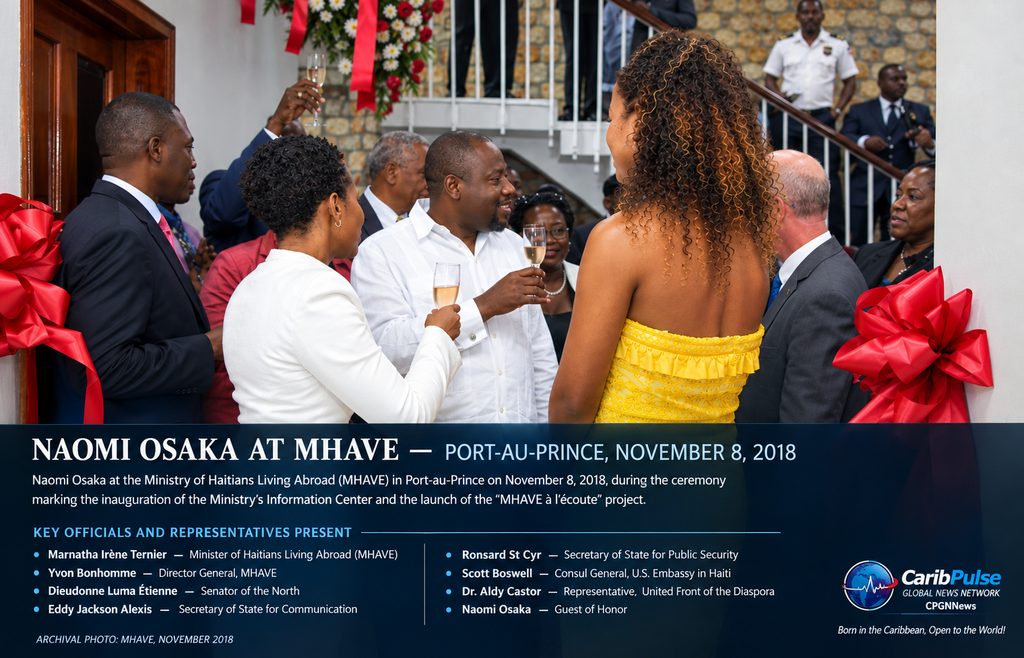
The strength of this photograph lies precisely in the fact that it records more than a visit. It preserves a moment in which several dimensions of Naomi Osaka’s story converged within the same institutional space: Haitian lineage, international sporting achievement, the diaspora, national institutions and Haiti’s recognition of one of its children shaped by dispersion. Above all, it reminds us that the relationship between a nation and its diaspora cannot be reduced to financial transfers, declarations of attachment or occasional returns. It can also take the form of institutional encounters, human relationships, cultural transmission and mutual recognition.
This is what gives Naomi Osaka’s return to Haiti a significance that deserves to be examined more deeply. Her story should not be transformed into Haiti’s symbolic property, any more than it would be fair to reduce her identity to her paternal ancestry. Naomi Osaka belongs first and foremost to her own history. Yet her journey allows Haiti to see itself differently, through one of those human trajectories that connect several countries, cultures and generations. Her return in 2018 made that relationship visible. For a few days, it transformed a family lineage into a lived experience, a family name into a territory rediscovered, and inherited memory into an encounter with the country itself.
It is precisely from this encounter that the question of the diaspora takes on a broader dimension. Naomi Osaka is not a single model of Haitian belonging abroad. She is one of its most visible expressions. Her story offers a window onto a much wider reality: that of generations of Haitians and people of Haitian descent whose lives have been built elsewhere, yet whose relationship with Haiti can continue to take multiple, independent and evolving forms.
LE REGARD DU CPGNNews
Naomi Osaka’s journey invites us to look beyond an individual story, and even beyond Haiti, in order to understand a profound transformation taking place in the contemporary world. Her trajectory connects Japan, the United States and the Haitian Caribbean, but it also reflects the experience of millions of people whose family histories, cultures, memories and identities now unfold across several continents. Through her story, a reality long regarded as peripheral comes into the very center of our time: the diaspora is no longer merely the external extension of a nation. It has become one of the defining human geographies of the contemporary world.
Naomi Osaka embodies this new geography with exceptional visibility. Born in Japan, raised in the United States, connected through her father to a Haitian family history and transformed into a globally recognized sporting figure, she cannot be contained within a single definition. She represents Japan on the court, carries a Haitian family history and belongs to a globalized world in which human trajectories no longer necessarily follow political borders. Her story therefore does not ask us to choose between different forms of belonging. On the contrary, it shows that an identity can be plural without being fragmented, transnational without being uprooted and global without losing the memory of its origins.
This is where Naomi Osaka’s story reaches far beyond tennis and beyond the Haitian context alone. It joins the trajectories of countless Caribbean, African, Asian, Latin American and European diasporas that, generation after generation, have helped shape the societies in which they live while maintaining connections with the places from which their histories emerged. The Caribbean itself has long carried this experience of human movement, departures, returns, families separated by oceans and cultures capable of surviving distance. Today, that historical experience has become a global reality.
A person may be born in one country, grow up in another, inherit from a parent the memory of a third, build a career somewhere else and remain emotionally connected to several histories at once. That person may speak several languages, carry multiple inheritances, move between different cultures and pass on to the next generation a memory that no longer belongs to a single geography. This plurality is not an anomaly. It is becoming one of the defining characteristics of our time.
The diaspora should therefore no longer be viewed solely as a population that has left its country. It can also be understood as a way for a nation, a culture or a civilization to continue moving through the world. It carries languages, traditions, knowledge, skills, professional networks, artistic creations, capital, values and memories. It connects territories that might otherwise gradually drift apart. In doing so, it becomes a cultural, intellectual, economic and human force whose significance extends far beyond migration statistics.
The Haitian diaspora offers a particularly powerful illustration of this reality. Despite crises, ruptures, disasters, disappointments and distance, it has contributed, alongside those who remained in the country, to keeping Haiti alive and standing. Generations of Haitians living abroad have supported their families, financed education, cared for loved ones, created businesses, transmitted their culture, developed networks and continued to speak of Haiti to their children, sometimes born thousands of miles from the land of their parents. This contribution has become so familiar that it can sometimes fail to receive the recognition it deserves.
Behind financial remittances are sacrifices. Behind journeys are emotional bonds. Behind projects are acts of loyalty. Behind generations born elsewhere is often the determination not to allow a family history to disappear. And behind this multitude of visible and silent gestures lies a fundamental reality: a considerable part of the Haitian nation now lives beyond its borders while continuing to participate in its existence.
This contribution deserves to be understood differently. The diaspora cannot be regarded merely as a source of resources to be called upon whenever the country faces a crisis. It is a living part of the nation, with its skills, experiences, networks, achievements, wounds, expectations and creative capacities. Its relationship with Haiti must be allowed to evolve into something deeper than emotional or financial obligation: a relationship built on trust, dignity and shared responsibility.
The renaissance of Haiti will also depend on this transformation. It cannot be built solely within the country, any more than it can be imposed upon those who live abroad. It must bring together those who remained and those who left around a renewed understanding of the nation, one open enough to recognize that people can contribute to its future from Port au Prince, Jacmel, Montreal, Miami, New York, Paris, Tokyo or any other city in the world. The question is therefore not simply how to bring Haitians back. It is how to ensure that they never cease to feel connected to the destiny of their country.
It is within this perspective that Yvon Bonhomme’s experience at the Ministry of Haitians Living Abroad acquires a significance that extends beyond a past administrative position. It reflects direct experience of the relationship between Haiti and its populations dispersed throughout the world. Above all, it reminds us that diaspora policy cannot be reduced to institutional mechanisms. It requires a human understanding of those who live far from the territory, of their journeys, expectations, achievements, wounds and of the ways in which they continue to carry Haiti within their own lives.
That experience now represents an intellectual and human asset for understanding the evolving relationship between territory and diaspora. It makes it possible to view the question not only from Haiti, but also from that meeting ground where memory, mobility, identity, citizenship and globalization intersect. It is precisely this ability to connect realities rather than place them in opposition that gives the subject of diaspora its full depth.
For CPGNNews, this evolution in perspective is essential. Our time can no longer be understood solely through the borders of states. Contemporary societies are also shaped by people moving between them, by transnational families, by new generations growing up between cultures and by human networks that now connect continents. To understand the world therefore also means understanding these invisible geographies that cross official maps.
Naomi Osaka is a particularly luminous expression of this reality. Her story shows that a person can carry several inheritances without having to renounce any of them, build a global identity without erasing her origins and transform the complexity of her journey into a source of strength rather than contradiction. She should not be reduced to Haiti because her father is Haitian, any more than she should be defined solely by Japan because she represents its colors in sport. Her story belongs to her. It is precisely for that reason that it can teach us something about the world.
The same care should guide the way we look at diasporas. The issue is not to claim symbolic ownership of them, to ask them to prove their belonging or to confine them within permanent nostalgia. It is to recognize what they have become: spaces of creation, transmission and encounter; bridges between continents; places where identities are continually reshaped without necessarily disappearing; and forces capable of transforming the memory of an origin into energy for the future.
This reality is particularly significant in the Caribbean. Caribbean peoples have long learned to live with oceans, migration, historical ruptures and movement between islands and continents. Their diasporas now form an immense human architecture connecting the region with North America, Europe, Latin America and other parts of the world. To view them merely as distant communities would be to overlook one of the great strengths of the contemporary Caribbean.
The global diaspora therefore compels us to rethink the very meaning of nationhood. A nation does not necessarily disappear when its children leave. It can continue to live through their memories, families, works, businesses, commitments and relationships with those who remained. It can even extend its influence far beyond its territory when it knows how to transform distance into connection.
This is why Haiti’s Renaissance cannot be lasting without a renaissance in the relationship between Haiti and its diaspora. But this reflection concerns far more than Haiti. It concerns every nation whose children leave, every society that welcomes people from elsewhere and every generation now growing up with several cultural horizons at once. It belongs to our century.
Naomi Osaka’s journey allows us to observe this transformation without confining her story to a single category. Her life becomes an entry point into a much broader question: how can nations continue to exist in a world where their children increasingly live elsewhere, identities are becoming more plural and geographical borders are no longer sufficient to define human belonging?
The answer lies neither in requiring people to return to a land of origin nor in erasing their roots in the name of a global identity. It lies in the ability to build relationships strong enough for distance not to mean rupture, free enough for belonging not to become constraint and open enough for several inheritances to coexist without cancelling one another.
This is where, for CPGNNews, the true significance of Naomi Osaka’s story lies. She reminds us that roots are not always a place where one remains. They can be a memory one carries, a history one transmits, a relationship one chooses to preserve and, at times, a source of strength that one transforms into a future. In this new world, diasporas are no longer the margins of nations. They are part of their emerging geography.
And perhaps this is precisely what the Haitian diaspora, with remarkable constancy, has been reminding the world for generations: despite hardship, distance and wounds, it has continued, alongside those who remained at home, to keep alive something that could have disappeared. That loyalty deserves to be recognized not as a debt owed to Haiti, but as a profound expression of what a nation can become when it refuses to allow its human bonds to be broken.
The next step should therefore not be simply to ask more of the diaspora. It should be to offer it a vision. A Haiti capable of rising again, modernizing, restoring its dignity and becoming once more a place to which its children, wherever they live, can contribute without having to abandon the lives they have built. A Haiti capable of understanding that its children scattered throughout the world do not represent a loss, but a global presence. A Haiti capable, finally, of transforming that presence into collective strength.
For the permanence of a nation depends not only on the strength of its institutions or the extent of its territory. It also depends on the ability of its children to continue believing that it deserves a future.
Haiti is therefore not simply a country its diaspora has left behind. It is also a story that its diaspora has helped keep alive. And if the Renaissance of Haiti is ever to reach its full meaning, it must know how to transform that loyalty, dispersed across the world, into a new force in the service of Haiti, the Caribbean and a more universal vision of human dignity.
It is within this perspective that CPGNNews looks at Naomi Osaka. Not as Haiti’s symbolic property, not as a mere icon of Japan, and not as a personality to be confined within a single identity, but as one of the most visible expressions of a world in transformation, where roots can be multiple, horizons global and belonging profoundly human.
A nation does not travel only with those who leave. It travels with what they carry from it, with what they pass on to the generations that follow, and with everything they may one day give back when they become, in turn, bridges between worlds.
ACKNOWLEDGEMENTS
This dossier is the result of a research process involving reading, verification, source comparison, and reflection devoted to a personality whose journey extends far beyond the boundaries of tennis. Naomi Osaka serves here as an entry point into a broader examination of Haiti, its diaspora, transnational identities, the circulation of human capital, and new forms of national representation in a world where belonging is no longer confined to a single territory. CPGNNews wishes to acknowledge the journalists, researchers, sports institutions, public organizations, archives, specialized platforms, and media outlets that, over the years, have documented Naomi Osaka’s journey, her sporting rise, her ties to Haiti, her public statements, and her relationship with her different forms of belonging.
Particular recognition goes to the international sports sources that made it possible to follow her professional career with precision and to understand how the tennis world documented her story. The Women’s Tennis Association notably documented her visit to Haiti in November 2018 and the welcome she received following her first Grand Slam title. The international press also provided complementary perspectives on that visit, particularly on her relationship with her Haitian roots and the personal experience she gained from it. The Miami Herald, in particular, published an in depth report in March 2019 examining the effects of her stay in Haiti and the relationship between her international trajectory and the Haitian heritage passed down to her by her father.
CPGNNews also acknowledges the work of Haitian and Caribbean media outlets that documented her arrival, her visit, her activities, and the institutional and popular welcome she received in November 2018. Their archives make it possible to place the event within its national context and to complement accounts produced by international media. These different contributions have been treated not as simple repetitions of the same news event, but as complementary pieces of a corpus that helps explain how Naomi Osaka was perceived, welcomed, and represented in Haiti as well as throughout the wider world.
These acknowledgements do not, however, constitute an exhaustive inventory of every media outlet that has published an article, news report, interview, analysis, or feature on Naomi Osaka throughout her career. Such an inventory would go far beyond the scope of this dossier. Rather, they express our recognition of the broader journalistic and documentary ecosystem whose work made it possible to establish, verify, and contextualize the elements retained in this research. The principal references actually used are presented in the documentary section that follows.
SPECIAL NOTE FROM THE AUTHOR
This dossier also possesses a particular documentary dimension for its author. In November 2018, when Naomi Osaka was visiting Haiti in what would become an important chapter in her public relationship with her father’s country, the author of this research, Yvon Bonhomme, was serving as Director General of the Ministry of Haitians Living Abroad, known by its French acronym MHAVE. In that capacity, he personally participated in the official reception of Naomi Osaka during her stay in Haiti.
This circumstance is not presented here as an argument from authority and does not constitute the foundation of the analysis developed throughout the dossier. It belongs to the documentary history of the event and simply provides this research with a testimony directly connected to the sequence under examination. The analysis must be capable of being understood and evaluated independently of this personal experience. For that reason, the facts concerning Naomi Osaka’s career, her visit to Haiti, her family origins, and the international reception of her story have been placed, as far as possible, within a corpus of public, journalistic, sporting, and institutional sources.
The photograph published following this note should therefore be understood as a documentary archive rather than as an autobiographical or promotional element. It preserves a precise moment in the recent history of Haiti and in Naomi Osaka’s journey, when sport, diaspora, diplomacy, national representation, and family memory converged within the same institutional setting. Media archives from November 2018 also confirm the presence of several Haitian officials and diplomatic representatives during the activities surrounding her visit.
DOCUMENTARY ARCHIVE
Naomi Osaka in Haiti, November 2018
This photograph belongs to the documentary record of Naomi Osaka’s visit to Haiti in November 2018. It bears witness to the official welcome extended to the champion following an exceptional 2018 season during which she won her first Grand Slam title at the US Open. Contemporary journalistic sources establish that Naomi Osaka was in Haiti from November 6 to 10, 2018, as part of a visit organized at the invitation of the Haitian authorities. Her stay included institutional activities in Port au Prince as well as a visit to Jacmel, a city closely associated with her father’s family history.
According to the documentary information associated with this archive, the photograph includes Naomi Osaka, Yvon Bonhomme, then Director General of MHAVE, former Minister Marnatha Irène Ternier, former United States Consul General in Haiti Scott Boswell, and former Senator Dieudonne Luma Étienne, among others. Haitian media reports from the period confirm the presence of several of these officials during the official activities surrounding the visit and help place the photograph within the institutional context of November 2018. The image is therefore not merely a personal keepsake. It also represents an archival record preserving a moment when a world class champion, whose life emerged from several cultural and geographical spaces, was officially welcomed in the country to which her family history connects her.
Photographic credit: personal archive of Yvon Bonhomme, November 2018.
PRIMARY SOURCES AND DOCUMENTARY PRINCIPLES
This dossier draws upon a body of international sports sources, international press, Haitian and Caribbean media, institutional communications, and public documents concerning Naomi Osaka’s journey, her family origins, her career, her visit to Haiti, and broader questions relating to the diaspora and transnational identities. The sources do not all serve the same function. Some establish biographical or sporting facts, others directly document the 2018 visit, while others provide journalistic or analytical perspectives on the significance of the event.
The list presented here does not claim to catalogue every publication worldwide devoted to Naomi Osaka. It brings together the principal references actually used to construct, verify, or contextualize the dossier. This distinction is methodologically important: CPGNNews does not present as “acknowledged” every media outlet that has reported on Naomi Osaka, but recognizes the sources whose work actually contributed to the research.
International Sports Sources
The Women’s Tennis Association, WTA, constitutes one of the principal sporting references for this dossier. Its archives help document Naomi Osaka’s visit to Haiti in November 2018, the welcome she received following her US Open victory, and the way this episode was presented within the international tennis community. The WTA has also published material on the media reception of her rise and therefore represents a particularly useful source for placing her career within the recent history of professional tennis.
Women’s Tennis Association, WTA
Tennis.com and We Love Tennis also served as useful references for comparing international sports coverage of her visit to Haiti with information concerning her career and family origins.
International Press
The Miami Herald occupies a particular place within the documentary corpus because of its March 2019 report examining the personal consequences of Naomi Osaka’s visit to Haiti and the relationship between that experience and her Haitian heritage. This publication represents an important source for understanding that the visit cannot be reduced to a simple institutional ceremony or media event, but must also be situated within the personal journey of a young champion confronting the complexity of her different forms of belonging.
Archives of the Associated Press were also used to document the international dimension of the visit and the reception of Naomi Osaka in Haiti following her US Open title. They help place the Haitian event within the broader international coverage of her sporting career.
Haitian and Caribbean Press
Haitian media constitute an essential component of the documentary corpus because they make it possible to examine the event from its country of origin and to compare local perceptions with those of international media. Le Nouvelliste documented Naomi Osaka’s arrival in Haiti and the circumstances of her stay. Radio Vision 2000 also covered her arrival and the first stages of her visit. HaitiLibre reported on her reception at the airport and the presence of several government officials. Other Haitian publications, including InfoHaïti, Le Floridien, Vant Bèf Info, and Haiti Tempo, contributed to preserving the record of different aspects of this sequence, including institutional activities, her visit to Jacmel, and Naomi Osaka’s connection to her Haitian family heritage.
The value of these sources lies precisely in their complementarity. International media provide a perspective on how Naomi Osaka’s journey was perceived from outside Haiti, while Haitian media document how her arrival was received within the country and the importance attributed to her connection with Haiti. Comparing these perspectives helps prevent a single narrative from dominating the interpretation of an event that possesses sporting, familial, cultural, diplomatic, and political dimensions.
Institutional Sources
Public communications from Haitian authorities constitute another important category of primary sources. These include information concerning Naomi Osaka’s arrival, the activities organized during her stay, official ceremonies, and initiatives undertaken by the Ministry of Haitians Living Abroad. These documents have been treated with the caution appropriate to any use of institutional communications, distinguishing between facts that can be independently established and formulations belonging to official discourse.
This methodological precaution is particularly important for a dossier devoted to identity and belonging. The present work therefore carefully distinguishes place of birth, family ancestry, parental origin, cultural socialization, nationality, emotional belonging, claimed identity, and sporting representation. These categories may intersect without being interchangeable. The analysis of Naomi Osaka rests precisely on this distinction.
AN INDEPENDENT EDITORIAL RESEARCH
This dossier is neither an official biography of Naomi Osaka nor an institutional publication devoted to her career. It is an independent editorial research project that uses her journey as an entry point for examining deeper transformations involving the Haitian diaspora, transnational identities, the circulation of human capital, international representation, sports diplomacy, and new forms of human power.
The approach begins with an individual journey in order to raise a collective question: how can a nation continue to exist within the lives of its children when they live, grow, work, create, and succeed beyond its territory? Naomi Osaka is not presented as representative of the entire Haitian diaspora. Her journey is exceptional in its visibility, sporting achievements, and particular combination of family, cultural, and geographical affiliations. It is precisely this singularity that makes it possible to observe, through a particularly visible case, phenomena affecting millions of people belonging to contemporary diasporas.
She was born in Japan, grew up primarily in the United States, represents Japan in international tennis, and, through her father, carries a family history deeply connected to Haiti. Her visit to the country in November 2018 added a territorial and personal dimension to this history, particularly through her time in Jacmel. These different realities do not cancel one another and should not be artificially merged. They coexist and illustrate a fundamental transformation in contemporary human geography: a person’s identity can be rooted simultaneously in several spaces without one necessarily having to erase the others.
This is why the central question of this dossier is ultimately not whether Naomi Osaka is or is not Haitian in some simplistic sense. The more meaningful question is what it means to belong to a nation when that nation also exists through those who have left its territory, their children, and the generations that follow them. Naomi Osaka’s journey therefore makes it possible to examine Haiti’s capacity to recognize, understand, and engage a diaspora whose potential extends far beyond financial transfers and includes skills, networks, knowledge, professional experience, international influence, and global presence.
The deeper question opened by this research is therefore how to move from viewing the diaspora primarily as an external population toward understanding it as a human, cultural, professional, and strategic extension of the nation. Such an evolution can only be sustainable, however, if it rests upon trust, reciprocity, credible institutions, and a relationship that respects individual autonomy while recognizing the power of historical and family connections.
Naomi Osaka is therefore neither definitive proof of a particular national identity nor a symbol that can be confined to a single definition. She is an exceptional case that allows us to look differently at the relationship between territory, memory, family, diaspora, and international representation. Her journey reminds us that a nation can be territorially limited while possessing a human geography far greater than its borders.
NAOMI OSAKA, A HAITIAN PRIDE BEYOND BORDERS
This dossier begins with a champion born in Japan, raised primarily in the United States, representing Japan on the greatest stages of world tennis, and carrying, through her family history, a profound connection to Haiti. But it ultimately leads to a reflection that extends far beyond her personal story. From Jacmel to Osaka, from New York to Miami, from tennis courts to the world’s greatest international stages, her journey reveals a transformation in contemporary human geography in which belonging, memory, and the capacity to act now circulate far beyond territorial borders.
Naomi Osaka’s story therefore reminds us that a nation is measured not only by the extent of its territory, the strength of its institutions, or the number of people who reside within it. It is also measured by the memory it transmits, the relationships it maintains, the talents it supports, and the connections it is capable of building with its children, wherever they may live. For Haiti, this reflection opens a particularly important strategic perspective: understanding the diaspora not merely as an external community, but as a lasting component of its human capital and its presence in the world.
Haiti is not only a place, it is also a memory in motion.
CPGNNews,
CaribPulse Global News Network
International multimedia and multilingual editorial platform born in the Caribbean.
Born in the Caribbean, Open to the World!
Pro Dignitate, Inclusione et Progressu.
Independent editorial research, international analysis, and strategic understanding of the new geographies of identity, diaspora, and human power.
NAOMI OSAKA, A HAITIAN PRIDE BEYOND BORDERS
This dossier is an independent editorial research project devoted to Naomi Osaka as an entry point into a broader examination of Haiti, its diaspora, transnational identities, and the new geographies of human power.
Through her family history, international trajectory, and relationship with several cultural and geographical spaces, Naomi Osaka reveals a reality that extends far beyond tennis: a nation can continue to live within the journeys of its children long after they have moved beyond its territory. For Haiti, this reality opens an essential reflection on the diaspora, human capital, transmission, international representation, and the ability of a nation to build lasting relationships with those who carry a part of its history throughout the world.
Haiti is not only a place, it is also a memory in motion.
YVON BONHOMME
Independent Researcher | Essayist | Geopolitical Analyst | Journalist
Exclusive CPGNNews Special Report
NAOMI OSAKA, A HAITIAN PRIDE BEYOND BORDERS
END OF THE DOSSIER
“All rights reserved © CPGNNews, 2026.”
