

Editorial | CPGNNews – CaribPulse Global News Network
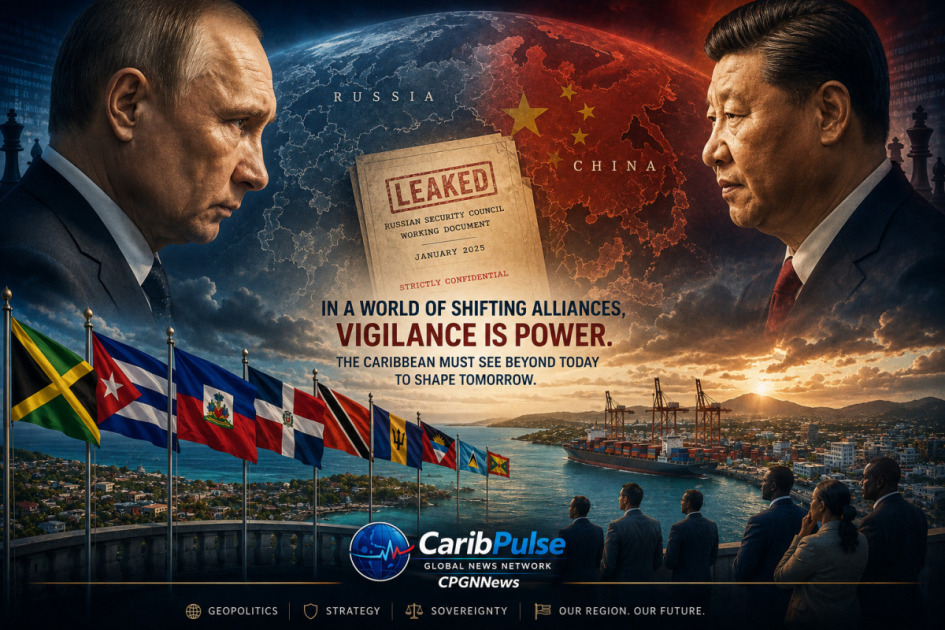
While Beijing and Moscow have spent the past several years projecting an image of a “friendship without limits” before the cameras of major international summits, the reality emerging from Russia’s strategic establishment appears far more nuanced. A recently leaked Russian Security Council working document, dated January 2025 and reported by MSN, sheds light on concerns that have rarely been expressed publicly. For part of Russia’s security apparatus, China is no longer viewed solely as an indispensable partner in the face of Western sanctions, but increasingly as a rising power whose economic, technological and demographic expansion could eventually challenge some of the Russian Federation’s core national interests.
At first glance, the revelation appears paradoxical. Since the outbreak of the war in Ukraine, the two powers have never appeared closer. Bilateral trade has reached record highs, Russian oil and gas exports have shifted dramatically toward Chinese markets, and Beijing has become one of Moscow’s most important economic lifelines, helping soften the impact of Western sanctions. On the international stage, both governments consistently advocate a multipolar world order while challenging what they see as Western dominance of global affairs.
Yet geopolitics has never been governed solely by diplomatic declarations. States cooperate when their strategic interests align, but they also prepare for the day those interests begin to diverge. The leaked document appears to confirm that within Russia’s highest strategic circles, China’s growing influence is increasingly regarded as a matter of national security. Beijing’s expanding investments in Siberia and Russia’s Far East, the development of cross-border infrastructure, access to natural resources, and China’s growing ambitions in the Arctic are all reportedly fueling concerns that extend far beyond economics.
Siberia: The Heart of Russia’s Strategic Anxiety
Siberia and Russia’s Far East account for nearly two-thirds of the country’s territory while remaining sparsely populated. Rich in energy reserves, minerals and forests, these vast regions have long been considered essential to Russia’s national security. Across the border stands China—a country whose economic, industrial and demographic weight continues to grow at an unprecedented pace.
For many Eurasian affairs specialists, the prospect of increasing Russian economic dependence on China has been a subject of strategic debate for years. The leaked document suggests these concerns have now moved beyond academic discussions and into the highest levels of Russia’s national security establishment.
This reflects a profound shift in the balance of power. Two decades ago, Russia was widely regarded as the dominant military and geopolitical power in the relationship. Today, China has become the world’s second-largest economy, a global leader in manufacturing, technology and international investment. Russia, by contrast, continues to bear the economic burden of a prolonged war while operating under an extensive sanctions regime.
An Increasingly Unequal Partnership
Perhaps the most significant lesson emerging from this episode is the growing asymmetry in the Russia-China relationship.
Unlike Moscow, Beijing enjoys a highly diversified network of economic partners across Europe, Asia, Africa, the Middle East and Latin America. Russia remains strategically valuable as a supplier of energy and raw materials and as a diplomatic partner in challenging Western influence, but it is by no means indispensable to China’s economic future.
Russia, on the other hand, has become increasingly dependent on Chinese markets to export its hydrocarbons, maintain critical trade flows and access industrial goods that are now more difficult to obtain elsewhere. The deeper this dependence becomes, the more the balance of power shifts toward Beijing. It is precisely this evolving dynamic that appears to be causing growing concern among Russian strategists.
Why This Matters to the Caribbean
At first glance, this quiet rivalry may seem far removed from Caribbean affairs. That would be a serious miscalculation.
Over the past fifteen years, the Caribbean has steadily emerged as an area of growing strategic interest for major global powers. China has significantly expanded its investments in ports, highways, hospitals, energy infrastructure and telecommunications throughout the region. In several island nations, Beijing has become one of the leading commercial and financial partners, playing an increasingly important role in financing major development projects.
Russia, meanwhile, has pursued a different strategy. Its regional influence relies more heavily on military cooperation, diplomatic engagement, energy agreements and closer political ties with selected governments. While the methods differ, the objective remains largely the same: establishing a lasting presence in a region that sits astride vital maritime routes connecting the Atlantic Ocean, the Gulf of Mexico and the Panama Canal.
In this context, understanding the evolution of Russia-China relations is no longer an academic exercise for Caribbean policymakers. Should Moscow begin viewing Beijing less as a strategic partner and more as a geopolitical competitor, both powers may seek to strengthen their influence in strategically important regions—including the Caribbean.
The region could therefore face an increase in competing investment offers, financial assistance, infrastructure projects and strategic partnerships. Such competition may create valuable opportunities for development, but it could also expose Caribbean nations to greater economic and diplomatic dependency unless managed through balanced and carefully crafted foreign policies.
A Lesson for Small States
Beyond the Russian case itself, the leaked document reinforces one of international politics’ oldest truths: alliances are rarely built on trust alone. They are built on converging interests.
As long as Moscow and Beijing share the objective of limiting Western influence in global affairs, their partnership will likely continue to deepen. Yet common interests do not eliminate national ambitions, strategic calculations or mutual suspicion.
The document offers an unusually rare glimpse into the internal thinking of a major power confronted with a partner that has gradually become more powerful than itself. It reminds us that behind every summit meeting, every joint declaration and every strategic partnership lies a continuous process of risk assessment and long-term planning.
The Caribbean in an Emerging Global Order
As the international balance of power continues to evolve, Caribbean nations can no longer afford to observe great-power competition from the sidelines. The challenge is not to choose between competing blocs, but to preserve strategic autonomy by diversifying partnerships, demanding greater transparency in financial agreements and strengthening regional cooperation.
The leaked Russian document does not undermine the strategic partnership between Moscow and Beijing. Rather, it reminds us that in geopolitics, the strongest alliances are often those sustained by the greatest vigilance. Governments across the Caribbean that recognize these signals, understand the shifting dynamics of global power and anticipate the next phase of geopolitical realignment will be better positioned to safeguard their national interests in an increasingly complex world.
Sources: This editorial is based primarily on information reported by MSN regarding a leaked January 2025 Russian Security Council working document, complemented by publicly available analyses from international affairs specialists. The geopolitical assessment, Caribbean perspective and editorial analysis presented here are the work of the CPGNNews editorial team.
By Sofia Jasmin
CPGNNews | CaribPulse Global News Network
