


CPGNNews / CaribPulse Global News Network analysis
The text under review highlights a reality that is now widely acknowledged: the recent decline in oil prices does not signal a return to stability. The current market easing, driven by a temporary diplomatic thaw between the United States and Iran, unfolds within a broader international environment still shaped by multiple and overlapping tensions.
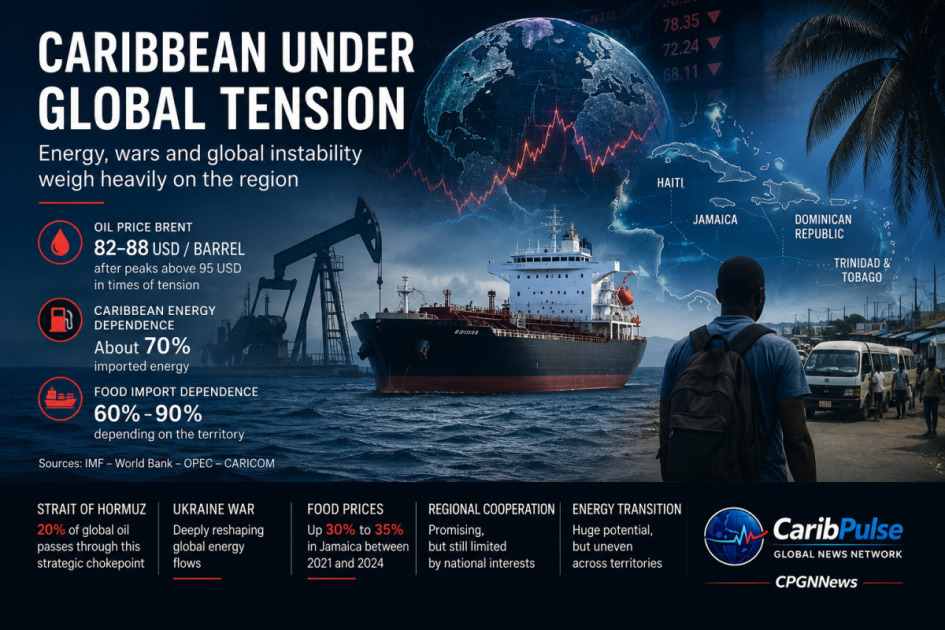
The Strait of Hormuz remains a critical strategic chokepoint in the global energy system. At the same time, the war in Ukraine continues to reshape global oil and gas flows in a lasting way. Against this backdrop, Caribbean economies remain particularly exposed due to their heavy reliance on imported energy and food supplies.
A sound but still partial reading of the data
The figures cited in the analysis are broadly consistent with current regional trends:
- around 70% energy dependence in several Caribbean economies,
- between 60% and 90% dependence on imported food depending on the territory,
- an estimated pass-through effect of 2% to 4% increase in transport costs for every $10 rise in oil prices.
Taken together, these indicators help explain how global energy fluctuations translate directly into the cost of living across the region.
Local realities that reflect structural pressure
The case of Haiti illustrates this dependence with particular clarity. In an economy where a significant share of electricity is generated through diesel-powered systems, any movement in oil prices is quickly transmitted to essential public services.
Fuel price increases often lead to immediate adjustments in hospitals, schools, and small businesses, which must adapt operating hours, services, or costs in response to higher energy expenses.
In Jamaica, available data points to a substantial rise in the cost of the basic food basket between 2021 and 2024, estimated at roughly 30% to 35%. A significant portion of this increase is linked to transport costs, both maritime and land-based, which remain closely tied to global energy prices.
The limits of regional cooperation
The analysis raises the prospect of energy procurement pooling within CARICOM. While this idea is regularly discussed, it continues to face structural constraints rooted in the differing economic realities of member states.
Energy-producing countries such as Trinidad and Tobago operate within global market dynamics, while net-importing economies focus primarily on cost reduction and price stability. This structural imbalance significantly limits the scope for a unified regional energy policy.
An underutilized energy transition
The Caribbean holds considerable renewable energy potential, particularly in solar, wind, and geothermal resources. Several initiatives are already underway, especially in Barbados, Dominica, and Guadeloupe.
However, progress remains uneven across the region. Financial, technical, and institutional constraints continue to slow large-scale deployment.
In this context, oil price volatility acts both as a persistent economic pressure and as a potential catalyst for accelerating the energy transition.
The Caribbean within global power dynamics
The regional situation cannot be understood solely through an economic lens. The Caribbean also occupies a strategic position within global maritime routes and broader geopolitical competition.
Foreign investment in ports, telecommunications, and transport infrastructure reflects a growing strategic interest from major global powers.
This trend underscores that the Caribbean is not only a space of economic vulnerability but also an arena of geopolitical interaction within wider global competition.
Conclusion
The current dynamics of global energy markets reflect an international system defined by simultaneous and interconnected shocks. The recent easing in oil prices represents a cyclical adjustment rather than a structural correction of existing imbalances.
In this environment, Caribbean economies remain highly exposed to external shocks, while still retaining adaptation capacity through energy transition efforts and regional cooperation initiatives.
The central challenge for the region lies in transforming structural vulnerability into a strategic lever for long-term economic resilience.
CPGNNews / CaribPulse Global News Network
International analysis from the Caribbean — interpreting global dynamics and their regional impact.
