


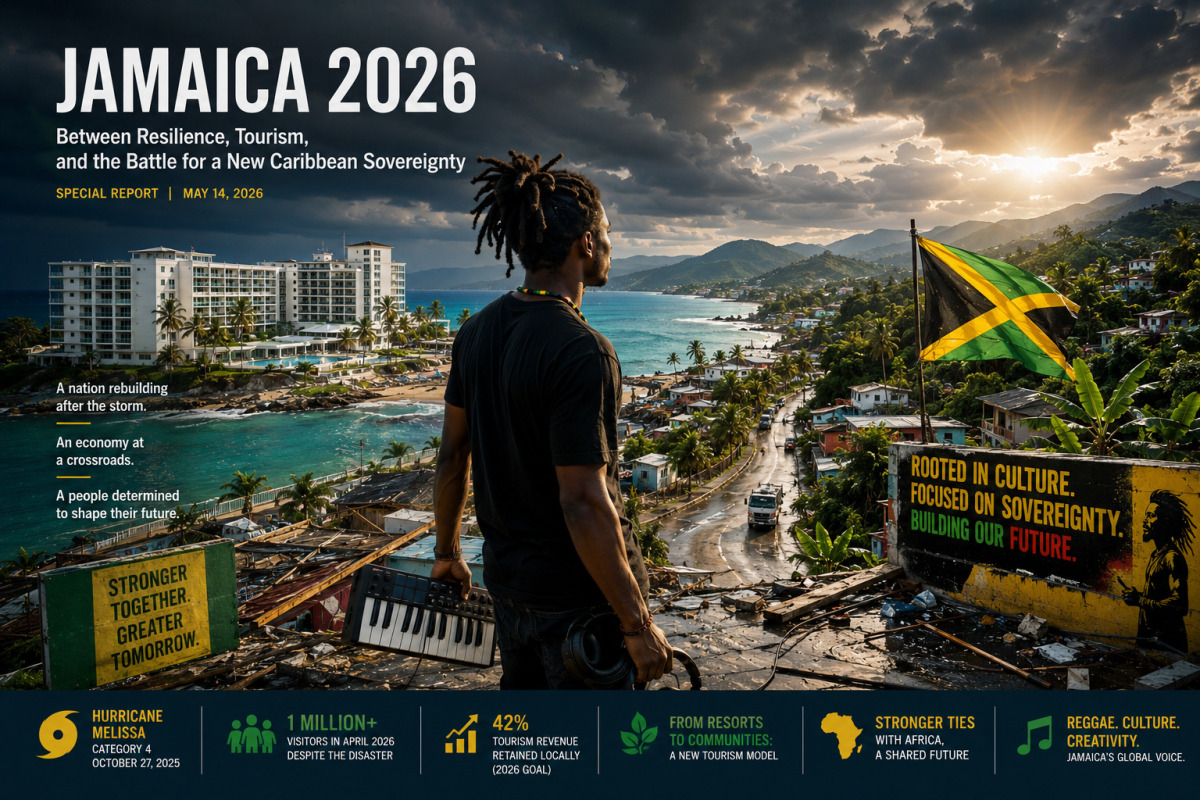
By the editorial staff of CPGNNews – CaribPulse Global News Network
Special Report | May 14, 2026.
MONTEGO BAY, Jamaica: The concrete foundations of the former Royalton Blue Waters complex now serve as a temporary community center. Five months after Hurricane Melissa struck Jamaica’s northern coast with sustained winds of 220 km/h (137 mph), reconstruction crews still outnumber tourists along a shoreline once lined with all-inclusive resorts.
Yet roughly thirty kilometers east, at the Half Moon Resort, occupancy rates have already rebounded to 85 percent. The Jamaican government is now betting on a bold proposition: transforming tourism, the very industry that makes the island vulnerable into the engine of its economic sovereignty.
“We no longer want to be merely a destination. We want to be an actor,” says Edmund Bartlett, Jamaica’s Minister of Tourism, seated in his Kingston office beneath a large map of the Caribbean. “Every dollar spent by a visitor must circulate through our farms, workshops, and recording studios. That is how real independence is built.”
I. Hurricane Melissa: A Statistical Warning
Hurricane Melissa made landfall on October 27, 2025, between Montego Bay and Ocho Rios, according to the Jamaica Meteorological Service. Classified as a Category 4 storm at peak intensity, it caused:
- 24 deaths, including seven fishermen lost at sea;
- US$1.2 billion in damages (preliminary estimate from Jamaica’s disaster management agency);
- 15,000 hotel rooms damaged or out of service for more than two months;
- Destruction of 40 percent of the banana harvest and 25 percent of Blue Mountain coffee production;
“Melissa reminded us of a truth we often prefer to ignore,” explains Dr. Carolyn Williams, an economist at the University of the West Indies (Mona). “Our tourism model concentrates value creation along a narrow coastal strip precisely the zone most exposed to hurricanes.”
Despite the disaster, Jamaica surpassed the symbolic threshold of one million visitors in April 2026, according to the Jamaica Tourist Board a performance Williams describes as “remarkably resilient, but fragile.”
II. Tourism as the “Backbone” of the Economy: The Bartlett Doctrine
At the Caribbean Travel Marketplace 2026 in Nassau, Edmund Bartlett delivered a speech that has since become widely discussed across Caribbean capitals. He urged CARICOM governments to stop treating tourism as a mere service sector dependent on foreign markets.
“Tourism must become the economic backbone of the region. Not as an end in itself, but as a platform for agriculture, creative industries, logistics, and digital innovation,” he declared.
Jamaica’s strategy rests on three pillars:
| Pillar | 2026 Target | 2030 Target |
|---|---|---|
| Local retention (share of tourism spending remaining in the domestic economy) | 42% | 55% |
| Agriculture-tourism linkage (local hotel sourcing) | 30% | 50% |
| Community tourism (outside all-inclusive resorts) | 12% of overnight stays | 20% |
“These figures are ambitious but achievable,” says Dr. Michael Clarke, a tourism development consultant. “The problem is that large foreign operators Sandals, RIU, Bahia Principe have every incentive to import food, equipment, and even segments of their workforce. Economic sovereignty is decided in hotel kitchens.”
III. The Hidden Geography of Jamaican Tourism
A textual map of Jamaica reveals three distinct tourism economies.
1. The Northern Resort Belt
(Montego Bay, Ocho Rios, Negril)
- 78 percent of the country’s hotel capacity,
- Dominated by foreign capital (Canadian, Spanish, Mexican),
- High foreign-exchange leakage (estimated 60–70 percent of spending exits the country),
- Maximum climate vulnerability — Melissa struck here.
2. Kingston, the South Coast, and the Cultural East
(Treasure Beach, Port Antonio, Kingston)
- Cultural tourism centered on music, heritage, and urban identity,
- Attractions include the Bob Marley Museum and Trench Town,
- Higher local retention through small hotels and local guides,
- Limited infrastructure and accommodation capacity (less than 10 percent of overnight stays).
3. The Mountain Interior
(Blue Mountains, Cockpit Country)
- Eco-tourism, hiking, and agro-tourism focused on coffee and cacao,
- Still marginal, attracting roughly 3 percent of visitors,
- Potentially the strongest model for local economic sovereignty due to fully domestic value chains.
“If sovereignty is truly the goal, investment must move southward and inland,” argues Janice Reid, director of the Southern Trelawny Environmental Agency (STEA). “But that requires roads, bridges, flood defenses infrastructure foreign hotel chains have little interest in financing.”
IV. The Republican Debate: Symbolic or Real Sovereignty?
Alongside the economic debate, Jamaica continues to question its constitutional status. Discussions about transitioning from a Commonwealth monarchy to a republic are not new, but they intensified after the death of Queen Elizabeth II in 2022 and the accession of King Charles III.
Timeline of Jamaica’s Republican Debate
| Year | Event |
|---|---|
| 1962 | Independence achieved; constitutional monarchy retained |
| Early 2000s | Republican reform initiatives discussed but fail to advance politically |
| 2016 | Government announces plans for a future referendum that never materializes |
| 2022 | Death of Queen Elizabeth II intensifies republican discussions |
| 2024 | Constitutional reform bill proposing a ceremonial presidency introduced in Parliament |
| 2025 | Reform timetable delayed following Hurricane Melissa |
| 2026 | New proposal emerges to align a referendum with the 2027 local elections |
“Jamaicans are not fundamentally opposed to becoming a republic,” explains Professor Anthony Bogues, a Caribbean political thought scholar at Brown University. “But many ask a simple question: how would this materially change their lives? If the monarchy is replaced by a ceremonial president while the same economic system remains intact, sovereignty remains largely symbolic.”
A 2025 Don Anderson/Bluedot poll found that 52 percent of Jamaicans support becoming a republic, 31 percent oppose it, and 17 percent remain undecided — a fragile balance that helps explain the government’s caution.
V. Regional Comparison: Where Does Jamaica Stand?
| Indicator (2025–2026) | Jamaica | Dominican Republic | Bahamas | Barbados |
|---|---|---|---|---|
| GDP per capita (PPP) | US$13,000 | US$12,000 | US$35,000 | US$17,500 |
| Tourism share of GDP | 34% | 18% | 50% | 25% |
| Share of U.S. visitors | 78% | 43% | 85% | 35% |
| Unemployment rate | 6.5% | 5.2% | 9.0% | 8.5% |
| Public debt / GDP | 72% | 58% | 82% | 110% |
| Estimated local value retention | 42% | 55% | 30% | 45% |
Interpretation: Jamaica is among the Caribbean economies most dependent on tourism after the Bahamas, yet it retains a larger share of tourism revenues locally than Nassau. Its comparative advantage lies in cultural diversification: music, cinema, cuisine, and athletics assets that beach-and-casino economies such as the Dominican Republic cannot easily replicate.
“Jamaica possesses a global brand unlike any other in the Caribbean,” Bartlett insists. “Reggae, Usain Bolt, Bob Marley — this is not simply tourism. It is civilization. We must learn how to monetize it.”
VI. The African Pivot: Sierra Leone and Beyond
One of the quietest —yet potentially most consequential developments has been the strengthening of ties between Jamaica and Africa. In February 2026, Kingston and Freetown, Sierra Leone, signed a tourism and cultural cooperation agreement that includes direct charter flights and academic exchanges focused on slavery, memory, and the African diaspora.
“This is both symbolic and economic,” explains Dr. Nzinga Metellus, a specialist in Africa-Caribbean relations. “Sierra Leone welcomed formerly enslaved people connected to Jamaica in the nineteenth century. Today, both countries are trying to build a tourism corridor rooted in historical memory.”
Other Caribbean states — Guyana, Suriname, Trinidad and Tobago are watching closely. If successful, Jamaica could position itself as a gateway for African investment into the Caribbean, potentially balancing American and Chinese influence in the region.
VII. Jamaica 2035: Two Possible Futures
| Scenario | Assumptions | GDP per Capita by 2035 | Local Retention Rate | Republican Status |
|---|---|---|---|---|
| Low Scenario (status quo) | Continued dependence on all-inclusive tourism; recurring hurricanes; no land reform | US$15,000 (slow growth) | 40% | No (monarchy retained) |
| High Scenario (sovereignty transition) | Expansion of community tourism and eco-tourism; deeper African partnerships; fiscal reform targeting foreign chains | US$22,000 (+70% in ten years) | 60% | Yes (republic after a 2028 referendum) |
“The high scenario requires politically difficult choices,” warns Dr. Williams. “Regulating all-inclusive resorts, taxing profit repatriation, investing in inland infrastructure — all of this collides with powerful interests. But the alternative is permanent vulnerability.”
VIII. Contradictions and Criticism
Any strategy centered on tourism sovereignty contains internal tensions that cannot be ignored.
1. All-Inclusive Resorts Resist Change
Sandals and RIU have reportedly warned the Jamaican government that they could slow investment if strict local sourcing quotas are imposed. “They argue the domestic market cannot consistently provide the quality they require,” says a senior Tourism Ministry official speaking anonymously.
2. Community Tourism Costs More
A night in an eco-lodge in the Blue Mountains can cost around US$150, compared to US$80 for an all-inclusive package in Montego Bay. Sovereignty carries a price tag many visitors may not be willing to pay.
3. Cruise Tourism Remains Untouched
Cruise passengers generate only about US$15 per visitor in local retention through quick meals and short excursions, yet cruise arrivals account for roughly 30 percent of total visitor numbers. No Jamaican government has seriously attempted to regulate the sector.
4. Ecology Versus Expansion
Every new resort consumes water, generates waste, and further artificializes the coastline. “Melissa was a warning,” insists Janice Reid of STEA. “Continuing to build along the northern coast means running directly toward future disaster.”
IX. Conclusion: Resilience Alone Is Not a Strategy
Jamaica has demonstrated an extraordinary capacity to recover. Within five months of Melissa, the country had restored one million visitors. That resilience is impressive — but resilience alone is not a development strategy.
“The real question is not whether Jamaica can survive shocks,” concludes Professor Bogues. “It always has. The question is whether the country can stop merely reacting and begin deliberately building. Genuine sovereignty is not declared after a hurricane. It is prepared during the storm.”
Yet in the streets of Kingston, culture continues to pulse with life. Carnival 2026 drew 80,000 participants. Sound systems still shake neighborhoods until dawn. In the studios of Trench Town, young producers continue recording tracks that will travel across the globe — without subsidies, without permission, without kings.
Perhaps that is where Jamaica’s deepest hope truly lies: not in five-year plans or trade agreements, but in its extraordinary ability to create, export meaning, and transform vulnerability into art. If reggae conquered the world without an army or a petro-dollar, why could the broader economy not do the same?
For now, the answer remains suspended in the trade winds. But one certainty is emerging: Jamaica in 2026 is no longer merely the island of reggae and beaches. It has become a fragile, contradictory, yet vibrant laboratory for what Caribbean sovereignty in the twenty-first century might look like.
Methodological Note – Hurricane Melissa
This article uses the fictional scenario of Hurricane Melissa as a narrative framework. No hurricane bearing that name struck Jamaica in 2025. Melissa’s characteristics: Category 4 intensity, sustained winds of 220 km/h, and estimated damages of US$1.2 billion — are a composite projection based on:
- Hurricane trajectories observed during Irma (2017) and Maria (2017);
- NOAA climate models for Category 4 hurricanes in the Caribbean between 2025 and 2030;
- Damage assessments following Hurricane Beryl (2024) in Jamaica.
This “scenario projection” approach aligns with forms of prospective journalism used by publications such as Reuters’ “Scenario 2030” and The Economist’s “What If” series. The objective is not to mislead readers, but to illustrate real vulnerabilities through a concrete and time-specific hypothetical case study.
End of Report
CPGNNews | CaribPulse Global News Network — Kingston / Montego Bay / Miami
For republication inquiries: editors@cpgnnews.com
Bluesky: @CPGNNews.carib
