


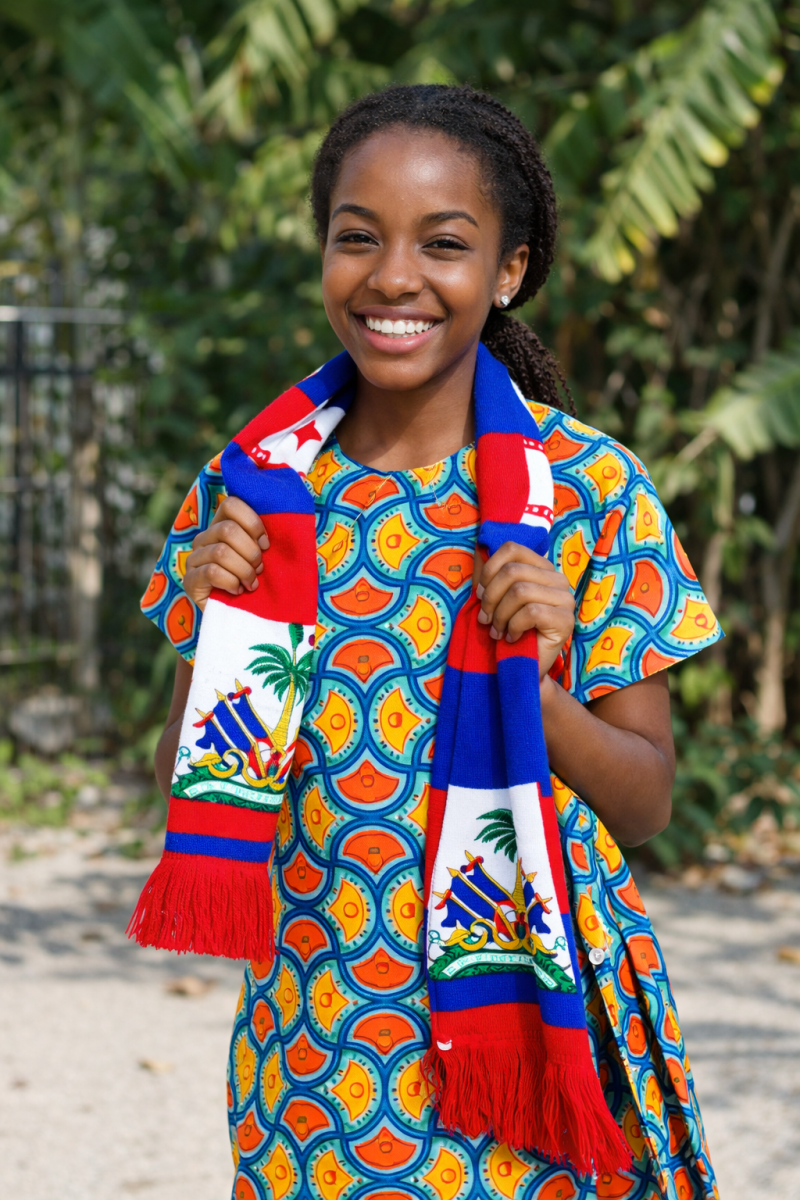
LOMÉ, Togo: The confetti had not yet settled on the stage of the Hôtel Petit Bruxelles. Ariana Milagro Lafond, 19, had just won the eighth edition of the House of Challenge competition. But instead of raising the oversized check or waving to the crowd, she stepped up to the microphone and spoke to a country more than 8,000 kilometers away.
“To the gangs destroying Haiti, lay down your weapons,” she said, her voice firm but her eyes wet. “We just want to live.”
The words were spoken on April 11, 2026, just moments after a historic victory. For the first time, a Haitian woman had won this pan-African competition, which blends dance, digital influence and real-time public voting. But what transformed this athletic performance into a moment of national catharsis was what she did with the trophy: she turned it into a megaphone.
A Historic First for a Haitian Woman.-
The House of Challenge competition, founded in 2018, brings together participants from several African countries and the diaspora each year. The 2026 edition included more than 50 contestants from 15 countries.
Facing Cameroon’s Mk Michelle, 22, who was considered the favorite, Ariana Lafond won decisively in the final. The format was demanding: two rounds of dance judged by a panel of international artists, followed by a live head-to-head on TikTok where contestants had to mobilize their communities. It was in this final event that she made the difference. For ninety minutes, her supporters in Haiti, in the diaspora communities of Miami, Montreal, Paris, and across West Africa voted in massive numbers.
Final score: 514 million points to 214 million.
“I stopped looking at my phone after half an hour,” Ariana said, a few hours after the ceremony. “I was crying too hard to see the screen.”
A Journey Forged in a Difficult Context.-
Born in Port-au-Prince, Ariana Lafond grew up in an environment marked by instability. Since the assassination of President Jovenel Moïse in July 2021, the country has experienced a dramatic escalation of violence, with armed groups expanding rapidly.
She discovered TikTok at fourteen, at a time when schools were regularly closing because of street clashes. “I needed something that belonged to me,” she says. “Something the gangs couldn’t take.”
With no professional structure, no coach, no dance studio, she taught herself. In her living room, pushing furniture against the wall. During the frequent power cuts in her neighborhood, she would wait for the electricity to return before recording.
Her mother, Marie-Carmelle, who accompanied her to Lomé, tells a revealing story. “A few days before the final, there was a general blackout that lasted 48 hours. Ariana had to cross the city to go to an aunt’s house. She took roads controlled by armed men. She arrived exhausted, but she rehearsed.”
Asked about that moment, Ariana smiles, then her face hardens. “That day, I told myself: if I go through this to train, I will not lose for them.”
A Victory Powered by the Diaspora.-
Ariana Lafond’s success can be largely explained by a massive mobilization beyond Haiti’s borders. Communities in North America, Europe and Africa actively participated in the online vote, turning the final into a truly transnational event.
“I have never seen a mobilization like this,” says a member of the organizing team who requested anonymity. “The votes came from Miami, Montreal, Paris, but also from Senegal, Ivory Coast, Cameroon. She built a bridge.”
This dynamic underscores the growing role of diasporas in giving international visibility to Haitian talent – and, more broadly, in circumventing the lack of local infrastructure.
A Message That Resonates in a Country in Crisis.-
Beyond the artistic performance, it was Ariana Lafond’s public intervention that left a lasting mark. By calling on armed groups to lay down their weapons, she stepped into particularly sensitive territory. According to several estimates, nearly 80 percent of Port-au-Prince is now under gang control.
Her message, widely shared on social media, sparked numerous reactions in Haiti. In Pétion-Ville and Delmas, small crowds gathered, Haitian flags in hand, to celebrate what many saw as a victory for dignity.
“This was not an ordinary explosion of joy,” wrote a columnist in a Port-au-Prince newspaper the next day. “It was a liberation.”
Asked about the risks – several journalists and public figures who have criticized the gangs have been threatened or forced into exile – Ariana does not seem naive. “I know what I said,” she replies. “But silence hasn’t worked. Politicians have failed. The international community talks and does nothing. Maybe a girl with a microphone can do something different.”
Her mother, at her side, nods but does not smile.
Between Inspiration and Limitations.-
While Ariana Lafond’s victory is celebrated, it also highlights the country’s structural difficulties. The lack of sports and cultural infrastructure, the absence of institutional support, and widespread insecurity continue to hold back many young talents.
In this context, the young champion’s journey appears as an exception rather than the result of a structured system. “Imagine what she could have done with a studio, a coach, a safe place to train,” says a Haitian sports analyst who requested anonymity. “We are losing hundreds of Ariana Lafonds every year. They just never make it to Lomé.”
Robert Fatton Jr., a Haitian-American political scientist at the University of Virginia, cautions against an overly optimistic reading. “Ariana Lafond is extraordinary, but she is also the exception that proves the rule,” he explains. “The rule is that Haiti’s youth have been abandoned. No amount of individual talent can replace functioning schools, safe streets, and a state that protects its citizens.”
An Opening Toward Africa.-
The fact that this victory took place on the African continent is not insignificant. It illustrates the potential for new connections between Haiti and Africa, beyond historical ties, particularly in the cultural and digital spheres.
The support received from several African countries during the final reflects a growing interest in trajectories emerging from the diaspora. “They saw a young Black woman from a country that suffered slavery, colonialism, and neglect,” says a Togolese journalist who attended the final. “They recognized the story. They voted for the underdog, yes. But also for the sister.”
Ariana has already received informal invitations to compete in Senegal and to collaborate with influencers in Ivory Coast. “Africa is not our past,”she says. “It can be our future. We just have to build the bridge.”
What’s Next for Ariana Lafond?
The winner has announced her intention to use part of her prize money thirty million CFA francs, or approximately $50,000 to fund educational projects in Haiti, primarily through her initiative “Project Haiti” (school canteens, vocational training workshops).
She also plans to continue her studies in international relations while developing her international career. In the short term, she wants to expand her project to all ten departments of the country.
“The car, I’m going to sell it,” she says. “The money, I’m not keeping it for myself. It is for Haiti.”
A Symbol for Haitian Youth.-
In a national context marked by uncertainty, Ariana Lafond represents, for many, a figure of hope. Without claiming to offer an immediate solution to the crisis, her journey nevertheless reminds us that positive paths remain possible, even in the most constrained environments.
“She showed us that you can succeed without exile and without resignation,” says a 17-year-old high school student met in Delmas.
For Ariana, the message is simple: “A child with a dream does not pick up a gun.”
Conclusion.-
Ariana Lafond’s victory goes beyond the framework of a simple competition. It is part of a larger reality: that of a country searching for bearings and prospects.
Her widely shared message has not transformed the security situation. The gangs will not lay down their weapons because a 19-year-old girl asked them to. But perhaps, as she hopes, a few young people will think twice before picking one up.
And in a country where so little works, that hesitation is already a beginning.
From our special correspondent in Lomé and Port-au-Prince
Marc-Evens Louissaint
Photographs by Emmanuelle Juste
