


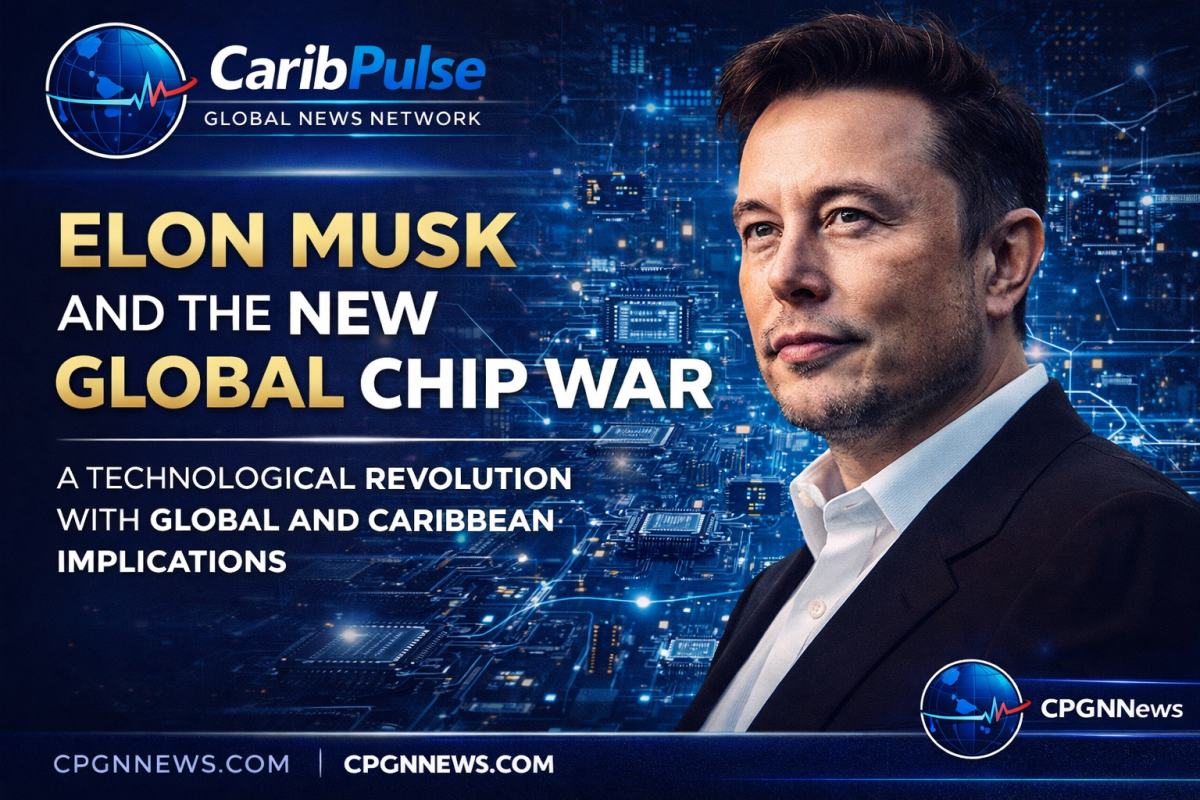
By the CPGNNEWS Editorial Team | Strategic Analysis – April 2026
In the shadow of visible geopolitical conflicts, another war is unfolding silent, technological, yet decisive: the war over semiconductors.
At the center of this battle, Elon Musk is preparing a major industrial push: the large-scale production of chips dedicated to artificial intelligence. Far more than an industrial project, this initiative reflects a profound reshaping of global power dynamics. For the Caribbean, it raises a critical strategic question: remain a spectator—or enter the technological arena of the 21st century.
An Invisible but Decisive War
Since the early 2020s, semiconductors have become the equivalent of oil in the 20th century: a critical, indispensable, and highly strategic resource.
Today’s most advanced AI systems require enormous computing power. By 2025, training certain models involves thousands of processors running for weeks, sometimes across globally distributed data centers. This demand has driven an explosion in the need for specialized chips.
A handful of players currently dominate the sector:
- NVIDIA,
- Intel,
- TSMC
- Samsung Electronics.
This concentration creates a critical dependency. TSMC alone produces more than half of the world’s advanced chips.
The result: systemic vulnerability—particularly in the event of tensions surrounding Taiwan, now a true nerve center of the global economy.
Musk’s Industrial Bet: Full Vertical Integration
In response to this dependency, Elon Musk is pursuing a radically different strategy: total vertical integration.
Through his companies Tesla, SpaceX, and xAI, he aims to control the entire process:
- chip design,
- manufacturing,
- end-use integration.
This project sometimes referred to as “Terafab” seeks to produce chips optimized for:
- artificial intelligence,
- humanoid robots,
- autonomous vehicles,
- space systems.
The objective is simple yet ambitious: minimize external dependence as much as possible.
A Key Nuance: Bold but Realistic
Building a cutting-edge foundry (sub-3nm fabrication) remains an immense challenge. Each TSMC facility can require investments of up to $30 billion. It is therefore unlikely that Musk will attempt to compete across all segments.
His real strength lies elsewhere: optimization through specialization. Chips designed for specific applications AI, robotics, automotive where system integration matters as much as raw power.
It is this targeted approach that makes the project credible.
A Break from the Traditional Tech Model
Until now, innovation has relied on a clear division of roles:
- design (NVIDIA),
- manufacturing (TSMC),
- integration (Apple, Google).
Elon Musk is attempting to break this model.
As he did in the automotive sector with Tesla, he aims to internalize critical components to reduce dependencies and accelerate innovation.
If successful, this strategy could redefine the rules of the game: companies capable of mastering the entire technological chain—from design to final application.
Accelerating the Scientific Revolution
The implications extend far beyond industry.
More powerful chips could accelerate:
- medical research,
- climate modeling,
- fundamental science,
- automated discovery.
The ambition of xAI reflects this momentum: to develop systems capable of solving complex problems autonomously.
We may be entering a new era—one of science augmented by artificial intelligence.
Robotics: A Turning Point for Human Labor
This project is also closely tied to robotics.
Tesla’s humanoid robot, Optimus, symbolizes this transformation.
In the long term, such machines could operate across:
- industry,
- logistics,
- agriculture,
- services.
This raises a fundamental question: what will be the role of human labor?
History shows that every technological revolution destroys some jobs while creating others. However, the current speed of change may outpace the ability of many economies especially more fragile ones to adapt.
A Strategic Space Dimension
The project extends beyond Earth.
SpaceX could integrate these chips into:
- satellite constellations,
- global communication networks,
- orbital digital infrastructure.
This convergence between space and digital technology signals a new phase: a globally distributed internet, partially beyond the planet itself.
An Open Geopolitical Conflict
Semiconductors are now at the heart of a major strategic rivalry.
Key players include:
- United States,
- China,
- South Korea,
- Taiwan.
U.S. technological restrictions on China illustrate rising tensions. Chips are no longer just industrial components they have become instruments of geopolitical power. In this context, Musk’s project could strengthen American technological sovereignty while also creating a new form of dependency centered on a private actor.
A Caribbean Perspective: A Region at a Crossroads
For the Caribbean, this revolution may seem distant. It is not.
Countries such as Haiti, Jamaica, Barbados, and Trinidad and Tobago face a strategic choice:
adapt or be left behind.
Real Opportunities (But Targeted)
Let’s be clear: the Caribbean will not become a semiconductor manufacturing hub.
However, several niches are within reach:
- low-carbon data centers,
- AI data processing and annotation,
- digital infrastructure maintenance,
- specialized tech services.
Some islands could emerge as regional digital hubs, particularly due to their renewable energy potential.
Major Risks
The challenges are significant:
- growing technological dependence,
- widening digital divide,
- brain drain,
- limited investment capacity.
Without a clear strategy, the region risks remaining on the margins of this transformation.
Building a Caribbean Strategy.-
In response, several priorities emerge:
- invest in technological education,
- develop local digital ecosystems,
- attract targeted investments,
- strengthen regional cooperation through CARICOM,
- negotiate knowledge and technology transfers.
Conclusion
The chip war is not merely an industrial issue it is a profound transformation of the global economy.
By seeking to control the infrastructure of artificial intelligence, Elon Musk is positioning himself within a broader logic of global power.
For the Caribbean, the challenge is clear: not to remain on the sidelines. In the world taking shape, technology will no longer be just a driver of development—it will become a central pillar of sovereignty.
